The Classroom Chameleon
Substitute teacher interview questions are designed to test your resilience and adaptability. Unlike a regular classroom teacher who has months to build relationships and routines, a substitute teacher (or “supply teacher”) has about 5 minutes to establish authority and rapport before the bell rings. Hiring managers are looking for candidates who can walk into a chaotic room, take charge immediately, and turn a potential “free day” into a productive learning experience.
The interview will focus heavily on “What If” scenarios. What if there are no lesson plans? What if a student refuses to work? What if a fight breaks out? You need to demonstrate that you have a “Bag of Tricks” – a toolkit of filler activities, management strategies, and de-escalation techniques that work across grade levels and subjects. You must prove that you are not just a warm body, but a professional educator who can maintain the continuity of learning in the teacher’s absence.
This guide dives deep into the tactical reality of substitute teaching. We explore the “Sub Report” (your communication lifeline), strategies for instant respect, and how to handle the dreaded “Teacher didn’t leave anything” scenario. Whether you are a retired teacher returning to the classroom or an aspiring educator building your resume, these answers will help you show that you are the reliable backup every principal needs.
Instant Classroom Management
Q: How do you establish authority in the first 10 minutes of class?
The first 10 minutes determine the entire day. I stand at the door to greet students as they enter. This establishes my presence immediately. I introduce myself firmly but warmly: “Good morning, I am [Name], and I am your teacher today.”
I write the agenda and my name on the board so there is no ambiguity. I set the expectation early: “Mr. Smith left great notes about this class, and I expect to write a glowing report for him.” By framing the day as a continuation of their regular routine rather than a break from it, I reduce the “substitute syndrome” where students test boundaries.
Q: A student tries to switch seats or claims “We are allowed to do this.” How do you handle it?
This is the oldest trick in the book. I stick to the “Trust but Verify” approach. I ask for the seating chart immediately. If I don’t have one, I might let them sit where they want initially but with a caveat: “You can sit there as long as you are working. If there is one disruption, I will move you.”
Regarding rules (“We’re allowed to use phones”), I default to school policy, not classroom custom. “I’m not sure what Mr. Smith allows, but the school rule is no phones, so that is the rule for today.” It is safer to be too strict than too lenient. I frame it as my rule for my day, rather than arguing about their regular teacher’s habits.
Q: How do you handle a disruptive student who refuses to work?
I use the “Least Invasive Intervention.” I don’t stop the class to argue. I walk over to the student, crouch down to their eye level (private correction), and ask, “Is there something blocking you from starting?” Sometimes they just don’t have a pencil.
If it is defiance (“I’m not doing this”), I don’t force it. I say, “That is your choice, but I have to leave a note for your teacher about what was accomplished today. I’d love to write that you finished the assignment.” Then I walk away. I prioritize the learning of the other 29 students over a power struggle with one. I document the refusal but don’t let it derail the lesson.
Q: What is your strategy for a “noisy” class that won’t settle down?
I don’t yell. Yelling signals I’ve lost control. I use non-verbal cues first, like flicking the lights or a rhythmic clap. If that fails, I use the “wait time” strategy. I stand at the front, perfectly still and silent, looking at the clock.
When they finally quiet down, I say, “We just wasted 3 minutes of your time. That is 3 minutes we might have to take from the end of class.” I then immediately launch into an engaging activity. Sometimes I reset the room by having everyone stand up, stretch, and sit back down to break the chaotic energy flow.
Instructional Adaptability
Q: What do you do if there are NO lesson plans?
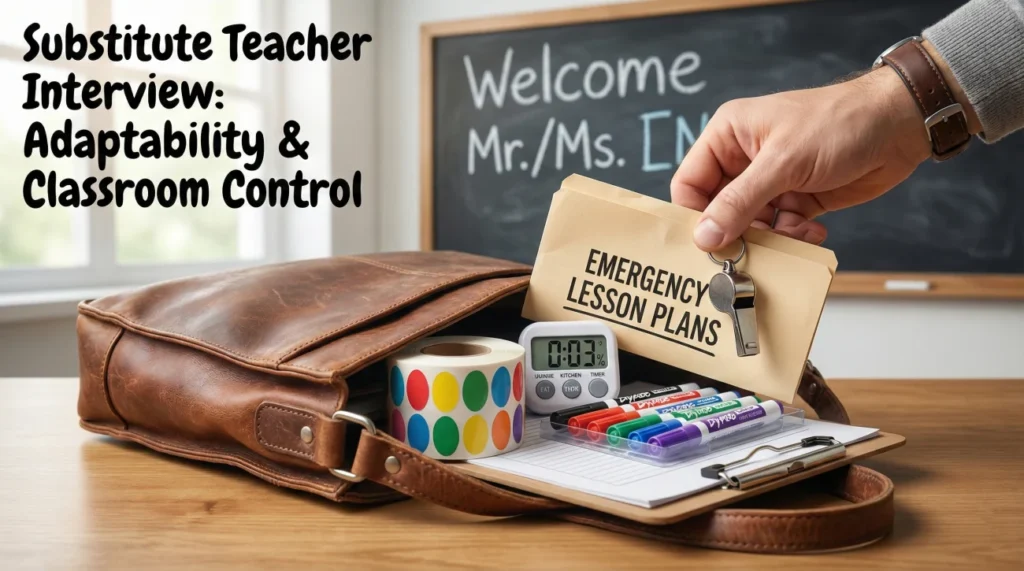
I always carry a “Sub Bag” (Survival Kit) for this exact scenario. It contains grade-appropriate filler activities: logic puzzles, “design a new app” prompts, Mad Libs for grammar, or generic writing prompts (“If you could have any superpower…”). I can also facilitate a review game like “Silent Ball” or “20 Questions” related to the subject matter. My goal is to keep them busy and supervised; idle time is the enemy of management.
Q: How do you teach a subject you are not an expert in (e.g., Calculus)?
I am honest with the students. “I am not a math expert, but I am an expert learner.” I ask the students to help each other. “Who thinks they understand problem #3? Can you come up and show the class?” I facilitate peer-to-peer teaching. My role shifts from “Sage on the Stage” to “Guide on the Side,” managing the environment so the students can access the work even if I can’t explain the theorem myself.
Q: The lesson plan finishes 20 minutes early. What do you do?
I never let them “just hang out.” That invites chaos. I transition to an enrichment activity. “Since you worked so fast, we have time for a challenge.” I might do a “Sponge Activity” like “Brain Quest” trivia, or a “Line-Up Game” (line up by birthday without talking). If they have laptops, I direct them to approved educational sites (Kahoot, Khan Academy). I keep the structure until the very last bell.
Q: Following the Plan vs. Improvising
My primary duty is to follow the teacher’s plan to maintain continuity. However, if the plan is clearly failing (e.g., the technology isn’t working or the students are totally confused), I must improvise. I will pivot to a backup activity that covers similar skills (e.g., reading the textbook aloud instead of watching the video). I always leave a note explaining why I deviated so the teacher knows it was a strategic decision, not negligence.
Q: Helping Special Education Students
I look for the “Confidential Folder” or notes about IEP/504 accommodations. If none are left, I observe. If a student is struggling, I offer help discreetly. “Would it help if I read this part to you?” or “You can do just the even numbers.” I rely heavily on the Paraprofessionals (if present) as they are the experts on those students. I treat them as co-teachers, not assistants.
Q: Using Technology in a new classroom
I arrive early to test the tech (SmartBoard, Projector). If I can’t log in, I ask a trustworthy student (often identified by the teacher’s notes) to help set it up. “Who is the tech expert in this class?” Students love to help. If the tech fails completely, I revert to analog methods (whiteboard, discussion) immediately without wasting 20 minutes trying to fix it.
Safety & Emergency Scenarios
A fight breaks out in your classroom. What is your immediate reaction?
Safety is the priority. I use a loud verbal command: “Stop! Move away!” I immediately send a runner to the office or use the classroom phone/intercom to call for security. I do not physically intervene (unless trained and allowed by district policy) to avoid liability or injury.
I direct the other students (“audience”) to move to the hallway or the far side of the room to remove the audience effect. Once administration arrives and handles the combatants, I focus on calming the rest of the class and documenting exactly what I saw (who started it, what happened) for the incident report.
The fire alarm goes off. You don’t know the drill for this specific room.
I grab the class roster (critical) and the emergency bag if available. I look for the evacuation map by the door. If I can’t find it, I follow the class next door. I act calm and authoritative.
“Line up, leave your stuff, follow me.” Once outside, I take attendance immediately. I hold up a red/green card (if provided) to signal status to admin. I keep the students together and quiet so I can hear instructions. Admitting “I don’t know where to go” causes panic, so I fake confidence while following the crowd.
A student reports a medical emergency (e.g., seizure or severe allergic reaction).
I call the Nurse/Office immediately. “Medical Emergency in Room 204.” If I know it’s a seizure, I clear the area around the student so they don’t hit their head. If it’s an allergy, I ask if they have an EpiPen (some carry them). I do not administer medication unless trained and authorized.
I assign a student to stand by the door to flag down the nurse. I keep the other students calm and seated. After the student is taken care of, I debrief the class briefly to lower anxiety before returning to the lesson.
Professionalism & Feedback
Q: What do you leave for the regular teacher at the end of the day?
The “Sub Note” is my professional signature. It must be detailed and positive. I include:
1. Attendance: Who was absent/tardy.
2. Work Completed: “We finished the worksheet and started the reading.”
3. Behavior: I praise helpful students by name (“Star Students”). I mention behavioral issues factually (“John struggled to focus”) rather than emotionally.
4. Housekeeping: “I collected the papers and put them on your desk.”
A good note makes the teacher’s return easier and ensures they request me again.
Q: How do you handle ” Confidentiality” as a substitute?
I am a guest in the school, and I see a lot. I might see grades, behavior plans, or family issues. I follow FERPA strictly. I do not discuss a student’s behavior with other parents, students, or even other teachers in the lounge (unless relevant to their safety). Gossip kills a substitute’s reputation. What happens in Room 204 stays in Room 204, except for the report to the teacher/admin.
Q: Why do you want to be a substitute teacher?
I enjoy the variety and the challenge. Every day is a new adventure. It allows me to impact a wide range of students across the district. (If you are an aspiring teacher): It is the best training ground to see different teaching styles and classroom management techniques before I have my own room. (If you are retired): It allows me to stay connected to education and support my colleagues without the paperwork of full-time teaching.
Q: How do you ensure the classroom is left in good condition?
I follow the “Campsite Rule”: leave it better than I found it. Five minutes before the bell, we do a “floor sweep” for trash. I straighten the desks. I erase the board (unless it had ‘do not erase’ notes). I stack the papers neatly. Returning to a clean room is a gift to the teacher, and it is the easiest way to build a positive reputation.
Substitute Teacher Knowledge Check
Test Your Sub Skills
1. What is the most important thing to do upon arriving at the school?
- Get coffee
- Check in at the main office and get the keys/badge/folder
- Go straight to the classroom
- Check your email
2. If a student asks to go to the nurse, you should:
- Say no
- Give them a pass (unless it’s obviously fake/excessive) and log the time
- Send them without a pass
- Call their parents
3. “Sponge Activities” are used to:
- Clean the board
- Soak up extra time if the lesson ends early
- Punish students
- Teach science
4. When taking attendance, you should:
- Wait until the end of class
- Do it immediately at the start and send it to the office (vital for safety/truancy)
- Ask students who is missing
- Skip it
5. “Proximity Control” involves:
- Yelling from the desk
- Walking near a misbehaving student to stop the behavior without words
- Touching the student
- Sending them to the office
6. If a student says “Our teacher lets us do this,” you should:
- Believe them immediately
- Follow the school rules/lesson plan unless you have proof otherwise (“Today, we are doing this”)
- Call the teacher
- Let them do it
7. A “Paraprofessional” in the room is:
- Your assistant to get coffee
- A specialized staff member there to support specific students (a valuable resource)
- A student teacher
- A parent volunteer
8. What item is critical to locate in the room immediately?
- The stapler
- The Emergency/Evacuation Folder (Red Folder)
- The lunch menu
- The chalk
9. You should leave the classroom:
- Messy
- As clean or cleaner than you found it
- With the windows open
- Unlocked
10. “Wait Time” refers to:
- Waiting for the bell
- Pausing after asking a question to let students think
- Waiting for the bus
- Waiting in the office
11. FERPA prohibits you from:
- Grading papers
- Discussing a student’s grades or behavior with other parents/students
- Talking to the principal
- Using the computer
12. If a student has a seizure, your first job is to:
- Put something in their mouth
- Protect them from injury (clear the area) and time the seizure
- Run away
- Hold them down
13. Which is a good “Attention Getter”?
- Screaming “Shut up!”
- Rhythmic clapping or “If you can hear me, clap once”
- Throwing an eraser
- Turning on the TV
14. If you don’t know the answer to a student’s question, you should:
- Make it up
- Admit it and ask the class to help find the answer (“Let’s look it up”)
- Ignore the student
- Guess
15. “Active Supervision” means:
- Sitting at the desk on your phone
- Circulating the room, scanning, and interacting with students
- Watching from the doorway
- Sleeping
16. The “Sub Report” should be:
- Negative and complaining
- Detailed, honest, and professional
- Non-existent
- Written by a student
17. In a “Lockdown” drill, you should:
- Open the door to check
- Lock the door, turn off lights, move students out of sight, and stay silent
- Continue teaching
- Let students use phones
18. If a student has a specialized health plan (e.g., diabetes), it will usually be noted in:
- The textbook
- The confidential sub folder or nurse’s note
- The lunch menu
- The library
19. A “floater” substitute:
- Works in the pool
- Moves between different classrooms as needed throughout the day
- Only works half days
- Teaches only art
20. The most effective way to prevent behavior issues is:
- Punishment
- Keeping students engaged and busy with clear expectations
- Yelling
- Giving candy
❓ FAQ
📜 Do I need a teaching license to sub?
It depends on the state/district. Many states only require a Bachelor’s degree (in any field) and a background check (fingerprinting). Some states allow those with an Associate’s degree or a high school diploma + training (Substitute Certificate) to work. Check your local district’s HR page.
💸 How often do I get paid?
Usually bi-weekly or monthly. Note that subs are typically paid a daily rate (per diem) and do not get paid for holidays or summer break. It is “gig economy” work within the school system.
📞 How do I get jobs?
Most districts use an automated system like Frontline (Aesop) or SmartFind. You log in (or use an app like Jobulator) to see open jobs and click to accept. Building relationships with secretaries and teachers is key; they can “request” you specifically, bypassing the general pool.
🍎 Can this lead to a full-time job?
Yes. Subbing is the best “extended interview.” Principals get to see your work ethic and classroom management firsthand. Many long-term subs are hired permanently when a vacancy opens.
👖 What should I wear?
Dress professionally (Business Casual). You want to be distinguishable from the students, especially in high school. Comfortable shoes are mandatory as you will be standing all day. Avoid jeans unless it’s a specific “Spirit Day.”
The Unsung Hero
To succeed with substitute teacher interview questions, you must project confidence and flexibility. Principals want to know that you are a low-maintenance problem solver. They want a sub who handles the small fires so the administration doesn’t have to.
Focus on your ability to build rapid rapport (“I learn names quickly”) and your toolkit for downtime (“I always have a backup plan”). Show them that you view subbing not as “babysitting,” but as a vital professional service that keeps the school running smoothly.
⚠️ Disclaimer: The interview strategies, sample answers, and negotiation tips provided in this guide are for educational purposes only. Hiring decisions are subjective and vary by company and industry. While these strategies are based on professional HR standards, they do not guarantee a specific job offer or result.