The Adult Students Trust First
Paraprofessional interview questions sit right on the edge between instruction and care. Interviewers want evidence that you can notice small things, follow plans precisely, and support learning without accidentally becoming the main teacher in the room.
Schools rely on paraprofessionals for inclusion, behavior support, and everyday routines. Committees will probe your judgment: when to prompt, when to step back, how to document data, and how to keep boundaries clear so a student builds independence instead of dependence.
Inside, you will find interview-ready ways to talk about de-escalation, confidentiality, IEP support, and teamwork with teachers and specialists. If you can show calm consistency and a “fade the help” mindset, you will stand out fast.
Understanding the Role & Boundaries
Q: How do you define the role of a paraprofessional in an inclusive classroom?
I see the role as a bridge to independence. My job is to support the student in accessing the general education curriculum and social environment, not to isolate them. I am there to implement the accommodations listed in the IEP – whether that is scribing for them, breaking down tasks, or managing behaviors – while constantly looking for opportunities to step back so the student can do it themselves. I am also an extra set of eyes for the teacher, collecting data on what works and what doesn’t.
Q: What is the difference between “helping” and “enabling”?
Helping is doing with the student or setting them up for success; enabling is doing for the student what they can do for themselves. If I tie a student’s shoes when they have the motor skills to do it but are just slow, I am enabling them and hindering their growth. Helping would be using a verbal prompt (“Check your shoes”) or a visual guide. My goal is always “least intrusive support” to build their self-confidence and functional skills.
Q: How do you handle confidentiality regarding student information?
I adhere strictly to FERPA guidelines. I understand that a student’s disability, behavior, and grades are legal and private matters. I never discuss a student’s day with other parents, community members, or even other teachers who don’t have an educational need to know. If a parent asks me in the grocery store, “How is Johnny doing?” I politely deflect and say, “I love working with him, but for specific updates, you should reach out to his teacher.”
Q: What would you do if you disagreed with the lead teacher’s approach?
I respect that the teacher is the instructional leader and holds the license. I would never contradict them in front of students or other staff. I would follow their directive in the moment to maintain a united front. Later, I would ask for a private time to discuss it, framing my concern around the student’s response: “I noticed that when we did X, Johnny seemed to shut down. Have we considered trying Y?” I view us as a team, but I respect the hierarchy of decision-making.
Behavior Support & Data Collection
Q: How do you handle a student who becomes physically aggressive (hitting/biting)?
Safety is the first priority. I would follow the student’s Behavior Intervention Plan (BIP) and my safety training (like CPI). I would clear the area of other students and dangerous objects. I would keep my distance and use a calm, neutral voice, avoiding power struggles.
I would not take it personally. I understand behavior is communication. After the de-escalation, I would document the incident meticulously using an incident report, noting the antecedent (trigger), the behavior, and the consequence, so the team can adjust the plan if needed.
Q: What is “ABC Data” and how do you collect it?
ABC stands for Antecedent, Behavior, and Consequence. It is crucial for understanding the “why” (function) of a behavior. When I collect this data, I am objective and factual.
Antecedent: “Teacher asked student to put away iPad.” Behavior: “Student threw pencil on floor.” Consequence: “Student was sent to break corner.” I record this in real-time or immediately after, without adding my emotional interpretation (like “Student was angry”), so the IEP team has valid data to analyze patterns.
Q: A student refuses to work and puts their head down. What do you do?
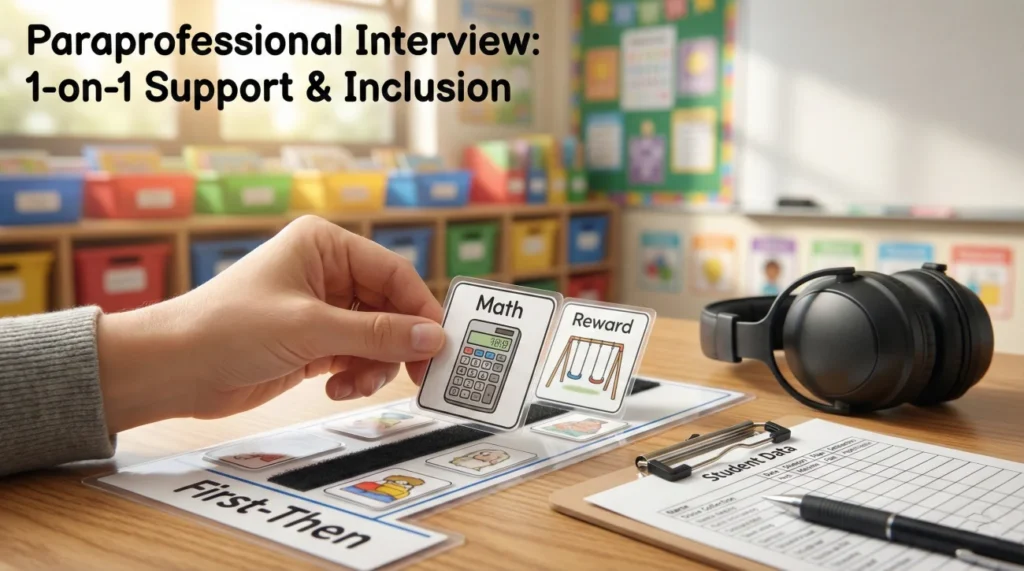
I avoid a public confrontation. I approach quietly and use the “First-Then” strategy: “First finish two math problems, Then you can have 2 minutes of drawing.” I check for barriers – is the work too hard? Are they tired?
I might offer a choice: “Do you want to use a pen or a pencil?” or “Do you want to start with question 5?” Giving them a sense of control often breaks the refusal cycle. If they still refuse, I wait them out while praising students who are working, removing the attention from the negative behavior.
Q: How do you support a non-verbal student?
I presume competence; just because they don’t speak doesn’t mean they don’t understand. I use their preferred mode of communication, whether that is a PECS book (Picture Exchange Communication System), a tablet with a speech app (AAC device), or sign language.
I model language constantly (“narrating the day”). I wait longer for a response to process. I also teach peers how to interact with the student, facilitating social inclusion by bridging the communication gap (“He is smiling, that means he likes the game”).
Q: A student elopes (runs away) from the classroom. What are your steps?
I immediately alert the teacher and call the office/security via walkie-talkie or phone with the student’s location and description (“Code Elopement”). I follow the student at a safe distance to keep them in sight but try not to chase, as that often turns it into a game for them.
My goal is to guide them to a safe area, blocking exits if possible. Once they are safe, we re-examine the environment to see what triggered the flight response – was it noise, a difficult task, or a transition? – to prevent it next time.
Q: How do you handle a situation where the student is becoming dependent on you?
I use a strategy called “Fading Support.” If I have been sitting right next to them (“velcro aide”), I start moving my chair a few feet away. Then I move to standing behind them.
I switch from verbal prompts to gestural prompts (pointing to the book instead of saying “Open your book”). I encourage them to ask a peer for help (“Ask your neighbor what page we are on”) before asking me. I celebrate their independence to reinforce that they can do it alone.
Situational Judgment & Ethics
You witness another staff member speaking harshly or inappropriately to a special needs student.
This is a difficult but mandatory reporting situation. My first duty is to the student’s safety and dignity. If it is happening in the moment and escalating, I might step in gently to redirect the student (“Hey Johnny, come help me over here”) to diffuse the situation.
Afterward, I must report the incident to my supervisor or the principal. I stick to the facts of what I saw and heard. Silence is complicity, and these students often cannot advocate for themselves, so I must be their voice.
A parent tries to give you a gift or asks you to babysit outside of school hours.
I check the district policy first, as many have strict rules against dual relationships. Generally, I politely decline babysitting to maintain professional boundaries. “I love working with Sarah, but I make it a rule not to babysit my students to keep our school relationship professional.”
Regarding gifts, if it is a small token (like a mug), it is usually fine, but significant gifts must be declined. I thank them for the thought but explain that my greatest reward is seeing their child progress.
You are assigned to a new student who has a medical condition (e.g., seizures) you are unfamiliar with.
I immediately ask for training. I am not a nurse, but I need to know the protocol. I ask to meet with the School Nurse to review the student’s Individual Health Plan (IHP).
I ask specific questions: What are the warning signs? When do I call 911? Do I need to carry emergency medication (like an EpiPen)? I ensure I am confident in the emergency procedures before I am left alone with the student. Being unprepared is a safety risk.
Professional Growth & Adaptability
Q: How do you handle the stress and physical demands of this job?
I prioritize self-care and perspective. I know that on difficult days, the student isn’t giving me a hard time; they are having a hard time. I don’t hold grudges; every day is a fresh start. Physically, I use proper body mechanics when lifting or transferring students to protect my back. I also lean on my team for support – debriefing after a tough incident helps release the stress so I don’t take it home.
Q: Are you comfortable with personal care tasks (toileting/feeding)?
(If applicable) Yes, I view personal care as a matter of dignity. I follow all hygiene and safety protocols (gloves, lifting). I maintain a respectful and cheerful attitude during these times to ensure the student doesn’t feel embarrassed. I also look for ways to teach independence during these routines, such as having them wash their own hands or hold their own spoon, consistent with their OT/PT goals.
Q: How do you stay engaged during “downtime” when the teacher is lecturing?
There is rarely true downtime. If the teacher is lecturing, I am scanning the room to ensure my student is attending. I might be taking notes for them, preparing materials for the next activity, or creating data sheets. I model good student behavior (listening, not on my phone). If my assigned student is fine, I check if other students near us need help, ensuring I am a resource for the whole class.
Q: Why do you want to work as a paraprofessional?
I find immense satisfaction in the “small wins.” Seeing a student finally write their name, or navigate a social conflict without hitting, gives me joy. I want to be the person who provides the stability and encouragement they need to succeed. I believe that inclusion makes the whole school better, and I want to be a part of making that a reality for these students.
Paraprofessional Competency Quiz
Take the 20-Question Challenge
1. The primary role of a paraprofessional is to:
- Replace the teacher and design the lessons
- Support the instructional and behavioral goals of the student
- Do the student’s homework for them
- Manage the school’s front office
2. FERPA laws protect:
- The teacher’s salary information
- The privacy of student educational records
- The school lunch menu
- The playground equipment
3. “Elopement” in a school setting means:
- A student getting married secretly
- A student wandering or running away from a supervised area
- A student skipping a grade level
- A student graduating early
4. In “ABC Data,” the “A” stands for:
- Aftermath (what happened later)
- Antecedent (what happened right before the behavior)
- Action (the behavior itself)
- Attitude (how the student felt)
5. If a student is having a meltdown, you should:
- Yell louder than them to get control
- Remain calm, limit verbal clutter, and ensure safety
- Physically restrain them immediately
- Laugh at them
6. A BIP is a:
- Basic Instruction Packet
- Behavior Intervention Plan
- Big Important Paper
- Break In Progress
7. “Fading Support” means:
- Leaving work early
- Gradually reducing help to foster independence
- The student’s grades are dropping
- Turning down the lights
8. If a parent asks you about another student’s behavior, you:
- Tell them everything you know
- Politely refuse due to confidentiality rules
- Make up a story
- Tell them to ask the principal
9. AAC stands for:
- Always Act Calmly
- Augmentative and Alternative Communication
- Apple and Android Computer
- Autism Awareness Club
10. When scribing for a student, you should:
- Write the correct answer even if they say the wrong one
- Write exactly what the student dictates, verbatim
- Write your own opinion
- Draw a picture instead
11. A “Mandated Reporter” is required to report:
- Bad grades
- Suspected child abuse or neglect
- Students who are late
- Teachers who are boring
12. “Inclusion” refers to:
- Keeping special ed students in a separate building
- Educating students with disabilities in general education classrooms
- Only including students who have straight As
- Including lunch in the schedule
13. Which is a “Positive Reinforcement”?
- Taking away recess
- Giving a high-five or token for completing a task
- Yelling “No!”
- Ignoring the student
14. If you don’t understand how to use a piece of equipment, you:
- Guess and hope for the best
- Ask the teacher or specialist for training
- Refuse to use it
- Hide it
15. “Proximity Control” is:
- Using a remote control
- Standing near a student to encourage on-task behavior
- Measuring the distance between desks
- Controlling who sits next to whom
16. When working with a student with a physical disability, you should:
- Do everything for them to be nice
- Encourage them to do as much as possible themselves
- Pity them openly
- Avoid them
17. A “Visual Schedule” helps students by:
- Decorating the room
- Making the day’s routine predictable and reducing anxiety
- Teaching them to draw
- Blocking the window
18. If a student tells you they are being bullied, you:
- Tell them to toughen up
- Report it to the teacher/admin immediately
- Confront the bully yourself physically
- Ignore it
19. “Presuming Competence” means:
- Assuming the student cannot understand
- Assuming the student has the capacity to understand and learn
- Assuming the teacher is always right
- Assuming you know everything
20. The most important relationship for a para to build is with:
- The janitor
- The student and the lead teacher
- The superintendent
- The bus driver
❓ FAQ
🎓 What do schools usually require for a paraprofessional role?
Many districts hire with a high school diploma plus a screening test, college credits, or a paraeducator certification. The interview is often more about reliability, communication, and your ability to follow an IEP or behavior plan consistently than about advanced coursework.
🧷 Will I be expected to do personal care tasks?
Sometimes, depending on the assignment and the student’s needs. If personal care is part of the role, the school should provide training, protective equipment, and clear procedures that protect student dignity and your safety. It is reasonable to ask what tasks are included before accepting a placement.
🧭 Am I allowed to discipline a student?
You should not invent consequences on your own. Follow the classroom systems, the teacher’s directions, and any behavior intervention plan. Your authority usually looks like redirection, proximity, prompting replacement behaviors, and documenting what you saw so the team can respond consistently.
🤝 What if the student rejects my help or pushes me away?
Start small: predictable greetings, neutral support, and choices that give the student control. Consistency builds trust over time. If rapport is still hard, communicate with the teacher so you can adjust supports and avoid power struggles that make the relationship worse.
It depends on the district. Some roles follow the school day only, while others include duties like arrival supervision, bus duty, or after-school programs. Ask about hours, benefits, and whether summer or extended school year positions are available.
Your Last Mile in the Interview
Interview panels hire paraprofessionals they can trust. Use paraprofessional interview questions to rehearse answers that highlight consistency, calm behavior support, and a “prompt, then fade” approach that builds independence. When you can show teamwork and good judgment in small moments, you sound like the kind of adult every classroom needs.
⚠️ Disclaimer: The interview strategies, sample answers, and negotiation tips provided in this guide are for educational purposes only. Hiring decisions are subjective and vary by company and industry. While these strategies are based on professional HR standards, they do not guarantee a specific job offer or result.