The Front Office Is the School’s Pulse
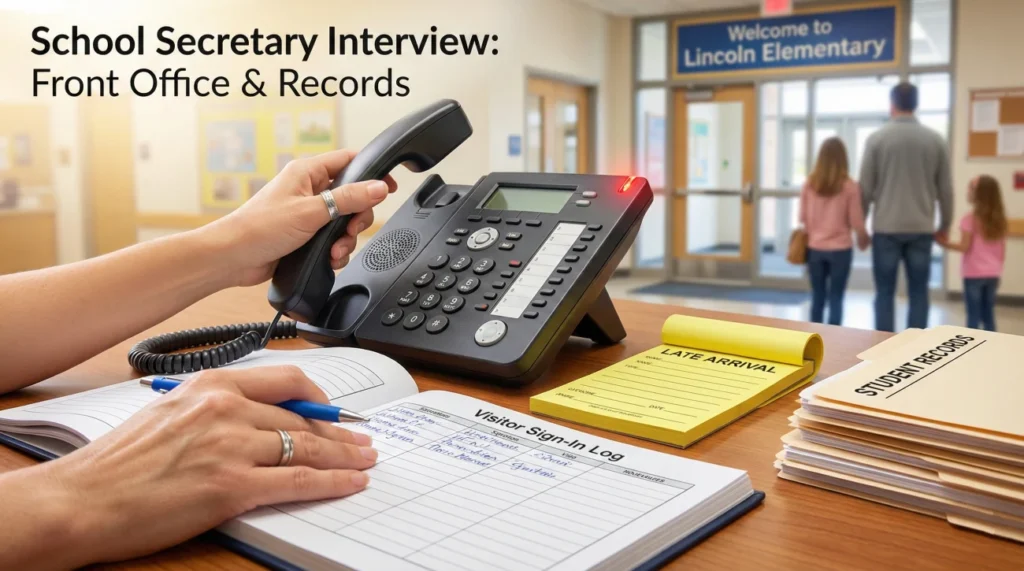
School secretary interview questions are really questions about trust. The front office sees everything: worried parents, late buses, urgent messages, confidential paperwork, and a steady stream of small problems that cannot wait.
Hiring teams want to know if you can stay calm, protect privacy, and keep the day moving. That means strong communication, sharp organization, and comfort with technology, all while treating people with patience even when they are stressed or rude.
This guide helps you translate real front office moments into clear interview answers, so you sound like someone who can be the reliable anchor of the building from the first bell to the last call.
Customer Service & School Culture
Q: How do you handle a busy morning with phones ringing and parents waiting?
I prioritize the people in front of me while acknowledging the phone. I would smile at the parent at the counter and say, “I’ll be right with you,” then answer the phone with a polite, “School Office, please hold.”
I triage quickly. If the phone call is an emergency (bus accident), it takes precedence. If it’s a routine question, I ask them to hold or offer to call back. I remain calm because my energy sets the tone for the office. I use a notepad to track requests so nothing falls through the cracks during the rush.
Q: How do you deal with an angry or aggressive parent?
I listen to understand, not to argue. I let them vent without interrupting, validating their feelings: “I can see you are very upset about this.” I maintain a low, calm voice and positive body language.
I never take it personally. I look for the solution within my power. If I can fix it (e.g., correcting an attendance error), I do it immediately. If I can’t, I explain the next step: “I need to have the Principal speak with you about this. Let me see when she is available.” If they become threatening, I follow safety protocols to protect the staff and students.
Q: Why do you want to work in a school specifically?
I want to work in a school because I want my organizational skills to serve a higher purpose. In a corporate office, a missed deadline might cost money; in a school, a lost record affects a child’s future.
I enjoy the energy of students and the sense of community. I want to be the welcoming face that makes a nervous kindergartner or a stressed parent feel safe and supported. I thrive in an environment where no two days are the same.
Q: How do you handle confidentiality (FERPA)?
I treat student data with the highest level of security. I understand that I cannot discuss a student’s grades, behavior, or family situation with anyone who does not have an “educational right to know.”
If a parent asks about another child involved in a fight with their son, I politely but firmly state, “I can only discuss your child with you.” I never gossip in the staff lounge. I lock my computer screen when I step away and keep sensitive files in locked cabinets.
Operations & Data Management
Q: How do you manage student attendance records?
I prioritize accuracy because funding depends on it. I check the “unverified absences” list daily by 9:30 AM. I call parents immediately to verify why the student is not in school.
I look for patterns (chronic absenteeism) and flag them for the administration or counselor. I am meticulous about coding absences correctly (medical vs. vacation) in the Student Information System (SIS) to ensure state reporting is accurate.
Q: A non-custodial parent tries to pick up a child. What do you do?
I check the student’s file and the legal custody documents immediately. I adhere strictly to the court orders on file. If the parent is not on the approved pickup list or has a restraining order, I do not release the child.
I politely ask them to wait while I “verify some paperwork,” and I quietly alert the principal and possibly the School Resource Officer. I prioritize the safety of the student over the convenience or anger of the adult.
Q: How do you handle cash handling and school funds?
I follow the district’s financial procedures to the letter to protect myself and the school. I issue a receipt for every penny collected (field trips, fundraisers).
I never leave cash on my desk; it goes into the safe immediately. I prepare deposits with a witness if required. I keep a clear paper trail so that any audit would find my records 100% accurate. Financial integrity is non-negotiable.
Q: How do you support the Principal?
I act as their executive assistant and gatekeeper. I manage their calendar to protect their instructional time. If a teacher just needs a form, I handle it so they don’t interrupt the Principal.
I anticipate needs. If there is a fire drill scheduled, I have the vest and roster ready. I keep them informed of the “temperature” of the school (staff morale, parent chatter) so they are never blindsided by an issue.
Q: How do you handle administering medication?
I only administer medication if I am trained and authorized by the district, and only with a doctor’s order and parent permission on file. I keep meds in a locked cabinet.
I log every dose: time, amount, and student name. If I am unsure or if a student looks unwell, I consult the School Nurse immediately. I never guess with medical safety.
Q: How do you prioritize tasks when everything is urgent?
I use a hierarchy: Safety issues (injured child, stranger on campus) are Priority 1. Time-sensitive operations (substitutes for classes, dismissal changes) are Priority 2. Long-term projects (filing, newsletter) are Priority 3.
I stay flexible. I might be filing, but if a sick child walks in, the filing stops. I communicate my timeline to staff: “I can get that report to you by 2 PM,” managing expectations so they know I haven’t forgotten them.
Safety & Technical Skills
A stranger tries to enter the building without an appointment.
I maintain the “Single Point of Entry” protocol rigidly. I speak to them through the intercom/camera first. I ask for their ID and the purpose of their visit before buzzing them in.
Once inside, I run their ID through the visitor management system (like Raptor) to check for sex offender status. I require them to wear a visitor badge. If they refuse or act suspicious, I do not unlock the secondary door and I alert security immediately.
You notice a student who seems neglected or abused.
I know that as a school employee, I am a Mandated Reporter. If I see signs (hygiene issues, bruising, strange behavior), I document my observations objectively (dates, times, what was said).
I report it to the Counselor or Principal immediately to follow the proper channel for contacting Child Protective Services (CPS). I do not investigate myself, but I ensure the information gets to the authorities who can help.
The fire alarm goes off during a busy parent intake.
I stop everything. I tell the parent, “We have to evacuate immediately, please follow me.” I grab the emergency “Go Bag” (rosters, emergency contacts, medical list).
I ensure the office is empty and close the door. My role during evacuation is often to account for students who were in the office/nurse’s station and communicate that to the command center. Routine business waits; safety does not.
Technology & Organization
Q: What is your experience with Student Information Systems (SIS)?
I am proficient in systems like PowerSchool / Skyward / Infinite Campus (customize based on reality). I am comfortable entering attendance, printing report cards, and updating demographic info. I am a quick learner with technology, so if you use a different system, I am confident I can master it quickly.
Q: How do you handle a teacher who forgets to submit attendance?
I send a polite but firm reminder: “Good morning! Please submit attendance so I can verify safety.” If it’s a chronic issue, I might ask if they need help with the system.
If it continues, I mention it to the Assistant Principal, not to get them in trouble, but because accurate attendance is a legal safety requirement (we need to know who is in the building in case of a fire).
Q: How do you organize the “End of Year” chaos?
I start early. I create a checklist for record archiving, supply inventory, and key collection. I communicate deadlines to teachers weeks in advance.
I organize the Cumulative Files (Cum Files) for students moving to the next school level so the transition is smooth. I believe that a well-closed year sets us up for a smooth opening in August.
Q: Why should we hire you?
You should hire me because I am reliable, discreet, and unfazable. I understand that the office is the nerve center of the school. I bring the organizational skills to keep the paperwork moving and the interpersonal skills to keep the people happy. I will treat your students like my own and your staff like family.
School Operations Competency Quiz
Take the 20-Question Challenge
1. FERPA stands for:
- Federal Education Rights and Public Access
- Family Educational Rights and Privacy Act
- Free Education Rules and Protection Act
- Financial Emergency Response Plan Act
2. A “Mandated Reporter” must report:
- Late students
- Suspected child abuse or neglect
- Bad grades
- Lost library books
3. The “SIS” refers to:
- School Internal Security
- Student Information System (database)
- Student Inspection Service
- Staff Incentive Scheme
4. If a parent is not on the “Emergency Card,” you can release the child to them:
- If the child says they know them
- Never, unless you get verbal confirmation from the custodial parent
- If they look trustworthy
- If they are a neighbor
5. “Triage” in the front office means:
- Cleaning the floor
- Prioritizing tasks/visitors based on urgency (medical/safety first)
- Sorting mail
- Answering the phone only
6. A “Cum File” (Cumulative Record) contains:
- The student’s lunch balance only
- The student’s academic history, test scores, and health records
- The teacher’s personal notes
- Library fines
7. When cash is collected, you must:
- Put it in your pocket
- Count it, receipt it, and secure it in the safe immediately
- Leave it on the desk for later
- Spend it on office supplies
8. A “PO” (Purchase Order) is used to:
- Order pizza personally
- Request and authorize payment for school supplies/services
- Post Office mail
- Principal’s Order
9. If a visitor refuses to wear a badge, you:
- Let them in anyway
- Deny entry and call security/admin
- Follow them around
- Ask a student to watch them
10. An “IEP” is relevant to:
- International students only
- Special Education services (Individualized Education Program)
- Internal Emergency Plan
- Internet Explorer Protocol
11. “Truancy” refers to:
- Good attendance
- Habitual unexcused absences
- Being late once
- Getting sick at school
12. If a student needs medication, you need:
- Just the bottle
- A doctor’s order and parent signature
- The student’s word
- Nothing, just give it
13. The “PA System” is used for:
- Playing music all day
- Public Address announcements to the whole school
- Personal Assistant work
- Printing Assignments
14. When answering the phone, the most professional greeting is:
- “Hello?”
- “Good morning, [School Name], this is [Name], how can I help you?”
- “Hold on.”
- “Yeah?”
15. “Lockdown” implies:
- Recess time
- Immediate threat; doors locked, lights off, silence
- Locking the safe
- detention
16. A “Substitute Folder” should contain:
- Lunch money
- Rosters, lesson plans, seating charts, and emergency procedures
- Magazines
- Nothing
17. “Petty Cash” is:
- Useless money
- A small fund for minor office expenses
- Money for the principal’s lunch
- Lost and found money
18. If a teacher calls in sick at 6 AM, you:
- Ignore it until 8 AM
- Ensure a substitute is secured immediately (via system or calls)
- Tell the students to go home
- Teach the class yourself
19. To de-escalate an angry parent, you should:
- Yell back
- Listen calmly and lower your voice
- Roll your eyes
- Walk away without speaking
20. The most important skill for a secretary during a crisis is:
- Running fast
- Remaining calm and following protocol
- Screaming for help
- Hiding
❓ FAQ
📜 Do I need a degree?
Not always. Many schools value experience, reliability, and strong communication just as much. Highlight relevant office work, customer service, organization, and any training in school systems or records handling.
🩺 Do I have to be a nurse?
No. The secretary is not the medical provider, but you do need good judgment. Explain how you follow protocols, contact the nurse, document messages correctly, and stay calm when a situation feels urgent.
📅 Do secretaries work in the summer?
It depends on the contract and the school calendar. Some roles are ten month, others are year round. Answer by showing flexibility, then ask about the specific schedule for the position.
💻 What software do I need to know?
Be ready for email, calendars, spreadsheets, and student information systems. If you do not know their exact platform, emphasize that you learn tools quickly and you care about accuracy and data privacy.
👔 What is the dress code?
Most front offices lean business casual. The safest move is polished and practical, since you are visible to families all day. If unsure, ask about expectations and mirror the school’s tone.
Be the Calm Voice at the Door
If your answers show accuracy, discretion, and kindness under pressure, you will feel like the obvious choice. Practice with practical school secretary interview questions examples and answers, then walk in ready to be the person everyone can rely on when the day gets busy.
⚠️ Disclaimer: The interview strategies, sample answers, and negotiation tips provided in this guide are for educational purposes only. Hiring decisions are subjective and vary by company and industry. While these strategies are based on professional HR standards, they do not guarantee a specific job offer or result.