Travel Season in One Sentence
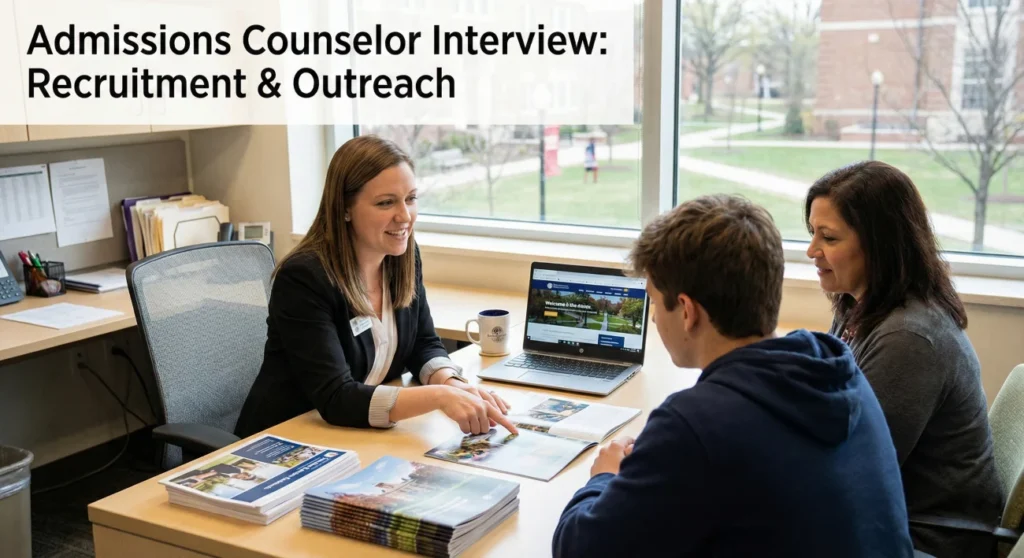
Admissions counselor interview questions sit at the crossroads of education and outreach. One conversation is about dreams and fit, the next is about deadlines, financial aid, and follow-through. The job rewards energy, but it punishes sloppy organization.
Committees want to hear how you run a territory like a plan, not a panic. They look for CRM discipline, resilience after rejection, and the ability to speak honestly without underselling the institution.
This guide helps you answer with strategy. You will learn how to explain your funnel, reduce melt with smart follow-up, and handle family conversations about cost with empathy and clarity.
Recruitment Strategy & Territory Management
Q: How do you plan your travel season for a new territory?
I start with data. I analyze historical enrollment trends: Which high schools have sent us students in the past? Which schools fit our profile but are underperforming? I create a tiered strategy.
“Tier 1” schools (feeder schools) get in-person visits and lunch table setups. “Tier 2” schools get virtual visits or emails. “Tier 3” schools get general marketing. I also look at demographic shifts to identify emerging markets. Efficiency is key; I plan travel loops that maximize face-time with students and minimize drive time.
Q: What is your “Elevator Pitch” for this university?
(Customizable Answer): “University X offers the resources of a research powerhouse with the intimacy of a liberal arts college. Here, you aren’t just a number in a lecture hall; you are a researcher in the lab from day one. We bridge the gap between theory and career, with 90% of our grads employed within 6 months. We offer a community where you are known, challenged, and supported to change the world.” I tailor the pitch to the specific student’s interest (e.g., focusing on engineering or arts) to make it stick.
Q: How do you handle “Melt” (students who deposit but don’t enroll)?
Summer melt is the silent killer of enrollment goals. I combat it with “High-Touch” communication. Once they deposit, I don’t stop talking to them. I send personalized texts about orientation, housing, and roommate matching.
I connect them with current students (Ambassadors) so they build a social anchor at the university before they arrive. I monitor their FAFSA and housing deposit status; if they miss a deadline, I call immediately to troubleshoot barriers. Engagement prevents melt.
Q: How do you use a CRM (Customer Relationship Management) system?
I live in the CRM (like Slate or Salesforce). It is my brain. I use it to track every interaction – emails, calls, visits. I set tasks for follow-up so no student is forgotten.
I use the reporting features to track my funnel: How many inquiries? How many applications? How many admits? This allows me to see where I am behind goal and adjust my strategy mid-cycle. If applications are down, I know I need to increase my outreach volume immediately.
Diversity & Difficult Conversations
Q: How do you recruit underrepresented or first-generation students?
I meet them where they are. I build relationships with Community-Based Organizations (CBOs) like Boys & Girls Clubs, not just guidance counselors. I offer workshops on “How to Apply” and “Financial Aid 101” for parents, often in the evenings or weekends.
I avoid jargon. I explain what “Office Hours” and “FAFSA” mean. I ensure they see themselves in our marketing materials and connect them with affinity groups on campus. Building trust with the family is as important as recruiting the student.
Q: A family loves the school but says it’s too expensive. What do you do?
I validate their concern; college is expensive. Then I pivot from “Sticker Price” to “Net Price.” I break down the financial aid offer line by line, highlighting grants and scholarships versus loans.
I discuss ROI (Return on Investment) – average starting salaries for their major. I check if they have appealed for more aid based on special circumstances. I fight for them with the Financial Aid office if appropriate. Sometimes, the answer is still no, but I ensure they feel they exhausted every option before walking away.
Q: How do you deliver a rejection decision to a student/parent?
I treat them with dignity. I explain the decision based on the data (GPA, rigor) without being defensive. I never apologize for the standard, but I empathize with the disappointment.
I offer a pathway: “This is a ‘Not Yet,’ not a ‘Never.'” I explain the transfer process or appeal process if applicable. I try to end the conversation by refocusing them on their future success, even if it isn’t with us initially.
Q: A parent is dominating the conversation during a visit. How do you engage the student?
I physically shift my body language to face the student. I ask direct questions to the student: “Mom clearly likes the safety record, but what are you looking for in a dorm?”
I empower the student gently. “This is going to be your home for four years.” I might separate them during the tour if possible (e.g., student panel vs. parent panel) to let the student speak freely. I treat the student as the decision-maker and the parent as the consultant.
Q: How do you handle a “Helicopter Parent” who calls constantly?
I set boundaries with kindness. I answer their questions but constantly loop the student in (cc’ing them on emails). I remind the parent, “We want [Student Name] to learn how to navigate this so they are successful in college.”
I use FERPA as a shield when necessary – explaining that once the student enrolls, their records belong to them, not the parent. I reassure the parent that their child is capable, helping them let go.
Q: How do you recruit Out-of-State students?
I sell the location as much as the school. If we are in a city, I sell the internships and nightlife. If we are rural, I sell the safety and community. I organize regional receptions so they can meet other local admits.
I am honest about the weather and travel logistics. I emphasize the “adventure” of leaving home. I connect them with other out-of-state students so they don’t feel like they will be the only one staying on campus on weekends.
Ethics & Reading Applications
You read an essay that reveals sensitive trauma or a crime.
I read with empathy but professional distance. If the essay reveals an ongoing safety threat or a crime that requires mandatory reporting, I consult the Dean of Admissions and Legal Counsel immediately.
If it is past trauma used to show resilience, I evaluate it based on the insight gained, not just the shock value. I ensure the student has the support systems they need if admitted. I keep the content strictly confidential within the review committee.
An alumnus pressures you to admit their underqualified child (Legacy).
I stick to the rubric. I acknowledge the family’s connection to the university and thank them for their loyalty. However, I explain that the admissions landscape has become more competitive.
If the student is denied, I own the decision based on academic metrics. I do not promise favors. I treat the application fairly, perhaps giving it a second read, but I do not compromise the integrity of the class for a donor. I let the Director handle the political fallout.
A student asks, “Is this a party school?” during a tour.
I answer honestly but reframe. “College is what you make of it. Social life is a big part of the experience, and our students have fun, but they also work incredibly hard.”
I pivot to the clubs, organizations, and campus events that provide social outlets without centering on alcohol. I emphasize that students who prioritize the ‘party’ over the ‘school’ usually don’t stay here long. I sell the vibrant community, not the frat parties.
Operations & Career Goals
Q: How do you handle the high travel volume and burnout?
I am disciplined about self-care on the road. I maintain a routine (healthy eating, gym) even in hotels. I use travel time efficiently for podcasts or audiobooks, not just work calls.
I stay connected to the home office digitally but unplug when the day is done. I focus on the “Why” – meeting a student who is excited about their future recharges me. I view the travel as a season, not a sentence.
Q: What makes a good “Student Ambassador” (Tour Guide)?
Authenticity. I look for students who love the school but aren’t robots. They need to be able to answer tough questions honestly (“The food is okay, but the sandwich bar is great”) rather than reading a script.
They need diversity in major and background. I train them to walk backward safely but also to “read the group” – adapting their stories to the interests of the families on the tour.
Q: How do you stay organized during “Reading Season” (reviewing applications)?
I set daily targets. If I have 1,000 apps to read in 6 weeks, I break it down to daily goals. I “norm” myself by re-reading the rubric every morning.
I use the “Two-Pass” method: a quick scan for the holistic view, then a deep dive into the transcript and essay. I take breaks to rest my eyes and brain so that the 50th applicant gets the same attention as the 1st. Fairness requires stamina.
Q: Why do you want to work in Admissions?
I believe that education is the great equalizer. I want to be the gate-opener, not the gatekeeper. I love the thrill of the “hunt” in recruitment, but more than that, I love the moment when a student finds their perfect fit. I want to demystify the complex process of higher ed and help build the next class of leaders for this university.
Admissions Competency Quiz
Take the 20-Question Challenge
1. The “Enrollment Funnel” stages are typically:
- Call, Visit, Apply, Deny
- Inquiry, Applicant, Admit, Deposit (Enrolled)
- Freshman, Sophomore, Junior, Senior
- Ignore, Email, Call, Text
2. “Summer Melt” refers to:
- Ice cream social events
- Students who pay a deposit but fail to enroll in the fall
- The AC breaking in the dorms
- Lower tuition in summer
3. FAFSA stands for:
- Federal Association for Student Aid
- Free Application for Federal Student Aid
- Financial Aid For Student Applicants
- Free Access for School Assistance
4. A “CRM” (like Slate) helps counselors:
- Clean Rooms Manually
- Manage communications and track student data through the funnel
- Create Recruitment Maps
- Calculate Room Meals
5. “Yield Rate” is the percentage of:
- Students who apply
- Admitted students who actually enroll
- Students who graduate
- Students who fail
6. A “Feeder School” is:
- A culinary school
- A high school that historically sends many students to your university
- A school that provides free lunch
- A rival college
7. “Need-Blind” admission means:
- The college does not give financial aid
- Admissions decisions are made without considering the applicant’s ability to pay
- The college is free
- The counselors are blindfolded
8. A “Holistic Review” considers:
- Only the GPA and SAT score
- The whole applicant (grades, essays, activities, context)
- Only the essay
- Only the interview
9. The “Common App” is:
- A popular game on phones
- A single online application accepted by nearly 1,000 colleges
- A common cold
- A standardized test
10. “Early Decision” (ED) is different from “Early Action” (EA) because:
- ED is earlier
- ED is binding (you must attend if accepted); EA is non-binding
- EA is binding; ED is non-binding
- There is no difference
11. A “Test-Optional” policy means:
- There are no tests in college
- Applicants can choose whether to submit SAT/ACT scores
- Tests are mandatory
- Only the SAT is accepted
12. “Territory Management” involves:
- Drawing maps
- Building relationships and recruiting strategy for a specific geographic region
- Fighting for land
- Managing campus landscaping
13. “Verification” in financial aid means:
- The student is rejected
- The government requires the college to double-check the accuracy of FAFSA data
- The student gets a scholarship
- The student is rich
14. A “CBO” stands for:
- College Board Organization
- Community-Based Organization (non-profits helping students)
- Central Business Office
- Chief Budget Officer
15. “Net Price” is:
- The sticker price on the website
- The actual cost to the family after grants and scholarships are deducted
- The price of books
- The price of internet
16. The “Enrollment Cliff” is caused by:
- A physical cliff near campus
- Declining birth rates leading to fewer high school graduates
- Students dropping out
- Colleges closing
17. “Legacy” status refers to:
- Students with high grades
- Applicants whose parents or grandparents attended the institution
- Students who play sports
- Students who leave money in their will
18. A “Waitlist” means:
- The student is rejected
- The student is qualified but there is no space; they may be admitted later
- The student must wait in line
- The application was lost
19. “Demonstrated Interest” is:
- A fee paid to apply
- Actions (visits, emails) that show a student is serious about attending
- Listing hobbies on the app
- Applying for financial aid
20. The “Common Data Set” (CDS) helps with:
- Cooking meals
- Standardized reporting of institutional data for rankings and comparison
- Creating student IDs
- Planning parties
❓ FAQ
🧳 How do I explain my territory strategy?
Walk through segmentation. Identify key schools, plan travel loops, and set outreach goals by tier. Then explain how you track results and adjust when the funnel stalls.
📣 How do I pitch the university without sounding scripted?
Use one authentic story, one differentiator, and one student outcome. Then tailor the last line to the student’s interests so it feels like a conversation, not a brochure.
📱 What is a smart way to recruit Gen Z?
Show that you meet them on the channels they use, but keep the message useful. Short videos, Q&A sessions, and quick response times work better than trying to chase every trend.
💸 How do I handle affordability conversations?
Acknowledge the concern, then move from sticker price to net price. Explain scholarships, aid steps, and timelines clearly, and partner with Financial Aid instead of guessing.
🌡️ How do I stay motivated after hearing “no” all day?
Talk about routines and volume. A strong process, clear daily targets, and small wins keep you steady. Confidence comes from consistency, not from one perfect call.
Final Thoughts
When you practice, focus on two things: how you drive outcomes and how you treat families ethically under pressure. Use this set of interview questions to rehearse your territory story, your melt plan, and your financial-aid answers until they feel natural, and you will stand out in any round of Admissions counselor interview questions.
⚠️ Disclaimer: The interview strategies, sample answers, and negotiation tips provided in this guide are for educational purposes only. Hiring decisions are subjective and vary by company and industry. While these strategies are based on professional HR standards, they do not guarantee a specific job offer or result.