The Bridge Between Policy and Practice
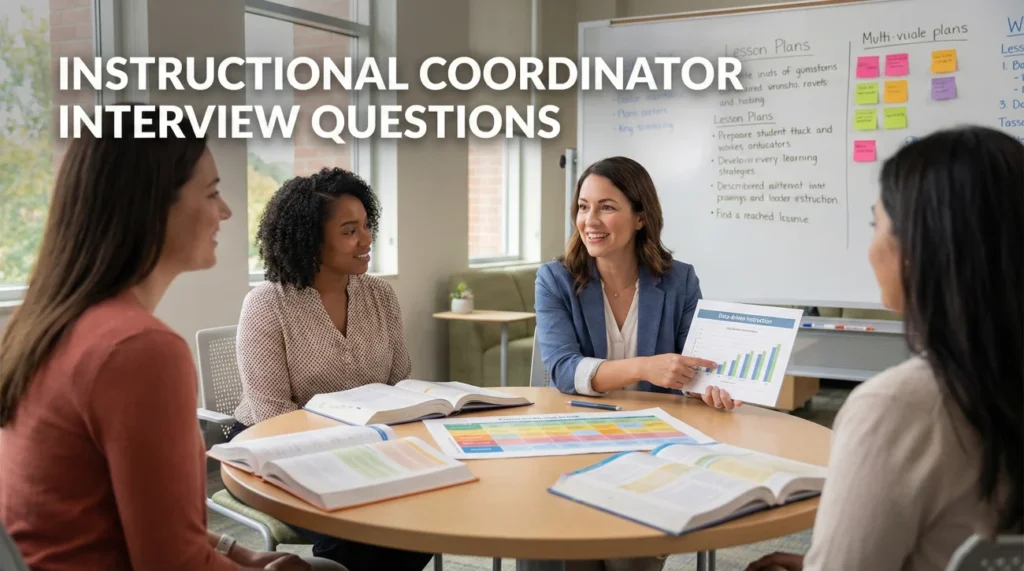
Instructional coordinator interview questions assess more than just your knowledge of pedagogy; they test your ability to be the critical link between district goals and classroom reality. Hiring committees are looking for a “Curriculum Architect” who can design rigorous learning paths and a “Teacher Whisperer” who can coach educators through the fatigue of modern schooling. The role requires balancing the technical precision of data analysis with the emotional intelligence needed to support burnt-out staff.
The instructional landscape is dominated by the “Science of Reading” mandates, the integration of AI in lesson planning, and the urgent need to address learning loss. Interviewers will ask: How do you move a veteran teacher away from debunked methods without alienation? Can you translate complex state testing data into actionable lesson plans for next Monday? Your answers must demonstrate that you drive student achievement not by mandates, but by empowering teachers with the right tools and confidence.
This comprehensive guide explores the core competencies of the role: curriculum alignment, instructional coaching cycles, professional development (PD) design, and data-driven decision-making. Whether you are interviewing for a district-wide role or a school-based coaching position, these strategies will help you prove that you are the instructional leader ready to elevate teaching and learning.
Curriculum Design & Implementation
Q: How do you ensure vertical alignment of curriculum across grade levels?
I start by auditing the “Curriculum Maps” to identify gaps or redundancies. I facilitate vertical articulation meetings where 5th-grade teachers talk directly to 6th-grade teachers to define what “mastery” looks like upon exit and entry. We look at the standards progression, not just the textbook table of contents.
I also use curriculum mapping software (like Atlas Rubicon or Chalk) to create a visual roadmap. If I see that fractions are introduced in 3rd grade but not reinforced until 5th, I work with the 4th-grade team to build spiraling review into their scope and sequence. My goal is a seamless student experience where skills build logically year over year, preventing the “summer slide” effect caused by disjointed instruction.
Q: How do you approach the adoption of a new textbook or digital resource?
I treat adoption as a collaborative research project, not a top-down purchase. I form an adoption committee that includes diverse voices: veteran teachers, special education specialists, and English Learner (EL) coordinators. We create a rubric based on our district’s specific needs and state standards, rather than relying on publisher sales pitches.
I mandate a pilot period where we test the materials in real classrooms. I collect data on ease of use, student engagement, and accessibility features. I ask, “Does this resource support our struggling learners, or just the high flyers?” I present the final recommendation to the board backed by this pilot data, ensuring our investment yields actual instructional value.
Q: Teachers are overwhelmed by a new state mandate (e.g., Science of Reading). How do you help them adjust?
I validate their overwhelm first. I acknowledge that shifting from “Balanced Literacy” to structured phonics is a massive pedagogical change, not just a tweak. I break the implementation into manageable “bite-sized” chunks. We don’t change everything in September; we focus on phonemic awareness in the fall, then phonics in the winter.
I model the new methods myself. I go into classrooms and teach a lesson using the new strategy so they can see it’s possible. I provide “grab-and-go” resources so they don’t have to create materials from scratch. My message is: “I am here to carry the heavy lifting of planning so you can focus on delivery.”
Q: How do you evaluate the effectiveness of a curriculum?
I look at the “Triangulation of Data.” I analyze standardized test scores (summative), common district assessments (interim), and classroom walkthrough data (qualitative). If test scores are low but walkthroughs show high fidelity to the curriculum, the curriculum itself might be misaligned to the test.
Conversely, if the curriculum is rigorous but student work samples show low cognitive demand, we have an implementation issue. I conduct “Curriculum Audits” where we look at student artifacts to see if the enacted curriculum matches the written curriculum. We adjust based on evidence, not intuition.
Instructional Coaching & Teacher Support
Q: What is your coaching philosophy?
I follow the “Partnership Principles” (like Jim Knight’s model). I am not a supervisor with a clipboard; I am a partner with a flashlight. My job is to help teachers see their practice more clearly, not to judge them. I believe that teachers are professionals who want to improve, and they grow best when they have autonomy in their goals.
I focus on “Capacity Building.” I don’t want to fix the lesson for them; I want to help them build the skills to fix it themselves next time. I use a cycle of “Identify, Learn, Improve” so that our work is structured and results-oriented, not just a friendly chat.
Q: How do you handle a teacher who is resistant to coaching?
I don’t take resistance personally; I view it as anxiety or fear of judgment. I start by building trust through “Low-Stakes” support. I might offer to laminate materials, find a resource for them, or cover their class for 10 minutes. I show I am there to serve, not evaluate.
I ask for permission before giving feedback. I say, “I noticed something interesting during the transition, would you be open to hearing it?” If they say no, I respect it and wait. Eventually, when they see their colleagues succeeding with my support, they usually open the door. I play the long game.
Q: How do you structure a coaching cycle?
I use a 4-6 week cycle focusing on one specific, measurable goal (e.g., “Increasing student talk time”). We start with a pre-conference to define the goal and the strategy. Then, I observe or co-teach to gather data (e.g., tallying student responses).
We meet weekly to analyze the data and tweak the strategy. At the end of the cycle, we celebrate the growth. Keeping it time-bound prevents “coaching drift” where we talk about everything but accomplish nothing. We get a quick win, then move to the next goal.
Q: How do you use video in coaching?
Video is the “Truth Teller.” Teachers often don’t realize they are calling on the same three students until they see it. I encourage teachers to record themselves for their own viewing first. I provide a specific checklist so they know what to look for, preventing them from just criticizing their appearance.
If they trust me, we watch a clip together. I let them speak first: “What did you notice?” This empowers them to identify the area for growth. Video shifts the conversation from “My opinion vs. Your opinion” to “Let’s look at what actually happened.”
Q: How do you support a teacher on an Improvement Plan (PIP)?
This is a high-stakes situation where the line between coach and evaluator can blur, so I clarify my role. I am the “Support,” the Principal is the “Evaluator.” I help the teacher decipher the Principal’s feedback. If the goal is “better classroom management,” I break that down into concrete actions like “Greeting students at the door” or “Using a countdown timer.”
I document our support sessions rigorously to show that the district provided due diligence. However, I remain a safe space for them to vent and practice. My goal is to help them save their career, but I cannot do the work for them.
Q: How do you differentiate PD for staff with different skill levels?
One-size-fits-all PD is rarely effective. I use a “Choice Board” or “EdCamp” model where teachers can select sessions relevant to their needs. A rookie teacher might need “Classroom Management 101,” while a veteran needs “Advanced AI Integration.”
I also leverage internal expertise. I ask the rockstar teacher to lead a session on their strength. This validates their expertise and relieves me from being the sole “sage on the stage.” I survey staff afterward not just on satisfaction (“Did you like the lunch?”) but on impact (“How will you use this tomorrow?”).
Data Analysis & Difficult Conversations
A veteran teacher claims that “Data-Driven Instruction” kills their creativity.
I reframe data as a tool for creativity, not a replacement for it. I explain, “Data tells us who needs help and what they are missing, but how you teach that skill is where your creativity shines.” I show them that by using data to group students effectively, they can actually design more interesting, targeted activities rather than teaching a generic lesson that bores half the class.
I avoid using data as a weapon. I never post scores publicly in the staff room. We look at data privately or in small trusted PLCs (Professional Learning Communities). I focus on growth, not proficiency. When they see that data helps them reach the quiet kid in the back, they usually buy in.
You notice a significant achievement gap in a specific subgroup (e.g., EL students) across the district.
I act immediately by conducting a “Root Cause Analysis.” Is it a curriculum bias? A lack of scaffolding training for teachers? Or a scheduling issue where EL students miss core content for pull-out services? I look at the schedule and the materials first.
I then implement targeted PD on “Sheltered Instruction” strategies (like SIOP). I work with the EL specialists to co-plan lessons that are linguistically accessible but cognitively demanding. I monitor this subgroup’s data monthly. We cannot claim to be a successful district if we are only successful for some students.
A principal asks you to coach a teacher, but the teacher thinks they are doing fine.
I navigate this “Referral Coaching” carefully. I meet with the teacher and ask, “What is your goal for this year?” finding a common ground that aligns with the Principal’s concerns without explicitly saying “The boss sent me to fix you.”
If they say everything is perfect, I ask to observe to “learn from their success.” During the observation, I collect objective data on the area of concern (e.g., student engagement). When I show them the data (“I noticed 12 students had their heads down”), it creates a gap between their perception and reality. That gap is the entry point for coaching.
Professional Development & Future Trends
Q: How do you measure the impact of Professional Development (PD)?
I use the “Guskey Levels of Evaluation.” Level 1 is participant reaction (Did they like it?). Level 2 is learning (Did they get the knowledge?). Level 3 is organizational support. Level 4 is use of new knowledge (implementation). Level 5 is student learning outcomes.
Most districts stop at Level 1. I push for Levels 4 and 5. I look for the strategy in walkthroughs two weeks after the PD. If I don’t see it, the PD failed. We then reflect: Was the training unclear, or are there barriers to implementation? We adjust the follow-up support based on this evidence.
Q: How do you integrate AI and technology into the curriculum?
I advocate for “Pedagogy First, Technology Second.” I don’t want teachers using AI just to say they used it. I train them on how AI can save them time (e.g., generating leveled reading passages or rubric feedback) so they can focus on relationships.
I also focus on “Digital Citizenship.” We must teach students how to use AI ethically as a tutor, not a cheater. I help write the district guidelines on academic integrity in the age of AI. Technology should amplify human intelligence, not replace critical thinking.
Q: How do you support new teachers (induction/mentoring)?
I ensure they have a “Survival Guide” for the first month – logistics, not just pedagogy. They need to know how to take attendance and call the office before they can worry about Bloom’s Taxonomy. I pair them with a mentor who is a match in personality, not just grade level.
I protect them from “Committee Fatigue.” I advocate to keep them off extra duties so they can focus on their classroom. I check in on their mental health, not just their lesson plans. Retention starts with making them feel like they belong and can succeed.
Q: How do you stay current with educational research?
I am an active member of organizations like ASCD and Learning Forward. I read research journals, not just blogs. I follow thought leaders who cite evidence, not just trends.
I also curate this research for my teachers. They don’t have time to read a 30-page study. I summarize the key takeaways in a “Monday Minute” email or a one-page visual. My job is to be the filter that brings the best, most relevant ideas into our district.
Instructional Coordinator Challenge
Take the 20-Question Challenge
1. “Vertical Alignment” in curriculum ensures that:
- All teachers stand up while teaching
- Skills progress logically from one grade to the next
- Textbooks are stacked vertically in the room
- All grades teach the exact same content
2. A “Formative Assessment” is primarily used to:
- Assign a final grade at the end of the term
- Monitor student learning to provide ongoing feedback
- Evaluate teacher performance for pay raises
- Rank students for college admissions
3. “Differentiation” usually involves adjusting:
- The content, process, product, or environment
- The content, process, product, or environment
- Only the difficulty of the final exam questions
- The seating chart of the classroom only
4. The “Zone of Proximal Development” (Vygotsky) refers to:
- What a learner can do with guidance/scaffolding
- What a learner can do with guidance/scaffolding
- The area where students sit in the classroom
- The quiet zone for independent reading time
5. “Backward Design” (UbD) starts with identifying:
- The fun activities students will enjoy
- The desired results or learning outcomes
- The textbooks available in the closet
- The number of days in the school calendar
6. A “Pacing Guide” helps teachers to:
- Run faster during physical education
- Stay on track to cover standards within the year
- Slow down instruction to fill the time
- Determine when to take their lunch breaks
7. “Scaffolding” instructional support means:
- Building physical structures in class
- Providing temporary support that is removed over time
- Making the work easier permanently for students
- Giving students the answers to the test
8. “RTI” (Response to Intervention) is a framework for:
- Evaluating principal performance annually
- Identifying and supporting struggling learners early
- Responding to technology issues in the lab
- Retiring teachers’ insurance benefits plans
9. A “Rubric” is most effective when it is:
- Kept secret until after the assignment is graded
- Shared with students before they begin the task
- Used only by the principal for evaluations
- Written in complex academic language only
10. “Bloom’s Taxonomy” classifies learning objectives by:
- Alphabetical order of the key terms
- Complexity and specificity of cognitive levels
- The age of the students in the classroom
- The subject matter being taught that day
11. “PLC” stands for:
- Private Learning Center for students
- Professional Learning Community for educators
- Public Library Card registration system
- Parent Liaison Committee for fundraising
12. “High-Leverage Practices” are teaching strategies that:
- Require expensive technology to implement
- Are fundamental to supporting student learning
- Are only used in high school AP classes
- Focus solely on standardized test preparation
13. “Universal Design for Learning” (UDL) aims to:
- Make all classrooms look exactly the same
- Remove barriers to learning for all students
- Design universal uniforms for all students
- Create a single curriculum for the world
14. “Project-Based Learning” (PBL) focuses on:
- Memorizing facts for a multiple choice test
- Solving real-world problems over an extended period
- Doing short projects at the end of a unit
- Building models out of clay and paper only
15. A “Standards-Based Report Card” grades students on:
- Their behavior and attendance record
- Mastery of specific skills or content standards
- Their comparison to other students in class
- The amount of extra credit they completed
16. “Modeling” in instruction involves:
- Wearing fashionable clothes to school
- Demonstrating the thinking process or skill explicitly
- Having students read the textbook silently
- Assigning homework without explanation
17. “Student Agency” refers to:
- A travel agency for student field trips
- Students having voice and choice in their learning
- Students working for the school administration
- Strict control of student movements in class
18. “Metacognition” helps students to:
- Memorize metal elements in chemistry class
- Think about their own thinking and learning process
- Ignore their mistakes and move on quickly
- Compete with their peers for higher grades
19. “Flipped Classroom” model means:
- Turning desks around to face the back
- Instruction is accessed at home, practice in class
- Students teach the class instead of the teacher
- Changing classrooms every single period
20. “Summative Assessment” occurs:
- During the lesson to check understanding
- At the end of a unit to evaluate mastery
- Before the unit begins as a pre-test check
- Randomly throughout the week for points
❓ FAQ
🏛️ Is this an admin or teacher role?
It is often a hybrid. You are typically on an administrative salary scale or a “teacher plus stipend” contract. You have leadership responsibilities but usually do not evaluate teachers formally (hire/fire), which allows you to maintain a trusting coaching relationship.
📊 How much data analysis is involved?
A significant amount. You need to be comfortable with Excel, Google Sheets, and data visualization platforms (like Tableau or PowerBI). You don’t need to be a data scientist, but you must be able to spot trends and explain them to non-technical staff.
🗓️ Do I work in the summer?
Usually, yes. While teachers are off, Instructional Coordinators are busiest – analyzing the previous year’s data, rewriting curriculum maps, and planning the “Back to School” PD week. It is typically a 10.5 or 12-month position.
🍎 Do I need to be an expert in all subjects?
No, and you shouldn’t pretend to be. If you are a literacy specialist coaching a math teacher, focus on general pedagogy (engagement, pacing, classroom management). Admit what you don’t know and lean on the teacher’s content expertise.
🤝 How do I handle conflict with a Principal?
Alignment is key. Have regular meetings to ensure your coaching goals match their building goals. If there is a disagreement, discuss it privately. In public, you and the administration must present a united front to the staff to avoid confusion.
Final Thoughts
To succeed in this role, your answers to instructional coordinator interview questions must balance vision with practicality. Districts don’t need another person to write a beautiful curriculum document that sits on a shelf; they need a leader who can bring that curriculum to life in the classroom. By highlighting your ability to coach with empathy, analyze with precision, and lead with humility, you show that you are the catalyst for the academic growth they are seeking.
⚠️ Disclaimer: The interview strategies, sample answers, and negotiation tips provided in this guide are for educational purposes only. Hiring decisions are subjective and vary by company and industry. While these strategies are based on professional HR standards, they do not guarantee a specific job offer or result.