Curiosity With Guardrails
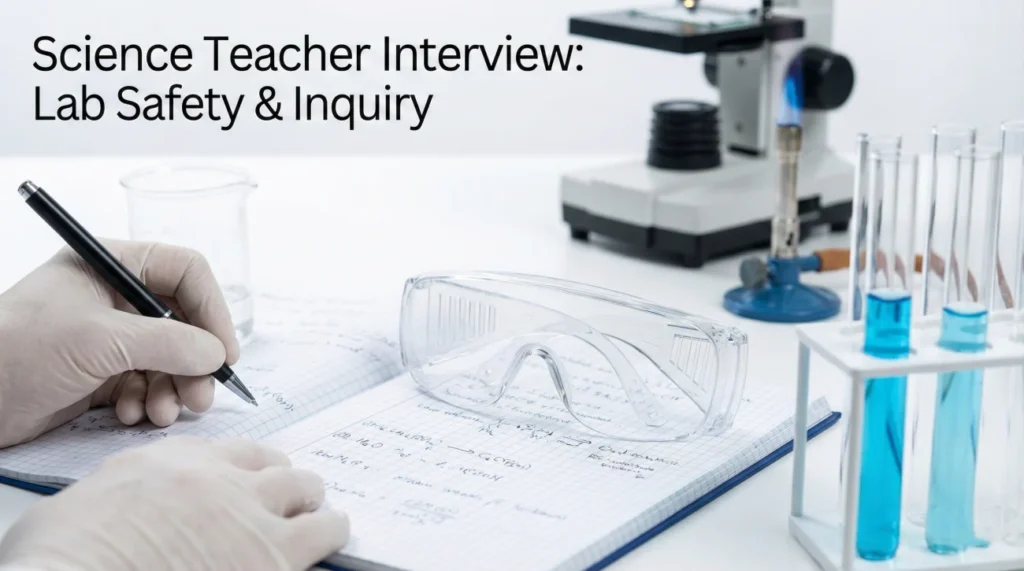
Science teacher interview questions reveal whether you can run a room where students investigate like scientists while staying safe and focused. It is a rare mix of wonder and discipline.
Expect questions about inquiry structures, like the 5E model, and about how you use evidence-based writing through CER. At the same time, interviewers will test your safety mindset: routines, roles, lab contracts, and what you do when a student ignores goggles or a spill happens.
This guide helps you speak the language of strong science instruction, from phenomena-based learning to clean assessment design. You will also find ways to explain your lab management so it sounds confident, calm, and realistic for a crowded classroom.
NGSS & Inquiry-Based Instruction
Q: How do you incorporate the NGSS (Next Generation Science Standards) into your teaching?
I focus on “Three-Dimensional Learning.” I don’t just teach the content (Disciplinary Core Idea). I pair it with a Practice (like “Developing Models”) and a Crosscutting Concept (like “Cause and Effect”). For example, instead of just lecturing on photosynthesis, students might build a physical model to track the flow of energy (Practice) and analyze how matter is conserved in the system (Crosscutting Concept).
I also emphasize “Phenomena-Based Learning.” I start units with an anchoring phenomenon – a real-world event that is puzzling (e.g., “Why did the bridge collapse?”) – and the entire unit is a quest to explain that event using scientific principles, rather than just learning chapters in a book.
Q: Explain the 5E Model and how you use it.
The 5E model is my framework for inquiry.
1. Engage: I hook students with a demo or a question (e.g., crushing a can with air pressure).
2. Explore: Students investigate hands-on before I define terms. They gather data.
3. Explain: This is where we synthesize their findings. I introduce vocabulary here to label what they just experienced.
4. Elaborate: They apply the concept to a new context (transfer).
5. Evaluate: Assessment of their understanding (CER or performance task).
This sequence ensures students build their own understanding rather than just verifying mine.
Q: What is the difference between a “Cookbook Lab” and “Inquiry”?
A “Cookbook Lab” gives students a recipe: Step 1, Step 2, Step 3, Expected Result. It confirms what they already know and requires little thinking. Inquiry requires students to design part of the experiment.
In a Guided Inquiry lab, I might give them the question and the materials but ask them to design the procedure to test variables. In an Open Inquiry lab, they generate the question themselves. My goal is to move students away from blindly following directions toward thinking like scientists who must troubleshoot and problem-solve.
Q: How do you use CER (Claim, Evidence, Reasoning) in your classroom?
CER is the structure I use for all scientific writing and arguments.
– Claim: A one-sentence answer to the question.
– Evidence: Quantitative data or qualitative observations from the lab (not “I think”).
– Reasoning: The scientific principle that connects the evidence to the claim.
I scaffold this heavily. Early in the year, I might provide the Evidence and ask for the Claim. By the end, they must construct the full argument. This moves them from “The liquid turned red” to “A chemical change occurred because the pH indicator changed color, which indicates the formation of an acid.”
Lab Safety & Classroom Management
Q: A student repeatedly takes off their safety goggles. What do you do?
I have a zero-tolerance policy for safety violations because vision loss is permanent. My policy is “Goggles on, or you’re gone.”
First offense is a verbal warning/reminder. Second offense, they are removed from the lab activity immediately and given an alternative paper-based assignment (which is rigorous, not “free time”). I document the incident and contact home. Allowing them to stay sets a dangerous precedent that safety is optional.
Q: How do you prepare students for a hazardous lab?
I use a “Safety Contract” signed by students and parents at the start of the year. Before a specific lab, I do a “Pre-Lab Safety Briefing.” We identify the specific hazards (e.g., “This acid burns skin,” “Glass is hot”).
I demonstrate the emergency procedures: “If X spills, we do Y.” I often require students to pass a mini-safety quiz with 100% accuracy before they are allowed to touch the materials. Preparation prevents panic.
Q: How do you manage materials and cleanup in a large class?
I assign specific roles within lab groups: Principal Investigator (leads), Materials Manager (gets supplies), Recorder (data), and Safety Officer/Cleanup Captain. This distributes responsibility.
I stop the lab 5-7 minutes before the bell for cleanup. I do not dismiss the class until my “Check-Out” is complete – meaning all stations are clean, glassware is washed, and inventory is accounted for. Peer pressure helps here; the whole class waits until Station 4 is clean.
Q: What do you do if a chemical spills?
I follow the SPILL protocol: Stop everyone, Protect the area (cordon off), Identify the chemical, Locate the spill kit, Lean on training.
If it’s a minor acid spill, I neutralize it with a base (baking soda). If it’s a base, I use an acid (vinegar). If it’s volatile or unknown, I evacuate the room and call the custodian/hazmat. I model calm authority. I never let students clean up hazardous chemical spills; that is my job.
Q: How do you handle a “failed” experiment?
I reframe it: “There are no failed experiments, only unexpected data.” If a lab doesn’t yield the textbook result, it’s a teachable moment about experimental error or variables.
We analyze why. Was the chemical contaminated? Was the temperature different? This analysis is often more scientifically rigorous than getting the “right” answer. It teaches resilience and critical thinking.
Q: How do you make labs accessible for students with physical disabilities?
I consult the IEP and the student. For a student in a wheelchair, I ensure we have an adjustable-height lab table. For fine motor challenges, I might use larger beakers or plastic instead of glass.
I also use “Virtual Labs” (Gizmos, PhET) as a supplement or alternative if the physical risk is too high. Collaboration is key; I ensure they have a meaningful role in the group (e.g., data analysis) even if they cannot physically manipulate the equipment.
Controversial Topics & Ethical Scenarios
A parent asks to opt their child out of learning evolution due to religious beliefs.
I listen respectfully to their concerns, but I hold the line on the curriculum. I explain, “I respect your personal beliefs. In this class, we teach evolution as the fundamental scientific theory that explains the diversity of life, consistent with state standards.”
I clarify that I am not asking the student to change their belief, but they are required to understand the scientific material. I focus on the nature of science – evidence, theory, and observation – rather than debating theology. I usually involve an administrator if they persist.
You catch a student trying to steal a chemical or piece of equipment.
This is a major safety breach. I confiscate the item immediately and quietly remove the student from the lab setting. I do not make a scene that might cause them to do something rash (like ingest it or throw it).
I refer this to the administration immediately as it poses a liability and safety risk to the school. The student would lose lab privileges until a restorative meeting and safety contract re-signing occurs. I also do a full inventory check to ensure nothing else is missing.
Students are squeamish about dissection or ethically opposed to it.
I acknowledge their feelings and explain the educational value of seeing anatomy in 3D. However, I do not force a student to cut if they are visibly distressed, as they won’t learn anything.
I offer alternatives: they can be the “Recorder” while their partner cuts, or they can use a high-quality virtual dissection program. Most states actually have laws requiring schools to offer alternatives to dissection upon parent request, so I ensure I am compliant with that.
Instructional Strategies & Misconceptions
Q: How do you address common scientific misconceptions (e.g., seasons are caused by distance from the sun)?
I use “Discrepant Events” – demonstrations that yield a result contrary to their intuition. For the seasons misconception, we might analyze data showing the Earth is actually closer to the sun in January (for the Northern Hemisphere).
I force them to confront the conflict between their belief and the data (“Cognitive Dissonance”). Then, we rebuild the correct model (axial tilt) together. If I just lecture the truth, they will memorize it for the test but revert to their misconception later.
Q: How do you use technology in the science classroom?
I use technology to visualize the invisible and gather data. I use probeware (vernier sensors) to collect real-time data on pH, temperature, or motion, which allows us to focus on analysis rather than manual plotting.
I use simulations like PhET to show molecular interactions or orbital mechanics that are impossible to see in a lab. I also use collaborative tools like Google Jamboard for modeling, allowing students to draw and revise their mental models collectively.
Q: How do you differentiate content for English Language Learners (ELLs)?
Science is language-heavy (“Tier 3 Vocabulary”). I use visual word walls with pictures for every term. I use sentence stems for their lab reports (“The data shows… because…”).
I rely heavily on “Realía” (real objects) and hands-on experience. An ELL student might not understand the word “density,” but if they hold a piece of lead and a piece of foam, they feel the concept. The hands-on lab is the great equalizer; it provides a shared experience to hang the vocabulary on.
Q: Why do you want to be a science teacher?
I want to teach students how to ask questions and find their own answers. In a world full of misinformation, scientific literacy is a survival skill. I love the “Aha!” moment when a student connects a concept to their daily life. I want to create a safe space where students can be curious, make messes, make mistakes, and discover the wonder of the natural world.
Science Teacher Competency Quiz
Take the 20-Question Challenge
1. The “E” in the 5E model that focuses on assessment is:
- Explain
- Evaluate
- Elaborate
- Experiment
2. NGSS stands for:
- National General Science Standards
- Next Generation Science Standards
- New Global Scientific Systems
- Natural Growth Science Strategies
3. In a CER framework, “Reasoning” connects:
- The student to the teacher
- The Evidence to the Claim using scientific principles
- The hypothesis to the conclusion
- The math to the science
4. What is the first priority in any lab activity?
- Getting the right answer
- Student Safety
- Finishing on time
- Saving materials
5. A “Discrepant Event” is used to:
- Punish students
- Expose misconceptions by showing a surprising result
- Skip the lab
- Test for colorblindness
6. “Tier 3 Vocabulary” refers to:
- Everyday words
- Domain-specific scientific terms (e.g., photosynthesis, isotope)
- Slang words
- Words with three syllables
7. The best way to neutralize a base spill is usually:
- Water only
- A weak acid (like vinegar/acetic acid)
- A strong acid
- Paper towels only
8. “Formative Assessment” in science looks like:
- The final exam
- Walking around checking student observations during a lab
- State standardized testing
- Grading the textbook cover
9. Which is a “Science and Engineering Practice” (SEP)?
- Memorizing facts
- Developing and Using Models
- Sitting quietly
- Copying notes
10. A “Crosscutting Concept” (CCC) is:
- A scalpel used in dissection
- A theme that bridges disciplines (e.g., Patterns, Energy and Matter)
- A dangerous shortcut
- A wrong answer
11. If a student gets a chemical in their eye, you flush it for:
- 2 minutes
- 15 to 20 minutes
- 30 seconds
- Until it stops hurting
12. “Phenomena-Based Learning” starts with:
- Definitions
- An observable event that needs explanation
- The test
- Reading the textbook chapter
13. To prevent contamination, you teach students:
- To pour excess chemicals back into the original bottle
- Never to return unused chemicals to the original container
- To taste the chemical
- To mix everything together
14. “Wait Time” after asking a question allows:
- The teacher to rest
- Students to process and formulate a deeper answer
- The bell to ring
- Students to check their phones
15. The “Flipped Classroom” in science involves:
- Turning tables over
- Learning content at home (video) and doing labs in class
- Doing labs at home
- Students teaching the teacher
16. SDS stands for:
- Science Data Sheet
- Safety Data Sheet (formerly MSDS)
- Student Daily Schedule
- Systematic Discovery Science
17. Which is a “Cross-Curricular” connection?
- Doing biology in chemistry class
- Using graphing (Math) and writing arguments (ELA) in Science
- Running in the hallway
- Eating lunch in the lab
18. “Inquiry” moves the student from:
- Passive consumer to active investigator
- Active investigator to passive consumer
- Knowing to guessing
- Safety to danger
19. The best way to differentiate a lab for advanced students is:
- Give them more work
- Have them design the experimental procedure themselves (Open Inquiry)
- Let them leave early
- Have them wash the dishes
20. Which chemical is generally stored separately from others?
- Water
- Flammables and Oxidizers (incompatible storage)
- Salt
- Sugar
❓ FAQ
🧬 Do I need a specific science major for the grade I teach?
Requirements vary, but schools often look for a solid content foundation plus the right certification. If your degree is adjacent, highlight how you stay current, like coursework, labs, professional learning, or hobbies that keep your scientific thinking sharp.
🧾 Who pays for lab supplies?
Budgets differ widely. Some schools provide basic consumables, while others expect you to stretch funds with reusable materials and microscale labs. Mention practical ideas like sharing inventory with the department, applying for mini-grants, or designing labs that are high-impact without being high-cost.
🩹 What if a student gets hurt during a lab?
Your answer should show a safety-first mindset: stop the activity, secure the area, get medical support, and follow school reporting procedures. The best prevention is clear training, strict routines, and enforcing safety rules consistently before an incident happens.
🔬 Should I run a hands-on lab every day?
Hands-on does not always mean chemicals and glassware. A strong program mixes investigations, models, demos, data analysis, and short reading or writing tasks that build scientific reasoning. The goal is frequent inquiry with realistic time for setup, cleanup, and reflection.
📱 Do you ban phones in the lab?
Set a clear policy tied to safety. Phones can be useful for timers or data collection, but during hazardous steps they should be put away. Interviewers want to hear that your expectations are explicit and enforced, not negotiated mid-lab.
Leaving the Panel Confident
A great science interview sounds like controlled curiosity. Review science teacher interview questions and prepare examples that combine inquiry, clear expectations, and non-negotiable safety. When you can explain how students investigate, write with evidence, and clean up responsibly, you come across as a professional who can run a lab and a learning culture.
⚠️ Disclaimer: The interview strategies, sample answers, and negotiation tips provided in this guide are for educational purposes only. Hiring decisions are subjective and vary by company and industry. While these strategies are based on professional HR standards, they do not guarantee a specific job offer or result.