The Jack-of-All-Trades Educator
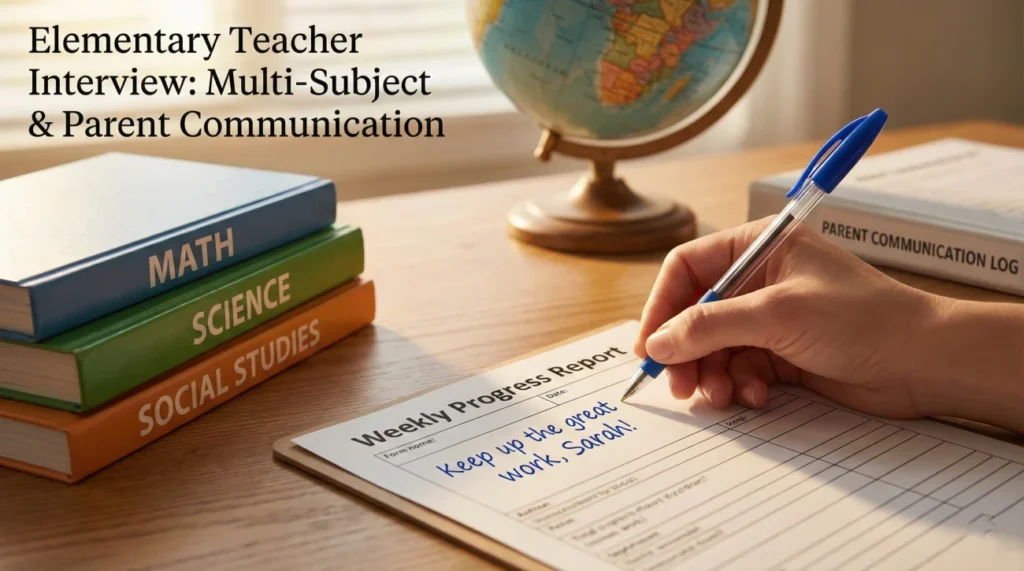
Elementary teacher interview questions focus on the unique challenge of being a generalist expert. Unlike high school teachers who specialize in one subject, an elementary teacher must pivot seamlessly from teaching phonics to explaining fractions, then to a science experiment on erosion, all before lunch. Hiring managers are looking for candidates who can manage this cognitive load while maintaining a structured, nurturing environment for 25 to 30 students.
You will be tested on your ability to differentiate instruction for a wide range of reading levels within a single class. You must demonstrate how you use data to form small groups, how you handle the “helicopter parent” or the disengaged guardian, and how you manage transitions to prevent chaos. The interview will probe your depth in both literacy (Science of Reading) and numeracy (Conceptual Math).
This guide covers the core competencies of the K-5 classroom. We explore the logistics of running “Math Daily 3” or “Daily 5” literacy centers, the art of the parent-teacher conference, and the strategies for supporting students with diverse needs (IEP/504) in a general education setting. These answers will help you prove you are the organized, adaptable leader your students need.
Multi-Subject Instruction
Q: How do you structure a 90-minute Literacy Block?
I use a “Balanced Literacy” approach aligned with the Science of Reading. I start with a 15-20 minute Whole Group Mini-Lesson focused on a specific skill (e.g., Main Idea or Phonics rule). Then, the class breaks into rotations (45-60 minutes).
While I pull Small Groups for targeted guided reading (Tier 2 intervention), the other students work independently on “Daily 5” stations: Read to Self, Work on Writing, or Word Work. I end with a 10-minute Closing Circle to share learning and review the objective. This ensures every student gets face time with me at their instructional level.
Q: Describe your strategy for teaching “New Math” (Conceptual Math).
I focus on the “Why” before the “How.” Instead of just teaching the standard algorithm for subtraction immediately, I use the CRA Model (Concrete, Representational, Abstract).
For example, with double-digit subtraction, we start with Concrete base-10 blocks to physically “borrow” a ten. Then we move to Representational drawings (number lines or place value charts). Finally, we do the Abstract algorithm. This builds number sense so students understand that “borrowing” is actually “regrouping,” reducing anxiety and errors.
Q: How do you integrate Science and Social Studies into a busy schedule?
Time is tight, so I use Cross-Curricular Integration. I don’t treat them as separate silos. During the Literacy block, the “Read to Self” books might be non-fiction texts about the Solar System (Science) or the American Revolution (Social Studies).
In writing, we might write a persuasive letter to the mayor (Civics/Writing). I also use “Science Fridays” for hands-on experiments that reinforce math skills (measuring/graphing data). This “double-dipping” ensures content coverage without extending the school day.
Q: What is your approach to homework in elementary school?
I believe homework should be practice, not new learning. It should build confidence, not frustration. I follow the “10 minutes per grade level” rule. For a 3rd grader, that’s 30 minutes max.
My priority is reading. If a student does nothing else, I want them to read for 20 minutes a night. I provide “Menu Options” (e.g., play a math game, cook a recipe, write a letter) to allow family flexibility. I never grade homework for accuracy, only for completion/effort, because I can’t control the home environment.
Differentiation & Inclusion
Q: Tiered Assignments
I keep the learning objective constant but change the complexity. If the goal is “Understand Cause and Effect,” Tier 1 might match pictures. Tier 2 writes a sentence using a sentence stem (“Because ___, then ___”). Tier 3 writes a paragraph predicting future effects. All students master the concept, but at their zone of proximal development.
Q: Supporting ELL/ESL Students
I use Visuals and Realia (real objects). I label everything in the room in both languages. I pre-teach vocabulary before the lesson. I use “Sentence Frames” to help them structure their speaking. I also allow them to use their native language for brainstorming (“translanguaging”) before translating to English, valuing their bilingualism as an asset.
Q: Gifted Student Challenge
Gifted students need depth, not just “more work.” I use “Anchor Activities”. When they finish early, they don’t get a second worksheet; they work on a long-term “Passion Project” or a logic puzzle. I encourage them to be “Expert Helpers” (if they are socially willing) to teach a peer, which reinforces their own understanding through explanation.
Q: Reading Groups Management
I group dynamically based on data, not permanently. I might have a “Phonics Group” for kids struggling with decoding and a “Comprehension Group” for fluent readers who miss the meaning. I re-assess every 6 weeks. While I am with a group, the rest of the class uses a “Must Do / May Do” list so they are self-directed and don’t interrupt me.
Q: Sensory Accommodations
For students with ADHD or sensory processing needs, I offer “Flexible Seating” (wobble stools, standing desks, floor cushions). I allow “Fidgets” (with clear rules: “It’s a tool, not a toy”). I incorporate “Brain Breaks” (GoNoodle) every 20 minutes to reset the collective nervous system of the class.
Q: IEP Data Tracking
I keep a “Data Binder.” If an IEP goal is “Student will raise hand 4/5 times,” I tape a sticky note to their desk and tally marks during the lesson. I don’t rely on memory. I review this data weekly to see if interventions are working or need adjustment before the next IEP meeting.
Classroom Management & Culture
It is a rainy day schedule (indoor recess) and the energy is chaotic. How do you reset the class?
Indoor recess is the ultimate test. I don’t yell over the noise. I turn off the lights to signal a reset. I use a calm, rhythmic clap pattern that they must repeat. Once I have their eyes, I acknowledge the energy: “I know we have the wiggles because we didn’t go outside.”
I lead a structured 2-minute “shake out” or yoga stretch. Then, I lower the energy by reading a chapter of a compelling read-aloud book in a whisper voice. Curiosity quiets a room faster than commands. We transition back to work only when the collective breath of the room has slowed down.
A student creates a distraction every time you transition from Math to Reading.
This suggests “Transition Anxiety.” The student might struggle with the unstructured time or the subject change. I would implement a Pre-Correction strategy. Before I announce the transition to the class, I walk to that student’s desk.
I quietly say, “In one minute, we are switching to Reading. I need you to put your book away and get your folder. Can you do that for me?” I might give them a specific job (“Can you be the light monitor?”) to give the transition a purpose. Creating a predictable routine minimizes the opportunity for misbehavior.
You catch a student cheating on a spelling test.
I handle it discreetly to avoid public shaming. I would quietly remove the paper and ask the student to see me at recess. I view cheating as a sign of pressure or lack of preparation, not moral failure.
Privately, I ask, “Why did you feel you needed to look at [Name]’s paper?” Usually, they admit they were scared to fail. I invalidate the score but offer a retake opportunity (perhaps in a different format) so they can prove they learned the words. I reinforce integrity: “I care more about what you know than what your neighbor knows.” I inform parents only if it becomes a pattern.
Parent & Community Communication
Q: How do you handle a Parent-Teacher Conference for a struggling student?
I use the “Sandwich Method,” but with substance. I start with a genuine strength (“He is so kind to his peers”). Then I present the data (work samples, test scores). I avoid teacher jargon. Instead of saying “He is low in phonemic awareness,” I say “He struggles to hear the sounds in words, which makes spelling hard.”
I finish with a concrete plan: “Here is what I am doing at school (Tier 2 group), and here is one simple thing you can do at home (read for 10 mins).” I position us as a team: “We are partners in his success.” I leave time for their questions and validate their worries.
Q: Describe your system for regular parent communication.
I believe in “No Surprises.” I send a Weekly Newsletter (digital via email/ClassDojo) every Friday. It covers: 1) What we learned this week. 2) Upcoming dates. 3) A “Ask your child…” prompt to spark dinner conversation.
For individual behavior, I adhere to the “Positive Contact” rule. I try to send a “Good News” note or call for every student in the first month. This builds a reservoir of goodwill so that if I ever have to call with bad news later, the parent knows I see the good in their child too.
Q: A parent emails you late at night demanding to know why their child was bullied.
I adhere to the “24-Hour Rule” for emotional emails. I do not reply at 11 PM. I wait until morning to draft a calm, professional response. I acknowledge the email: “Thank you for bringing this to my attention. I take safety very seriously.”
I do not discuss the other child’s discipline (FERPA privacy). I state, “I am investigating the incident and have spoken to the students involved. Here is the plan to ensure your child feels safe today.” I prefer to move these conversations to a phone call or in-person meeting, as tone is often lost in email.
Q: How do you involve parents who cannot volunteer during the school day?
Not every parent can be a room mom. I offer “At-Home” volunteer opportunities. “Can you cut out these laminated shapes for math while you watch TV?” “Can you donate a box of tissues?” I also use technology (Zoom/Seesaw) to let them see the classroom virtually. I validate that sending a well-rested, fed child to school is the most important contribution they make.
Elementary Education Knowledge Check
Test Your K-5 IQ
1. In the “Daily 5” framework, which is NOT one of the core components?
- Read to Self
- Work on Writing
- Teacher Lecture
- Word Work
2. “Exit Tickets” are primarily used for:
- Attendance
- Formative assessment to guide the next day’s instruction
- Final grades
- Homework
3. The “Morning Meeting” structure typically includes:
- Test taking
- Greeting, Sharing, Group Activity, and Message
- Silent reading
- Recess
4. A “Graphic Organizer” (like a Venn Diagram) helps students:
- Draw pictures
- Visually structure their thoughts and see relationships between concepts
- Practice handwriting
- Color inside lines
5. “RTI” stands for:
- Read To Interest
- Response to Intervention (Multi-tier support system)
- Right To Instruction
- Real Time Inquiry
6. In Math, an “Array” is used to teach:
- Subtraction
- Multiplication (Rows and Columns)
- Geometry
- Time
7. “Fluency” in reading involves:
- Reading as fast as possible
- Speed, Accuracy, and Prosody (Expression)
- Memorizing the dictionary
- Answering questions
8. A “Rubric” is most useful for grading:
- Multiple choice tests
- Subjective assignments like essays or projects
- Math facts
- Attendance
9. “Bloom’s Taxonomy” classifies learning objectives by:
- Age appropriateness
- Complexity and specificity (from Remember to Create)
- Alphabetical order
- Subject matter
10. “Anchor Charts” are:
- Store-bought posters
- Visuals created with students during a lesson to record key strategies
- Maps of the ocean
- Teacher lesson plans
11. A “Running Record” assesses:
- Running speed
- Reading behaviors and error patterns
- Math calculation
- Writing spelling
12. “Think-Pair-Share” is a strategy to:
- Keep students quiet
- Increase student participation and processing time
- Grade students
- End the class
13. Which Tier of RTI is for “Universal Instruction” (Whole Class)?
- Tier 1
- Tier 2
- Tier 3
- Tier 4
14. “Manipulatives” (like Base-10 blocks) are used to:
- Play during recess
- Make abstract math concepts concrete
- Distract students
- Build towers only
15. “Close Reading” requires students to:
- Read with their eyes closed
- Read a short text multiple times for deep analysis and evidence
- Skim for the main idea
- Read a whole book quickly
16. A “504 Plan” provides:
- Specialized instruction
- Accommodations for access (e.g., preferential seating) based on disability
- Free lunch
- Transportation
17. “Project-Based Learning” (PBL) starts with:
- A lecture
- A driving question or real-world problem
- A test
- A worksheet
18. The “Zone of Proximal Development” suggests teaching material that is:
- Too easy
- Too hard
- Just beyond current ability, achievable with guidance (scaffolding)
- Already mastered
19. “Checking for Understanding” (CFU) should happen:
- At the end of the unit
- Throughout the lesson (every 5-10 mins)
- Only on quizzes
- Never
20. “Growth Mindset” praises:
- Intelligence (“You’re so smart”)
- Effort and strategy (“You worked hard to solve that”)
- Grades only
- Being the fastest
❓ FAQ
📜 Do I need a Master’s degree?
In most US states, a Bachelor’s and a teaching license are the minimum. However, some states (like NY or MA) require a Master’s within 5 years. A Master’s often comes with a salary bump, but experience is the primary hiring factor.
💸 How much of my own money will I spend?
Realistically, $200-$500 a year on classroom decor, treats, or extra supplies. It shouldn’t be this way, but it is. Ask the PTO or Principal about reimbursement budgets before spending your own cash.
⏰ What are the actual hours?
Contract hours might be 8:00-3:30, but effective teachers often arrive at 7:30 and leave at 4:30. Grading often happens on weekends. Boundary setting is crucial to prevent burnout.
🍎 Which grade level is best?
K-2 is heavy on foundational literacy and nurturing (“tying shoes”). 3-5 is heavy on content depth, state testing, and developing independence. Choose based on your patience level and content passion.
💻 Is tech mandatory?
Yes. You will use a Learning Management System (Google Classroom/Canvas), digital gradebooks, and interactive whiteboards daily. Being “bad at computers” is no longer an option.
The Heart of the School
To succeed with elementary teacher interview questions, you must present yourself as a flexible, data-driven professional who loves kids. Administrators want to know that you can handle the academic pressure while creating a classroom where students feel safe to fail and try again.
Focus on your ability to wear many hats. Share stories about how you differentiated a math lesson for a struggling learner, or how you partnered with a difficult parent. Show them that you are organized, resilient, and ready to be the consistent positive force in your students’ lives.
⚠️ Disclaimer: The interview strategies, sample answers, and negotiation tips provided in this guide are for educational purposes only. Hiring decisions are subjective and vary by company and industry. While these strategies are based on professional HR standards, they do not guarantee a specific job offer or result.