The Architect of Resilience
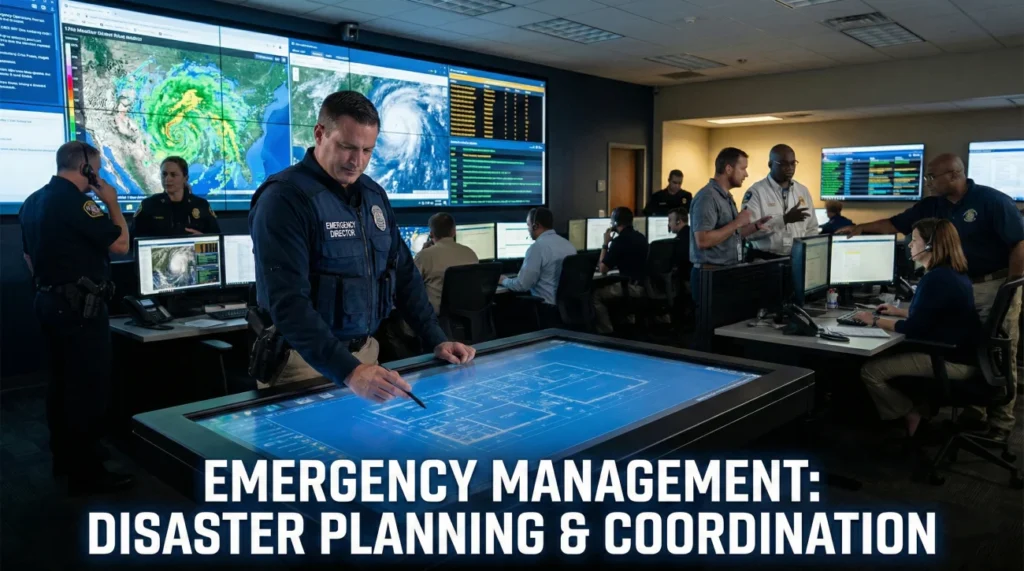
When the hurricane hits, the wildfire spreads, or the grid goes down, the public looks to the first responders; but the first responders look to the Emergency Management Director (EMD). You are the architect of the community’s resilience, the strategic mind that plans for the unthinkable before it happens and coordinates the chaos when it does. Hiring managers are searching for a leader who can balance the bureaucratic demands of federal grants with the raw, high-stakes pressure of a live Emergency Operations Center (EOC). To secure this executive role, you must be prepared to answer emergency management director interview questions that test your ability to build coalitions among disparate agencies, manage political expectations during crises, and design mitigation plans that save lives and property.
This position requires a unique blend of skills; you must be a grant writer, a public speaker, a logistician, and a diplomat. You are not just managing an event; you are managing the entire cycle of disaster: Mitigation, Preparedness, Response, and Recovery. Interviewers will probe your experience with the Incident Command System (ICS), your knowledge of FEMA’s reimbursement processes, and your philosophy on community engagement. They want to know if you can lead when the plan fails and improvisation is the only option left.
To lead your community through its darkest hours, you must demonstrate that you have the foresight to prepare and the fortitude to act. This guide provides the strategic, high-level answers you need to prove you are the steady hand capable of steering the ship through the storm.
The Four Phases of Emergency Management
Q: Describe your experience with “Mitigation” planning.
Mitigation is the investment we make today to reduce suffering tomorrow. My approach involves a robust Hazard Identification and Risk Assessment (HIRA). I analyze historical data to identify our top threats (e.g., floods, cyberattacks).
I then pursue grant funding (like FEMA’s BRIC program) to harden infrastructure. For example, in my last role, I secured funding to elevate critical generators above the 100-year flood plain. I also work with zoning boards to prevent development in high-risk areas. Mitigation is not glamorous, but for every $1 spent, we save $6 in response costs, and that is the ROI I sell to stakeholders.
Q: How do you assess a community’s “Preparedness” level?
Preparedness is measured by capabilities, not just plans on a shelf. I use the THIRA (Threat and Hazard Identification and Risk Assessment) process to determine our capability gaps.
I look at our “Core Capabilities” like communications, logistics, and mass care. I conduct regular full-scale exercises to stress-test these systems. If the radio system fails during a drill, that is a success because we found the failure before the real disaster. I also assess the “whole community” preparedness, engaging private businesses and faith-based groups to ensure they have continuity plans, as government cannot do it alone.
Q: What is your philosophy on leading the “Response” phase in the EOC?
In the EOC (Emergency Operations Center), my job is coordination, not tactical command. I support the Incident Commanders in the field by getting them the resources they need.
I operate by the “manage by objective” principle of ICS. I set the operational periods and the overarching goals (e.g., “Life Safety” is always #1). I ensure information flows up to the policy group (Mayor/Governor) and down to the field. I control the chaos by sticking to the structure, ensuring that every request is tracked and every dollar is accounted for from minute one to ensure reimbursement later.
Q: “Recovery” is often the longest phase. How do you manage it?
Recovery begins while the response is still active. I appoint a Recovery Manager early. I focus on both short-term restoration (power, water) and long-term rebuilding.
I am intimately familiar with the Stafford Act and the Public Assistance (PA) process to get federal funds. I also focus on the human side; mental health recovery for responders and citizens. I view recovery as an opportunity to build back better (resiliency), not just to return to the status quo. I manage expectations with the public, communicating that recovery is a marathon, not a sprint.
Operations and Coordination
Q: Explain your proficiency with NIMS and ICS.
NIMS (National Incident Management System) provides the common language we all speak. ICS (Incident Command System) is the organizational structure.
I am certified in ICS 100-400 and IS-700/800. I understand the roles of the Command Staff (PIO, Safety, Liaison) and the General Staff (Ops, Planning, Logistics, Finance). I know how to scale the system up for a major hurricane or down for a local parade. Using standard ICS prevents turf wars and ensures that when mutual aid arrives, they can plug in seamlessly.
Q: How do you handle a “Resource Scarcity” situation?
When demand exceeds supply (e.g., sandbags during a flood), I prioritize based on life safety and critical infrastructure. I activate Mutual Aid Agreements (EMAC) immediately.
I look for alternative sources; if I can’t get sandbags, can I get jersey barriers? I communicate the shortage honestly to the public to manage expectations. I also implement strict resource tracking to prevent hoarding. Decisions are made based on the “greatest good” ethical framework, documented clearly for the after-action review.
Q: How do you manage spontaneous volunteers (“the uninvited”)?
Well-meaning but untrained volunteers can become a “second disaster.” I do not turn them away; I channel them. I set up a Volunteer Reception Center (VRC) away from the danger zone.
I partner with established NGOs (like the Red Cross or CERT) to vet and manage them. I give them low-risk, high-labor tasks like filling sandbags or sorting donations. I ensure they are tracked for liability purposes. If they self-deploy to the hot zone, I use law enforcement to enforce the perimeter for their own safety.
Q: Describe your experience with “Mass Care” and sheltering.
Sheltering is complex. It involves feeding, sleeping, sanitation, and medical support. I have pre-designated shelter sites (usually schools) with MOUs in place.
I plan for “Functional Needs Support Services” (FNSS) to ensure people with disabilities (wheelchairs, oxygen) are accommodated, not separated. I also plan for pets, as people will refuse to evacuate without them. I coordinate with the Red Cross for management, but I know that ultimately, the local government is responsible for the welfare of its citizens.
Q: How do you ensure effective communication when cell towers are down?
Redundancy is key. I do not rely on one system. I maintain a satellite phone bank. I have a strong relationship with local Amateur Radio (Ham) operators (RACES/ARES) who can provide backup comms.
I use the Government Emergency Telecommunications Service (GETS) and Wireless Priority Service (WPS) cards to get priority on congested networks. I also use “runners” (physical messengers) if digital comms fail completely. I test these backup systems monthly, not just during disasters.
Q: How do you manage the “politics” of a disaster declaration?
A declaration unlocks funding and powers. I advise the chief elected official (Mayor/County Executive) on the thresholds. I track the damages in real-time to see if we meet the per-capita indicator for a federal declaration.
I draft the declaration language in advance so it is ready to sign. I navigate the political pressure by sticking to the data; I won’t recommend a declaration if we don’t meet the criteria, as it damages credibility. I serve as the technical advisor, allowing the politicians to be the public face of reassurance.
Crisis Scenarios and Leadership
A train carrying hazardous materials derails in your town. What are your first 3 actions?
1. Life Safety/Evacuation: I immediately recommend an evacuation or shelter-in-place order for the downwind zone based on the ERG (Emergency Response Guidebook) distances. I use the reverse-911 system and sirens to alert the public.
2. Activation: I activate the EOC to Level 1 (Full Activation). I bring in the HazMat team, Fire, Police, and Public Health. I notify the state warning point.
3. Information: I send a PIO (Public Information Officer) to the media staging area to control the narrative. I need to stop rumors before they start. My focus is stabilizing the incident while preparing for the long-term environmental cleanup.
The Mayor wants to release information that you know is unverified. How do you handle it?
I intervene respectfully but firmly. “Mr. Mayor, if we release that and it’s wrong, we lose the public’s trust forever. We will not be able to get them to listen when the next evacuation order comes.”
I offer a compromise: “We can say ‘We are investigating reports of X’ rather than confirming it.” I explain that credibility is our most valuable asset in a crisis. If he insists, I document my objection, but I work hard to persuade him that accuracy creates calm, while rumors create panic.
Your EOC loses power and the generator fails. What is your continuity plan?
This is a COOP (Continuity of Operations) event. I immediately transfer command to our alternate EOC location (hot site) or a mobile command post.
I ensure the “go-kits” with laptops, maps, and sat phones are moved. I transfer the phone lines. If moving isn’t possible, I switch to “analog mode”: whiteboards, paper logs, and runners. We train for this “lights out” scenario. The mission continues regardless of the facility status. I would also have a serious conversation with the logistics chief about why the generator failed maintenance checks.
You have to coordinate agencies that hate each other (e.g., Police vs. Fire). How do you manage the conflict?
I acknowledge the rivalry but enforce the “Unified Command” structure. I bring the leaders into a room and say, “In this room, we have one mission. Leave the badges at the door.”
I focus them on the shared objectives. If they argue over jurisdiction, I refer to the plan/statute. If personality conflicts persist, I separate them physically in the EOC layout or assign liaisons to bridge the gap. I model professional collaboration. I do not take sides. I remind them that the public doesn’t care about the patch on the shoulder; they care about who is coming to help.
Administration and Grants
Q: Describe your experience with the “After Action Review” (AAR).
The AAR is the most important part of the cycle because it drives improvement. I conduct it as a “no-fault” learning session. I ask three questions: What was supposed to happen? What actually happened? Why was there a difference?
I encourage honesty from the ground-level responders. I produce an Improvement Plan (IP) with specific corrective actions, assigned owners, and deadlines. I don’t let the AAR sit on a shelf; I use it to update the Emergency Operations Plan (EOP). We fail forward.
Q: How do you manage federal grants like EMPG or SHSP?
Grant management is a fiduciary responsibility. I align the grant spending with our strategic capability gaps (THIRA). I ensure every purchase is allowable and allocable.
I maintain strict inventory control of equipment bought with grant funds. I meet all quarterly reporting deadlines. I understand that a “clawback” of funds due to mismanagement would cripple our budget, so I treat grant compliance with the same seriousness as a tactical operation. I am the steward of the taxpayer’s investment in safety.
Q: What is “Public Information” vs. “Public Warning”?
Public Information is general education (e.g., “Have a go-bag”). Public Warning is an urgent call to action (e.g., “Evacuate now”).
I use the IPAWS (Integrated Public Alert and Warning System) to send WEA (Wireless Emergency Alerts) to phones. I understand the psychology of warnings; the message must be specific, consistent, and come from a trusted source. Over-warning causes “warning fatigue,” so I reserve the high-level alerts for true life threats.
Q: How do you include “Vulnerable Populations” in your planning?
I do not plan for them; I plan with them. I invite representatives from the disability community, nursing homes, and non-English speaking groups to the planning table.
I ensure we have accessible transportation for evacuation. I ensure alerts are in multiple languages and formats (ASL). I map where these populations live. A plan that only works for the able-bodied and wealthy is a failed plan. Equity is a core component of my emergency management philosophy.
Emergency Management Knowledge Quiz
20 Practice Questions
1. “FEMA” stands for:
- Federal Emergency Medical Agency
- Federal Emergency Management Agency
- Fire and Emergency Mutual Aid
- First Emergency Manager Association
2. The “Stafford Act” authorizes:
- The military to take over
- Federal disaster assistance to states
- Local taxes for police
- The building of hospitals
3. “NIMS” ensures:
- All responders wear the same uniform
- Standardized incident management nationwide
- The media gets interviews first
- No one works overtime
4. “ICS” is based on:
- Voting on decisions
- Span of control and unity of command
- Whoever arrives first is boss
- Political rank
5. “Mitigation” aims to:
- Respond faster to fires
- Reduce loss of life/property long-term
- Hire more police officers
- Clean up after the storm
6. An “EOC” is the:
- End Of Crisis
- Emergency Operations Center
- Emergency Officer Command
- Early Observation Center
7. “Mutual Aid” is:
- Borrowing money from the bank
- Sharing resources between jurisdictions
- Insurance for property damage
- Federal funding only
8. “Span of Control” typically limits a supervisor to:
- 10-15 people
- 3-7 people (optimal 5)
- 20 people
- Unlimited people
9. A “JIC” coordinates:
- Joint Intelligence Collection
- Joint Information Center (Media)
- Job Interview Center
- Juvenile Incarceration Center
10. “COOP” stands for:
- Cooperative Planning
- Continuity of Operations Plan
- Community Organization Of Police
- City Official Operations Policy
11. “HazMat” refers to:
- Hazardous Materials
- Hazardous Materials
- Hazardous Matters
- Hazardous Matrix
12. “CERT” is a program for:
- Certifying new buildings
- Community Emergency Response Team (Volunteers)
- Central Emergency Radio Tower
- City Emergency Rescue Truck
13. Which phase comes after Response?
- Mitigation
- Recovery
- Preparedness
- Planning
14. “Unity of Command” means:
- Everyone agrees on the plan
- Everyone reports to only one supervisor
- All agencies wear one uniform
- The Mayor is in charge of tactics
15. “Situation Awareness” is:
- Knowing the weather forecast
- Knowing what is happening around you
- Reading the rule book
- Listening to the radio
16. “Demobilization” involves:
- Starting the operation
- Releasing resources and going home
- Destroying damaged equipment
- Firing bad employees
17. “ESF” stands for:
- Emergency Service Fund
- Emergency Support Function
- Essential Safety Factor
- Early Storm Forecast
18. A “Tabletop Exercise” is:
- Eating lunch at the EOC
- Discussion-based drill in a room
- Building furniture for shelters
- Testing sirens physically
19. “VOAD” coordinates:
- Voluntary Organizations Active in Disaster
- Voluntary Organizations Active in Disaster
- Vehicle Operations And Drivers
- Victim Outreach And Defense
20. “Resiliency” is the capacity to:
- Avoid all disasters
- Recover quickly from difficulties
- Predict the future exactly
- Stop hurricanes from hitting
❓ Frequently Asked Questions
🎓 What certification is the “gold standard”?
The Certified Emergency Manager (CEM) credential offered by the IAEM (International Association of Emergency Managers) is the most respected global certification. It requires a mix of experience, education, professional contributions, and passing a rigorous exam.
🏛️ Is this a political job?
It is “politically adjacent.” You are often appointed by and report to elected officials. While you must remain apolitical and focus on safety, you need political savvy to navigate budgets, secure declarations, and manage the optics of a crisis response.
📞 Are you on call 24/7?
Yes. Disasters do not keep office hours. You are the person who gets the call at 3 AM when a chemical plant explodes or a tornado touches down. You must be available, sober, and ready to deploy constantly. It is a lifestyle, not just a job.
💼 Do I need a Master’s degree?
For Director-level roles in larger jurisdictions, a Master’s in Emergency Management, Public Administration (MPA), or Homeland Security is increasingly expected. However, significant operational experience (Fire, Police, Military) can sometimes substitute for advanced degrees in smaller agencies.
🚀 What is the career path?
You might start as a Planner or Exercise Coordinator. Then move to Deputy Director. From Director, you can move to larger cities, state-level agency leadership (state EMA), FEMA regional roles, or private sector Business Continuity (BC) roles which often pay more.
The Calm in the Chaos
The Emergency Management Director is the person who brings order to the worst day of a community’s life. You are the calm center of the storm. When you walk into the interview, show them your strategic mind. Show them that you can plan for the worst, lead with confidence when the plan breaks, and rebuild stronger when the dust settles.
By mastering these emergency management director interview questions, you demonstrate that you are ready to accept the ultimate responsibility of protecting your community.
⚠️ Disclaimer: The interview strategies, sample answers, and negotiation tips provided in this guide are for educational purposes only. Hiring decisions are subjective and vary by company and industry. While these strategies are based on professional HR standards, they do not guarantee a specific job offer or result.