The Judge’s Right Hand
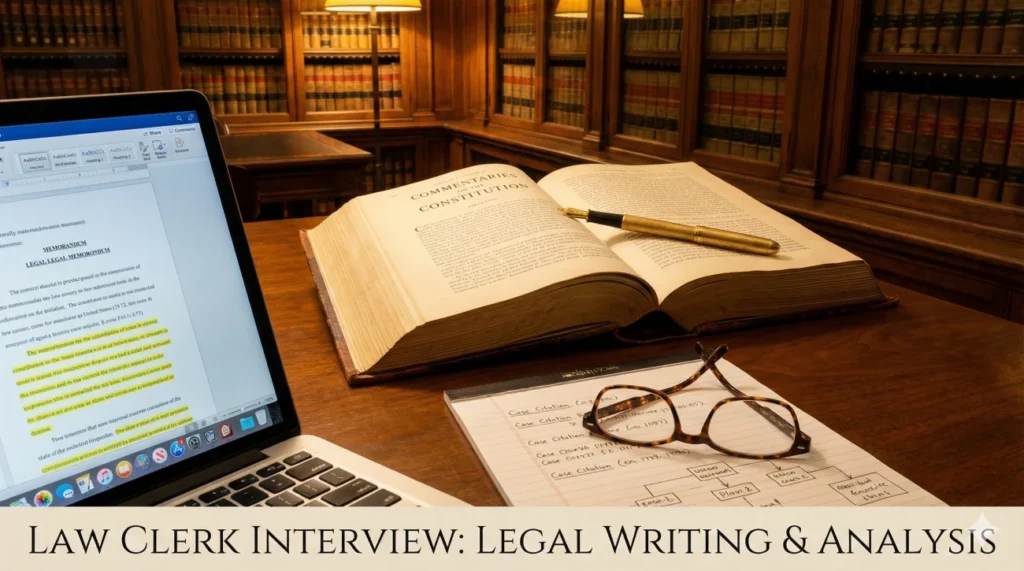
A judicial clerkship is often considered the most prestigious entry-level position in the legal profession. As a Law Clerk, you are not just an employee; you are the judge’s intellectual sparring partner, researcher, and drafter. Whether you are clerking for a trial court judge who needs quick rulings on evidentiary motions or an appellate judge who needs deep dives into constitutional theory, the core requirement is the same: elite legal analysis and flawless writing.
The interview process for a clerkship is notoriously rigorous. Judges are looking for more than just good grades; they need to know if you can synthesize complex facts, spot the dispositive issue in a haystack of arguments, and write with a clarity that will withstand appellate review. They will test your loyalty, your work ethic, and your ability to keep the secrets of the chambers. Prepare to answer law clerk interview questions that probe your writing process, your approach to statutory interpretation, and your ability to adapt to the judge’s specific voice. This guide will help you demonstrate that you are ready to serve the bench.
Legal Writing and Drafting
Q: Describe your process for drafting a judicial opinion or bench memorandum.
My process begins with a “deep read” of the parties’ briefs. I do not just read them; I actively dissect them, noting the key authorities cited and any obvious gaps in logic. I then verify the record to ensure the facts cited are actually supported by the evidence. Before I write a single sentence, I create a detailed outline. This structure ensures the opinion flows logically: procedural history, facts, standard of review, legal analysis, and conclusion. When I draft, I focus on clarity and precision. I write the “roadmap” paragraph first so the reader knows exactly where we are going. I constantly ask myself, “Is this sentence necessary for the holding?” If not, I cut it. My goal is to produce a draft that is so tight and well-reasoned that it requires minimal editing by the judge.
Q: How do you handle a situation where the case law is ambiguous or unsettled?
Ambiguity is where the real work begins. I start by looking for binding precedent in our jurisdiction. If none exists, I look for persuasive authority from other circuits or districts. I analyze the “dicta” in related cases to see if the higher court has signaled a direction. I also look at the legislative history or the public policy rationale behind the statute. In my memo to the judge, I do not hide the ambiguity. I present the split in authority clearly: ” The First Circuit says X, but the Ninth Circuit says Y.” I then recommend a path forward based on which reasoning is most consistent with our court’s prior jurisprudence, giving the judge options with the pros and cons of each.
Q: How do you ensure you are adopting the judge’s “voice” in your writing?
The opinion belongs to the judge, not me. Before I start drafting, I read a dozen of the judge’s previous opinions, specifically in the same area of law. I analyze their style: Do they use short, punchy sentences or long, complex clauses? Do they prefer active verbs? Do they use footnotes extensively or sparingly? Do they have a specific way of citing the record? I create a “style sheet” of their preferences. When I draft, I try to mimic their cadence. I accept their edits not as criticism, but as calibration. Over time, my goal is for the judge to read a draft and feel like they wrote it themselves.
Q: What is your approach to “Bluebooking” and citation accuracy?
I view Bluebooking as a proxy for attention to detail. If a citation is sloppy, the reader (and the appellate court) will doubt the substance of the argument. I cite-check as I write, rather than leaving it all for the end. I verify every pinpoint cite to ensure the proposition is actually supported by the specific page referenced. I check the weight of authority – is it a holding or just dicta? I check the subsequent history to ensure the case hasn’t been overturned (KeyCite/Shepardize). I am familiar with the local rules which might override The Bluebook in certain instances. I take pride in a flawless “Table of Authorities.”
Q: How do you deal with writer’s block when facing a complex legal issue?
I treat writer’s block as a sign that I need more information or a better structure. I step away from the blank screen and go back to the research. Often, re-reading a key case will unlock the analytical path. Alternatively, I talk it through out loud (to myself or a co-clerk, if permitted). Explaining the issue verbally often forces me to simplify the logic. I also use the “chunking” method – I commit to writing just one small section, like the factual background, to get the momentum going. I remind myself that the first draft doesn’t have to be perfect; it just has to exist.
Legal Research and Analysis
Q: A party cites a case that seems to support their argument perfectly. What do you do?
I verify it ruthlessly. I read the entire case, not just the headnote or the quoted snippet. Often, the quote is taken out of context, or the facts of that case are materially distinguishable from ours.
I check if the language cited is the actual holding or just dicta. I also check the procedural posture – was it a dismissal on the pleadings or a summary judgment? If the standard of review was different, the “perfect” quote might be irrelevant. I never take an attorney’s characterization of a case at face value.
Q: How do you prioritize research when you have a tight deadline?
I start broad and narrow down quickly. I use secondary sources (treatises, practice guides) to get the landscape of the law in 20 minutes. This prevents me from missing the forest for the trees.
I then dive into the binding authority. I focus on the “controlling” cases first. If I find a Supreme Court or Circuit case on point, I stop digging for district court cases. I set a time limit for each issue. I realize that in a trial court, a “good enough” answer today is often better than a “perfect” answer next week, especially for emergency motions.
Q: Explain the difference between “binding” and “persuasive” authority.
Binding authority comes from a court directly above us in the appellate chain. For a federal district court, that means the Supreme Court and the specific Circuit Court of Appeals for that district. We must follow it.
Persuasive authority comes from other circuits, district courts, or state courts (on federal issues). We can choose to follow it if the reasoning is sound, but we are not required to. Understanding this hierarchy is critical for writing an opinion that will survive appeal. I always lead with binding authority.
Q: How do you research legislative history?
I use this only when the statutory text is ambiguous. I look at the committee reports, which are generally considered the most authoritative source of legislative intent. I look at the sponsor’s statements on the floor.
I am careful to distinguish between the views of the entire body and the views of a single legislator. I use databases like ProQuest Congressional or the specific legislative history libraries on Westlaw/Lexis. I always keep in mind the canon that “statutory interpretation begins with the text,” so legislative history is a secondary tool, not the primary one.
Q: What is the “standard of review” and why does it matter?
The standard of review is the lens through which we view the case. Is it “de novo” (we look at it fresh), “abuse of discretion” (we defer to the lower decision unless it’s crazy), or “clear error” (for factual findings)?
Identifying the correct standard is the first step in any memo. If the standard is “abuse of discretion,” I might disagree with the lower court’s choice but still have to affirm it because it wasn’t irrational. Getting the standard wrong ensures the opinion will be reversed. I state the standard clearly at the beginning of every analysis section.
Q: How do you stay updated on changes in the law?
I set up automated alerts on Westlaw/Lexis for key search terms related to the judge’s docket. I read the “slip opinions” released by our Circuit Court every day.
I also scan legal news aggregators like Law360 or SCOTUSblog for major developments. If a new case comes down that affects a matter currently under advisement in our chambers, I immediately flag it for the judge and draft a supplemental memo explaining its impact. Being proactive protects the judge from issuing an opinion that is obsolete the moment it is signed.
Chambers Ethics and Dynamics
You disagree strongly with the judge’s decision on a case. What do you do?
I remember my role. I am the clerk, not the judge. During the deliberation phase, I will advocate for my view respectfully. I will write a memo outlining why I think the law points the other way. I will test the judge’s logic.
However, once the judge makes the final decision, my job shifts. I must draft the opinion to support their decision as persuasively as possible, even if I personally disagree. I do not undermine the judge or sabotage the draft. If the judge asks me to write a dissent (in an appellate panel), I do that with equal vigor. My loyalty is to the judge’s office.
A former classmate who is now an attorney on a pending case calls you to “chat.” How do you handle it?
I put up a wall immediately. I tell them, “I cannot discuss anything related to pending cases or chambers business.” I keep the conversation strictly personal and brief, or I end it.
Even asking “How is the judge doing?” can be a fishing expedition for the judge’s mood or health. I avoid any appearance of impropriety. If the case is active, I might recuse myself from working on it if the friendship is close enough to question my impartiality, or at least disclose the relationship to the judge immediately.
You find a typo in a released opinion. What do you do?
I tell the judge immediately. I do not hide it. If it is a simple clerical error, the court can usually issue a “sua sponte” order correcting the mistake (often called a “nunc pro tunc” order depending on jurisdiction).
If it is a substantive error that affects the legal reasoning, it is even more critical to address it before it is cited by other courts. I take responsibility for the oversight and draft the correction order. Transparency is the only way to maintain the integrity of the record.
How do you handle the confidentiality of the chambers?
Confidentiality is absolute. What happens in chambers stays in chambers. I do not discuss cases with my spouse, my parents, or my friends. I do not post about work on social media.
I am careful even in the courthouse elevator or the cafeteria; I never mention case names or parties where I could be overheard. The judge’s internal deliberations, draft opinions, and conversations with other judges are top secret. A breach of this trust is a career-ending event. I treat every document as if it were classified.
Law Clerk Knowledge Quiz
20 Practice Questions
1. What is “stare decisis”?
- The power to declare laws invalid
- The doctrine of following precedent
- The standard for summary judgment
- The right to a speedy jury trial
2. A “writ of certiorari” is:
- A lower court’s final order
- A request for Supreme Court review
- A demand for payment of damages
- A motion to dismiss the case
3. Which source is binding on a federal district court?
- A decision from another district court
- A decision from its own Circuit Court
- A law review article by a professor
- A decision from a state lower court
4. “Dicta” refers to:
- The binding holding of the case
- Non-binding comments by the judge
- The text of the dissenting opinion
- The footnotes in the legal brief
5. What is a “bench memo”?
- A note left on the judge’s bench
- A memo analyzing a pending motion
- A transcript of the oral argument
- A list of all the filed exhibits
6. “De novo” review means the appellate court:
- Defers to the trial court’s findings
- Reviews the issue completely fresh
- Sends the case back for a retrial
- Reviews only for clear factual errors
7. Which signal indicates direct support?
- Cf.
- See
- But see
- See generally
8. “Id.” is used to:
- Introduce a new case citation
- Refer to the immediately preceding citation
- Refer to the judge’s identity
- Identify a specific page number
9. What is a “concurrence”?
- A vote against the majority opinion
- Agreeing with result but different reasoning
- A request for a rehearing en banc
- A summary of the case facts only
10. “En banc” means the case is heard by:
- A panel of three selected judges
- All judges of the court sitting together
- A single judge in their chambers
- A jury of twelve citizens only
11. “Shepardizing” ensures:
- The spelling of the case is correct
- The case is still good law (valid)
- The page numbers are accurate
- The judge likes the cited case
12. Which comes first in a citation?
- The volume number of the reporter
- The name of the case (parties)
- The page number of the case
- The year the decision was issued
13. “Statutory construction” is:
- Building a new courthouse
- Interpreting the meaning of a statute
- Drafting a new law for voting
- Challenging a law’s validity
14. What is “standing”?
- The right to speak in court
- The legal right to bring a lawsuit
- The location of the courtroom
- The height of the judge’s bench
15. A “remand” order:
- Dismisses the case permanently
- Sends the case back to lower court
- Affirms the lower court decision
- Transfers the case to Supreme Court
16. “Mootness” means:
- The issue is very important
- The issue is no longer relevant/live
- The case is ready for trial
- The argument is very persuasive
17. Which is a primary source of law?
- Black’s Law Dictionary
- The Federal Rules of Civil Procedure
- A law review article
- A legal blog post
18. “Summary judgment” is granted when:
- The judge is tired of the case
- No genuine dispute of material fact
- The plaintiff asks for it nicely
- The jury cannot decide the case
19. The “holding” of a case is:
- The background facts
- The court’s legal decision/rule
- The dissenting judge’s opinion
- The attorney’s main argument
20. “Per curiam” opinion is:
- Written by a specific judge
- Issued by the court as a whole
- Written by the law clerk only
- Issued without any legal research
❓ Frequently Asked Questions
📝 Do I need to be on Law Review to get a clerkship?
It is highly preferred but not an absolute bar. Law Review (especially serving as an editor) signals to the judge that you have rigorous editing and citation skills. However, strong grades, exceptional writing samples, and glowing recommendations from professors can overcome the lack of Law Review membership, especially for state court or trial-level clerkships.
⏳ How long does a clerkship last?
Most federal and state clerkships are “term” positions lasting one or two years. These are stepping stones to big law firms or government service. Some judges hire “career clerks” who stay indefinitely, providing long-term institutional memory for the chambers.
💼 Can I work at a law firm before clerking?
Yes. Many judges value candidates with 1-2 years of practice experience because they understand the practical realities of litigation (discovery disputes, motion practice) better than fresh graduates. This is increasingly common for district court clerkships.
🏛️ What is the difference between District and Circuit clerkships?
District Courts are trial courts; clerks deal with “live” issues, discovery motions, jury trials, and sentencing. It is fast-paced and fact-heavy. Circuit Courts are appellate courts; clerks deal with “cold” records, reviewing legal errors from below. It is more academic, research-intensive, and writing-focused.
🚀 Does a clerkship help my career?
Immensely. It is a gold star on your resume. Big law firms often pay substantial “clerkship bonuses” (sometimes $50k-$100k) to incoming associates who have clerked. It opens doors to prestigious government jobs (DOJ, USAO) and academia. More importantly, you gain a mentor for life in your judge.
The Apprenticeship of a Lifetime
A clerkship is more than a job; it is a master class in the law. You see behind the curtain of the judicial system, learning how decisions are truly made. When you interview, you must show the judge that you are not just brilliant, but also humble, hardworking, and easy to be around in the close quarters of chambers.
Focus on your writing. Be ready to defend every sentence in your writing sample. Show them that you have the intellectual stamina to dig for the answer and the integrity to follow the law wherever it leads. By preparing with these law clerk interview questions, you are positioning yourself to earn the trust of a judge and embark on the most rewarding year of your legal career.
⚠️ Disclaimer: The interview strategies, sample answers, and negotiation tips provided in this guide are for educational purposes only. Hiring decisions are subjective and vary by company and industry. While these strategies are based on professional HR standards, they do not guarantee a specific job offer or result.