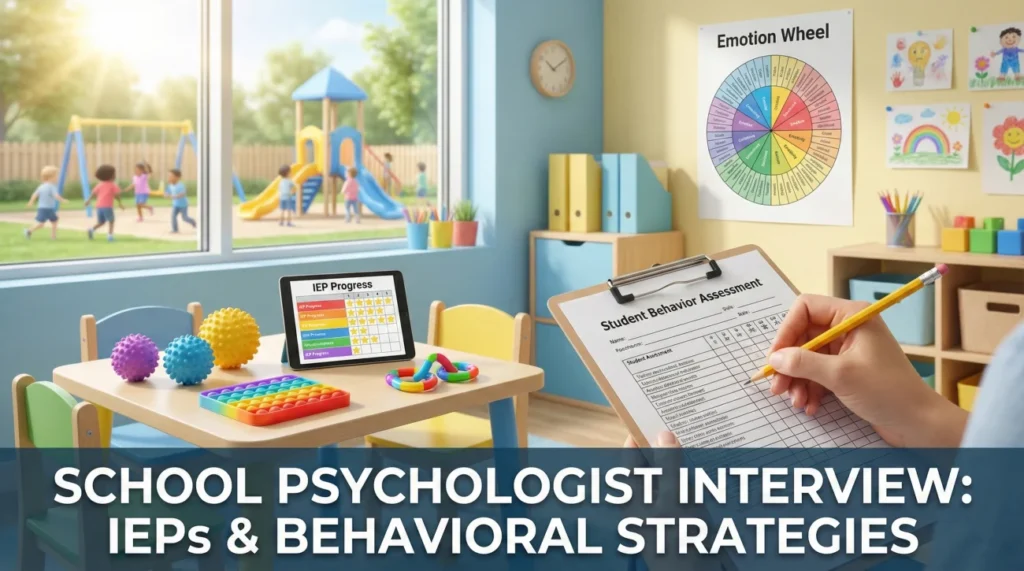
The Bridge Between Learning and Mental Health
School psychologists operate at the critical intersection of education, psychology, and law.
You are not just a counselor; you are a data scientist who analyzes learning disabilities, a legal expert who navigates the complexities of the Individuals with Disabilities Education Act (IDEA), and a crisis manager who responds when a school tragedy strikes.
Hiring managers (typically Directors of Special Education or Principals) are looking for a practitioner who can balance the rigorous demands of testing and report writing with the soft skills needed to calm an angry parent or connect with a withdrawn student. They need to know that you can write a legally defensible IEP, conduct a valid Functional Behavioral Assessment (FBA), and collaborate with teachers who are often overwhelmed and under-resourced.
To secure this role, you must be prepared to answer school psychologist interview questions that test your diagnostic acumen, your knowledge of Multi-Tiered Systems of Support (MTSS), and your ability to advocate for students while maintaining collaborative relationships with staff.
Psychoeducational Assessment and Diagnosis
Q: Walk me through your process for a comprehensive psychoeducational evaluation.
My assessment process is data-driven and multi-faceted. I start with a thorough file review and developmental history interview with parents to understand the “whole child.” I observe the student in multiple settings (classroom, playground) to compare behavior across contexts. For cognitive testing, I typically use the WISC-V or WAIS-IV depending on age. I assess academic achievement using the WJ-IV or KTEA-3 to look for the “pattern of strengths and weaknesses” often indicative of a Specific Learning Disability (SLD). I also include social-emotional rating scales (like the BASC-3) from parents, teachers, and the student. I synthesize all this data to determine eligibility, ensuring that the results are not due to lack of instruction or cultural/linguistic differences.
Q: How do you explain complex test results to parents who may be resistant or confused?
I avoid jargon. Instead of saying “Your child has a deficit in working memory,” I say, “Your child has a hard time holding information in their head long enough to use it, like remembering a three-step instruction.” I use visual aids like the bell curve to explain where their child falls relative to peers, emphasizing that “average” is a broad and healthy range. I start with the child’s strengths to build rapport and hope. If parents are resistant to a diagnosis, I validate their feelings but focus on the function of the diagnosis: “This label is just a key that unlocks the door to the services and accommodations your child needs to succeed.”
Q: Differentiate between a Specific Learning Disability (SLD) and an Intellectual Disability (ID).
This is a crucial distinction for placement. An Intellectual Disability (ID) is characterized by significant limitations in both intellectual functioning (typically an IQ below 70) and adaptive behavior (daily living skills), affecting learning globally. A Specific Learning Disability (SLD), however, occurs when there is a significant discrepancy between a student’s cognitive ability (which is often average or above average) and their academic achievement in a specific area like reading (dyslexia) or math (dyscalculia). In SLD, the student has the potential to learn but faces a specific processing barrier; in ID, the barrier is a generalized cognitive delay. The interventions for each are vastly different.
Q: How do you assess for Autism Spectrum Disorder (ASD) in a school setting?
School-based ASD assessment focuses on educational impact. I use gold-standard tools like the ADOS-2 (Autism Diagnostic Observation Schedule) and the ADI-R (Autism Diagnostic Interview-Revised) parent interview. I look for the trifecta: deficits in social communication, deficits in social interaction, and restricted/repetitive behaviors. I observe peer interactions closely: does the student initiate play? Do they understand non-verbal cues? I collaborate with the Speech-Language Pathologist (SLP) to assess pragmatic language. My goal is to determine if the student meets the IDEA criteria for Autism, which may differ slightly from a medical DSM-5 diagnosis, specifically focusing on whether the condition adversely affects educational performance.
IEPs, 504s, and Legal Compliance
Q: What is the difference between an IEP and a 504 Plan?
An IEP (Individualized Education Program) falls under IDEA law. It provides specialized instruction (special education) and related services for students with one of the 13 specific disability categories who need a modified curriculum to learn.
A 504 Plan falls under the Rehabilitation Act of 1973, a civil rights law. It provides accommodations (like extra time, preferential seating) to ensure equal access to learning for students with a disability, but it does not typically include specialized instruction or modified curriculum. Essentially, IEP is for “learning differently,” while 504 is for “accessing the same learning.”
Q: How do you handle an IEP meeting where the team is divided?
I act as the facilitator and data-anchor. If the parents want a service the school believes is unnecessary, or vice versa, I bring the conversation back to the data. “Let’s look at the progress monitoring charts.”
I ensure everyone feels heard, validating the parents’ advocacy while supporting the teachers’ professional judgment. I try to find a compromise or a trial period: “Let’s try this intervention for 6 weeks and collect data; if it doesn’t work, we will reconsider X.” If consensus is impossible, I ensure the Prior Written Notice (PWN) accurately reflects the refusal and the reasons why, documenting our compliance.
Q: Describe your experience with “Manifestation Determination” reviews.
This is a high-stakes meeting required when a special education student faces suspension of more than 10 days. My role is to determine if the behavior in question was caused by, or had a direct relationship to, the student’s disability.
Or, was it the direct result of the school’s failure to implement the IEP? If the answer to either is “yes,” the student cannot be expelled and must return to their placement (unless drugs/weapons/serious injury are involved). I rely heavily on the FBA and recent psychological data to make this determination objectively, separating the disability from the conduct.
Q: How do you write SMART goals for an IEP?
Goals must be Specific, Measurable, Achievable, Relevant, and Time-bound. Instead of “Student will behave better,” I write, “In 30 weeks, given a verbal prompt, Student will use a coping strategy (deep breathing) to de-escalate anger in 4 out of 5 observed opportunities.”
I ensure the goal is tied to the baseline data found in the assessment. I also ensure there is a clear method for measuring progress (e.g., weekly frequency charts) so that any teacher picking up the IEP knows exactly what to track.
Q: What is your role in the “Child Find” mandate?
Child Find requires districts to identify, locate, and evaluate all children with disabilities. My role is proactive. I analyze school-wide data to spot students who are struggling but haven’t been referred.
I train teachers on the warning signs of disabilities so they don’t just see “lazy” students. I also ensure we are screening broadly, including homeless or migrant students. If a parent requests an evaluation verbally, I treat it as a formal request start the timeline immediately to stay compliant.
Q: How do you support students in the Least Restrictive Environment (LRE)?
LRE dictates that students should be educated with non-disabled peers to the maximum extent appropriate. I advocate for inclusive practices. Before moving a student to a self-contained classroom, I ask, “Have we exhausted all aids and services in the general ed setting?”
I help general education teachers implement accommodations and modifications. I view a more restrictive placement as a last resort, used only when the nature of the disability is such that education in regular classes cannot be achieved satisfactorily.
Behavior Intervention and MTSS
A teacher demands a student be removed from class due to disruptive behavior. How do you respond?
I validate the teacher’s frustration first; they need to feel supported. Then I shift to problem-solving within the MTSS framework. I ask to observe the behavior to understand the context.
I explain that removal is a temporary fix, not an intervention. I work with the teacher to identify the “antecedent” (what happens before) and the “consequence” (what the student gets out of it). We develop a Tier 1 or Tier 2 intervention plan, such as a behavior chart or a “break card,” to manage the behavior in the classroom. My goal is to build the teacher’s capacity to handle the behavior, reducing referrals.
Explain the steps of a Functional Behavioral Assessment (FBA).
An FBA is a detective process to find the “why” behind the behavior. Step 1: Define the behavior operationally (e.g., “Student throws chair,” not “Student is aggressive”). Step 2: Collect data through direct observation (ABC charts: Antecedent, Behavior, Consequence) and interviews.
Step 3: Analyze the data to determine the function of the behavior. Is it to get attention? To escape a task? To get sensory input? Step 4: Formulate a hypothesis. Once we know the function, we can build a Behavior Intervention Plan (BIP) that teaches a replacement behavior that serves the same function appropriately.
How do you implement Tier 1 mental health supports school-wide?
Tier 1 supports are for all students (prevention). I advocate for social-emotional learning (SEL) curricula like Second Step. I might lead school-wide assemblies on bullying prevention or stress management.
I consult with administration to improve school climate, such as implementing Positive Behavioral Interventions and Supports (PBIS) where positive behaviors are rewarded school-wide. I analyze data (attendance, office referrals) to see if these universal supports are working or if we need to adjust our core instruction.
A student expresses suicidal ideation. What is your immediate protocol?
This is a red-alert crisis. I follow the district’s suicide risk assessment protocol immediately. I interview the student to assess plan, means, and intent. I do not leave the student alone.
I contact the parents immediately. If the risk is high/imminent, I coordinate with the parents to take the child to the ER, or call a mobile crisis unit if parents are unavailable or refusing. If the risk is moderate/low, I create a safety plan with the student and parents, remove access to means at home, and schedule immediate follow-up counseling. I document every timestamp and action taken to ensure liability protection.
School Psychology Knowledge Quiz
20 Practice Questions
1. “FAPE” stands for:
- Free Access to Private Education
- Free Appropriate Public Education
- Full Assessment of Pupil Education
- Federal Aid for Public Education
2. Which law governs IEPs?
- Section 504 of Rehab Act
- IDEA (Individuals with Disabilities Education Act)
- ADA (Americans with Disabilities Act)
- ESSA (Every Student Succeeds Act)
3. The “WISC-V” assesses:
- Reading achievement levels
- Cognitive ability (IQ) in children
- Adaptive daily living skills
- Emotional and behavioral issues
4. “RTI” refers to:
- Ready To Instruct
- Response To Intervention
- Return To Inclusion
- Right To Instruction
5. How often must an IEP be reviewed?
- Every 3 years
- At least once annually
- Every semester
- Only when parents ask
6. A “Triennial” is:
- A meeting every 3 months
- A re-evaluation every 3 years
- A test with 3 parts
- A 3-tier intervention
7. “Dyslexia” falls under which IDEA category?
- Other Health Impairment
- Specific Learning Disability
- Intellectual Disability
- Speech/Language Impairment
8. “ADHD” is typically served under:
- Specific Learning Disability
- Other Health Impairment (OHI)
- Emotional Disturbance
- Autism Spectrum Disorder
9. What is “Adaptive Behavior”?
- Ability to adapt to new schools
- Practical daily living skills
- IQ score above average
- Behavior in the classroom
10. “LRE” mandates placement with:
- Students with similar disabilities
- Non-disabled peers (maximum extent)
- The best teachers available
- The closest school to home
11. Who is a required IEP team member?
- The school nurse
- A General Education Teacher
- The guidance counselor
- The superintendent
12. “PBIS” focuses on:
- Punishing bad behavior quickly
- Positive Behavioral Interventions/Supports
- Private Boarding In Schools
- Parent Based Intervention Systems
13. The “BASC-3” measures:
- Math calculation skills
- Behavior and emotional status
- Reading comprehension speed
- Fine motor coordination
14. “Procedural Safeguards” are:
- Safety locks on school doors
- Parental rights under IDEA
- Teacher union rules
- Emergency drill procedures
15. “Executive Functioning” involves:
- Breathing and heart rate
- Planning, organizing, inhibiting
- Visual acuity and hearing
- Long-term memory storage
16. “Curriculum-Based Measurement” (CBM) is:
- A once-a-year IQ test
- Frequent, short progress probes
- A test of the teacher’s skill
- A textbook review process
17. A “BIP” is based on the results of:
- An IQ test
- A Functional Behavioral Assessment (FBA)
- A parent interview only
- A report card review
18. “Ferpa” protects:
- Health records (HIPAA)
- Educational records privacy
- Teacher employment files
- Free lunch applications
19. “Early Intervention” (Part C) serves:
- High school students
- Birth to age 3
- Kindergarten to grade 5
- College freshmen
20. “Twice Exceptional” (2e) means:
- Two disabilities present
- Gifted + Disability
- Failing two grades
- Speaking two languages
❓ Frequently Asked Questions
🏫 What is the difference between a School Psychologist and a School Counselor?
School Counselors typically focus on the entire student body, handling scheduling, college applications, and general social-emotional guidance. School Psychologists focus on special populations (special education), conducting psychological testing, managing crisis interventions, and consulting on severe behavioral issues. Psychologists have more training in psychometrics and clinical pathology.
🎓 Do I need a doctorate to practice in schools?
In most states, no. The entry-level requirement is usually a Specialist degree (Ed.S. or SSP), which is above a Master’s but below a Doctorate (typically 3 years including internship). A PhD or PsyD allows you to work in private practice or hospitals but is not strictly necessary for school-based roles, though it can lead to higher pay.
⚖️ Is the job mostly testing?
Traditionally, yes (“test and place”). However, the field is shifting toward the NASW Practice Model which emphasizes prevention, consultation, and mental health intervention. While testing is still a core duty (approx. 50%), modern roles involve more MTSS coordination, counseling, and crisis team leadership.
💰 Do school psychologists get summers off?
Usually, yes, following the teacher contract schedule. However, some districts hire on 11-month or 12-month contracts to handle summer assessments and ESY (Extended School Year) programs. The salary is typically on a separate, higher scale than teachers due to the advanced degree requirements.
🚀 Can I diagnose ADHD or Autism?
In the school setting, you determine “eligibility” for special education under IDEA categories (like OHI for ADHD or Autism). You do not give a “medical diagnosis.” However, your evaluation is often comprehensive enough that pediatricians will use your report to confirm a medical diagnosis. The distinction between “medical diagnosis” and “educational eligibility” is key.
The Advocate for Potential
A school psychologist is the detective who figures out how a child learns and the architect who designs the supports they need to thrive. When you interview, show them that you are not just a testing machine. Show them you are a collaborative problem solver who can translate complex data into a roadmap for success. By mastering these school psychologist interview questions, you demonstrate that you are ready to be the champion for the students who need you most, ensuring that no child’s potential is lost to an unsupported disability.
⚠️ Disclaimer: The interview strategies, sample answers, and negotiation tips provided in this guide are for educational purposes only. Hiring decisions are subjective and vary by company and industry. While these strategies are based on professional HR standards, they do not guarantee a specific job offer or result.