The Backbone of the Legal Team
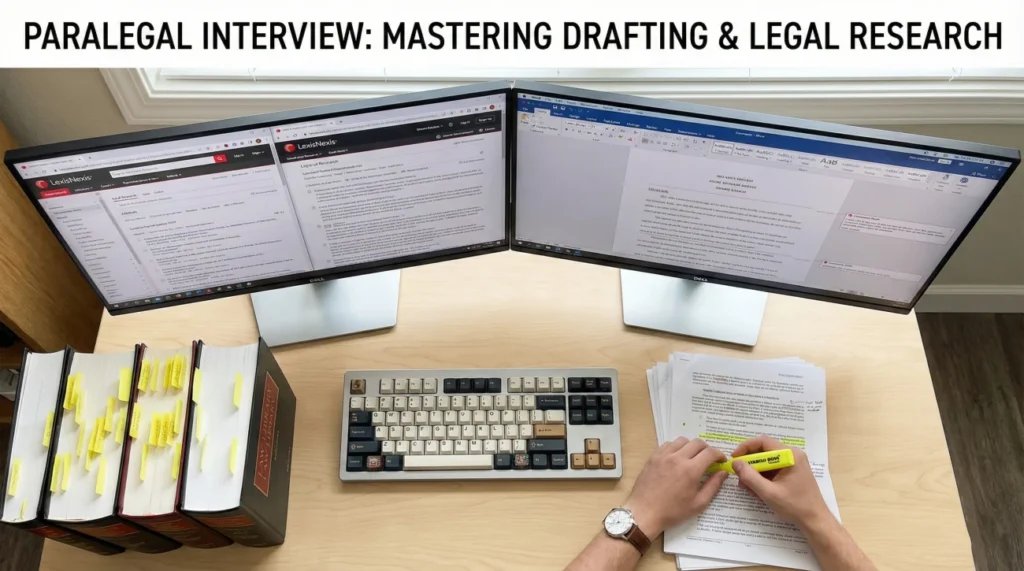
Attorneys may argue the case, but paralegals build the foundation upon which those arguments stand. That is exactly what paralegal interview questions are designed to reveal. In modern legal practice, the paralegal is far more than an administrative assistant; they are billable professionals who draft complex pleadings, unearth pivotal case law, and manage the chaotic flow of discovery. Hiring managers at top firms are looking for candidates who can hit the ground running, meaning you must demonstrate proficiency with tools like Westlaw, LexisNexis, and Relativity, along with an eagle eye for detail in drafting.
The interview process will probe your technical competence and your ability to handle the high-pressure environment of billable targets. You will face questions about your research methodology, your experience with specific legal documents, and your strategies for managing deadlines across multiple cases. Below are the core competencies required for the role, with detailed answers that highlight your value as a revenue-generating asset to the firm.
Legal Research and Analysis
Q: Describe your process for starting a research project on an unfamiliar legal topic.
I begin by ensuring I understand the specific legal question and the jurisdiction. I start with secondary sources, such as legal encyclopedias like Am Jur or CJS, and practice guides to get a broad overview of the landscape and identify key terms and leading cases. This saves billable time compared to diving straight into case law. Once I have the terminology, I move to primary authority using Westlaw or LexisNexis. I run Boolean searches to find relevant statutes and recent case law. I always “Shepardize” or “KeyCite” the most relevant cases to ensure they are still good law. Finally, I synthesize my findings into a memo that highlights the rule, the application to our facts, and any potential counter-arguments.
Q: Which legal research platforms are you proficient in, and do you have a preference?
I am proficient in both Westlaw Edge and Lexis+, as well as free resources like Google Scholar for initial broad searches. I am comfortable using Westlaw’s Key Number System to find cases by topic, which I find particularly efficient for statutory interpretation. On Lexis, I value the Shepard’s report for its granular analysis of negative treatment. My preference often depends on the firm’s subscription and the specific nature of the task; for example, I find Westlaw’s Practical Law excellent for transactional forms, while Lexis often has superior brief analysis tools. I am adaptable and can maximize the efficiency of whichever platform the firm utilizes.
Q: How do you verify that a case you are citing is still good law?
Verifying authority is non-negotiable. I use the citator services, specifically KeyCite on Westlaw or Shepard’s on Lexis. I look for the red or yellow flags. A red flag usually means the case has been overruled or reversed on at least one point, but I dig deeper to see if the reversal applies to the specific legal proposition we are relying on. Sometimes a case is overruled on procedural grounds but remains valid for substantive law. I also check the depth of treatment in citing cases to see how other courts have interpreted the holding recently. I never cite a case without reading the negative history first.
Q: Can you explain a time you found a “needle in a haystack” during research?
In a previous product liability case, we needed to find a precedent regarding a specific type of warning label defect in a niche jurisdiction. Standard keyword searches were yielding too many irrelevant results. I switched strategies and used the “terms and connectors” search to look for the proximity of “label” and “consumer expectation” within the same paragraph as the specific product type. I also examined the dissenting opinions of major cases in that circuit, as they sometimes cite obscure precedents that the majority ignored. I eventually found an unreported district court case that was factually almost identical to ours, which became the linchpin of our motion for summary judgment.
Drafting and Document Management
Q: What types of legal documents have you drafted independently?
I have extensive experience drafting routine litigation documents such as Answers, Complaints, and Notices of Appearance. I regularly draft discovery requests (Interrogatories, Requests for Production) and the corresponding responses, working closely with the client to gather the necessary facts. I also draft procedural motions, such as Motions for Extension of Time. For transactional work, I have drafted articles of incorporation, operating agreements, and meeting minutes. My goal is to produce a near-final draft that requires minimal attorney review, saving the client money and freeing up the attorney for high-level strategy.
In my last role, I was also responsible for drafting deposition summaries. I would digest hundreds of pages of transcripts into concise page-line summaries that highlighted key admissions and inconsistencies. This required not just summarizing what was said, but understanding the legal theory of the case to know what was important. I also have experience drafting privilege logs, ensuring that we describe the withheld documents with enough specificity to satisfy the court without revealing the privileged communication itself.
Q: How do you ensure accuracy and consistency when drafting a complex set of pleadings?
I rely on a rigorous proofreading process and the use of templates. I start with the firm’s approved form files to ensure formatting compliance with local court rules. I use the “Find and Replace” function carefully to update names and dates, but I always manually verify each instance to avoid the embarrassing mistake of leaving a previous client’s name in a document. I double-check all cross-references within the document to ensure that if paragraph numbers change, the references update.
For consistency, I maintain a “case bible” or a master facts sheet for each matter that lists the correct spelling of all parties, key dates, and defined terms. I refer to this constantly. Before finalizing, I use document comparison software like Litera Change-Pro or the “Compare” feature in Word to see exactly what changed from the previous version. Finally, I always check the local rules and the judge’s individual standing orders one last time before filing, as these can change without notice and technical non-compliance can lead to rejection.
Q: Describe your experience with e-filing systems (CM/ECF).
I am fully proficient with the federal CM/ECF system as well as various state-level e-filing portals like NYSCEF and File & ServeXpress. I understand the critical importance of redaction rules (Fed. R. Civ. P. 5.2) before filing, ensuring that social security numbers, dates of birth, and financial account numbers are masked. I know how to prepare text-searchable PDFs (OCR) and how to bookmark exhibits as required by many judges.
I handle the entire filing process: preparing the Notice of Filing, combining the main document with exhibits, selecting the correct event codes on the ECF docket to ensure the deadlines are triggered correctly, and handling the payment of fees. I verify the NEF (Notice of Electronic Filing) immediately after submission to confirm the docketing date and serve courtesy copies to chambers if required. I treat e-filing deadlines as 5:00 PM, not midnight, to allow a buffer for technical glitches.
Q: How do you handle a situation where an attorney gives you a drafting assignment with very vague instructions?
I view this as an opportunity to demonstrate initiative, but I also clarify to avoid wasted time. First, I review the case file to gather context that might explain the assignment. I check the deadline immediately. If the instructions are too vague to proceed safely, I prepare a quick outline or a list of specific questions and go back to the attorney. I might say, “I reviewed the file and I plan to draft the Motion to Dismiss based on lack of personal jurisdiction. Do you also want me to include an argument on venue, or save that for later?”
This approach shows that I have thought about the issue and am not just asking to be spoon-fed. If the attorney is unavailable, I look at similar filings in previous cases handled by that attorney to mimic their style and structure. I draft what I can, leaving clear placeholders/comments for the parts that need their input. It is better to present a partial draft with intelligent questions than to wait until the deadline and deliver nothing.
Q: What is your approach to organizing and managing exhibits for a trial or deposition?
Organization is key to a smooth trial. I start by creating a master index of all potential exhibits. I use naming conventions that are consistent and descriptive (e.g., “Exh001_Contract_2023-01-01”). I prefer to use digital trial presentation software like TrialDirector or OnCue to manage the database, but I also maintain hard copy binders as a backup. I ensure that every version of a document is tracked so we do not accidentally mark a draft as a final contract.
During the preparation phase, I pre-mark exhibits if allowed by the local rules to save time in court. I create cross-reference tables linking exhibits to specific witnesses and deposition testimony. This allows the attorney to ask, “Show me every document Witness X discussed,” and I can pull them up instantly. I also double-check the admissibility status of each exhibit, whether it has been stipulated to, objected to, or admitted, updating the index in real-time during the proceedings.
Q: How do you manage the “Billable Hour” requirement without sacrificing quality?
I treat billable time entry as a daily discipline, not a weekly chore. I enter my time contemporaneously or at the end of each day to ensure accuracy and capture every 0.1 hour. I write detailed narratives that clearly explain the value of the task to the client (e.g., instead of “Research,” I write “Legal research regarding statute of limitations for fraud claims in California”). This prevents write-offs during the billing review process.
To manage the target, I track my utilization rate weekly. If I am behind, I proactively ask attorneys for work. I also group similar tasks to be more efficient (batching phone calls or emails). However, I never “pad” time. If a task takes 0.2, it is 0.2. Efficiency is a form of quality. If I can draft a document in one hour that used to take two because I built a better template, that adds value to the firm. I communicate with attorneys about budget caps beforehand so I do not spend 10 hours on a task the client only authorized for 2.
E-Discovery and Technology
Explain your familiarity with the EDRM (Electronic Discovery Reference Model).
I understand the EDRM lifecycle from Information Governance through Presentation. My primary involvement is usually in the Preservation, Collection, Review, and Analysis stages. I know how to issue litigation holds to ensure clients do not delete relevant data. I have experience working with vendors to collect ESI (Electronically Stored Information) from custodians.
In the Review phase, I manage the document review teams or conduct first-pass review myself. I use tagging coding panels to mark documents for “Responsive,” “Privilege,” or “Confidential.” I understand the importance of quality control in this stage to prevent the inadvertent production of privileged material. I also assist in the Production phase, ensuring the load files are compatible with the opposing counsel’s system.
How do you handle a large document review project with a tight deadline?
I leverage technology to prioritize the review. I use “hit highlighting” for keywords and “email threading” to reduce the volume by grouping replies with their original messages. This allows us to review the final email in a chain and bulk-tag the rest, saving significant time. I also use “near-duplicate” detection to group similar documents.
I set daily targets for myself and the review team (e.g., 50 documents per hour). I monitor the progress and quality metrics. If we are falling behind, I flag it to the supervising attorney early so we can either add more reviewers or negotiate a rolling production schedule with the opposing counsel. I ensure the coding palette is simple and clear to minimize decision fatigue and errors among the reviewers.
A client sends you a box of disorganized physical receipts. How do you process them?
First, I maintain the chain of custody. I log the receipt of the box, date it, and label it. I do not shuffle the papers randomly; I try to maintain the original order if possible, or I organize them logically (by date or vendor) if they are truly chaotic. I then scan the documents to create digital copies, applying OCR (Optical Character Recognition) so they become searchable.
Once digitized, I name the files consistently and upload them to our case management system. I create an index in Excel summarizing the key data points (date, amount, payee) so the attorney does not have to flip through the PDFs to calculate damages. I keep the original physical copies in a secure, fire-proof location, as we may need the “best evidence” at trial.
Ethics and Professional Responsibility
Q: How do you handle a situation where a client calls and asks for legal advice when the attorney is unavailable?
I strictly adhere to the rule against the Unauthorized Practice of Law (UPL). I listen politely to the client’s question and take detailed notes. I then explain clearly, “I am a paralegal, not an attorney, so I cannot give you legal advice. However, I will relay your question to the attorney immediately and ensure they get back to you.” I can provide procedural information (e.g., “The court date is set for Tuesday”) but never substantive advice (e.g., “You should plead guilty”). I document the conversation in the file to protect the firm.
Q: You discover you inadvertently sent a privileged email to opposing counsel. What do you do?
I act immediately. I invoke the “clawback” agreement (Fed. R. Evid. 502). I contact the opposing counsel via phone and email to notify them of the inadvertent disclosure. I instruct them to delete the email and not to read or disseminate it. I then inform the supervising attorney right away; hiding the mistake is worse than the mistake itself. We then follow up with a formal letter logging the privileged document. I also investigate how the error happened (e.g., autocomplete on email address) to prevent recurrence.
Q: An attorney asks you to bill time for a task you did not do to meet a quota. How do you react?
This is an ethical violation and potential fraud. I would respectfully refuse. I might say, “I am not comfortable billing for work I haven’t performed, as that would violate billing guidelines and ethical standards.” If the attorney persists, I would escalate the issue to the office manager or the firm’s ethics committee. My integrity and the firm’s reputation are worth more than a few billable hours. I would focus on finding legitimate billable work to meet the quota instead.
Q: How do you maintain confidentiality when working remotely or in public spaces?
I strictly follow the firm’s remote work policy. I never work on sensitive documents on public Wi-Fi without a secure VPN. I use a privacy screen on my laptop if I am traveling. I do not leave files or devices unattended. I ensure my home workspace is private so family members or guests cannot see client information or hear confidential calls. When printing documents at home, I shred them immediately after use rather than putting them in the regular trash.
Paralegal Skills Assessment
20 Practice Questions
1. What does “Shepardizing” a case mean?
- Summarizing the case facts briefly
- Checking if the case is good law
- Finding the judge’s full biography
- Printing the case for the file binder
2. Which symbol is used for a Boolean “wildcard”?
- The ampersand symbol (&)
- The exclamation point (!)
- The percentage sign (%)
- The dollar sign symbol ($)
3. What is a “bates stamp” used for?
- Uniquely numbering document pages
- Notarizing a signature page
- Marking a document as urgent
- Sealing a confidential envelope
4. What is the deadline for an Answer in federal court?
- 14 days after service of summons
- 21 days after service of summons
- 30 days after service of summons
- 60 days after service of summons
5. “Ex parte” communication refers to:
- Communication with the client only
- Communication without the other party
- Communication after the trial ends
- Communication by a former party
6. Which document starts a civil lawsuit?
- The Motion for Summary Judgment
- The Answer to the Complaint
- The Complaint and Summons filed
- The Discovery Request form
7. What is “redaction” in legal documents?
- Highlighting important text in red
- Obscuring sensitive information text
- Editing grammar errors in the text
- Adding comments to the document margin
8. A “deposition” is best described as:
- A written question sent to parties
- Sworn oral testimony out of court
- A formal request for documents
- A final argument made at trial
9. UPL stands for:
- Uniform Paralegal Legislation
- Unauthorized Practice of Law
- United Paralegal Licensing
- Universal Practice Liability
10. In citation “410 U.S. 113”, “U.S.” refers to:
- The United States Constitution
- The United States Reports
- The United States Senate
- The United States Code
11. A “tickler system” is used for:
- Calculating billable hours worked
- Tracking deadlines and reminders
- Organizing client contact lists
- Filing documents electronically
12. Which is NOT a discovery method?
- Interrogatories to parties
- Requests for Admission
- Motion to Dismiss case
- Request for Production
13. “Metadata” in e-discovery is:
- Data about data (hidden info)
- The main text of the document
- The file name of the document
- The printed version of a file
14. A “contingency fee” means:
- Hourly billing for all work
- Payment depends on winning case
- Flat fee paid in advance
- Pro bono work for free
15. “Privilege log” lists:
- All documents produced in discovery
- Documents withheld for privilege
- Documents destroyed by the client
- Documents found on the internet
16. The “moving party” is the one who:
- Files the initial complaint
- Files a specific motion
- Opposes the specific motion
- Wins the final verdict
17. “Stare decisis” means:
- To stand by the facts
- To stand by decided cases
- To start a new decision
- To stare at the decision
18. What is a “retainer”?
- A type of legal document
- An upfront fee paid by client
- A court order to stop work
- A witness subpoena fee
19. “Voir dire” relates to:
- Drafting a contract term
- Jury selection process
- Filing an appeal brief
- Settling a case quickly
20. Which court is the “highest” in the US?
- The Circuit Court of Appeals
- The Federal District Court
- The US Supreme Court
- The State Supreme Court
❓ FAQ
💼 Is a paralegal certificate required?
It depends on the employer and jurisdiction. While California law (B&P Code 6450) mandates specific education for the title “paralegal,” many other states do not. However, an ABA-approved certificate is highly valued by top firms and can substitute for a lack of experience.
💰 How are billable hours different from actual hours?
Actual hours are the time you are at your desk. Billable hours are the time directly attributable to a client case. Administrative tasks, lunch, and internal meetings are non-billable. You often need to work 9-10 actual hours to capture 7-8 billable hours.
📊 What software should I learn first?
Master Microsoft Word (styles, table of authorities) first; it is the bread and butter. Then, gain familiarity with a research platform (Westlaw or Lexis) and a practice management tool like Clio or MyCase. E-discovery platforms like Relativity are advanced but valuable.
⚖️ Can a paralegal represent a client in court?
Generally, no. Paralegals cannot appear in court, sign pleadings, or give legal advice. There are limited exceptions in some administrative hearings (like Social Security or certain immigration matters) where non-lawyer representation is permitted.
🚀 What is the career path for a paralegal?
You can advance to Senior Paralegal, Paralegal Manager, or Practice Group Specialist. Some specialize in high-demand fields like IP or e-discovery. Others use the role as a stepping stone to law school or transition into legal operations or legal tech sales.
The Indispensable Professional
The modern legal landscape demands more than just administrative support; it requires paralegals who are proactive problem solvers, technology experts, and revenue generators. By mastering the art of research, drafting, and case management, you position yourself not as an assistant, but as an indispensable partner in the practice of law.
When you walk into your interview, focus on your capacity to make the attorney’s life easier and the client’s case stronger. Show them you understand the business of law: efficiency, accuracy, and billable integrity. With these paralegal interview questions in your arsenal, you are ready to prove that you are the asset the firm cannot afford to lose.
⚠️ Disclaimer: The interview strategies, sample answers, and negotiation tips provided in this guide are for educational purposes only. Hiring decisions are subjective and vary by company and industry. While these strategies are based on professional HR standards, they do not guarantee a specific job offer or result.