The First Line of National Defense
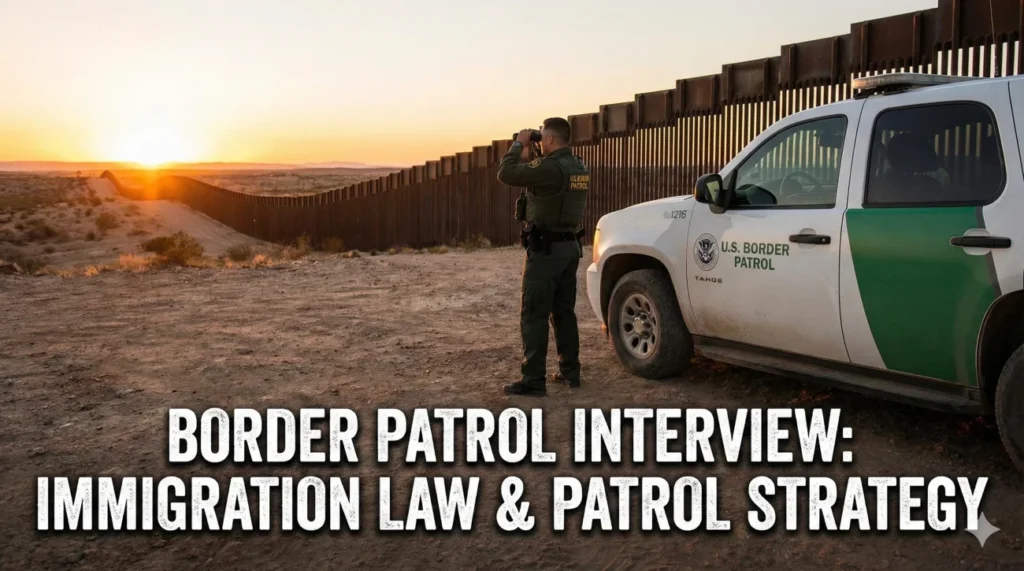
A Border Patrol Agent is more than a law enforcement officer; you are the sentinel who guards the nation’s boundaries against illegal entry, terrorism, and transnational crime. The job requires immense physical stamina to track groups across rugged terrain for miles, the legal acumen to interpret complex immigration statutes in seconds, and the moral fortitude to treat every individual with humanity regardless of their status.
Hiring panels for Customs and Border Protection (CBP) are looking for candidates who can operate independently in remote locations, make sound decisions under extreme stress, and uphold the Constitution without compromise. To earn the green uniform, you must be prepared to answer border patrol agent interview questions that test your ability to detect deception, your knowledge of the Fourth Amendment at the border, and your resilience in the face of political and humanitarian challenges.
Immigration Law and Authority
Q: Explain the difference between “Title 8” and “Title 42” authority.
Title 8 is the standard body of immigration laws in the US Code. It governs the admissibility of aliens, deportation proceedings, and asylum claims. Under Title 8, if I apprehend someone, they are processed for removal but have the right to claim asylum and see a judge. Title 42 was a public health order (used during COVID-19) that allowed for the immediate expulsion of migrants to prevent the spread of disease, bypassing standard Title 8 processing. As an agent, I must know which authority is currently in effect and apply the correct processing pathway, as using the wrong one violates federal law and agency policy.
Q: What is the “100-mile zone” and what are your powers within it?
Federal regulations give Border Patrol agents certain powers within 100 miles of any external boundary (land or sea). Within this zone, I can conduct warrantless stops if I have “reasonable suspicion” of an immigration violation. However, this is not a blank check. I cannot stop a car just because of the driver’s ethnicity. I need specific articulable facts (e.g., a vehicle riding low as if heavy, erratic driving near the border). At a fixed checkpoint within this zone, I can stop vehicles briefly to ask about citizenship without suspicion, but extending the stop requires further justification.
Q: Define “Alienage” and how you establish it.
Alienage refers to the status of being a non-citizen. My primary job is to determine alienage. I do this by asking the subject, “What country are you a citizen of?” If they admit to being a citizen of another country and cannot produce valid entry documents (visa, green card), I have established alienage and removability. If they claim US citizenship, the burden shifts to me to disprove it. I cannot arrest someone for an immigration violation until I have probable cause to believe they are a non-citizen present illegally.
Q: What is “Asylum” and what is your role when a migrant claims it?
Asylum is a legal protection for people fleeing persecution based on race, religion, nationality, political opinion, or social group. My role is not to grant asylum; that is for an Asylum Officer or Judge. My role is to recognize a “credible fear” claim. If a migrant says, “I am afraid to go back,” I must stop the expedited removal process and refer them for a credible fear interview. I document their claim accurately. Ignoring a claim of fear violates international treaty obligations and US law.
Patrol Tactics and Tracking
Q: What is “Sign Cutting” (Tracking)?
Sign cutting is the art of detecting physical evidence of human passage. I look for “sign” like flattened grass, broken twigs, or footprints in the dirt.
I analyze the “age” of the sign. Is the footprint crisp (fresh) or degraded by wind (old)? I determine the number of people by counting unique prints. I determine direction of travel. “Cutting for sign” means moving ahead of the group’s path to a “trap” (a dirt road or drag road) to see if they have crossed it yet, allowing me to close the distance effectively.
Q: You are patrolling alone and spot a group of 10 migrants. What do you do?
Officer safety is paramount. I do not rush in blindly. I observe from a distance of cover to assess the group composition (men, women, children, armed guides).
I radio my location and the group count to dispatch immediately. If the group appears compliant (families surrendering), I might approach with caution. If they are evading or appear to be smugglers (carrying square bales), I wait for backup. I use “command presence” and verbal commands in Spanish (“¡La Migra! ¡Siéntense!”) to gain control. I never let them surround me.
Q: How do you use sensors and technology on patrol?
I utilize the “Integrated Surveillance Tower” (IST) systems and ground sensors. When a seismic sensor trips, I check the classification (human vs. animal).
I use night vision goggles (NVGs) and thermal imaging (FLIR) to spot heat signatures in the brush. Technology is a force multiplier; it tells me where to look, but I still have to use my tracking skills to make the apprehension. I also use mobile biometric devices to check fingerprints in the field for criminal history or warrants before transport.
Q: Describe your driving skills in off-road conditions.
Border Patrol work often involves 4×4 driving on rugged terrain. I understand how to engage 4-wheel drive properly.
I know how to navigate sand washes (momentum is key) and steep rocky grades (low gear). I am aware of the vehicle’s clearance limits. I inspect my vehicle before every shift (tires, fluids). Getting stuck in a remote area without communications is a life-safety hazard, so I drive conservatively and prioritize arriving safely over arriving fast.
Q: How do you handle a “bailout” (vehicle pursuit where occupants run)?
Bailouts are chaotic. When the vehicle stops and occupants scatter, I notify dispatch of the location and direction of flight.
I prioritize the driver/smuggler if possible, but I also check the vehicle first for injured persons or those left behind (children in the trunk). I secure the vehicle. I coordinate with other units to set up a perimeter. I do not run blindly into the brush if I am alone, as smugglers may be armed or waiting in ambush. I methodically clear the area.
Q: What is the “Checkpoint” procedure?
At a checkpoint, my authority is limited to a brief immigration inquiry. I ask, “Are you a US citizen?” I observe the driver’s reaction (kinesics).
I look for “load indicators” (vehicle riding low, nervousness, odors). If I am satisfied with the citizenship answer, I must let them go. If I have suspicion, I refer them to “Secondary Inspection” for a more thorough check. I use K-9 units to sniff the vehicle’s exterior (a “free air sniff” is not a search). I follow the Supreme Court ruling (Martinez-Fuerte) that governs checkpoint legality.
Ethical Scenarios and Humanitarian Aid
You find a group of migrants who are dehydrated and one is unconscious. What is your priority?
Human life takes precedence over enforcement. I immediately transition from law enforcement mode to rescue mode. I call for EMS or a BORSTAR (Search, Trauma, and Rescue) unit.
I provide first aid within my training, offering water and shade. I do not worry about processing their paperwork until they are medically stable. If I have to transport them to the hospital, I do so. Letting someone die in the desert is a failure of duty. I treat them with the humanity I would want for my own family in distress.
You see a fellow agent use excessive force on a compliant migrant. What do you do?
I have a duty to intervene. I physically step in to stop the assault, perhaps by pulling the agent away or saying, “I’ve got him, he’s secure.”
Once the situation is de-escalated, I must report the incident to the Joint Intake Center (JIC) or my supervisor immediately. Excessive force violates civil rights and the agency’s core values. The “Green Wall” of silence cannot protect criminal conduct. I write a truthful memo detailing exactly what I saw. Integrity is non-negotiable.
A rancher offers you a key to his private gate to “patrol anytime.” Do you accept?
I consult my supervisor first. While good community relations are vital, accepting a key creates a liability and expectation.
We usually have official agreements or lock-combinations for ranch access. I ensure any access is officially documented so I am not accused of trespassing or doing favors. I thank the rancher for his support but ensure I follow agency protocol for property access. I maintain a professional distance so my patrolling decisions are not influenced by personal relationships.
You arrest a drug mule carrying 50lbs of fentanyl. He offers to tell you where the stash house is if you let him go. What do you do?
I do not make deals. I am an arresting agent, not a prosecutor. I say, “I cannot let you go, but I will convey your cooperation to the case agent and the US Attorney.”
I arrest him and seize the drugs. I notify the intelligence unit or DEA task force immediately about the intel on the stash house. Letting a drug trafficker walk with that amount of narcotics is illegal and dangerous. I secure the prisoner and let the appropriate investigative units handle the “flipping” process properly.
Agency Knowledge and Fitness
Q: What are the core values of CBP?
The core values are Vigilance, Service to Country, and Integrity. Vigilance means never letting my guard down, as the threat is constant. Service to Country means putting the national interest above my own comfort or safety. Integrity means doing the right thing even when no one is watching, like in the middle of the desert at 3 AM. I align my actions with these values every shift.
Q: Are you willing to relocate to the Southwest Border?
Yes. I understand that the mission need is greatest on the southern border (Texas, Arizona, New Mexico, California). I am prepared to live in a remote or rural community. I have discussed this with my family and we are ready for the lifestyle change. I view the border assignment as the best place to learn the job and gain field experience.
Q: Describe your physical fitness regimen.
I train specifically for the job’s demands. I run long distances for endurance (tracking) and do sprints for chases. I lift weights for the strength needed to apprehend resistant subjects or carry an injured person. I practice hiking with a weighted pack. I maintain a healthy diet and hydration routine. I understand that my fitness can be the difference between life and death for me or my partner.
Q: How do you handle the political nature of the job?
I focus on the law, not the politics. Policies change with administrations, but the statutes (Title 8, Title 18) remain relatively stable. I execute the mission as defined by my chain of command. I do not engage in political debates with the public or press while in uniform. I stay professional and focus on the humanitarian and security aspects of my duties, ignoring the noise of the news cycle.
Border Patrol Knowledge Quiz
20 Practice Questions
1. “CBP” stands for:
- Central Border Police
- Customs and Border Protection
- Control of Border Patrol
- Citizen Border Protection
2. The “100-mile zone” allows:
- Searching homes without warrants
- Warrantless vehicle stops with reasonable suspicion
- Arresting citizens without cause
- Driving as fast as you want
3. “Sign Cutting” is:
- Cutting fences
- Tracking footprints/physical evidence
- Using sign language
- Putting up warning signs
4. “Title 8” deals with:
- Public health orders
- Immigration laws and removal
- Customs duties
- Drug enforcement
5. “Linewatch” involves:
- Watching a fishing line
- Patrolling near the physical border
- Working at a checkpoint
- Administrative desk work
6. A “Coyote” is slang for:
- A wild animal only
- A human smuggler
- A drug mule
- A border patrol vehicle
7. “BORSTAR” is:
- Border Star Award
- Search, Trauma, and Rescue Unit
- Tactical Assault Team
- K-9 Unit
8. “BORTAC” is:
- Border Tactical Unit (Special Ops)
- Border Patrol Tactical Unit
- Border Technical Assistance
- Border Tracking Corps
9. “Sensors” primarily detect:
- Smells
- Seismic activity / Movement
- Colors of clothing
- Languages spoken
10. “Load” refers to:
- The weight of your pack
- A group of migrants or drugs
- Ammo in your gun
- Fuel in the truck
11. “Brush out” means:
- Combing your hair
- Erasing sign/footprints to reset the drag road
- Cutting down bushes
- Hiding in the brush
12. “Give up” refers to:
- Quitting the job
- Migrants who surrender voluntarily
- Losing a trail
- Running out of gas
13. “OTM” stands for:
- On The Move
- Other Than Mexican (nationality)
- Over The Mountain
- Officer Team Member
14. What is a “Drag Road”?
- A place for drag racing
- A smooth dirt road used to spot footprints
- A paved highway
- A river crossing
15. “Reasonable Suspicion” is needed for:
- Asking citizenship at a checkpoint
- A roving patrol vehicle stop
- Saying hello to a citizen
- Driving on patrol
16. “Probable Cause” is needed for:
- A consensual encounter
- Arrest or warrantless search
- Looking at a vehicle
- Asking a question
17. “Concealed Carry” allows agents to:
- Hide evidence
- Carry firearms off-duty (LEOSA)
- Wear plain clothes on duty
- Hide from supervisors
18. A “Bundle” usually refers to:
- A group of kids
- A backpack of marijuana/drugs
- Your paycheck
- A stack of paperwork
19. “Visual Tracking” relies on:
- GPS devices
- Eyesight and light angles
- Dogs sniffing
- Drones only
20. “Check-in” ensures:
- You get paid
- Officer safety/accountability in the field
- The truck is clean
- The radio works
❓ Frequently Asked Questions
👮 Is Border Patrol part of the military?
No. It is a civilian federal law enforcement agency under the Department of Homeland Security (DHS). While the structure is paramilitary (uniforms, rank), agents are civilian employees with full law enforcement authority (arrest, search, seizure).
🇪🇸 Do I need to speak Spanish?
Yes. Functional Spanish is required. If you do not speak it, you will be taught at the Academy. You must pass a Spanish proficiency exam to graduate and keep your job. It is a critical officer safety tool for communicating with the majority of subjects encountered.
🎓 How long is the Academy?
The Border Patrol Academy in Artesia, New Mexico, is approximately 6 months (117 training days). It covers law, Spanish, physical training (PT), firearms, driving, and tactics. It is considered one of the toughest federal academies physically and academically.
🐴 Can I be a Horse Patrol Agent?
Yes, but not immediately. Specialized units like Horse Patrol, K-9, ATV, BORTAC, and BORSTAR are competitive. You typically need 2-3 years of field experience as a line agent before you are eligible to try out for these specialty units.
💰 What is the pay like?
Agents are paid on the “General Schedule” (GS) scale, typically starting at GS-5, 7, or 9 depending on education/experience. However, with “Administratively Uncontrollable Overtime” (AUO) or the current BPAPRA overtime pay, agents earn significantly more than base salary, often reaching six figures within a few years.
Honor First
The Border Patrol motto is “Honor First.” It reminds you that the integrity of the border depends on the integrity of the agent. When you walk into the interview, show them that you have the stamina to walk the line, the intellect to apply the law, and the character to do it right. By mastering these border patrol agent interview questions, you prove that you are ready to stand the watch and protect the homeland.
⚠️ Disclaimer: The interview strategies, sample answers, and negotiation tips provided in this guide are for educational purposes only. Hiring decisions are subjective and vary by company and industry. While these strategies are based on professional HR standards, they do not guarantee a specific job offer or result.