The Shadow in Plain Sight
The world of a Private Investigator (PI) is far removed from the noir films of the past; today, it is a profession driven by data, technology, and patience. Whether you are conducting surveillance for an insurance fraud case or digging into public records for a corporate background check, the job requires a unique blend of invisibility and tenacity. Hiring managers are looking for candidates who can blend into any environment, who know the legal limits of privacy, and who can document their findings with courtroom-ready precision. To secure this role, you must be prepared to answer private investigator interview questions that test your surveillance tradecraft, your ability to find people who don’t want to be found (skip tracing), and your ethical judgment in the field.
Surveillance Tradecraft and Tactics
Q: Describe your preparation process before starting a mobile surveillance job.
Preparation prevents the “burn.” I start by researching the subject thoroughly using open-source intelligence (OSINT) to know their vehicle, their schedule, and what they look like. I map out the location on Google Street View to identify choke points and suitable observation posts. I prepare my vehicle: full tank of gas, tinted windows, blackout curtains, and supplies (food, water, pee bottle) so I never have to leave my post. I have my camera gear ready with charged batteries and empty memory cards. I also have a “cover story” ready in case a neighbor approaches me.
Q: You are following a subject and they start driving erratically. What do you do?
Erratic driving (speeding up, U-turns, stopping suddenly) usually means I’m “burned” (detected). My priority is to not escalate the situation or endanger public safety. I would back off immediately and let them go. Chasing them confirms their suspicion and creates liability. I would turn off onto a side street and wait. If I have a second investigator on the team, I would radio them to take over the “eye” from a different vehicle. If I am alone, I terminate the surveillance for the day and try again later with a different vehicle or strategy. Losing the subject is better than a confrontation or a lawsuit.
Q: How do you handle a “static” surveillance in a quiet residential neighborhood without being noticed?
Blending in is key. I choose a vehicle that fits the neighborhood (e.g., a minivan in the suburbs, a work truck in a rural area). I park in a spot that offers a view but isn’t directly in front of the subject’s house. I sit in the back seat with tinted windows and curtains so my silhouette isn’t visible from the front. I avoid running the engine or using brake lights. I stay off my phone screen to avoid the “glow.” If a neighbor gets suspicious, I might have a magnetic sign (like “Utility Survey”) to slap on the door as a cover, or I simply move to a new spot.
Q: What equipment is essential for your surveillance kit?
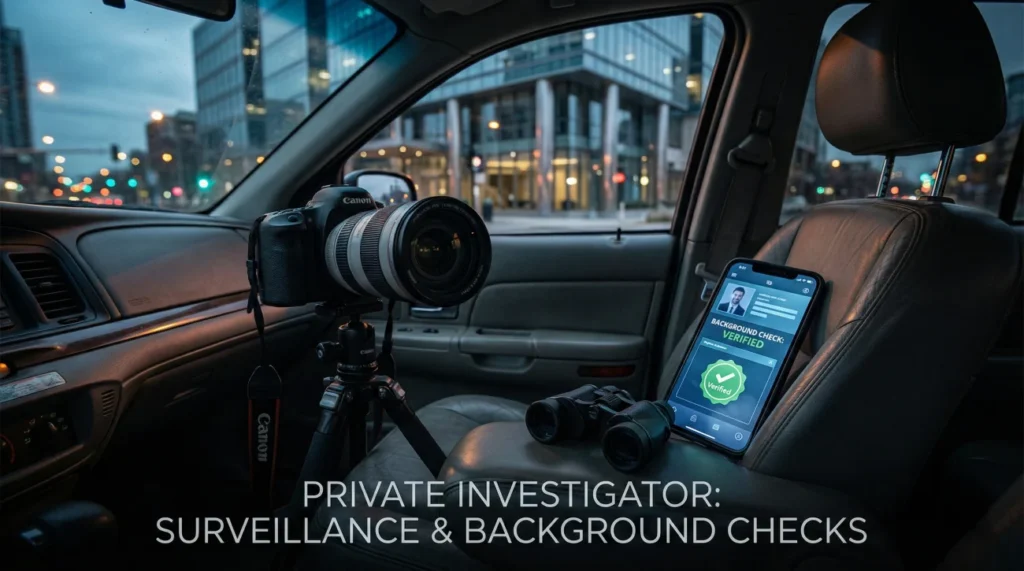
Beyond the obvious camera with a high-zoom lens (at least 50x optical), I carry a tripod or monopod for stability. I have a dashcam for driving footage. I carry a power bank for all devices. I have a voice recorder for dictating notes while driving. I carry a change of clothes (hats, jackets) to alter my appearance quickly. I also have a “comfort kit” with snacks, water, and hygiene products. Critically, I carry a printed copy of my PI license and the case assignment in case law enforcement stops me.
Background Checks and Skip Tracing
Q: What is “Skip Tracing” and what tools do you use?
Skip tracing is the art of finding a person who has “skipped” town or is hiding. I start with proprietary databases like TLOxp or Accurint, which aggregate public records (credit headers, utility bills).
However, databases are often outdated. I cross-reference this with social media analysis (OSINT), looking for check-ins, family connections, or photos. I might call former landlords or neighbors using a pretext. I look for “digital exhaust”: venmo transactions, Amazon wishlists, or voter registration records. It is a puzzle where I connect disparate data points to find a current address.
Q: How do you verify employment for a background check without tipping off the subject?
If the background check is pre-employment (FCRA regulated), the subject usually knows. But for a covert investigation (like child support), discretion is key. I call the business main line and ask for the subject by name: “Hi, is John Smith in today?”
If they say “He’s out to lunch,” I have verified employment. I might use a pretext, posing as a delivery driver needing to confirm drop-off hours. I never lie about who I am if it violates the law, but I use social engineering to get the truth. I might also conduct surveillance at the workplace during shift changes to get visual confirmation.
Q: Explain the difference between a “criminal history check” and a “civil records check.”
Criminal history reveals arrests, convictions, and incarcerations. It tells you if the person broke the law. Civil records reveal lawsuits, bankruptcies, liens, divorces, and restraining orders.
Civil records often tell a richer story about a person’s character and financial stability. A person might have a clean criminal record but be sued ten times for fraud or non-payment of debt. I check both county and federal courthouses because different cases are filed in different jurisdictions. Ignoring civil records leaves a huge blind spot.
Q: What is “OSINT” and how do you use it ethically?
OSINT (Open Source Intelligence) is gathering data from publicly available sources. I use it to build a profile before surveillance. I check Facebook, Instagram, LinkedIn, and TikTok.
I look for photos of their vehicle, their hobbies (which tell me where they might go), and their associates. Ethically, I only access what is public. I do not “hack” accounts, guess passwords, or create fake profiles to “friend” them (which can be considered pretexting/catfishing and may be illegal or unethical depending on the jurisdiction). I passively observe what they have chosen to share with the world.
Q: How do you find hidden assets in a divorce case?
Assets leave a paper trail. I look for property deeds transferred to relatives or LLCs just before the divorce filing. I search for UCC filings which indicate loans for business equipment.
I look at lifestyle versus reported income. If they claim poverty but drive a leased luxury car, I trace the lease. I look for boat or aircraft registrations. I cannot access bank accounts directly without a court order (that is illegal), but I can find the evidence that points to where the money went, giving the attorney the ammunition to subpoena the records.
Q: A client asks you to wiretap a spouse’s phone. How do you respond?
I refuse immediately. Wiretapping is a federal felony. I explain to the client, “I cannot do that, and anyone who says they can is likely breaking the law and putting you at risk of jail time.”
I pivot to legal alternatives. “We cannot tap the phone, but we can conduct surveillance to see who they are meeting. We can look at phone records if you share a plan and have access. We can look at public social media interactions.” I educate the client on what is legal and admissible in court versus what they see in movies.
Field Scenarios and Ethics
You are conducting surveillance and the police knock on your car window. What do you do?
I remain calm and keep my hands visible. I do not exit the vehicle unless asked. I identify myself immediately: “I am a licensed Private Investigator working a case.”
I provide my PI license and ID. I explain briefly why I am there (e.g., “I am conducting surveillance on a subject in this block”) without revealing the specific client or subject details unless necessary or compelled. Police usually respect the job once they know I am a professional and not a stalker. I maintain a good relationship with law enforcement because they can blow my cover or help me.
A client wants you to find their biological mother, but she doesn’t want to be found. What do you do?
This is an adoption reunion case. I explain to the client upfront that I can locate her, but I cannot force contact. I act as an intermediary.
Once I find her, I reach out discreetly (usually by letter) to ask if she is open to contact. If she says no, I report to the client: “I located her, but she does not wish to be contacted.” I do not give the client her address or phone number in this case. Giving the information against her will could lead to harassment or danger. I respect the privacy of the subject.
You catch a claimant in a workers’ comp fraud case lifting heavy weights at a gym. How do you document it?
This is the “money shot.” I need high-quality video that clearly identifies the subject. I film continuously to show the duration and intensity of the activity.
I ensure I capture their face clearly. I also film them leaving the gym and getting into their car to prove it is the same person. I write a report detailing the time, location, and specific activities (e.g., “Subject bench pressed 200 lbs for 3 sets of 10 reps”). I maintain the original video file chain of custody so it is admissible in court to prove fraud.
You lose the subject in traffic. Do you speed to catch up?
No. I do not break traffic laws. Getting a speeding ticket or causing an accident creates liability for me and my client. It also draws attention.
If I lose them, I predict where they might be going based on my pre-surveillance research (home, work, gym) and head there safely. If I can’t reacquire them, I terminate surveillance and try again another day. “Don’t burn the case to save the tail.” Losing a subject once is better than reckless driving.
Report Writing and Legal Compliance
Q: Describe your report writing style.
My reports are objective, chronological, and devoid of opinion. I write in the third person (“Investigator observed…” not “I saw…”). I state facts: “Subject entered the bar at 10:00 PM and exited at 11:30 PM stumbling.” I do not write “Subject was drunk.” I include video timestamps for every observation. I assume my report will be read by a jury or opposing counsel, so I am meticulous about grammar and clarity. The report is the product the client pays for.
Q: What is “Pretexting” and when is it legal?
Pretexting is using a false identity or story to gather information. It is generally legal for PIs to use pretexts to identify a person or location, provided they do not impersonate a police officer, a doctor, or a federal official. However, under the Gramm-Leach-Bliley Act (GLBA), it is illegal to use pretexting to obtain financial information from a bank. I use pretexting carefully and ethically, usually to verify an address or employment, never to access protected records.
Q: How do you ensure you are not stalking?
The difference between surveillance and stalking is “legitimate purpose.” As a licensed PI, I have a contractual reason to be there (insurance claim, legal case). I document my purpose in the case file. I do not harass, threaten, or intimidate the subject. I observe from a distance in public places where there is no “reasonable expectation of privacy.” I do not trespass on private property or peek into windows. Staying within the law protects me from stalking charges.
Q: How do you prepare for court testimony?
I review my report and video footage until I know it cold. I stick to the facts in my report. If asked a question I don’t know, I say “I don’t recall” or “It’s not in my report.” I do not speculate. I dress professionally. I remain calm under cross-examination, knowing the opposing attorney’s job is to discredit me. I direct my answers to the jury. My credibility is my most valuable asset.
Private Investigator Knowledge Quiz
20 Practice Questions
1. What is “OSINT”?
- Official Secret Intelligence
- Open Source Intelligence
- On Site Investigation
- Office Security Internal
2. “Skip Tracing” means:
- Following someone on foot
- Locating a missing/hiding person
- Skipping a background check
- Tracing a drawing
3. Which is a legal surveillance location?
- Inside the subject’s fenced yard
- A public street or sidewalk
- Peeking through a bathroom window
- Inside a private office building
4. “Sub Rosa” investigation refers to:
- Investigating flowers
- Secret surveillance (Under the Rose)
- Submarine investigation
- Background checks only
5. “Pretexting” is:
- Texting before calling
- Using a ruse to get information
- Writing a report early
- Pretending to be a cop
6. Can a PI wiretap a phone?
- Yes, with client permission
- No, it is a federal crime
- Yes, for divorce cases
- Only on landlines
7. “GLBA” protects:
- Medical records
- Financial/Banking information
- Driving records
- School transcripts
8. “FCRA” regulates:
- Criminal investigations
- Background checks for employment
- Surveillance drones
- Firearm permits
9. A “Process Server” delivers:
- Food to the office
- Legal court documents
- Evidence to the lab
- Computer servers
10. “Chain of Custody” is for:
- Keeping the dog on a leash
- Documenting evidence handling
- Tracking billable hours
- Watching a child custody exchange
11. What is “Geo-tagging”?
- Tagging a friend in a photo
- GPS data embedded in photos/posts
- A geography game
- Graffiti on a wall
12. “Surveillance” is best done:
- In a bright red sports car
- In a nondescript vehicle
- On a bicycle
- While wearing a tuxedo
13. Can a PI arrest someone?
- Yes, just like a cop
- No, only “citizen’s arrest” rules apply
- Only on weekends
- Only for felonies
14. “Trash Pull” involves:
- Pulling a car out of the mud
- Searching trash left on public curb
- Deleting bad files
- Insulting the subject
15. A “cover story” helps to:
- Lie to the judge
- Explain presence if confronted
- Cover up a crime
- Write a fictional book
16. “GPS Tracking” of a vehicle usually requires:
- Just the client’s money
- Owner’s consent or Court Order
- A very fast car
- Google Maps app
17. Which is a public record?
- Medical history
- Property deed / Tax assessment
- Credit card statement
- Private email content
18. “Due Diligence” investigation is for:
- Catching a cheating spouse
- Business vetting before a deal
- Finding a lost dog
- Delivering pizza
19. “TSCM” (Bug sweeping) stands for:
- Total Security Camera Management
- Technical Surveillance Countermeasures
- Top Secret Case Management
- Tactical Scanner Control Method
20. “AOE/COE” investigations relate to:
- Missing persons
- Workers’ Compensation claims
- Divorce settlements
- Criminal defense
❓ Frequently Asked Questions
📜 Do I need a license to be a PI?
In most states, yes. Requirements typically include passing a background check, passing a state exam, and having verified investigative experience (often 2,000 – 6,000 hours under a licensed PI or in law enforcement). Practicing without a license is a crime in many jurisdictions.
🔫 Do PIs carry guns?
Some do, but it is not automatic. You typically need a separate firearms permit (like a “exposed carry” or “CCW”). Many PIs choose not to carry to reduce liability, as the job is about observation, not confrontation. Use of force is a last resort for self-defense only.
🕵️♀️ How do PIs get paid?
Most work on a retainer system. The client pays an upfront deposit (e.g., $1,500), and the PI bills hourly (e.g., $75-$150/hour) plus expenses (mileage, database fees) against that retainer. Flat fees are common for simple background checks or process serving.
🚔 Are PIs police officers?
No. PIs are private citizens. They have no special police powers. They cannot arrest people (beyond citizen’s arrest), run license plates (in most states), or ignore traffic laws. They rely on their wits and public access laws, not a badge.
🚀 What is the best way to start?
Find a licensed agency and apply as an “investigative intern” or “associate.” You need a mentor to sign off on your hours for licensure. Having a background in criminal justice, journalism, or military intelligence can help you get your foot in the door.
The Truth Seeker
Private investigation is not about fedoras and smoke-filled rooms; it is about discipline, technology, and ethics. You are a professional truth-seeker in a world full of secrets. When you interview, show them your patience. Show them your attention to detail. Prove that you can sit in a hot car for 8 hours without losing focus, and that you can write a report that will stand up in court. By mastering these private investigator interview questions, you show that you are ready to operate in the shadows to bring the truth to light.
⚠️ Disclaimer: The interview strategies, sample answers, and negotiation tips provided in this guide are for educational purposes only. Hiring decisions are subjective and vary by company and industry. While these strategies are based on professional HR standards, they do not guarantee a specific job offer or result.