The Clinician’s Role in Healing
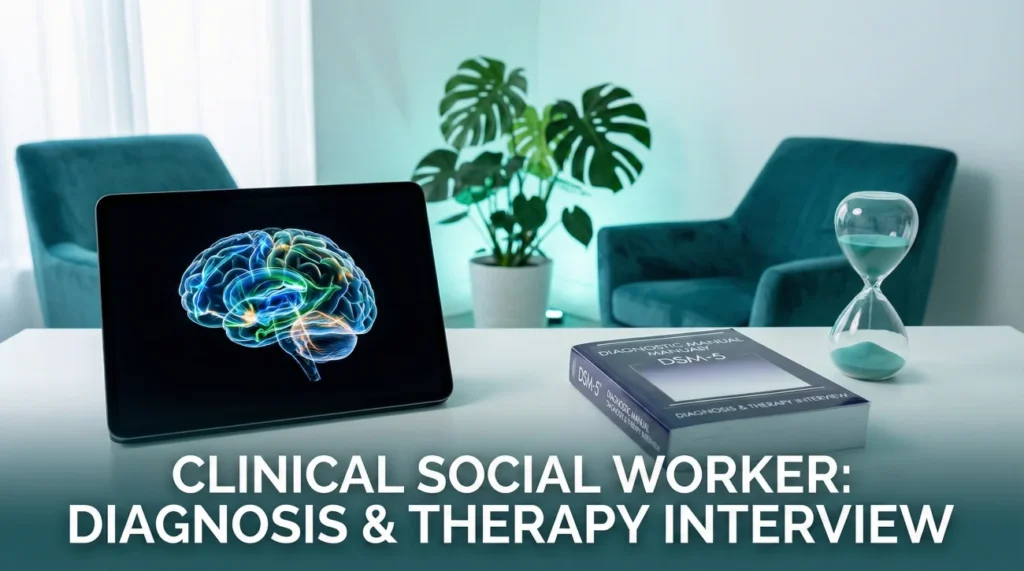
Clinical social work represents the intersection of mental health treatment and social justice. Unlike generalist social workers who primarily connect clients to resources, Clinical Social Workers (LCSW/LICSW) are licensed to diagnose mental health disorders and provide psychotherapy. You are expected to hold the space for deep trauma, navigate complex family systems, and apply evidence-based interventions to facilitate healing.
Hiring managers for clinical roles are looking for practitioners who can seamlessly blend diagnostic precision with the empathetic “person-in-environment” perspective. They need to know you can differentiate between Bipolar Disorder and Borderline Personality Disorder, that you can write a treatment plan that satisfies insurance requirements, and that you can manage a caseload of high-acuity clients without burning out. The interview will test your clinical judgment, your theoretical orientation, and your ability to handle ethical gray areas.
Prepare to answer clinical social worker interview questions that delve into your specific therapeutic techniques, your experience with the DSM-5-TR, and your approach to the therapeutic alliance. This guide provides the in-depth clinical answers you need to demonstrate your readiness for advanced practice.
Assessment, Diagnosis, and DSM-5
Q: Walk me through your process for conducting an initial biopsychosocial assessment.
My assessment process is structured but conversational. I start by establishing rapport and explaining confidentiality to create safety. I then systematically cover the presenting problem: duration, intensity, and triggers. I move to the “Bio” aspect, asking about medical history, sleep, appetite, and substance use. For “Psycho,” I explore their mental health history, past treatments, and current symptoms like anxiety or depression. Finally, the “Social” component covers their living situation, employment, relationships, and cultural background. I always ask about trauma history and current safety (suicide/homicide risk). My goal is not just to gather data but to understand the client’s narrative and how these factors interact to maintain the problem.
Q: How do you differentiate between Bipolar Disorder and Borderline Personality Disorder?
This is a critical differential diagnosis. While both involve mood instability and impulsivity, the key difference lies in the frequency and triggers of the mood shifts. Bipolar Disorder is episodic; mood shifts (mania/depression) last for days or weeks and are often independent of external events. In contrast, the mood shifts in Borderline Personality Disorder (BPD) are reactive, often triggered by interpersonal stressors (like perceived abandonment), and can shift rapidly within hours. Additionally, BPD is characterized by a chronic pattern of unstable relationships and self-image, whereas Bipolar patients may have stable periods (euthymia) between episodes. I look for the sustained “manic” criteria (decreased need for sleep, grandiosity) to rule in Bipolar.
Q: A client presents with symptoms of depression. What other diagnoses would you rule out first?
Before confirming Major Depressive Disorder, I must rule out physiological causes and other mental health conditions. First, I screen for substance use; alcohol is a depressant and can mimic depression. I also recommend a medical rule-out for thyroid dysfunction or vitamin deficiencies (like D or B12) which can cause lethargy and low mood. Clinically, I rule out Bipolar Disorder by asking about history of manic episodes; treating Bipolar depression with antidepressants alone can trigger mania. I also assess for Adjustment Disorder (is this a temporary reaction to a stressor?) and Bereavement to ensure I am not pathologizing normal grief.
Q: How do you use the DSM-5-TR in your practice while maintaining a strengths-based perspective?
I view the DSM-5 as a necessary tool for communication and billing, but not the totality of the client’s identity. I use it to name the cluster of symptoms which validates the client’s struggle and guides evidence-based treatment. However, I frame the diagnosis as a part of their experience, not who they are. I don’t say “She is a schizophrenic”; I say “She is experiencing symptoms of schizophrenia.” I balance the diagnosis by documenting their resilience, coping skills, and support systems in the assessment. The diagnosis tells us what we are treating; the strengths-based perspective tells us how we will survive it.
Q: What is your experience with assessing for suicide risk?
I take a direct and thorough approach. I ask explicitly, “Are you having thoughts of killing yourself?” If yes, I assess the plan, means, intent, and timeline. “Do you have a plan? Do you have access to the pills/gun? Do you intend to do this today?” I also assess protective factors like children, pets, or religious beliefs. Based on the risk level (Low, Moderate, High/Imminent), I intervene. This ranges from creating a detailed safety plan and increasing session frequency to facilitating voluntary or involuntary hospitalization. I always document this assessment meticulously and consult with a supervisor immediately in high-risk cases.
Therapeutic Modalities and Interventions
Q: What is your primary theoretical orientation?
I operate primarily from a Cognitive Behavioral Therapy (CBT) framework, integrated with Person-Centered principles. I believe that our thoughts influence our feelings and behaviors.
By helping clients identify cognitive distortions (like catastrophizing), we can restructure those thoughts to improve emotional regulation. However, I ground this in a Person-Centered approach (empathy, unconditional positive regard) because the therapeutic alliance is the strongest predictor of success. I am flexible and will pull from DBT or Motivational Interviewing depending on the client’s needs.
Q: Describe how you use Dialectical Behavior Therapy (DBT).
I use DBT primarily for clients with emotional dysregulation or self-harm behaviors. I focus on the four modules: Mindfulness, Distress Tolerance, Emotion Regulation, and Interpersonal Effectiveness.
For a client in crisis, I teach Distress Tolerance skills like “TIP” (Temperature, Intense exercise, Paced breathing) to lower physiological arousal. I help them grasp the dialectic that “You are doing the best you can AND you need to do better.” This balance of acceptance and change is crucial for clients who feel invalidated.
Q: How do you handle a client who is resistant to therapy?
I view resistance as a protective mechanism or a sign of ambivalence, not defiance. I use Motivational Interviewing (MI) to explore it. I “roll with resistance” rather than confronting it.
I might say, “It sounds like you were forced to come here and that feels really unfair.” Validating their frustration often lowers their defenses. I ask open-ended questions to help them find their own reasons for change (“What would your life look like if this problem was gone?”). I focus on building rapport first; no intervention works without trust.
Q: Explain your approach to trauma-informed care.
Trauma-informed care asks “What happened to you?” instead of “What is wrong with you?” I prioritize safety, trustworthiness, and choice. I ensure the physical environment is safe and predictable.
I move at the client’s pace to avoid re-traumatization. I teach grounding techniques (like the 5-4-3-2-1 senses exercise) to manage dissociation before delving into trauma narratives. I recognize that many “symptoms” (like aggression or withdrawal) are actually survival adaptations to past trauma. I validate their survival while helping them learn adaptive skills for the present.
Q: How do you terminate therapy with a client?
Termination is a vital phase of treatment, not just an ending. I begin discussing it weeks in advance. We review the progress made toward their treatment goals and celebrate successes.
We develop a relapse prevention plan, identifying potential triggers and coping strategies they can use independently. I allow space for them to process feelings of loss or anxiety about ending. I frame it as a graduation – they are ready to be their own therapist. I also provide resources for re-entry if they need support in the future.
Q: When would you refer a client to a psychiatrist?
I refer when symptoms are significantly impairing daily functioning despite therapy, or when there is a biological component that therapy alone cannot address. For example, if a client is too depressed to get out of bed to come to sessions, or is experiencing psychosis (hallucinations/delusions).
I also refer for Bipolar mania or severe ADHD. I explain to the client that medication is like a tool that can “turn down the volume” on the symptoms so that therapy can be more effective. I collaborate with the psychiatrist to monitor adherence and side effects.
Clinical Scenarios and Ethics
A client tells you they committed a crime years ago that was never solved. Do you report it?
Generally, no. Confidentiality protects past crimes unless there is a specific exception like child abuse or elder abuse. If they confess to a bank robbery 10 years ago, that is privileged.
However, if the past crime involves a continuing threat (e.g., they buried toxic waste that is currently poisoning a water supply), the analysis might change. But typically, my duty is to the client’s privacy. Reporting a past crime would destroy the therapeutic alliance and violate HIPAA/ethical codes. I would explore the guilt they feel about it therapeutically.
You feel sexually attracted to a client. How do you handle it?
I would address this immediately in my own supervision or personal therapy, never with the client. It is a human reaction, but acting on it is a severe ethical violation.
I would assess if the attraction is interfering with my objectivity or the client’s treatment. If I can manage my feelings and remain professional, I continue. If the countertransference is too strong and impacting my judgment, I would ethically transfer the client to a colleague, framing it as a need for a different clinical expertise to avoid harming the client with the truth.
A client is furious because you filed a CPS report. How do you repair the relationship?
I validate their anger. I do not get defensive. I say, “I know you are angry and feel betrayed. I want to hear how you feel.” I remind them of the limits of confidentiality we discussed at intake.
I explain that my duty to ensure safety (the child’s) supersedes our confidentiality, but that I still care about them. I frame the report as a way to get the family help, not punishment. I stick with them through the investigation process to show I am not abandoning them. Sometimes the relationship ends, but often, consistent support during the crisis can repair it.
A parent demands to see the therapy notes of their 16-year-old child. What do you do?
Legally, parents often have the right to access records, but clinically, this can destroy the teen’s trust. I would first try to negotiate with the parent.
I would explain, “For therapy to work, your teen needs a private space to speak openly. Reading the notes might cause them to shut down.” I would offer to provide a general summary of treatment goals and progress instead of the raw notes. If the parent insists and the law supports them, I would meet with the teen first to prepare them and discuss what is in the notes, minimizing the surprise.
Clinical Knowledge Quiz
20 Practice Questions
1. Which axis was removed in DSM-5?
- The diagnostic axis
- The multiaxial system (Axis I-V)
- The psychosocial stressor list
- The medical condition code
2. “Transference” refers to:
- Therapist’s feelings toward client
- Client’s feelings toward therapist
- Transferring a client to new agency
- Moving trauma to the conscious mind
3. EMDR is primarily used for:
- Eating disorders
- Schizophrenia management
- Post-Traumatic Stress Disorder (PTSD)
- Autism Spectrum Disorder
4. “Duty to Warn” applies when:
- A client is using illegal drugs
- There is an identifiable victim/threat
- A client confesses a past crime
- The client is suicidal only
5. Which is a symptom of Mania?
- Hypersomnia (sleeping too much)
- Decreased need for sleep
- Low self-esteem
- Psychomotor retardation
6. “Motivational Interviewing” focuses on:
- Confronting denial aggressively
- Resolving ambivalence to change
- Teaching coping skills directly
- Analyzing childhood dreams
7. What is “Euthymia”?
- A severe depressive state
- A normal, stable mood state
- A rapid cycling mood state
- A manic psychotic state
8. “Anhedonia” means:
- Excessive energy levels
- Inability to feel pleasure
- Fear of open spaces
- Hearing voices
9. Which cluster is Borderline Personality Disorder in?
- Cluster A (Odd/Eccentric)
- Cluster B (Dramatic/Erratic)
- Cluster C (Anxious/Fearful)
- It is not a personality disorder
10. “Solution-Focused Therapy” asks:
- “Why did your mother do that?”
- “What is the Miracle Question?”
- “How does that make you feel?”
- “What is your earliest memory?”
11. A “genogram” maps:
- Genetic DNA markers
- Family relationships/patterns
- Brain wave activity
- Social support networks
12. “Vicarious Trauma” affects:
- The client’s family only
- The clinician helping the client
- The perpetrator of the crime
- The insurance company
13. Which medication class treats anxiety?
- Antipsychotics
- Benzodiazepines
- Stimulants
- Mood Stabilizers
14. “Informed Consent” is required:
- Only for surgery
- Before starting therapy treatment
- After the client is cured
- Only for minors
15. “Cognitive Restructuring” involves:
- Changing the brain surgery
- Challenging irrational thoughts
- Hypnotizing the client
- Scheduling activities
16. “Dual Diagnosis” means:
- Two therapists treating one client
- Mental illness + Substance use
- Depression + Anxiety combined
- Bipolar I + Bipolar II
17. The “identifid patient” is:
- The one paying the bill
- The family member carrying the symptom
- The therapist in the room
- The doctor making the referral
18. “Grounding techniques” help with:
- Manic episodes
- Dissociation and anxiety
- Depressive lethargy
- Narcissistic rage
19. “SOAP” notes stand for:
- Simple, Objective, Action, Plan
- Subjective, Objective, Assessment, Plan
- Standard, Observation, Analysis, Payment
- Symptoms, Origins, Actions, Progress
20. “Rapport” is:
- A formal psychological report
- Trusting relationship with client
- The final diagnosis code
- A technique to break silence
❓ Frequently Asked Questions
📜 What is the difference between LMSW and LCSW?
An LMSW (Licensed Master Social Worker) usually practices under supervision and may focus on case management or macro work. An LCSW (Licensed Clinical Social Worker) has completed post-graduate clinical supervision hours (usually 3,000+) and passed a clinical exam, allowing them to diagnose, provide therapy independently, and bill insurance.
🧠 Can clinical social workers prescribe medication?
Generally, no. Prescribing is reserved for psychiatrists, nurse practitioners, or medical doctors. However, clinical social workers must have a strong working knowledge of psychopharmacology to monitor adherence, recognize side effects, and collaborate effectively with prescribers.
💼 Is private practice a viable option?
Yes, for LCSWs. Private practice offers autonomy and potentially higher income. You can accept private pay or credential with insurance panels. However, it requires business skills (marketing, billing) and can be isolating, so peer supervision groups are essential.
🏥 What is “medical social work”?
This specialty involves working in hospitals or clinics. Clinical social workers here assess psychosocial needs related to illness, provide crisis intervention for trauma/grief, and handle discharge planning. It is fast-paced and requires understanding medical terminology.
🚀 How do I handle licensure portability?
Social work licensure is state-specific, which can be challenging if you move. However, the “Social Work Licensure Compact” is an emerging initiative to improve portability. Currently, you often need to apply for licensure by endorsement in a new state, proving your exam scores and supervision hours.
The Art of Clinical Practice
Clinical social work is an art form grounded in science. It requires you to be a detective of the psyche, a guardian of ethics, and a partner in healing. When you interview, you must show that you are not just a technician applying a manual, but a human being capable of deep connection and critical thinking.
By preparing with these clinical social worker interview questions, you demonstrate that you are ready to handle the weight of the work. You show the hiring manager that you have the diagnostic clarity, the therapeutic skill, and the professional resilience to change lives.
⚠️ Disclaimer: The interview strategies, sample answers, and negotiation tips provided in this guide are for educational purposes only. Hiring decisions are subjective and vary by company and industry. While these strategies are based on professional HR standards, they do not guarantee a specific job offer or result.