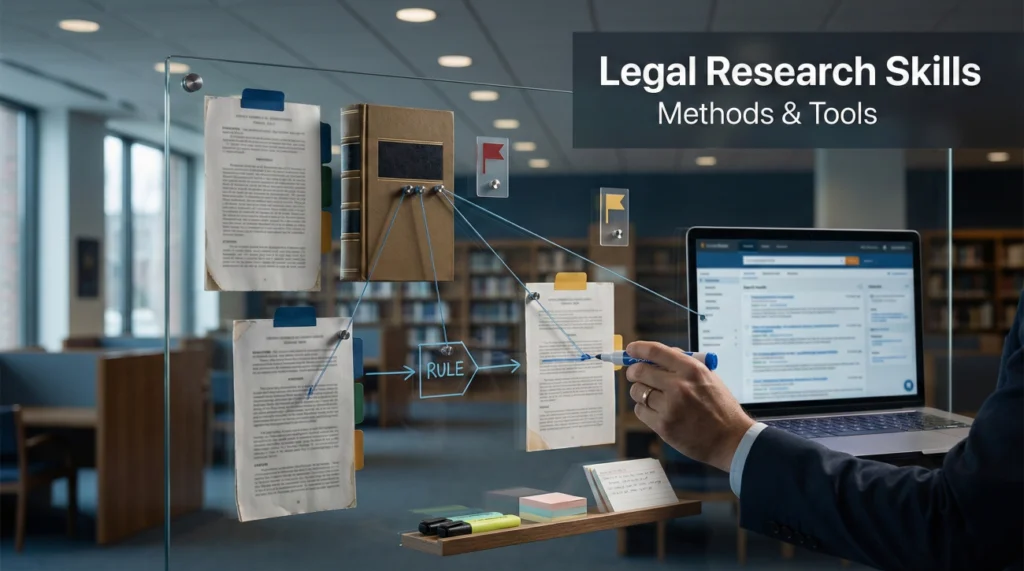
- What strong legal research is: Finding controlling authority fast, checking validity, then building persuasive analysis that fits the right jurisdiction and facts.
- Systematic process: Start with secondary sources for context, then locate statutes, regulations, and cases, evaluate authority strength, and synthesize into a clear argument.
- Authority hierarchy: Know binding vs persuasive sources, court levels, recency, and precedential value so you cite fewer, stronger authorities instead of dumping citations.
- Database skill set: Use natural language for exploration, terms and connectors for precision, headnotes/topics to expand, and citators to confirm good law and track treatments.
- Analysis and interviews: Apply IRAC, analogize and distinguish cases, weigh counterauthority, and explain your research method with one concrete example without breaking confidentiality.
Foundation of Legal Practice
Effective legal research skills underpin all legal work: finding relevant precedents, interpreting statutes, analyzing regulations, and building persuasive arguments grounded in authority. Whether supporting litigation, drafting contracts, advising clients, or developing policy, legal professionals must efficiently navigate complex legal information systems and apply systematic reasoning frameworks.
This guide establishes foundational legal research competencies. You’ll learn systematic case law research methods, master legal database navigation, understand statutory and regulatory interpretation, develop legal reasoning frameworks, and demonstrate research proficiency during interviews.
Systematic Legal Research Process
Effective research follows structured methodology ensuring comprehensive, efficient analysis rather than haphazard searching.
Core Research Steps
Professional legal research proceeds through systematic phases from issue identification through authority validation.
| Research Phase | Key Activities | Common Pitfalls to Avoid |
|---|---|---|
| 1. Issue Identification | Define legal questions precisely, identify relevant jurisdiction, determine practice area | Vague questions yielding unfocused results, missing jurisdictional nuances, researching wrong area |
| 2. Background Research | Review secondary sources (treatises, practice guides, law review articles) for overview | Diving into primary sources without context, missing fundamental concepts, inefficient searching |
| 3. Primary Source Location | Find controlling statutes, regulations, and case law using databases and citators | Relying solely on outdated sources, missing recent developments, incomplete search terms |
| 4. Authority Evaluation | Assess precedential value, check current validity, analyze fact patterns and holdings | Citing overruled cases, misunderstanding binding vs. persuasive authority, missing distinctions |
| 5. Analysis and Synthesis | Compare authorities, reconcile conflicts, apply to client facts, develop arguments | Cherry-picking favorable authorities, ignoring contrary precedent, weak analogical reasoning |
💡 Pro tip: Always begin with secondary sources (legal encyclopedias, practice guides, law review articles) before diving into primary sources. Secondary sources provide overview, context, key cases, and search terms preventing wasted time researching wrong issues or missing foundational concepts. This counterintuitive approach of reading “about the law” before reading “the law itself” saves hours ultimately.
Understanding Legal Authority Hierarchy
Not all legal sources carry equal weight: understanding hierarchy prevents citing inappropriate or weak authority.
- ⚖️ Mandatory/Binding authority: Must follow (statutes, regulations, higher court decisions in same jurisdiction)
- 📖 Persuasive authority: May follow (sister state cases, lower court decisions, secondary sources, well-reasoned analysis)
- 🏛️ Court hierarchy: Supreme Court > Appellate Court > Trial Court within jurisdiction
- 📅 Temporal consideration: Recent cases supersede older when law evolves, but seminal cases retain authority
- 🎯 Precedential value: Published opinions > unpublished, majority > dissent/concurrence, on-point > dicta
Expert advice: New legal researchers often cite excessive authority trying to appear thorough, actually diluting argument strength. Select most relevant, highest-authority sources supporting each point. One controlling Supreme Court case outweighs ten lower court persuasive authorities. Quality over quantity: three perfectly on-point cases beat fifteen marginally relevant citations requiring extensive distinguishing.
Statutory and Regulatory Research
Statute and regulation research requires understanding legislative history, interpretive canons, and administrative guidance.
Statute Research Process
Finding and interpreting statutes involves multiple steps beyond reading statutory text.
| Research Step | Purpose | Tools and Techniques |
|---|---|---|
| Locate statutory text | Find current, official version of statute | Annotated codes (USCA, USCS), state code databases, official government sites |
| Review annotations | Find cases interpreting statute, identify key issues | Annotated code case summaries, topic classifications, cross-references |
| Check amendments | Ensure using current version, understand changes over time | Statutory history notes, effective dates, session laws, legislative tracking |
| Examine legislative history | Understand legislative intent, resolve ambiguities | Committee reports, floor debates, bill drafts, sponsor statements |
| Apply canons of construction | Interpret statutory language systematically | Plain meaning, legislative intent, avoid absurdity, specific controls general |
Administrative Regulations and Guidance
Regulations implement statutes with agency-specific rules requiring separate research methodology.
- Code of Federal Regulations (CFR): Final federal regulations organized by title and section
- Federal Register: Proposed rules, final rules, notices, tracking regulatory changes chronologically
- Agency guidance: Interpretive letters, policy statements, advisory opinions, technical bulletins
- State regulations: State administrative codes, agency websites, state registers
- Regulatory history: Understanding rule development, comment periods, amendments over time
Statutory Interpretation Principles
Courts apply systematic interpretive rules resolving statutory ambiguities.
- 📖 Plain meaning rule: Start with ordinary meaning of statutory language unless absurd
- 🎯 Legislative intent: When ambiguous, seek what legislature meant to accomplish
- ⚖️ Avoid absurdity: Reject interpretations leading to ridiculous or unjust results
- 🔍 Specific over general: Specific statutory provision controls over general one
- 📚 Whole act rule: Interpret provisions in context of entire statute, maintain consistency
Expert advice: Statutory research often proves more complex than case law research despite appearing simpler. Statutes require understanding: current version vs. version applicable to your facts (temporal application), legislative history and intent, judicial interpretation through case law, implementing regulations, and agency guidance. Never assume plain text tells complete story: statutory meaning emerges from multiple sources requiring synthesis.
Legal Analysis and Reasoning Frameworks
Legal research culminates in analysis: applying discovered law to client facts through systematic reasoning.
IRAC Analysis Structure
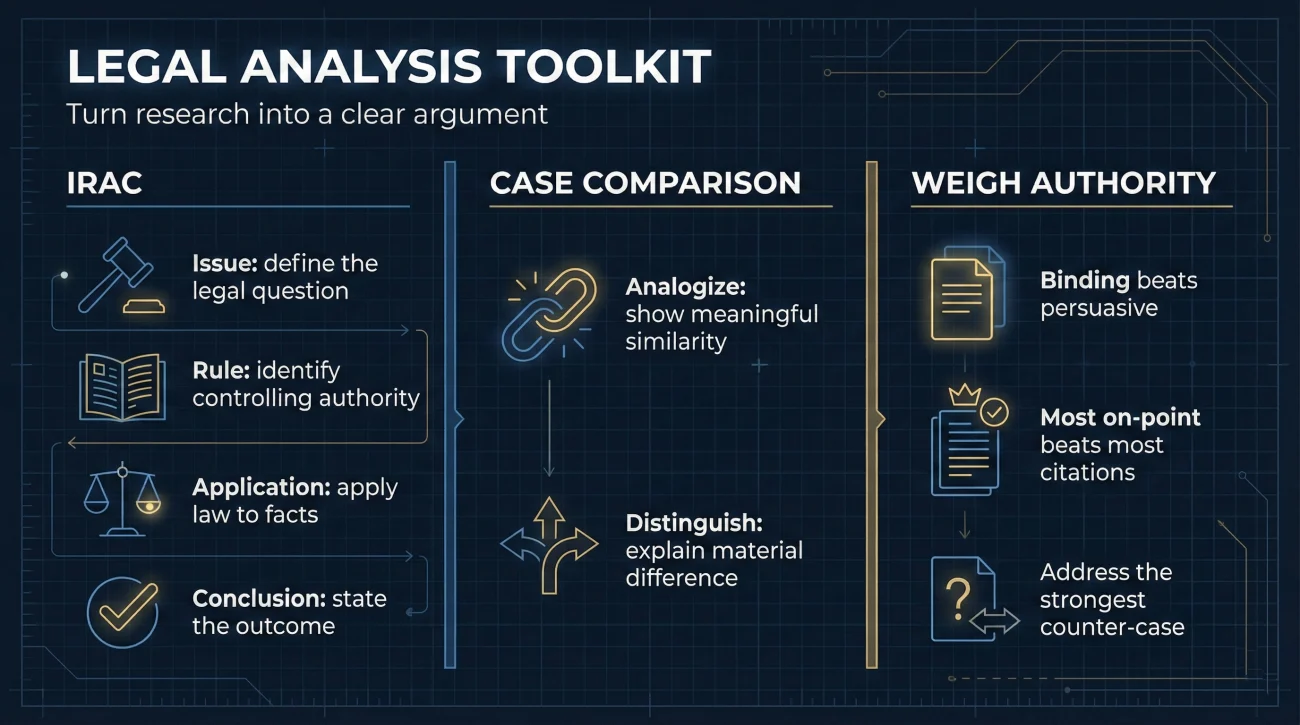
IRAC (Issue, Rule, Application, Conclusion) provides foundational framework for legal analysis and writing.
- Issue: Precise legal question presented by facts (Did employer breach duty by…?)
- Rule: Governing legal principles from statutes, regulations, case law (Elements of claim are…)
- Application: Apply rule to client facts through analogical reasoning (Here, similar to Case X because…)
- Conclusion: Answer to issue based on analysis (Therefore, employer likely liable because…)
Case Comparison and Distinction
Legal reasoning relies heavily on analogizing favorable cases and distinguishing unfavorable ones.
- 🔗 Analogizing: Show how client facts resemble favorable precedent in legally significant ways
- ↔️ Distinguishing: Demonstrate how client facts differ from unfavorable cases on material points
- ⚖️ Policy arguments: Support interpretation with practical, equitable, or policy considerations
- 📊 Weighing authorities: Address strongest contrary authority, explain why not controlling
Demonstrating Research Skills in Interviews
Legal interviews assess research proficiency through hypothetical scenarios and methodology questions.
- Describe systematic research process you follow, showing methodology not just database clicking
- Explain how you evaluate source credibility and authority (binding vs. persuasive, citator usage)
- Share example of complex research project: issue, sources consulted, challenges, how resolved
- Discuss staying current with legal developments (alerts, newsletters, CLE, professional reading)
- Mention specific database features you use beyond basic searching (headnotes, practice guides, citators)
For additional legal analysis frameworks and interview preparation techniques, review our comprehensive legal career preparation materials.
❓ FAQ
🎯 Should I memorize legal databases for interviews?
Know major platforms (Westlaw, LexisNexis, Bloomberg Law) and general capabilities, but don’t stress memorizing every feature. Most firms provide training on their specific systems. Focus on demonstrating systematic research methodology: how you identify issues, choose search strategies, evaluate authorities, validate citations. Strong researchers adapt quickly to any platform because they understand underlying research process. Mention databases you’ve used while acknowledging willingness to learn new systems.
💼 What if I don’t have access to expensive legal databases?
Discuss free alternatives you’ve used: Google Scholar (case law), government websites (statutes, regulations, courts), law school library access during your studies, bar association resources. Emphasize research skills transfer across platforms: Boolean operators, citation validation, authority hierarchy work regardless of database. Many employers expect training new attorneys on their subscription services. Show research competence through methodology description and examples even if lacking experience with premium platforms.
⏰ How long should legal research take?
Varies dramatically by question complexity, jurisdiction, practice area familiarity. Simple questions may require 30 minutes, novel issues spanning multiple jurisdictions could need days. In interviews, emphasize efficiency: starting with secondary sources for overview, using targeted searches rather than browsing, knowing when to stop (diminishing returns), and consulting colleagues when stuck. Junior attorneys sometimes over-research from fear of missing something: develop judgment about reasonable stopping points balancing thoroughness with client costs.
📋 Should I discuss legal writing in research interviews?
Yes, research and writing intertwine: research quality shows in written product. Mention how research informs writing: IRAC structure, citing strongest authority, addressing contrary precedent, using quotations strategically. If you have writing samples, reference how research supported analysis. Strong legal researchers produce well-supported, clearly reasoned writing because they found right authorities and applied them correctly. Many research-focused questions really assess whether you can produce usable written product from research.
✨ How do I show research skills without revealing client confidences?
Sanitize examples: “I researched enforceability of non-compete agreements in our jurisdiction” rather than “I researched whether we could stop John Smith from working for Competitor Inc.” Describe research methodology, challenges encountered, and solutions developed without disclosing client names, specific facts, or confidential strategies. Interviewers assess process and reasoning ability, not client details. Frame as “researched whether X legal principle applied when facts included Y element” maintaining generality while demonstrating competence.
Final Thoughts
Mastering legal research skills requires understanding systematic methodology, database proficiency, source evaluation, and analytical reasoning frameworks. Strong researchers demonstrate efficiency through secondary source consultation first, precision through targeted searching, thoroughness through citator validation, and judgment through authority selection supporting persuasive analysis rather than citing everything discovered.
⚠️ Disclaimer: The interview strategies, sample answers, and negotiation tips provided in this guide are for educational purposes only. Hiring decisions are subjective and vary by company and industry. While these strategies are based on professional HR standards, they do not guarantee a specific job offer or result.