The Architect of the War Room
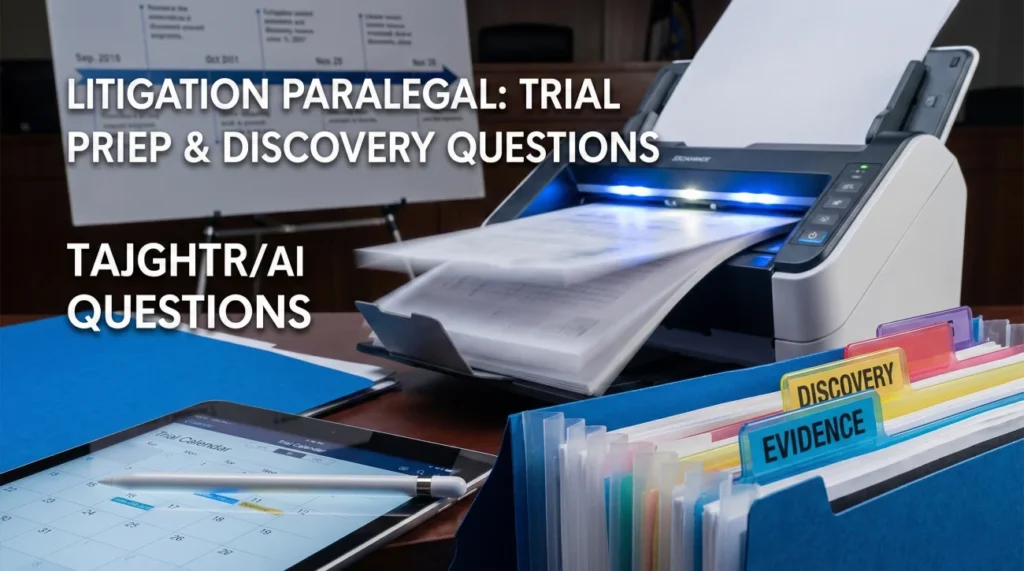
Litigation is a high-stakes environment where the outcome of a trial often hinges on the meticulous organization of the case file long before the first argument is made. As a litigation paralegal, you are the tactical commander of this process, responsible for managing the flood of discovery, tracking critical deadlines, and ensuring the attorney has the exact document they need the moment they need it.
Hiring managers are looking for a candidate who possesses a rare combination of procedural expertise, technical proficiency with e-discovery tools, and the mental stamina to work long hours under intense pressure. To land this role, you must be prepared to answer litigation paralegal interview questions that test your knowledge of the Federal Rules of Civil Procedure, your ability to draft privilege logs without error, and your strategy for managing the complex logistics of a trial.
Managing the Discovery Process
Q: How do you manage the discovery timeline to ensure no deadlines are missed?
Deadline management is the core of my job. I do not rely on a single system. I use a “rules-based” calendaring software, such as CompuLaw or Deadlines.com, to automatically calculate dates based on the Federal Rules of Civil Procedure or local state rules. I then verify these dates manually against the judge’s scheduling order. I set multiple reminders: a two-week warning, a one-week warning, and a 24-hour urgent alert. I also schedule “internal deadlines” for the attorneys a few days before the actual filing date to allow time for review and final edits. I circulate a weekly docket report to the entire team so everyone is aligned on upcoming priorities.
Q: Describe your experience with propounding and responding to discovery requests.
I handle the heavy lifting for both sides of the process. When propounding discovery, I draft Interrogatories, Requests for Production (RFP), and Requests for Admission (RFA) based on the case pleadings, tailoring the definitions to prevent the other side from playing word games. When responding, I meet with the client to gather the responsive documents and facts. I draft the initial responses and objections, such as “vague and ambiguous” or “attorney-client privilege,” for the attorney to review. I create a tracking chart to ensure every single request is answered or objected to, preventing any waiver of rights due to a non-response.
Q: How do you organize a document production from a client?
Organization prevents chaos. I start by establishing a clear protocol with the client on how to collect data to preserve metadata. Once received, I log the data into our review platform. I run a “deduplication” process to remove exact copies. I then prioritize the review based on custodians or keywords. Before production, I perform a strict quality control check for privilege and redactions. I ensure every page is Bates-stamped sequentially, for example DEF_00001, to create a unique identifier for the record. I maintain a production log that lists exactly what was produced, to whom, on what date, and in what format, which is crucial for resolving future discovery disputes.
Q: What is your strategy for drafting a privilege log?
A privilege log must be specific enough to justify the privilege but vague enough not to reveal the secret. I review the withheld documents to confirm they meet the criteria for Attorney-Client Privilege or Work Product Doctrine. On the log, I list the date, author, recipient, and a description. Instead of saying “Email re: legal advice,” which is too generic, I write “Email correspondence requesting legal advice regarding contract termination clauses.” I ensure the authors and recipients are identified by their roles, such as “John Doe, In-House Counsel,” to make it clear to the judge why the communication is protected. I treat the log as a litigation document that might be scrutinized by the court.
Trial Preparation and Support
Q: What is included in your “Trial Notebook” or “Trial Kit”?
My trial notebook is the master control center for the case. It includes a copy of the pleadings, all pre-trial motions and orders (especially Motions in Limine), and the exhibit list. I include a section for each witness with their deposition summary and direct/cross-examination outlines.
I also have a section for jury selection (voir dire) notes and seating charts. I maintain both a physical binder and a digital hyperlinked version on a tablet for the attorney. I also pack a “survival kit” with office supplies, chargers, court rules, and contact info for witnesses and court clerks.
Q: How do you prepare a witness for deposition or trial testimony?
I handle the logistical and document preparation so the attorney can focus on the testimony strategy. I create a “witness binder” containing all key documents authored by or sent to the witness, along with their prior statements or interrogatory verifications. I flag potential “hot documents” that opposing counsel might use to impeach them.
I coordinate the scheduling and location of the prep session. During the session, I take notes on the witness’s demeanor and credibility issues. I also help the witness understand the process by explaining where to sit, how to address the judge, and the importance of pausing before answering to allow for objections.
Q: Describe your proficiency with trial presentation software.
I am proficient with industry-standard tools like TrialDirector, OnCue, and Sanction. I know how to load the database with exhibits, transcripts, and synchronized video depositions. I can create “clips” of video testimony to impeach a witness instantly if they contradict themselves on the stand.
I am comfortable using the “call-out” and “highlight” features to zoom in on specific contract clauses or email text for the jury to see on the big screen. I understand the hardware setup as well; projectors, switching screens, and connecting to the court’s AV system. I always have a backup plan (a thumb drive or hard copies) in case technology fails.
Q: How do you handle the logistics of a remote or hybrid trial?
Remote trials require a higher level of technical vigilance. I ensure all exhibits are uploaded to the court’s digital evidence portal in advance, following strict naming conventions. I manage the Zoom or WebEx controls, ensuring breakout rooms are secure for attorney-client conversations.
I set up a “command center” with multiple monitors: one for the stream, one for the transcript, and one for team chat. I also conduct tech checks with witnesses to ensure their lighting, audio, and internet connection are professional and stable. I prepare digital exhibit binders with hyperlinked indices so the judge and witnesses can navigate easily.
Technical Skills and Drafting
You need to summarize a 300-page deposition transcript. What is your method?
I do not just read and summarize; I analyze. I start by reading the Notice of Deposition to understand the scope. I read the transcript once through quickly to get the flow. Then I go back for a page-line summary. I create columns: Page/Line, Summary, and Topic/Issue. I use the “Issue” column to tag key themes, such as “Breach,” “Damages,” or “Credibility.”
I focus on admissions, contradictions, and “I don’t recall” answers. I use the exact language of the witness for critical quotes rather than paraphrasing to preserve the nuance. I also create a separate “To-Do” list from the transcript, noting documents the witness promised to provide or names of new potential witnesses mentioned. This turns the summary into an actionable discovery tool.
How do you draft a Motion to Compel discovery?
A Motion to Compel is about showing the court we have been reasonable and they have been obstructive. I start by drafting the “Meet and Confer” declaration, detailing every email and phone call where we tried to resolve the dispute without court intervention. This is a requirement in most jurisdictions.
Then I draft the motion itself. I create a “side-by-side” chart: Column 1 has our Request, Column 2 has their Objection/Response, and Column 3 has our Argument for why the objection is invalid. This makes it easy for the judge to see the dispute at a glance. I cite the specific rules of procedure that mandate disclosure. I keep the tone professional but firm, focusing on the relevance of the documents to the claims and defenses.
What is your experience with “Cite Checking” and “Bluebooking”?
Cite checking is the final quality control gate. I am meticulous with The Bluebook (or local style manuals). I verify every citation in a brief. I check the format to ensure the abbreviations are correct and the year is included. I use the “id.” rule correctly.
But more importantly, I pull the actual case to verify the pinpoint cite. I ensure the quote in our brief matches the text in the case exactly. I check that the proposition we are citing the case for is actually supported by the holding. I also KeyCite/Shepardize one last time to ensure no negative history has appeared since the draft was written. A sloppy citation undermines the court’s trust in the attorney’s argument.
Litigation Knowledge Quiz
20 Practice Questions
1. What is a “Motion in Limine” used for?
- To dismiss the case entirely before trial
- To exclude specific evidence from trial
- To request a change of venue for trial
- To compel discovery responses quickly
2. The “work product doctrine” protects:
- Communications between client and lawyer
- Materials prepared in anticipation of trial
- Business advice given by corporate counsel
- Facts discovered during investigation only
3. Which discovery tool is sent to non-parties?
- Interrogatories (Rule 33)
- Requests for Admission (Rule 36)
- Subpoena Duces Tecum (Rule 45)
- Request for Production (Rule 34)
4. What does “ESI” stand for in litigation?
- Electronic System Interface data
- Electronically Stored Information
- Evidence Storage Inventory list
- Early Settlement Initiative plan
5. A “default judgment” occurs when:
- The plaintiff withdraws the complaint
- The defendant fails to answer in time
- The jury cannot reach a final verdict
- The judge dismisses the case with prejudice
6. Bates stamping is primarily used to:
- Seal confidential envelopes securely
- Identify and number document pages
- Notarize an affidavit or declaration
- Mark an exhibit as admitted evidence
7. What is the purpose of a “litigation hold”?
- To pause the lawsuit for settlement talks
- To preserve relevant data and documents
- To hold the defendant in contempt of court
- To delay the trial date for more preparation
8. “Impeachment” of a witness means:
- Removing them from the witness stand
- Attacking their credibility with proof
- Charging them with a crime in court
- Swearing them in before testimony
9. Interrogatories in federal court are limited to:
- 10 questions including subparts
- 25 questions including subparts
- 35 questions including subparts
- Unlimited number of questions
10. “Ex parte” means communication:
- With the client in private setting
- With the opposing counsel only
- With the judge without the other side
- With the media about the case facts
11. A “summary judgment” motion argues that:
- The case should go to trial immediately
- There are no genuine disputes of material fact
- The discovery period should be extended
- The judge should recuse themselves now
12. Which rule governs expert witness disclosures?
- Federal Rule of Civil Procedure 12
- Federal Rule of Civil Procedure 26
- Federal Rule of Civil Procedure 56
- Federal Rule of Civil Procedure 11
13. “Redaction” is the process of:
- Highlighting key text in yellow color
- Blacking out sensitive information text
- Summarizing long documents briefly
- Translating documents to English language
14. A “subpoena ad testificandum” requires:
- Production of documents only
- Appearance to give oral testimony
- Inspection of a physical premises
- Payment of a witness fee upfront
15. The “chain of custody” is vital for:
- Scheduling deposition dates
- Proving evidence integrity
- Tracking billable hours worked
- Managing client contact lists
16. “Document review” typically involves:
- Writing the final legal brief
- Coding for responsiveness and privilege
- Scanning physical papers into PDF
- Filing documents with the court clerk
17. A “stipulation” is an agreement between:
- The judge and the jury members
- Opposing parties on a procedural issue
- The lawyer and the client on fees
- The witness and the court reporter
18. “Demonstrative evidence” refers to:
- The murder weapon itself
- Charts/diagrams used to explain facts
- Sworn testimony from the stand
- The original contract document
19. “Metadata” can show:
- The legal argument of the brief
- When a document was created or edited
- The physical location of the server
- The cost of the software license fee
20. Which court is an appellate court?
- The US District Court
- The US Court of Appeals
- The US Bankruptcy Court
- The State Superior Court
❓ Frequently Asked Questions
⏱️ How much overtime is expected in litigation?
Litigation is cyclical. During discovery lulls, hours might be standard. However, during “trial mode” (usually 4-6 weeks before trial), overtime is almost guaranteed, often including nights and weekends. It is a “whatever it takes” environment where the team stays until the work is done.
💻 Do I need to know Relativity?
For mid-to-large firms, yes. Relativity is the industry standard for e-discovery. Being a “Relativity Certified User” is a significant resume booster. Smaller firms might use other tools like Logikcull or Everlaw, but the concepts of review, tagging, and production remain the same.
📜 Is a certificate necessary for litigation roles?
Many litigation managers prefer it, especially an ABA-approved certificate, as it ensures you understand civil procedure (FRCP). However, extensive experience managing complex discovery or trials can often substitute for formal education in this specific specialty.
📂 What is the difference between a Litigation Paralegal and a Legal Secretary?
A secretary handles administrative tasks like scheduling, travel, and formatting. A paralegal handles substantive legal work like drafting pleadings, researching case law, and managing discovery. Paralegal time is billable to the client; secretarial time usually is not.
🚀 Can this role transition to e-Discovery Project Manager?
Absolutely. Experienced litigation paralegals who master the technical side often transition into e-Discovery Project Management or Litigation Support roles. These positions often command higher salaries and focus more on technology and vendor management than traditional paralegal tasks.
The Verdict on Your Interview
The role of a litigation paralegal is not for the faint of heart; it requires a spine of steel and an obsession with detail. You are the safety net for the entire trial team. When you walk into the interview, do not just list your software skills; tell the story of how you organized a chaotic document production or how you found the needle in the haystack that won the case. By mastering these litigation paralegal interview questions, you demonstrate that you are not just a task-doer but a strategic partner ready to step into the war room and help the firm secure victory.
⚠️ Disclaimer: The interview strategies, sample answers, and negotiation tips provided in this guide are for educational purposes only. Hiring decisions are subjective and vary by company and industry. While these strategies are based on professional HR standards, they do not guarantee a specific job offer or result.