- What An Elevator Pitch Is: A 30 to 60 second version of your professional story designed for high-speed moments where you must earn attention fast.
- Where It Gets Used: Career fairs, networking events, quick phone screen openings, and any “give me the quick version” situation where time and focus are limited.
- Best Structure: Use a three-sentence model that covers Present role, Past proof with one strong metric or credential, and Future hook that explains what you want next.
- What To Cut: Drop job history, multiple achievements, hobbies, generic “passionate” claims, and any explanation about leaving roles, keep outcomes and remove process fluff.
- Delivery That Works: Aim for clear pacing with word-count targets (about 70 to 80 words for 30 seconds), use short pauses between sentences, practice versions for 30, 45, and 60 seconds, and avoid rushing or rambling past time.
When Every Second Counts
An elevator pitch for interview distills your entire professional story into 30-60 seconds of high-impact communication. Unlike traditional interview introductions that allow 90 seconds or more, this compressed format demands ruthless prioritization. Every word must earn its place by demonstrating immediate value or establishing critical credibility.
This 30 second introduction serves multiple scenarios: career fair conversations where recruiters spend minutes per candidate, networking events with brief interaction windows, phone screens that start with “give me the quick version,” or situations where you need to capture attention before someone moves on.
The challenge isn’t just speaking faster. It’s identifying the absolute core of your value proposition and communicating it clearly enough that listeners immediately understand what you do, why you’re good at it, and why they should care.
The Compression Framework
Creating an effective quick interview pitch requires strategic compression, not arbitrary cutting. You can’t simply take a 90-second introduction and speak faster. Instead, you must identify your highest-value information and present it in the most efficient possible structure.
The Three-Sentence Model
The most effective elevator pitches follow a three-sentence structure that mirrors the Present-Past-Future formula but with extreme compression:
- 🎯 Sentence 1 (Present): Who you are and what you do now, with specific context
- 📊 Sentence 2 (Past/Proof): Your most impressive achievement or credential that validates sentence 1
- 🚀 Sentence 3 (Future/Hook): What you’re looking for and why this conversation matters
| Career Stage | Sentence 1 (Present) | Sentence 2 (Proof) | Sentence 3 (Hook) |
|---|---|---|---|
| Student | “I’m a computer science major at State University specializing in AI.” | “I just completed a research project on neural networks that was presented at the regional tech conference.” | “I’m looking for summer internships where I can apply machine learning to real-world products.” |
| Entry-level | “I’m a digital marketing analyst at a B2B SaaS company.” | “In my first year, I increased our lead conversion rate by 35% through campaign optimization.” | “I’m exploring opportunities to take on broader marketing strategy in a growth-stage startup.” |
| Mid-career | “I’m a senior product manager at FinTech Corp, focusing on mobile banking features.” | “I led the launch of our payment feature that now processes $50M monthly.” | “I’m interested in roles where I can own entire product lines rather than individual features.” |
| Manager | “I manage a team of 15 engineers building cloud infrastructure at TechCorp.” | “We reduced system downtime by 80% while scaling to support 10x user growth.” | “I’m looking for director-level roles where I can build engineering organizations from the ground up.” |
| Executive | “I’m VP of Sales for a $200M enterprise software company.” | “I’ve built and led teams that delivered consistent 40% year-over-year growth across three companies.” | “I’m exploring CRO opportunities in companies preparing for aggressive market expansion.” |
Expert advice: The three-sentence model works because each sentence has one clear job. Sentence 1 establishes identity. Sentence 2 proves competence. Sentence 3 creates a reason to continue the conversation. Don’t blur these purposes.
Strategic Elimination
Creating a brief professional intro means knowing what to eliminate without weakening your message. Different elements get cut based on your career stage and the situation.
Always Eliminate
Certain elements never belong in a 30-second pitch regardless of context. These add length without adding value in ultra-short formats.
- Detailed job history or chronological progression
- Multiple achievements when one strong example suffices
- Hobbies or personal interests unless directly relevant
- Generic statements about being “passionate” or “hardworking”
- Explanations of why you left previous positions
Starting with “Well, let me tell you about my background…” wastes precious seconds on meta-commentary instead of actual content.
Situation-Dependent Cuts
Some elements might work in longer introductions but get cut in elevator pitches based on context. Educational background disappears for experienced professionals. Company names get dropped if they’re not recognizable. Technical details compress to outcomes.
| Element | Keep If… | Cut If… |
|---|---|---|
| University/Degree | Recent grad or prestigious institution | 5+ years into career or average school |
| Company Name | Well-known brand adds credibility | Unknown company, describe industry instead |
| Technical Process | Talking to technical audience | Keep outcome, drop methodology |
| Team Size Led | Leadership role being discussed | Individual contributor position |
| Specific Metrics | Impressive and verifiable | Vague or require extensive context |
💡 Pro tip: When in doubt, keep outcomes and cut process. “Increased revenue 40%” is clear. “Implemented a comprehensive strategy involving stakeholder alignment and iterative testing” says less in more words.
Delivery and Pacing
A condensed career summary fails if delivery undermines clarity. The goal is concise, not rushed. Speaking too quickly makes content incomprehensible. Pausing strategically helps listeners process dense information.
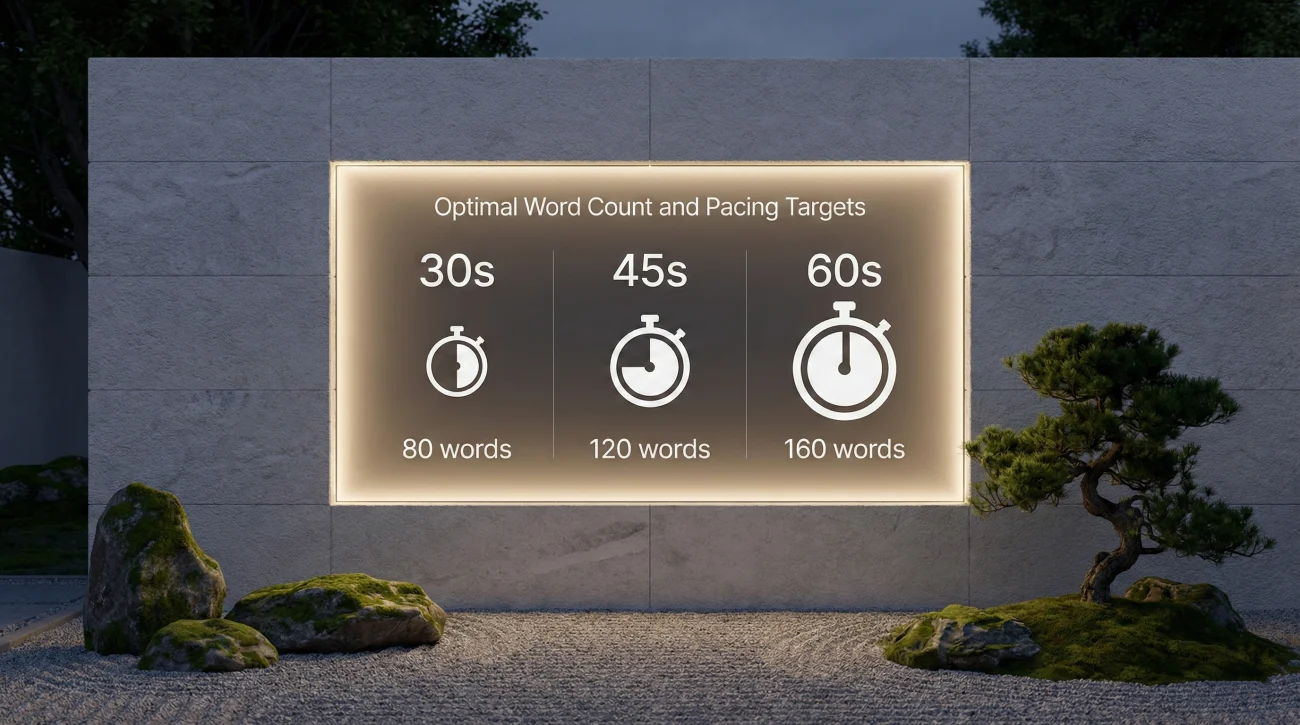
Word Count Guidelines
Natural speaking pace runs 140-160 words per minute. For a 30-second pitch, target 70-80 words total. For 45 seconds, aim for 105-120 words. For 60 seconds maximum, stay under 160 words.
- ⏱️ 30 seconds: 70-80 words (3 short sentences)
- ⏱️ 45 seconds: 105-120 words (3-4 sentences with one expansion)
- ⏱️ 60 seconds: 140-160 words (4-5 sentences with context)
Strategic Pausing
Brief pauses between sentences give listeners time to process. This feels counterintuitive when time is limited, but clarity matters more than cramming in extra words. Pause for one full breath between your three core sentences.
Rushing through your pitch signals nervousness, not efficiency. Controlled pacing demonstrates confidence even under time pressure.
Adapting to Different Contexts
Elevator pitches work across multiple scenarios, but each context demands slight adjustments to maximize impact. The core structure stays consistent while emphasis shifts.
Career Fairs and Job Expos
Career fair conversations compress further because recruiters meet hundreds of candidates. Your pitch needs to accomplish one goal: get a business card or email follow-up. Emphasize specifics that match booth signage. If they’re hiring software engineers, lead with “I’m a software engineer specializing in…” not generic “I’m a computer science major.”
Networking Events
Networking contexts allow slightly more flexibility. Your hook becomes an invitation to conversation rather than a request for opportunities. “I’m always interested in learning how other companies handle X” works better than “I’m looking for a job doing X.”
Phone Screen Openings
Some phone screens start with “Give me the quick version before we dive in.” This requests a compressed pitch even though time isn’t technically limited. Deliver your 45-second version and stop. Don’t fill silence by continuing. Let the interviewer guide what to expand.
| Context | Length Target | Hook Adjustment |
|---|---|---|
| Career Fair | 30 seconds | Direct ask for next steps |
| Networking Event | 45 seconds | Conversation invitation |
| Phone Screen | 45 seconds | Role alignment statement |
| Email Introduction | 60 seconds (written) | Specific value proposition |
| Elevator Encounter | 30 seconds max | Memorable hook for follow-up |
Expert advice: In true elevator encounters with senior executives, your goal isn’t to get hired on the spot. It’s to be memorable enough that they remember you when you follow up or apply through proper channels.
Building and Practicing Your Pitch
Effective elevator pitches require deliberate practice. Unlike longer introductions where you can adjust on the fly, the compressed format demands precision. Every word gets rehearsed until delivery feels natural despite being highly structured.

Writing Your Pitch
Start by writing your full 90-second introduction. Then create three versions: 60 seconds, 45 seconds, and 30 seconds. Each version removes less critical information while keeping core value intact. This forces you to identify what truly matters versus what’s just interesting background.
- Write the 90-second version first to establish full content
- Cut to 60 seconds by removing secondary achievements
- Compress to 45 seconds by simplifying sentence structure
- Reduce to 30 seconds by keeping only Present-Proof-Hook
Rehearsal Technique
Record yourself delivering each version. Listen for filler words, awkward pauses, or rushed sections. Time each delivery precisely. Practice until you can deliver your 30-second version in 28-32 seconds consistently, giving yourself buffer for natural variation.
💡 Pro tip: Practice with a timer visible but not your script. This trains you to internalize pacing while maintaining eye contact rather than reading memorized text.
Pitfalls to Avoid
Even well-intentioned elevator pitches fail when candidates make predictable errors that undermine their compressed message.

Pacing Failures
The most common mistake is speaking too quickly in an attempt to fit more content. This makes you incomprehensible. The second most common is rambling past your target time. Neither approach works.
- ❌ Too fast: Racing through content makes you sound nervous and unprofessional
- ❌ Too long: Going past 60 seconds signals poor judgment about time management
- ❌ Too vague: Generic statements without specifics waste limited time
- ❌ Too humble: Underselling achievements in already-compressed format leaves no impression
Saying “I’ve done a lot of different things” uses 7 words to communicate zero information. Name one specific thing instead.
Content Problems
Including multiple mediocre achievements instead of one strong one dilutes impact. Explaining why you left your last job consumes time better spent on what you can do. Leading with apologies or qualifiers (“I’m still learning, but…”) wastes critical opening seconds.
Being Expansion-Ready

A strong elevator pitch opens doors. The next challenge is smoothly expanding when someone responds “Tell me more.” Have a longer version ready that builds naturally from your compressed pitch without contradicting it. For detailed guidance on expanding your introduction effectively, explore strategies for crafting complete interview answers.
Modular Expansion
Build your pitch in layers. Your 30-second version is the core. Your 60-second version adds context to each core element. Your 90-second version includes additional achievements or background. This layered approach lets you expand naturally based on interest level.
If someone asks about your achievement in sentence 2, you should have 30 seconds of expansion ready: the challenge you faced, your specific approach, measurable results, and what you learned. Practice these expansions separately so you can deliver them smoothly when prompted.
❓ FAQ
🎯 How short is too short for an elevator pitch?
Fifteen seconds is too short to establish credibility and create a hook. You need at minimum 25-30 seconds to deliver the three core sentences effectively. Going shorter forces you into vague generalities that don’t differentiate you from other candidates.
💼 Should I memorize my pitch word-for-word?
Memorize the structure and key phrases, not exact wording. You need flexibility to adjust based on who you’re talking to. Your achievement numbers should be exact, but connecting words can vary naturally. Robotic delivery from perfect memorization sounds worse than slight variations delivered confidently.
⏰ What if someone interrupts my pitch halfway through?
That’s actually good – they’re engaged enough to ask questions. Answer their question directly, then decide if you need to complete your pitch or just continue the conversation naturally. Don’t force yourself to finish a scripted pitch if the dialogue has moved forward productively.
📋 Can I use my elevator pitch as my full interview introduction?
No. When you have 90 seconds available, use them. The elevator pitch is specifically for time-constrained situations. In formal interviews, expand to your full introduction. Using the compressed version when time isn’t limited makes you seem unprepared or unwilling to engage.
✨ How do I make a 30-second pitch memorable?
Specificity creates memorability. “Increased conversion 35%” sticks better than “improved performance.” Named achievements beat generic claims. One vivid detail beats three vague ones. Confident delivery with appropriate pacing makes content land harder than rushed rambling through more information.
Final Thoughts
Mastering the elevator pitch for interview gives you a versatile tool for countless professional situations. Career fairs, networking events, chance encounters, and phone screen openings all demand the ability to communicate your value in 30-60 seconds. This isn’t about dumbing down your experience – it’s about identifying and articulating your core value proposition with precision.
The three-sentence framework works because it mirrors how people naturally process new information. Present establishes context. Proof validates credibility. Hook creates reason to continue. Practice these elements until they flow naturally, then adjust length based on situation while maintaining the core structure.
Your elevator pitch won’t land you a job in 30 seconds. But it will earn you the next 30 minutes of conversation, which gives you the opportunity to make your full case. That’s exactly what it should do.
⚠️ Disclaimer: The interview strategies, sample answers, and negotiation tips provided in this guide are for educational purposes only. Hiring decisions are subjective and vary by company and industry. While these strategies are based on professional HR standards, they do not guarantee a specific job offer or result.