Freelance, Not Flaky
When you say tell me about yourself as a freelancer, the room is quietly translating. Are you a specialist or a drifter? Can you commit to one team, or will you disappear the moment the work gets boring? It is not personal, it is risk management.
Here is the twist: freelancing can be the cleanest proof of ownership. You have to win trust fast, scope work clearly, deliver without hand-holding, and still keep clients calm when priorities change. That is real-world accountability, not a theory from a job description.
So your intro needs one clear through-line: what you do, what results you create, and why you are choosing a full-time seat right now. If you make that transition feel intentional, the “stigma” turns into a signal of maturity and self-direction.
What Employers Worry About
Following Structure
Freelancers set their own schedules, choose their projects, and define their processes. Employers wonder if you can adapt to organizational structures, reporting relationships, and established ways of doing things.
Team Collaboration
Many freelance arrangements involve working independently with limited team interaction. Employers question whether you can collaborate effectively, navigate office dynamics, and contribute to team culture.
Long-Term Commitment
Freelancers have demonstrated they can work independently. Employers worry you’ll miss that independence and leave when you get restless, or that you’re only taking this job until your freelance business recovers.
Being Managed
After being your own boss, can you accept direction from someone else? Will you resist feedback? Will you struggle with organizational hierarchy?
| Employer Concern | How to Address It |
|---|---|
| Can’t follow structure | Describe working within client requirements and deadlines |
| Can’t collaborate | Highlight team projects, client relationships, partnerships |
| Won’t stay | Explain genuine reasons for wanting stability |
| Won’t take direction | Discuss receiving and implementing client feedback |
The Freelance Advantage
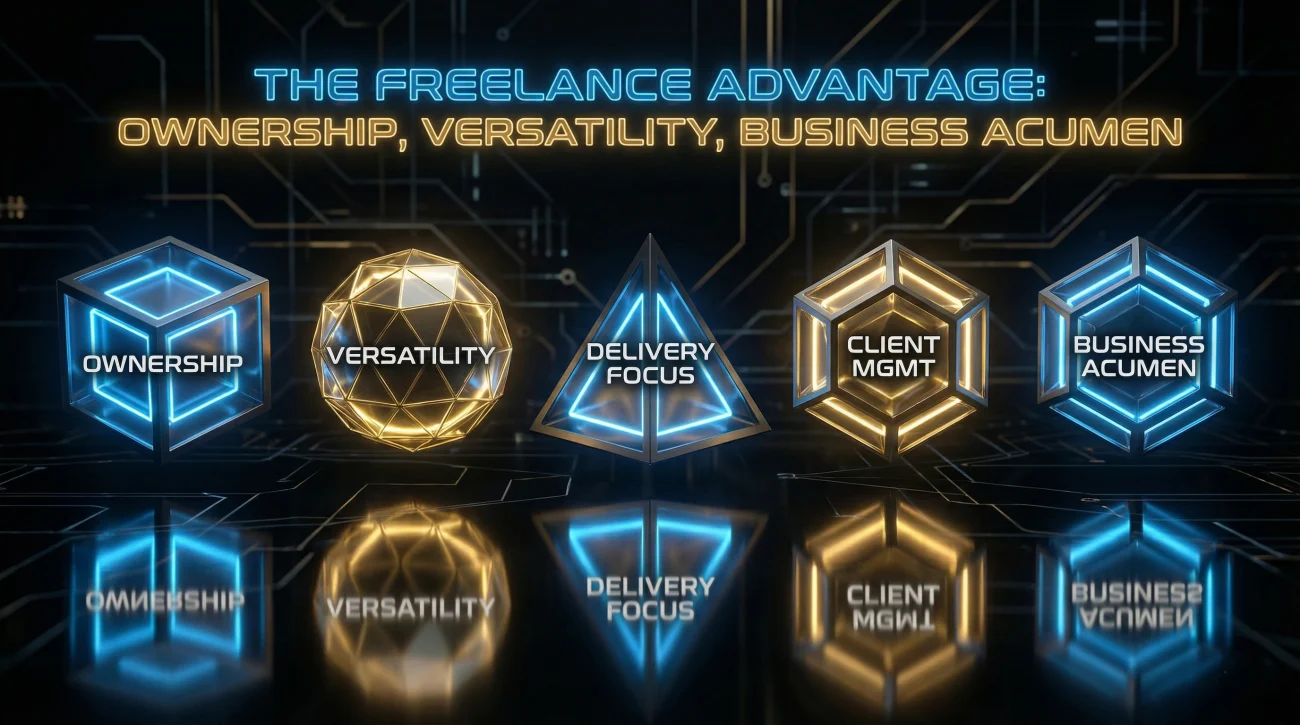
Freelance experience builds capabilities that traditional employment often doesn’t. Position these as advantages rather than just defending against concerns.
Ownership Mentality
Freelancers own everything: client relationships, project outcomes, finances, business development. This creates an ownership mentality that employees sometimes lack. You’re not waiting for someone to tell you what to do.
Client Management
Managing multiple clients builds skills in communication, expectation setting, and stakeholder management. You’ve likely navigated difficult client situations that gave you experience many employees never get.
Versatility
Freelancers often work across different industries, project types, and challenges. This exposure builds adaptability and broad perspective that specialists may lack.
Delivery Focus
When your income depends on satisfied clients, you develop intense focus on delivering results. Freelancers typically have strong track records of meeting deadlines and quality standards because their livelihood depends on it.
Business Acumen
Running a freelance business teaches fundamentals: pricing, negotiation, contracts, marketing, financial management. You understand business in ways that someone who has only been an employee might not.
Building Your Freelancer Introduction

Professional Identity
Lead with your professional expertise, not your employment status. “I’m a marketing strategist with eight years of experience” positions you better than “I’m a freelancer.”
“I’m a software developer specializing in mobile applications, with seven years of experience serving clients ranging from startups to Fortune 500 companies.”
Freelance Achievements
Describe accomplishments from your freelance work. Client outcomes, projects delivered, problems solved. Frame these as professional achievements, which they are.
Transition Motivation
Explain genuinely why you want to move from freelance to full-time. Positive reasons work better than negative ones. Wanting to focus deeply on one product, collaborate with a team, or have more stable income are all legitimate.
Organizational Fit
Address collaboration and structure proactively. Show you understand what’s different about organizational work and that you’re prepared for it.
Sample Freelancer Introductions
Designer Seeking Agency Role
“I’m a brand designer with six years of experience, the last four running my own design practice serving small businesses and startups. I’ve completed over fifty branding projects, from logo design through full brand identity systems.
Running my own practice taught me more than design. I learned to understand client needs, manage projects from brief through delivery, and communicate design decisions persuasively. My client retention rate was about eighty percent, and most of my work came from referrals.
I’m pursuing an agency role because I want to work on larger, more complex projects than I can handle alone, and I miss collaborating with other creative professionals. The energy of working with a team is something I’ve realized I value more than the independence of freelancing.”
Developer Seeking Product Company
“I’m a full-stack developer with eight years of experience building web applications. For the past five years, I’ve worked independently, delivering projects for clients in healthcare, fintech, and e-commerce.
As a freelancer, I’ve shipped over thirty products from initial concept through production deployment. I’ve learned to work within client constraints, hit deadlines reliably, and communicate technical concepts to non-technical stakeholders.
I’m looking for a full-time product role because I want to go deeper. As a freelancer, I build something and move on. I want to iterate, improve, and see how software evolves over time. Your company’s focus on continuous product improvement is exactly what I’m looking for.”
Consultant Seeking Corporate Role
“I’m a marketing strategist who has spent the last six years as an independent consultant working with B2B technology companies. My work focuses on positioning, messaging, and go-to-market strategy.
I’ve led strategy projects for companies ranging from early-stage startups to public companies. The common thread is helping technical companies explain their value in ways that resonate with buyers. My projects have contributed to multiple successful product launches and several acquisition exits.
I want to move in-house because I’ve realized I get the most satisfaction from seeing strategies through to execution, not just handing off recommendations. I’m looking for a company where I can own marketing strategy end-to-end rather than advising from the outside.”
For additional introduction frameworks, explore our comprehensive self-introduction guide.
❓ FAQ
🎯 Should I call myself a freelancer or something else?
Lead with your professional identity. “Independent consultant,” “business owner,” or simply your professional title work better than “freelancer.” Frame yourself as a professional who happened to work independently, not as an employment category.
💼 How do I show I can work in a team?
Describe collaborative aspects of freelance work: partnering with other freelancers, working within client teams, managing subcontractors, or collaborating on complex projects. Most freelance work involves more collaboration than outsiders assume.
⏰ What if they ask if I’ll go back to freelancing?
Be honest about your intentions. If you genuinely want full-time work, explain why. If you’re open to freelancing again someday, you can acknowledge that while emphasizing your current commitment to finding the right full-time opportunity.
📋 How do I present inconsistent work history?
Frame your freelance period as a coherent chapter, not a gap. “From 2019 to 2024, I ran an independent consulting practice serving X type of clients” is clearer than listing every project as a separate job.
✨ What about salary expectations after freelancing?
Research market rates for the role, not what you earned freelancing. Freelance rates include business expenses and lack of benefits that employment provides. Be prepared to discuss compensation realistically based on the full-time market.
Make Independence Sound Reliable
A good close makes tell me about yourself as a freelancer feel like a strength, not a warning label. Lead with a crisp identity, add one or two outcomes that sound measurable, then explain the “why now” in one sentence: you want deeper ownership, longer horizons, and a team where your pace becomes leverage. When the story is coherent, hiring managers stop worrying about flight risk and start seeing stability with extra range.
⚠️ Disclaimer: The interview strategies, sample answers, and negotiation tips provided in this guide are for educational purposes only. Hiring decisions are subjective and vary by company and industry. While these strategies are based on professional HR standards, they do not guarantee a specific job offer or result.