Your Network Is the Service
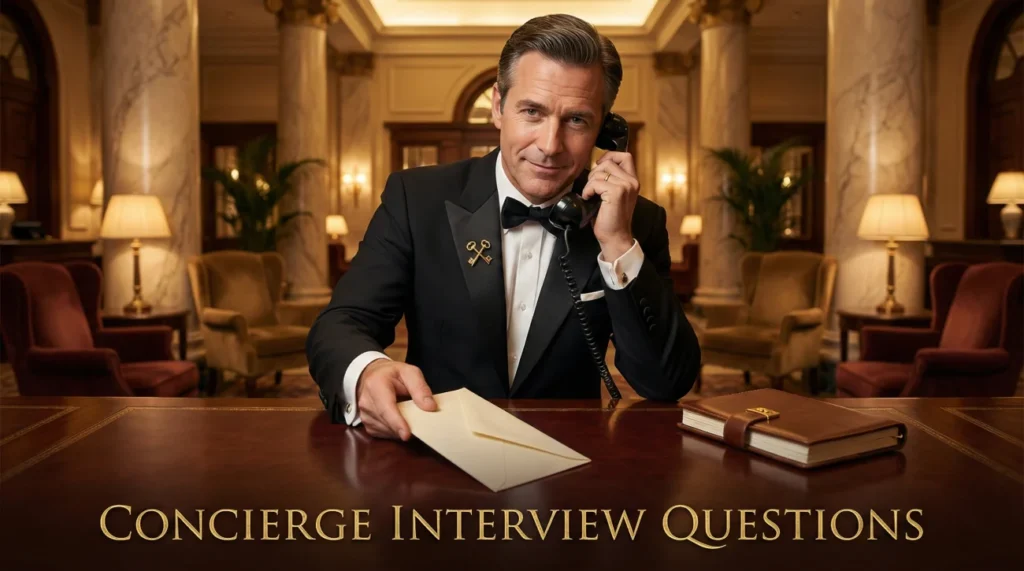
Concierge interview questions often start before you even finish saying hello. A guest walks up and says: “We need a table tonight, we land in 30 minutes, and it has to feel special.” That moment is the job. You are not a search engine. You are the person who knows who to call, what to ask for, and how to make the guest feel looked after while the clock is ticking.
Use these questions to demonstrate three things: your black book relationships, your calm under impossible requests, and your ethics when a venue offers incentives. Describe how you qualify a guest’s vibe in seconds, how you confirm details, and how you document requests so nothing disappears between shifts.
Local Knowledge & The “Black Book”
A Concierge is only as good as their information. Interviewers will test if your finger is truly on the pulse of the city.
Q: How do you stay updated on the latest restaurant openings and local events?
Answer: I treat the city as my office. I subscribe to industry newsletters like Eater and Time Out, but nothing beats boots on the ground. I spend my days off visiting new venues, introducing myself to managers, and tasting the menus. I maintain a digital “Black Book” (or CRM) tagged by vibe (e.g., “Romantic,” “Business,” “Late Night”) so I can match the perfect spot to the guest’s mood instantly. Knowledge is perishable, so I refresh it weekly.
Q: A guest asks for a restaurant recommendation but gives no details. How do you guide them?
Answer: I use the “Funnel Technique.” I ask qualifying questions: “Are we celebrating a special occasion tonight?” “Do you prefer a lively atmosphere or a quiet conversation?” “Is there any cuisine you are craving or avoiding?” This narrows down the thousands of options to three perfect choices. I never just recommend “my favorite” because my taste might not match theirs; I recommend what fits their story.
Q: Describe your relationship with local vendors (florists, ticket brokers, drivers).
Answer: My relationships are built on “Service through Friendship.” I nurture these connections by treating vendors with respect and sending them consistent business. I visit them personally to build rapport. Because I treat them well, they answer my call when I need a favor for a guest at the last minute. My network is my net worth in this role.
Q: What is your stance on “Kickbacks” or commissions from venues?
Answer: Integrity comes first. I recommend venues because they are the best for the guest, not because they pay me. If a venue offers a referral fee, I disclose it to my management or ensure it goes into a shared tip pool, depending on house policy. However, I never let a commission influence my recommendation. If I send a guest to a bad restaurant just for $10, I lose the guest’s trust forever, which is far more expensive.
Handling the “Impossible” Request
The magic happens when the answer should be “No,” but you find a way to make it “Yes.”
Q: A VIP guest wants a reservation at a restaurant that is fully booked for months.
The Strategy: Leverage Relationships.
Answer: I never say “It’s booked.” I say, “Let me see what I can do.” I call my contact at the restaurant directly, not the public line. I ask for a favor, perhaps squeezing them in at the bar or an early seating. If it is truly impossible, I suggest a “sister restaurant” or a place with a similar vibe where I can get them VIP treatment (free champagne/best table), ensuring they still feel special.
Q: A guest needs a specific medication at 3 AM. Pharmacies are closed.
The Strategy: Resourcefulness.
Answer: I check our internal first aid supply for basic OTC items. If it is prescription, I look for a 24-hour pharmacy, even if it is a drive away, and arrange a courier. If it is critical, I can connect them with a “House Doctor” service or telemedicine provider who can issue a prescription to a 24-hour location. I stay calm and provide options, ensuring their health is the priority.
Q: A guest wants tickets to a Sold Out concert tonight.
The Strategy: The Secondary Market.
Answer: “Sold out” usually means “Sold out at face value.” I contact my trusted ticket brokers who hold premium inventory. I explain the cost transparency to the guest: “I can secure these tickets, but the market price is currently $500 per seat. Shall I proceed?” If the price is too high, I look for last-minute drops on verified resale platforms. I manage the transaction to ensure they don’t get scammed.
Q: A guest wants to propose and needs a photographer and flowers in 1 hour.
The Strategy: Operational Sprint.
Answer: I activate my “Emergency Contacts.” I call a local florist who knows me and beg for a rush bouquet. I check Instagram for local photographers who might be nearby or ask a talented staff member to stand in if necessary. I set up a private area in the hotel (rooftop/garden) as a backup location if the original plan fails. I become the event planner on the fly.
Q: A guest lost their luggage. The airline isn’t helping.
The Strategy: Advocacy.
Answer: I take over the burden. I get their baggage claim number and spend the hours on hold with the airline so they can enjoy their day. I arrange for a “Survival Kit” (toiletries, charger) from the hotel. I can also direct them to a high-end rental service or personal shopper if they need clothes immediately for a meeting. I become their relentless advocate.
Q: A guest requests something illegal (drugs/escorts).
The Strategy: Professional Refusal.
Answer: I maintain a poker face. I do not judge, but I strictly refuse. “I am afraid I cannot assist with that request as it violates our hotel policy and local laws.” I do not lecture them. I pivot the conversation back to legal services: “However, if you are looking for entertainment, I can recommend an excellent jazz club or lounge nearby.” I protect the hotel’s license above all.
Logistics & Technology
The job is 50% magic and 50% logistics. If you forget to log a package, the magic is ruined.
Q: Which Concierge software are you familiar with (Alice, GoConcierge)?
Answer: I am proficient in Alice and GoConcierge. I use them to log every single interaction, trace packages, and set reminders for future requests. I believe in the “If it isn’t in the system, it didn’t happen” philosophy. I also use these tools to build guest profiles – noting that Mr. Smith prefers aisle seats and sparkling water, so the next time he visits, we anticipate his needs.
Q: How do you manage a high volume of packages and deliveries?
Answer: I treat packages with the same security as cash. I log them immediately upon arrival (scanning tracking numbers). I call or message the guest instantly: “A package has arrived for you.” I store them in a secure, locked area organized by last name or room number. For high-value items, I require a signature upon pickup. Losing a guest’s delivery is a service failure I avoid at all costs.
Q: How do you coordinate with the Front Desk regarding VIP arrivals?
Answer: I review the arrival report daily with the Front Office Manager. If I see a guest I have corresponded with via email is arriving, I ensure their itinerary is printed and placed in their room or waiting at the desk. I try to greet them personally in the lobby to put a face to the name. We act as one team; the Front Desk handles the room, I handle the experience.
Situational & Behavioral Scenarios
These questions test your empathy and your ability to read people.
A guest is visibly upset because their entire vacation plan was rained out.
The Strategy: The “Rainy Day” Pivot.
Answer: I validate their disappointment first. Then, I sell the “cozy” alternative. “I know this weather is terrible, but it’s actually the perfect day to visit [Museum Name] which is empty right now, or to enjoy a long, lazy lunch at [Restaurant].” I have a pre-prepared list of indoor activities (spas, cooking classes, shopping malls). I turn the bad weather into an opportunity to relax.
A guest asks for a recommendation that you personally dislike.
The Strategy: Objective Professionalism.
Answer: My personal taste is irrelevant. If they want a loud, touristy theme restaurant that I find tacky, but I know it fits their description of “fun,” I recommend it enthusiastically. I might add a small caveat: “It is very lively and popular with tourists, so it won’t be a quiet local experience, but the energy is great.” I serve the guest’s taste, not mine.
You promised a guest a reservation, but the restaurant lost it.
The Strategy: Own and Fix.
Answer: I own the problem completely. I don’t blame the restaurant. I call the restaurant and plead/negotiate to get them back in. If that fails, I find a better alternative immediately. I pay for their first round of drinks or taxi to the new venue. I apologize profusely: “I am so sorry for this mix-up, I have arranged a table at [Venue B] and they are expecting you with champagne.”
Concierge Skills Quiz
Test Your Concierge IQ
1. “Les Clefs d’Or” translates to:
- The Golden Door
- The Golden Keys (Professional association of concierges)
- The Key Master
- The Gold Hotel
2. A “Maitre d'” manages:
- The kitchen
- The dining room/Front of House reservations
- The valet parking
- The hotel cleaning
3. “Pax” refers to:
- Packages
- Passengers/People (e.g., “Table for 4 pax”)
- Passports
- Payments
4. What is a “Manifest”?
- A wish list
- A document listing passengers/guests for a tour or vehicle
- A menu
- A receipt
5. “Confirmed” reservation means:
- You hope it’s there
- The venue has acknowledged and secured the booking (often with a confirmation number)
- The guest paid
- The concierge called
6. “OpenTable” is:
- A table with no chairs
- A widely used online restaurant reservation platform
- A furniture store
- A kitchen tool
7. “Chartering” usually refers to:
- Drawing a map
- Hiring a private vehicle/boat/plane for exclusive use
- Writing a letter
- Checking in
8. A “Sommelier” specializes in:
- Cheese
- Wine
- Coffee
- Cigars
9. “Gratuity” is:
- Being grateful
- A tip given for service
- A tax
- A free item
10. “Turnaround Time” for laundry typically is:
- 10 minutes
- Same day or Overnight (Standard vs. Express)
- 1 week
- 1 month
11. “Prix Fixe” menu means:
- Price is fixed (negotiable)
- Fixed Price menu with set courses (no à la carte ordering)
- Expensive food
- Free food
12. “Black Car Service” implies:
- A dirty car
- Luxury private sedan transportation (often Lincoln/Mercedes)
- A taxi
- A bus
13. “Concierge” comes from the French word meaning:
- King of the Castle
- Keeper of the Candles (Comte des Cierges)
- Door Opener
- Key Holder
14. If a guest asks for a “Quiet Table,” you request:
- A table near the kitchen
- A corner table or booth away from high-traffic areas
- A table at the bar
- A table outside
15. “Running an Errand” means:
- Going for a jog
- Leaving the hotel to perform a task for a guest (buying medicine, picking up tickets)
- Running away
- Cleaning the lobby
16. “Logbook” is used for:
- Logging wood
- Recording all guest requests, shift notes, and pending tasks for the next shift
- Drawing pictures
- Guest signatures only
17. “Curating” an experience means:
- Booking the first thing you see
- Carefully selecting and organizing activities to match the guest’s specific taste
- Cleaning a museum
- Canceling a trip
18. “Walk-in” availability refers to:
- A closet
- Restaurants/Venues that accept guests without reservations
- Walking tours
- Hotels only
19. A “Rider” in event terms is:
- A passenger
- A list of specific requests/demands from a performer or VIP (e.g., green M&Ms)
- A horse
- A ticket
20. The most important tool for a Concierge is:
- A map
- Their contact list (Network)
- A key
- A suit
❓ FAQ
🗝️ What counts as a strong concierge “Black Book”?
A black book is a living contact network, not a list of popular places. Explain how you build relationships with hosts, managers, drivers, ticket brokers, and how you keep notes on vibe, price, and reliability.
📲 Do I need to know concierge software already?
It helps, but the bigger point is your habits. Say you log every request, use reminders, and write clear handoff notes. That shows you can manage volume without dropping details.
💬 What do I say when a request cannot be done?
Stay neutral and protect policy. You acknowledge the ask, refuse the illegal or unsafe option, and immediately offer two legal alternatives that still feel premium.
🌐 Are extra languages required?
Not always, but they are a major advantage in luxury settings. If you speak another language, tie it to smoother service and fewer misunderstandings under pressure.
🎩 How formal should I be at the interview?
Dress like the lobby standard: polished, conservative, and intentional. You represent the hotel’s tone, so your grooming should look reliable, not flashy.
Final Thoughts
To succeed in answering concierge interview questions, show you can translate a vague desire into a precise plan. Your best answers sound like: ask two quick clarifiers, call the right person, confirm the details, then update the guest with calm confidence. That is luxury.
Make it clear you work in sync with the front desk. When arrivals change or VIP notes update, you adjust the experience without drama.
⚠️ Disclaimer: The interview strategies, sample answers, and negotiation tips provided in this guide are for educational purposes only. Hiring decisions are subjective and vary by company and industry. While these strategies are based on professional HR standards, they do not guarantee a specific job offer or result.