The Evolution of Customer Support
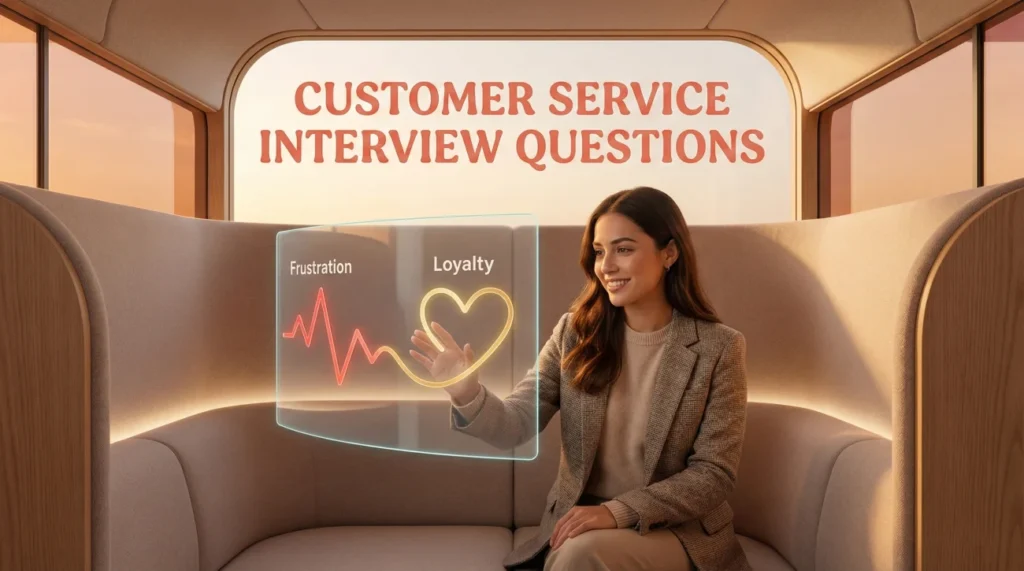
Customer service interview questions in 2025 are no longer just about your ability to apologize or smile through the phone. In today’s omni-channel environment, hiring managers are looking for “Customer Success” mindsets. They need to know if you can switch seamlessly between a live chat, an email, and a phone call while maintaining the same brand voice. They want to see if you can leverage AI tools to work faster without sounding robotic, and most importantly, if you possess the emotional intelligence (EQ) to turn a frustrated client into a loyal advocate.
This guide is your comprehensive playbook. We move beyond the basics to cover the “Service Recovery Paradox” (how fixing a mistake well can actually increase loyalty), the technicalities of modern ticketing systems like Zendesk and Salesforce, and the psychological tactics required for de-escalation. Whether you are applying for a remote support role for a tech startup or a front-line guest services position, demonstrating empathy and problem-solving agility is your key to the offer.
Core Philosophy & Soft Skills
Before testing your technical knowledge, interviewers need to verify your mindset. Do you view support as a cost center or a value driver? These questions assess your foundational approach to service.
Q: How do you define “exceptional” customer service?
Exceptional service is about anticipation and ownership. It is not just answering the question asked, but answering the next three questions the customer hasn’t thought of yet. For example, if a customer calls about a shipping delay, I don’t just give them the new date. I apologize, explain the context, offer a small gesture of goodwill (like a discount on the next order), and proactively monitor the package until it arrives to update them personally. It means taking the burden of worry off the customer’s shoulders.
Q: What does the phrase “The customer is always right” mean to you?
I interpret it as “The customer’s feelings are always valid.” While they may be factually wrong about a policy or a product limitation, their frustration is real. My job isn’t to debate facts but to validate their emotions and find a solution that aligns with company policy while making them feel heard. It is about preserving the relationship even when we have to say no to a specific request.
Q: Explain the difference between empathy and sympathy in a support context.
Sympathy is feeling for someone (“I am sorry that happened to you”), while empathy is feeling with someone (“I can understand how frustrating that must be”). In customer service, empathy is the more powerful tool. It builds a bridge. When I use empathy statements like “I would be upset in this situation too,” it de-escalates tension immediately because the customer realizes I am on their side, not a gatekeeper blocking them.
Q: How do you handle a “known issue” that the company hasn’t fixed yet?
Transparency is key. I never lie or make empty promises. I acknowledge the issue: “This is currently a known bug that our engineering team is prioritizing.” Then, I pivot to the workaround or the solution I can provide right now. Customers appreciate honesty more than a scripted deflection. I also ensure I add their case to the internal tracking ticket so they get notified automatically when a permanent fix is deployed.
Conflict Resolution & De-escalation
This is the most critical part of the interview. You will face questions about anger, unreasonable demands, and stress management. Show that you can be the “calm in the storm.”
Q: Describe a time you had to deal with an angry customer. How did you handle it?
I use the LAST method: Listen, Apologize, Solve, Thank. In a previous role, a customer was yelling because their subscription was renewed automatically. I let them vent without interruption. Once they paused, I lowered my voice and said, “I completely understand why that surprise charge is frustrating.” I explained the policy but immediately offered a refund as a one-time courtesy since they hadn’t used the service yet. The customer ended up apologizing for yelling and renewed manually the next month.
Q: How do you say “No” to a customer without upsetting them?
I use the “Yes, but…” or “Alternative Option” technique. Instead of a flat “No, we can’t do that,” I say, “While I cannot authorize a full refund for an item used for six months, what I can do is offer you a 20% discount on a replacement part and guide you through the repair process.” By focusing on what is possible rather than what is impossible, I keep the conversation constructive and helpful.
Q: Tell me about a time you turned a negative situation into a positive one (Service Recovery).
A hotel guest arrived to find their room wasn’t ready at 3 PM. They were exhausted and angry. Instead of just asking them to wait, I apologized, stored their bags, and offered them complimentary vouchers for drinks and appetizers at the hotel bar while they waited. I also upgraded their room view when it became available. They later left a 5-star review specifically mentioning how well the delay was handled. This proved the service recovery paradox: a fixed problem can build stronger loyalty than perfect service.
Q: How do you handle a customer who uses abusive language?
I have a thick skin, but I also have boundaries. I start with a warning: “I really want to help you, but I cannot continue this conversation if you use profanity.” If they continue, I follow company protocol, which usually involves placing them on a brief hold to let them cool down or escalating the call to a supervisor. I never retaliate or raise my voice. Staying professional preserves the company’s reputation and protects my own mental well-being.
Q: What do you do if you don’t know the answer to a customer’s question?
I avoid guessing, as misinformation damages trust. I say, “That is a great question. I want to be 100% sure before I give you an answer. Do you mind holding for two minutes while I double-check with our specialist?” If it takes longer, I take their contact info and promise a follow-up by a specific time. Reliability is better than a quick, incorrect answer.
Q: How do you maintain your own morale after a series of difficult calls?
I practice “emotional reset” techniques. After a bad interaction, I take a deep breath, stand up for a second if possible, and remind myself that the customer’s anger is not personal; it is directed at the situation. I also celebrate small wins with my team. Sharing a tough story and laughing about it with colleagues helps release the stress so I can answer the next call with a fresh, positive tone.
Tools, Prioritization & Omni-channel
Modern support is high-tech. You need to show proficiency with CRMs and the ability to juggle multiple channels without dropping the ball.
Q: Which customer service tools are you familiar with?
I have extensive experience with ticketing systems like Zendesk and Salesforce Service Cloud. I am comfortable managing ticket queues, using macros to speed up routine responses without sounding robotic, and documenting case notes for future reference. I am also familiar with live chat platforms like Intercom and project management tools like Jira for escalating technical bugs to the engineering team.
Q: How do you prioritize tickets when you have a high backlog?
I triage based on urgency and impact. Severity 1 issues (system outages, payment failures) always come first. Then, I look at SLA (Service Level Agreement) deadlines to ensure we aren’t breaching contracts. I also group similar tickets together; if 50 people are emailing about the same login bug, I can use a bulk response to resolve them quickly, clearing the queue to focus on more complex, individual issues.
Q: How does your communication style change between Live Chat, Email, and Phone?
On Live Chat, I am concise and conversational, using short sentences to keep the pace moving. On Email, I am more structured and thorough, anticipating follow-up questions to avoid a long back-and-forth thread. On the Phone, tone is everything; I use verbal nods (“I see,” “Go on”) to show active listening and adjust my speaking speed to match the customer’s pace. Adaptability is crucial in an omni-channel role.
Q: What is your experience with AI or chatbots in customer support?
I view AI as an assistant, not a replacement. I have used AI tools to draft initial email responses or to quickly summarize long ticket threads. However, I always review and personalize the output before sending. AI handles the data retrieval, but I handle the empathy and judgment call. If a customer is clearly frustrated with a chatbot loop, I know to intervene immediately and offer human connection.
Situational Scenarios
Hiring managers love “What would you do if…” questions to test your real-time problem-solving skills.
A loyal customer demands a refund for a product that is outside the return window. What do you do?
I first check their customer lifetime value (LTV). If they are a long-time loyal shopper, I advocate for a one-time exception, framing it as a reward for their loyalty: “Normally our policy is strict on this, but because you’ve been such a great customer for 3 years, I’m going to override it for you this time.” If the system absolutely blocks it, I offer store credit or a free shipping code for their next purchase. The goal is to retain the relationship.
You realize you made a mistake that caused a customer to be double-billed. How do you handle it?
I own it immediately. I call or email the customer before they even notice if possible. “Hello, I wanted to let you know I made an error and processed your payment twice. I have already initiated the refund, and you should see it in 3-5 days. I apologize for the inconvenience.” Proactive honesty turns a potential complaint into a demonstration of integrity.
A customer is complaining about a feature our product doesn’t have and likely never will. How do you respond?
I validate the “job to be done.” I ask, “What is the specific goal you are trying to achieve with that feature?” Often, I can show them a different way to achieve the same result using existing features. If not, I honestly explain that it’s not on the roadmap but I will log their feedback. I then try to highlight the strengths of the product that do fit their needs, preventing churn.
Metrics & Continuous Improvement
Prove that you understand the business side of support. It’s not just about feelings; it’s about data.
Q: What metrics do you track to measure your performance?
I focus on CSAT (Customer Satisfaction Score) because it directly reflects the quality of my help. I also watch my First Contact Resolution (FCR) rate, as solving issues in one interaction respects the customer’s time. While AHT (Average Handle Time) is important for efficiency, I never rush a call just to meet a metric if it compromises the quality of the resolution.
Q: How do you handle feedback from a low CSAT score?
I view negative feedback as free coaching. I review the ticket transcript to see where I missed the mark. Did I interrupt? Did I fail to set expectations? If the feedback is valid, I internalize the lesson. If the low score was due to a company policy (like a price increase) rather than my service, I discuss with my manager how we can better frame those messages in the future.
Q: How do you identify trends to help the product team?
Support is the “ears” of the company. If I tag five tickets in one day regarding “checkout error,” I immediately flag this to the technical team. I believe in documenting the “Why” behind tickets, not just closing them. By providing detailed categorization, I help the product team prioritize which bugs or features will have the biggest impact on reducing support volume.
Customer Service Skills Quiz
Test Your Service IQ
1. “CSAT” stands for:
- Customer Service Agent Team
- Customer Satisfaction Score
- Computer System Analysis Tool
- Call Support Average Time
2. The “Service Recovery Paradox” suggests that:
- Customers prefer automated service
- A successfully resolved failure can create higher loyalty than perfect service
- Mistakes always lead to churn
- Refunds are the only way to recover service
3. “First Contact Resolution” (FCR) means:
- Answering the phone on the first ring
- Resolving the customer’s issue in a single interaction
- Being the first person to speak to a customer
- Escalating to a manager immediately
4. When a customer is angry, the best first step is to:
- Interrupt them with a solution
- Listen actively and let them vent
- Put them on hold
- Tell them to calm down
5. “NPS” (Net Promoter Score) measures:
- How fast an agent types
- Likelihood of a customer recommending the company to others
- Number of products sold
- Network Performance Speed
6. Empathy is defined as:
- Feeling sorry for someone
- Understanding and sharing the feelings of another
- Agreeing with everything the customer says
- Solving the problem technically
7. A “Knowledge Base” (KB) is used to:
- Track employee attendance
- Store articles and guides for customers and agents
- Monitor call times
- Process payments
8. “Omni-channel” support means:
- Only offering phone support
- Providing a seamless experience across multiple channels (email, chat, phone, social)
- Using AI bots only
- Support available only during business hours
9. In the “LAST” method for handling complaints, “A” stands for:
- Argue
- Apologize
- Ask
- Analyze
10. “Churn” refers to:
- New customers signing up
- Customers stopping business with a company
- Mixing data types
- High call volume
11. A “Ticket” in customer support is:
- A prize for good work
- A record of a customer interaction or issue
- A fee charged to the customer
- A permission slip
12. “Soft Skills” include:
- Typing speed and software knowledge
- Communication, patience, and emotional intelligence
- Coding and programming
- Operating machinery
13. Which phrase is a “Negative Trigger” to avoid?
- “Let me find that out for you.”
- “Calm down.”
- “I understand your frustration.”
- “Here is what we can do.”
14. “SLA” stands for:
- Service Line Area
- Service Level Agreement
- Standard Legal Action
- System Log Analysis
15. “Active Listening” involves:
- Thinking about your answer while they talk
- Paraphrasing and confirming understanding
- Interrupting to save time
- Typing loudly while they speak
16. “Upselling” in a service context means:
- Ignoring the customer’s budget
- Suggesting a premium option that adds value to their needs
- Selling broken items
- Refusing service
17. “Escalation” means:
- Hanging up the phone
- Transferring the issue to a higher level of authority or expertise
- Deleting the ticket
- Ignoring the email
18. “Tone of Voice” is especially important in:
- Spreadsheets
- Phone and written communication
- Coding
- Filing paperwork
19. If a customer asks for a discount you cannot give, you should:
- Hang up
- Explain the value of the product and offer alternative assistance
- Give it anyway to avoid conflict
- Tell them they are cheap
20. “Customer Lifetime Value” (CLV) encourages agents to:
- Focus on the single transaction only
- Build long-term relationships for future revenue
- Ignore small customers
- Rush through calls
❓ FAQ
💼 How do I answer “Sell me this pen” in a support interview?
This is a trick question. In support, you don’t “sell” features; you solve problems. Ask questions first: “What are you currently using to write?” or “Do you ever get frustrated when your pen runs out of ink?” Then, position the pen as the solution to their specific pain point. Show you are a consultant, not a pusher.
🗣️ What if I don’t have call center experience?
Focus on transferrable skills. Have you worked in retail, hospitality, or even volunteered? Any role where you solved problems for people counts. Highlight your soft skills: patience, communication, and tech-savviness. Employers can teach you the software; they can’t easily teach you how to care about people.
🧠 How do I demonstrate “Emotional Intelligence”?
Use “I” statements in your stories. Don’t just say “I fixed the issue.” Say “I sensed hesitation in their voice, so I asked further questions to uncover the real worry.” Describe how you managed your own emotions during stress and how you validated the customer’s feelings.
🤖 Will AI replace customer service jobs?
AI will replace repetitive tasks, but not complex empathy-driven roles. The demand is shifting towards “Tier 2” support – agents who handle the complex, emotional, or high-stakes issues that bots can’t solve. Positioning yourself as a problem-solver who works with AI is the best career insurance.
📄 What should I put in my resume for this role?
Quantify your impact. Instead of “Handled calls,” write “Resolved 50+ tickets daily with a 98% CSAT score.” List specific tools like Zendesk, Intercom, or Jira. Mention any languages you speak, as bilingual support is in high demand.
Final Thoughts
To ace your customer service interview questions, remember that you are the face of the brand. Every answer should demonstrate that you are a resilient problem solver who puts the customer relationship first. Whether you are dealing with a software bug or an unhappy hotel guest, the core skill is the same: making the person across from you feel valued and heard.
Prepare your “war stories” – examples of times you turned a disaster into a delight. Show that you understand the metrics but lead with empathy. For more insights on general interview preparation, explore our hub on interview questions to build your confidence for the big day.
⚠️ Disclaimer: The interview strategies, sample answers, and negotiation tips provided in this guide are for educational purposes only. Hiring decisions are subjective and vary by company and industry. While these strategies are based on professional HR standards, they do not guarantee a specific job offer or result.