The Bar Tests Your Hands and Your Judgment
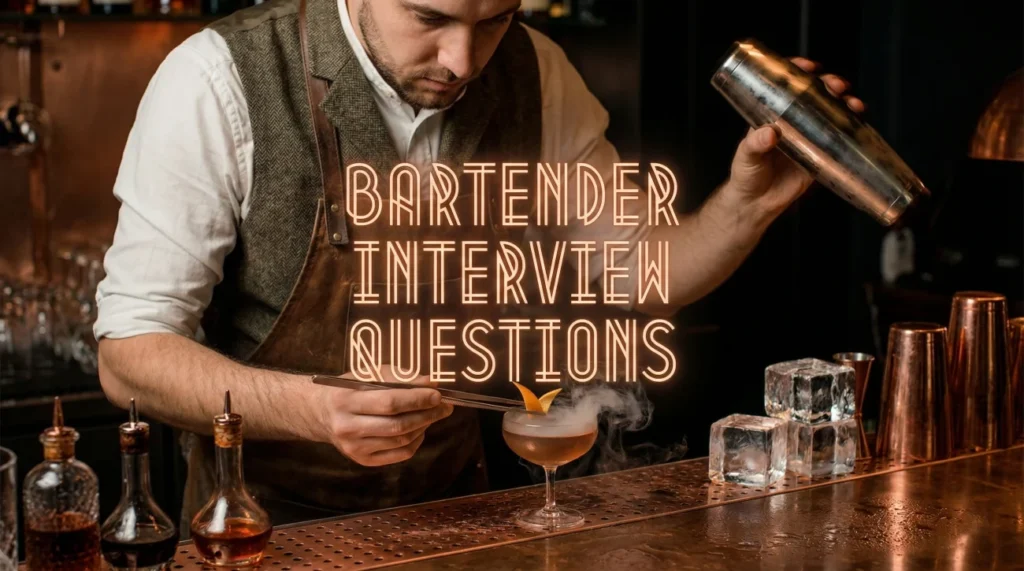
Bartender interview questions usually start with drinks, but they quickly reveal what matters most: speed under pressure, clean technique, and the confidence to say “no” when a guest has had too much. A good bartender can build a round fast. A great bartender can do it while keeping the room safe and the vibe friendly.
You will hear questions that feel like a working shift: classic builds, shake versus stir, how you set up your station, and how you handle chaos when the printer will not stop. The goal is simple: prove you can be fast, accurate, and calm, all at the same time.
Mixology & Product Knowledge
You cannot fake this. Expect a verbal or practical test on recipes and spirits. You need to know the “Why” behind the drink, not just the “How.”
Q: What are the main differences between a standard Old Fashioned and a Manhattan?
Answer: Both are whiskey classics, but the base and modifier differ. An Old Fashioned is typically Bourbon (or Rye), Sugar (cube or syrup), and Angostura Bitters, served on the rocks with an orange peel. A Manhattan uses Rye whiskey (traditionally), Sweet Vermouth (instead of sugar), and Angostura Bitters, served “up” (chilled, no ice) in a coupe with a cherry. The Manhattan is more herbal due to the vermouth; the Old Fashioned is more spirit-forward.
Q: When do you Shake vs. When do you Stir a cocktail?
Answer: The golden rule is: If it has juice, cream, or egg whites (cloudy ingredients), you Shake to aerate, emulsify, and dilute. Examples: Margarita, Daiquiri. If it is all spirits (clear ingredients), you Stir to chill and dilute without creating bubbles or cloudiness, maintaining a silky texture. Examples: Martini, Negroni.
Q: How do you handle the rising demand for “Low-ABV” or “Mocktails”?
Answer: I treat them with the same respect as full-strength cocktails. I don’t just pour juice in a cup. I use non-alcoholic spirits (like Seedlip or Lyre’s), fresh herbs, shrubs, and high-quality tonics to build complexity. I understand that the “Sober Curious” movement is a huge revenue opportunity, and a well-made $12 mocktail is better for the bottom line than a $3 soda.
Q: Explain the term “Wash Line.”
Answer: The wash line is the level where the liquid sits in the glass. It must be consistent. If a drink is served “up,” the wash line should be just below the rim to prevent spilling but look generous. In a highball, the wash line (after ice) should leave specific room for garnish. Consistency in wash lines ensures cost control and guest satisfaction – no one thinks they got “short-poured.”
Speed, Efficiency & The “Well”
Can you handle the rush? Interviewers want to hear about your workflow mechanics and how you prioritize orders.
Q: Explain “Mise en place” behind the bar.
The Strategy: Preparation is Survival.
Answer: Everything has a home. My fruit is cut, my syrups are backed up, my wines are uncorked, and my tools are in the sanitation bucket. If I have to leave the well to find a lime during a rush, I have already failed. I set my station up identically every shift so my muscle memory can take over when it gets busy.
Q: How do you build a “Round” of drinks efficiently?
The Strategy: Cheapest to Most Expensive.
Answer: I line up all glassware first. I pour ingredients in order of cost: juices/syrups first, then liqueurs, then the base spirit. If I make a mistake with the juice, I only waste pennies. I ice the glasses last to prevent dilution. I finish the draft beers while the cocktails are shaking. This ensures everything hits the bar top fresh at the same moment.
Q: What is a “Jigger” vs. “Free Pouring”? Which do you prefer?
The Strategy: Accuracy vs. Speed.
Answer: I am proficient in both, but I adapt to the venue. For craft cocktails with complex ratios, I always use a Jigger for precision. For high-volume wells (Gin & Tonics), I use a counted Free Pour for speed, provided I have tested my pour counts (1-2-3-4) for accuracy. I respect the house policy above my preference.
Q: How do you prioritize orders when the service printer is running and guests are waving?
The Strategy: Acknowledgement & Triage.
Answer: The guest in front of me usually takes priority over the ticket, but I multitask. I acknowledge the waving guest: “I see you, I’ll be right there!” while I am pouring the service drinks. I try to combine steps – if the service ticket needs a vodka soda and the guest wants one too, I make them simultaneously. Silence is the enemy; communication buys me time.
Q: How do you minimize waste behind the bar?
The Strategy: Profit Protection.
Answer: I follow FIFO (First In, First Out) for perishables like mint and citrus. I measure my pours accurately. I also look for creative ways to use “scraps” – like using leftover champagne for a syrup or dehydrating aging citrus wheels for garnish. Spillage is money on the floor, so I work clean and deliberate.
Q: The keg blows in the middle of a rush. What do you do?
The Strategy: Calm Communication.
Answer: I don’t panic. I tell the guest or server immediately: “That keg just kicked, it will be 3 minutes to change. Do you want to wait or switch to a bottle?” If I have a barback, I direct them clearly. If I am alone, I finish the current round of cocktails first, then run to the cooler. I never leave a half-poured drink sitting on the bar to go change a keg.
Responsible Service & Safety
You are the gatekeeper of sobriety. Interviewers need to know you have the confidence to say “No” to protect the establishment.
How do you cut off a customer who has had too much?
The Strategy: Be Firm but Non-Judgmental.
Answer: I don’t embarrass them. I lean in quietly and say, “Hey man, I think you’ve had enough for tonight. I can’t serve you another one, but I can get you a water or call you a cab.” I never phrase it as a question. It is a statement. I also remove their empty glass so there is no reason for them to linger. If they argue, I repeat the statement calmly: “I’d love to see you tomorrow, but tonight is done.”
A regular customer forgets their ID. Do you serve them?
The Strategy: License Protection.
Answer: If I know them personally and know they are of age, house policy might allow it. However, strict legal protocol says: “No ID, No Service.” I would say, “I know you’re old enough, Dave, but the cameras/cops don’t. I can’t risk my license or the bar’s license.” True regulars usually respect that because they value the relationship.
You break a glass near the ice bin.
The Strategy: The “Burn the Ice” Protocol.
Answer: This is a “Red Alert.” I immediately stop service. I pour grenadine or cranberry juice over the ice so no one accidentally uses it. I empty the entire bin (burn the ice) with hot water, wipe it out to ensure no shards remain, and refill it. It kills speed, but serving glass to a guest kills the business. I never take the risk of “just scooping around it.”
Situational & Service Scenarios
The bar is a stage. These questions test your ability to perform under pressure and handle difficult audience members.
A guest says “This drink is too weak. Make it stronger.”
The Strategy: Education vs. Confrontation.
Answer: I don’t just add free liquor. I might say, “I poured a standard 2oz shot. If you’d like a double, I can certainly ring that up for you.” Or, if it’s a balanced cocktail, I explain: “The lime juice in a Gimlet sometimes masks the gin, but it’s definitely in there.” Sometimes, I’ll pour a tiny “straw test” of liquor down the straw so their first sip is boozy – a classic bartender trick (if appropriate for the venue).
Two guests are getting aggressive with each other at the bar.
The Strategy: De-escalation.
Answer: I intervene early. I make eye contact and say loudly but friendly, “Hey guys, let’s keep it cool in here.” I physically stand between them behind the bar. If it escalates, I signal security or the manager immediately. I never come out from behind the bar to fight; the bar is my barrier and my safe zone.
It’s a slow Tuesday night. What are you doing?
The Strategy: Initiative.
Answer: If you have time to lean, you have time to clean. I deep clean the bottles (dusty bottles look bad), polish glassware, restock the fridges perfectly, or prep elaborate garnishes for the weekend rush. I might also experiment with a new cocktail recipe to present to the Bar Manager. I treat the downtime as preparation time.
Bartender Knowledge Quiz
Test Your Bar IQ
1. What is the base spirit in a “Moscow Mule”?
- Gin
- Vodka
- Rum
- Tequila
2. “Neat” means:
- Clean glass
- Room temperature spirit served without ice or mixers
- Served with one ice cube
- Served in a shot glass
3. “On the Rocks” means:
- Served on salt
- Served over ice
- Blended with ice
- Served with stones
4. What is a “Twist”?
- A dance move
- A piece of citrus peel twisted over the drink to release oils
- A spiral straw
- Mixing two spirits
5. “Muddling” is:
- Thinking hard
- Crushing ingredients (herbs/fruit) to release flavor
- Stirring quickly
- Shaking gently
6. Which of these is NOT in a Long Island Iced Tea?
- Gin
- Tequila
- Whiskey
- Vodka
7. “Call Drink” vs “Well Drink”:
- Call is ordered by phone
- Call specifies the brand (e.g., Jack & Coke); Well uses the house brand
- Well is healthier
- Call is cheaper
8. “IPA” stands for:
- International Pub Ale
- India Pale Ale
- Irish Pale Ale
- Icy Pour Ale
9. A “Chaser” or “Back” is:
- A person running
- A mild drink (water/soda/beer) taken after a shot of hard liquor
- The last drink of the night
- A rejected drink
10. “Vermouth” is technically a:
- Spirit
- Fortified and aromatized wine
- Liqueur
- Beer
11. What distinguishes a “London Dry Gin”?
- It is made in London
- It has no artificial flavors or sweeteners added after distillation
- It is very strong
- It is clear
12. “Double Straining” involves:
- Straining twice through the same tool
- Using a Hawthorne strainer + a fine mesh strainer to catch ice shards/pulp
- Straining into two glasses
- Using a cloth
13. A “Speed Pourer” helps to:
- Clean the bottle
- Control the flow of liquid for accurate counting/pouring
- Make the drink colder
- Stop insects
14. “Proof” is:
- Evidence of age
- Twice the percentage of alcohol by volume (ABV) (e.g., 100 Proof = 50% ABV)
- The price
- The quality rating
15. Which glass is used for a Cognac/Brandy?
- Highball
- Snifter
- Flute
- Shot glass
16. “Bitters” are used primarily for:
- Making the drink bitter only
- Adding complexity, balance, and aromatics (like salt and pepper for cooking)
- Coloring
- Preservation
17. “Top Shelf” refers to:
- Dusty bottles
- Premium, expensive brands of liquor
- Glasses stored high up
- The bar counter
18. “Draft” beer is served from:
- A bottle
- A keg/cask via a tap system
- A can
- A bucket
19. A “Virgin” drink is:
- A new recipe
- Non-alcoholic
- Made with olive oil
- Served in a white glass
20. “Last Call” means:
- The bartender is leaving
- The final opportunity to order drinks before the bar closes
- Calling a taxi
- The phone is ringing
❓ FAQ
🛠️ Do I need to bring my own tools?
It depends on the venue. Many craft bars like seeing you bring a basic kit (jigger, bar spoon, peeler, wine key, bottle opener), especially for a trial. High-volume bars often supply most tools. The safest move is to show up prepared with the essentials unless the manager tells you not to.
📜 Do I need a license?
In many places, yes. Responsible alcohol service certification is common, and some locations require it before you start. If you already have it, mention it. If you do not, tell them you are ready to complete it immediately. That signals maturity and respect for the rules.
💪 Is bartending physically hard?
Yes. You are on your feet for long hours, lifting cases, bending for ice, and shaking tins repeatedly. Your endurance matters, but so does your setup. A tidy, consistent station prevents wasted motion and keeps your body from getting wrecked by the shift.
💸 How good are the tips?
Tips vary by concept, location, and volume. What you can control is guest experience: fast service, strong conversation skills, and accuracy. Interviewers like candidates who understand that tips follow consistency, not luck.
🍸 What should I memorize before an interview?
Know the core classics and their families (Old Fashioned, Manhattan, Margarita, Daiquiri, Negroni, Martini). Be ready to explain your shake versus stir rule, standard pours, and how you avoid waste. If you can speak clearly about process, they will trust you with the well.
Leave Them With One Clean Promise
The strongest answers to bartender interview questions sound like this: “I work clean, I pour accurately, and I protect the room.” Back it up with one real example of handling pressure, one example of preventing waste, and one example of cutting someone off without turning it into a fight.
If you want extra practice for high-volume pacing and guest flow, skim these server interview practice questions and borrow the language that keeps service moving.
⚠️ Disclaimer: The interview strategies, sample answers, and negotiation tips provided in this guide are for educational purposes only. Hiring decisions are subjective and vary by company and industry. While these strategies are based on professional HR standards, they do not guarantee a specific job offer or result.