Quiet Shift, Loud Responsibility
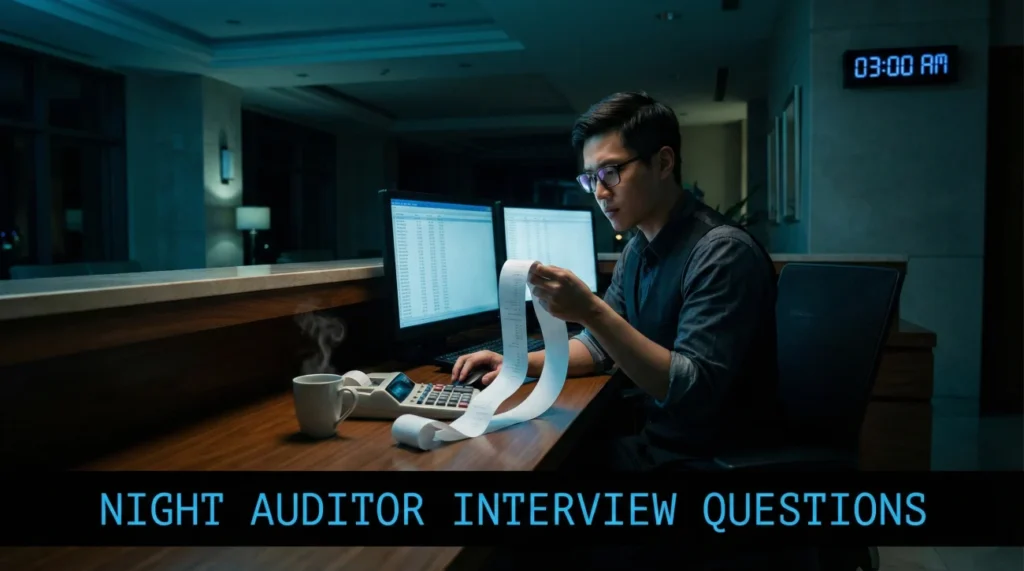
Night auditor interview questions are a test of trust. Picture the lobby at 2:07 AM: lights low, phones quiet, and you are the only person on duty who can balance the day, handle a late check-in, and respond to an alarm without freezing. This role blends accounting accuracy with real operational nerve.
Your answers should prove you can run the audit sequence, keep guests safe, and leave a clean handoff for the morning team. Talk about how you prepare downtime reports, how you investigate variances, and how you stay alert and professional when the building feels empty but the responsibility is full.
The Audit Process & Accounting
This is the core technical function. You must prove you understand the math behind the “End of Day” sequence.
Q: Walk me through the typical “Night Audit” sequence.
Answer: The process generally follows five steps: 1. Complete Outstanding Postings (ensure all room service/bar charges are posted). 2. Reconcile Room Status (verify housekeeping report against system occupancy). 3. Balance the Day’s Transactions (verify credit card batches and cash drops match the PMS). 4. Run the Audit (roll the business date to the next day and post room/tax charges). 5. Distribute Reports (generate the Daily Revenue Report for management).
Q: What do you do if the “Bucket Check” (Guest Ledger) doesn’t balance?
Answer: I do not just force it. I investigate. I compare the physical registration cards or credit card slips against the PMS postings line by line. I look for common errors like transposed numbers ($45 vs $54) or a charge posted to the wrong room. If I cannot find the error after thorough investigation, I document the variance clearly in the logbook for the Income Auditor to review, rather than delaying the date roll indefinitely.
Q: How do you handle a “Downtime” report?
Answer: Before running the audit (when the system goes offline briefly), I print the “Downtime Reports” (In-house guest list, Arrivals, Departures, Room Status). This is critical. If the system crashes or the power goes out, I need these hard copies to conduct manual check-ins/outs and account for every guest in the building during an emergency. Preparedness is non-negotiable.
Q: Describe your experience with “Rolling the Day.”
Answer: I understand that this is the point of no return. Once I hit “Roll Date,” yesterday’s revenue is locked. I ensure all departments have closed their shifts (POS systems) first. I monitor the progress bar closely; if it freezes, I know who to call (Support) immediately. I verify that the new business date is correct on the screen before starting any morning tasks.
Front Desk Operations (Overnight)
You are also the Front Desk Agent. You handle late check-ins and early check-outs with the same hospitality as the day team.
Q: A guest arrives at 2 AM with a reservation for “today” (the new date).
The Strategy: Policy Explanation.
Answer: This is a common confusion. Check-in time is usually 3 PM. I explain: “Your reservation is technically for the upcoming afternoon. However, since you are here now, I can check you in early.” If we have clean rooms ready, I might charge an “Early Check-in Fee” or a full night’s rate depending on policy. If no rooms are ready, I cannot check them in, but I offer to store bags.
Q: A guest calls at 3 AM complaining about noise from a party.
The Strategy: Solo Enforcement.
Answer: I take it seriously. I go to the noisy room immediately (or send security if available). I am firm but polite: “It is 3 AM and we have received noise complaints. I must ask you to lower your voices or I will have to ask you to leave.” If they refuse or get aggressive, I do not hesitate to call the police. The comfort of the many outweighs the fun of the few.
Q: How do you handle a “Walk-in” guest late at night?
The Strategy: Vigilance.
Answer: I assess the situation carefully. I quote the Rack Rate. I require a valid ID and a credit card that authorizes for the full amount plus incidentals. I generally do not accept cash from late-night walk-ins to deter illegal activity. I trust my gut; if something feels unsafe or “off” about the guest, I politely state we are sold out. Safety comes first.
Q: A guest wants to check out at 4 AM to catch a flight.
The Strategy: Efficiency.
Answer: I ensure the process is swift. I verify their folio charges with them. I offer to arrange a taxi or wake-up call the night before. I also offer a “Grab and Go” breakfast bag if the buffet isn’t open yet. It is the last impression they have of the hotel, so I make it warm and efficient, wishing them safe travels.
Q: The credit card batch fails to transmit.
The Strategy: Technical Troubleshooting.
Answer: I check the internet connection first. I try to resend the batch manually. If it fails repeatedly, I call the merchant support line immediately (they are 24/7). I verify that the transactions are stored locally (offline mode) so we don’t lose revenue. I leave a detailed note for the Controller in the morning log.
Q: How do you prepare the lobby for the morning shift?
The Strategy: Handoff Quality.
Answer: I print all necessary reports (Arrivals, VIPs). I tidy the front desk area and restock key cards/paper. I brew the fresh coffee for the lobby station at the designated time (e.g., 5:30 AM). I ensure the “Pass On” log is detailed so the AM shift isn’t blindsided by any issues from the night.
Safety, Security & Independence
You are the “Manager on Duty” (MOD). Interviewers need to know you won’t panic when the fire alarm rings.
The Fire Alarm goes off at 2 AM. What is your first action?
The Strategy: Crisis Command.
Answer: I check the panel to locate the zone. I do not silence it until verified. I grab the “Emergency Guest List” (Downtime Report). If it is a real fire, I call 911. I direct guests to the assembly point calmly via the PA system. I unlock the front doors for the fire department. I stay at the desk (if safe) to act as the communication hub. I do not panic.
A guest reports a medical emergency (heart attack) in their room.
The Strategy: Immediate Response.
Answer: I keep them on the line and call 911 on another line to patch them through or relay info. I send Security (or go myself with the AED) to the room immediately. I clear the elevators/lobby for the paramedics. I print the guest’s profile (for ID/medical info if listed). I document everything in an Incident Report.
You are alone and someone suspicious is loitering outside the glass doors.
The Strategy: Secure the Perimeter.
Answer: I ensure the automatic doors are locked (night mode). I do not let them in unless they show a room key or valid ID. I make eye contact to show I see them. If they don’t leave or try to force entry, I call the police non-emergency line (or emergency if threatened) and retreat to the secure back office. I never confront a threat physically.
The Night Shift Lifestyle
Can you actually handle the hours? Turnover is high because people underestimate the sleep disruption.
Q: How do you plan to manage your sleep schedule?
Answer: I have a strategy. I use blackout curtains and a white noise machine to simulate night during the day. I maintain a consistent sleep pattern even on my days off (as much as possible) to avoid “jet lag.” I understand that this shift requires discipline outside of work hours to be alert during work hours. I have worked nights before (or studied late), so I know my body can handle it.
Q: What do you do to stay alert during the quiet hours (3 AM – 5 AM)?
Answer: I stay active. Instead of sitting, I do rounds of the lobby or organize the back office. I stand up to work. I save tasks like folding key packets or stocking for this time. I drink water and eat light, healthy snacks rather than heavy meals that induce a food coma. I view this time as productive time, not “waiting” time.
Night Audit Knowledge Quiz
Test Your Audit IQ
1. “Rolling the Date” means:
- Moving a calendar
- Changing the PMS business date to the next day (posting Room & Tax)
- Cleaning the floor
- Checking out a guest
2. A “Bucket Check” compares:
- Water buckets
- Physical registration cards against the electronic system records
- Housekeeping supplies
- Cash drawers
3. “Room and Tax” is usually posted:
- At check-in
- Automatically during the Night Audit process
- At check-out
- At breakfast
4. “Downtime Reports” are for:
- Reading for fun
- Backup in case of system failure/power outage
- The police
- Housekeeping only
5. “G.O.P.” stands for:
- Guest On Property
- Gross Operating Profit
- General Opening Procedure
- Grand Opening Party
6. “No-Show” implies:
- A ghost
- A guest with a reservation who did not arrive or cancel
- A cancelled flight
- A quiet night
7. “Batch Settlement” involves:
- Cleaning dishes
- Transmitting all credit card transactions to the bank for payment
- Settling arguments
- Counting keys
8. “Occupancy Tax” is:
- A fine
- A local tax added specifically to the room rate
- Federal income tax
- Staff tax
9. A “Variance” is:
- A type of guest
- A discrepancy between two figures (e.g., cash count vs. system report)
- A discount
- A room change
10. “MOD” stands for:
- Master Of Design
- Manager On Duty
- Morning Opening Door
- Make Our Day
11. “Flash Report” is:
- A weather report
- A daily summary of key financial metrics (Occupancy, ADR, RevPAR)
- A fire alarm
- A guest complaint
12. “Incidentals” cover:
- The room rate
- Extra charges like room service, movies, parking
- Accidents
- Taxes
13. “Express Check-out” involves:
- Running fast
- Sliding the bill under the door/emailing it so the guest can leave without stopping at the desk
- Checking out early
- Paying cash
14. “Reg Card” stands for:
- Regular Card
- Registration Card (legal document signed at check-in)
- Region Card
- Regulation Card
15. “Ledger” is:
- A heavy book
- A collection of accounts (Guest Ledger, City Ledger)
- A ledge
- A key holder
16. “City Ledger” contains accounts for:
- Guests in the hotel
- Non-guest accounts (Direct Billing to companies, Banquets)
- The city mayor
- City taxes
17. “Comp” room means:
- Complimentary (Free)
- Complaint room
- Complex room
- Company room
18. “Master Account” is used for:
- The GM
- Grouping charges for a group/conference into one bill
- The master key
- VIPs only
19. If the fire panel shows a “Trouble” light, it means:
- There is a fire
- There is a system fault (not necessarily a fire, but needs maintenance)
- The alarm is off
- It is broken
20. The most important trait for a Night Auditor is:
- Cooking skills
- Trustworthiness and Independence
- Strength
- Charm
❓ FAQ
🌙 What does a typical night auditor shift actually include?
You handle late arrivals, basic guest needs, and then complete the end-of-day audit tasks before preparing reports for management. In the quiet hours, you also do security rounds and prep the desk for the morning.
🧾 Is the accounting part difficult?
It is more about precision than complex math. You follow a sequence, reconcile totals, and investigate mismatches instead of forcing numbers to fit.
☕ How do you stay awake during the slow hours?
Use movement and task rotation first, not caffeine. Save light admin work for the quiet window, hydrate, and avoid heavy meals that make you sluggish.
🔒 Is it safe to work alone overnight?
Hotels use locked doors, cameras, and procedures. Your best safety tools are policy, awareness, and knowing when to call security or emergency services instead of handling a risk yourself.
📚 Can students work this job?
Often, yes, because the shift can have downtime after the audit. The key is staying guest-ready at all times and following the hotel’s rules on what is allowed during quiet periods.
Final Thoughts
To succeed in answering night auditor interview questions, emphasize reliability, order, and composure. Hiring managers want the person who documents clearly, follows procedure, and stays steady when something unexpected happens at an inconvenient hour.
Round out your story by showing you understand the morning shift depends on your notes and prep. That teamwork mindset matters as much as the numbers.
⚠️ Disclaimer: The interview strategies, sample answers, and negotiation tips provided in this guide are for educational purposes only. Hiring decisions are subjective and vary by company and industry. While these strategies are based on professional HR standards, they do not guarantee a specific job offer or result.