The Skin Scientist
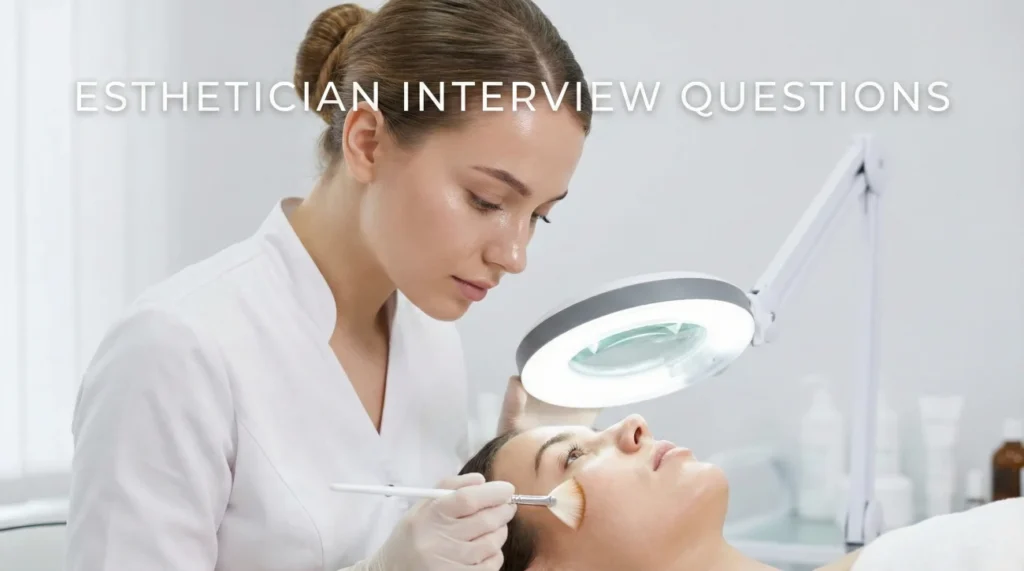
Esthetician interview questions go far beyond “Can you do a facial?” In 2025, an Esthetician is a skin scientist, a chemist, and a sales consultant rolled into one. With clients becoming increasingly educated through “SkinTok” and social media, hiring managers are looking for professionals who can debunk myths, explain the pH balance of the acid mantle, and perform advanced modalities like microcurrent or dermaplaning with surgical precision.
This comprehensive guide extracts the essential elements of the interview process. We examine the critical Skin Analysis consultation (identifying the difference between dry and dehydrated skin), the safety protocols for Chemical Peels, and the art of Retailing Homecare without sounding pushy. Whether you are applying to a medical spa (MedSpa) or a holistic wellness retreat, proving you have the knowledge to transform skin and the empathy to build trust is your foundation for success.
Skin Analysis & Consultation
You cannot treat what you cannot diagnose. Interviewers will test your ability to read the skin and create a custom plan.
Q: Explain the difference between “Dry” and “Dehydrated” skin.
Answer: This is the most common client confusion. Dry skin is a skin type (genetic) that lacks oil/lipids; it has small pores and can feel rough. Dehydrated skin is a skin condition (temporary) that lacks water; it can happen to oily skin types too and often presents as crepey lines or dullness. I treat Dry skin with oil-based ceramides, and Dehydrated skin with water-binding humectants like Hyaluronic Acid.
Q: Walk me through your consultation process with a new client.
Answer: I start with the intake form to check for contraindications (allergies, medications like Accutane). Then I perform a “Cleanse and Analyze” under the mag lamp. I ask lifestyle questions: “What is your current routine? How much water do you drink? What is your main concern today?” I touch the skin to feel for texture and temperature. I then explain my findings to the client before starting the treatment so we are aligned on the goals.
Q: A client wants a strong chemical peel but has a compromised barrier. What do you do?
Answer: I refuse the peel for their safety. Applying acid to a broken barrier (red, stinging, flaking) can cause chemical burns or post-inflammatory hyperpigmentation (PIH). I explain: “Your skin needs to be strong enough to handle the peel. Let’s start with a barrier-repair facial today using soothing peptides and LEDs. Once your skin is healthy and prepped in about 2 weeks, we can do the peel.” Safety first.
Q: How do you identify “Fitzpatrick Skin Types” and why does it matter?
Answer: The Fitzpatrick scale (I-VI) measures how skin reacts to UV light (burning vs. tanning). It is critical for laser and chemical peel safety. Types IV-VI (darker skin) have more melanin and are at higher risk for hyperpigmentation or scarring from aggressive heat/chemicals. I always adjust my settings and acid choices (e.g., avoiding strong glycolic, opting for mandelic or lactic) to protect melanin-rich skin.
Treatments & Modalities
From extractions to electricity, you need to show technical proficiency.
Q: Describe your technique for safe extractions.
The Strategy: Do No Harm.
Answer: I only extract non-inflamed comedones (blackheads) that are ready. I prep the skin with steam and desincrustation fluid to soften the sebum. I use gloved fingers wrapped in tissue (or a sterile lancet if allowed) and apply gentle pressure from the sides, wiggling the impaction out. If it doesn’t come out easily, I leave it. Forcing it damages the follicle and causes scarring. I follow up with high-frequency to kill bacteria.
Q: What is “Microcurrent” and how do you explain it to a client?
The Strategy: The “Gym for the Face” Analogy.
Answer: I tell clients: “Microcurrent is like a workout for your facial muscles. It uses low-level electricity to stimulate ATP (cellular energy) and re-educate the muscles to lift and tone.” I explain that it is cumulative; one session gives a nice glow, but a series of 6-10 gives a lasting lift. It is painless and non-invasive.
Q: How do you perform a “Brazilian Wax” efficiently and comfortably?
The Strategy: Speed & Support.
Answer: I use hard wax for sensitive areas. I work in small, manageable sections. I apply firm pressure immediately after pulling the strip to minimize pain receptors. I instruct the client to breathe. I keep the skin taut at all times to prevent bruising. My goal is to be done in 15-20 minutes to minimize their discomfort time.
Q: What are the benefits of LED Light Therapy?
The Strategy: Color Coding.
Answer: Blue Light kills p.acnes bacteria (great for acne). Red Light stimulates collagen and elastin (great for anti-aging). Yellow/Green helps with redness and pigmentation. It is a fantastic add-on because it is hands-free, painless, and boosts the results of the serum applied underneath.
Q: How do you treat “Maskne” (Acne from face masks)?
The Strategy: Friction & Bacteria Control.
Answer: Maskne is caused by friction and trapped moisture. I focus on gentle exfoliation (Salicylic acid) to unclog pores and barrier repair to fix the chafing. I advise clients to use a silk mask, change it daily, and avoid heavy makeup under the mask area.
Q: Explain “Dermaplaning” vs. “Microdermabrasion”.
The Strategy: Physical Exfoliation Types.
Answer: Dermaplaning uses a surgical blade to scrape off dead skin and vellus hair (peach fuzz), leaving skin smooth and hair-free. Microdermabrasion uses crystals or a diamond tip with suction to sandblast the skin and stimulate circulation. Dermaplaning is better for sensitive skin or those with lots of hair; Microderm is better for thick, textured skin.
Retailing & Homecare
A facial is 60 minutes; homecare is the other 29 days of the month. You must sell products to ensure results.
Q: How do you sell products without feeling “salesy”?
Answer: I educate, I don’t sell. Throughout the facial, I narrate: “I am applying this Vitamin C serum now because it will brighten that pigmentation we discussed.” At the end, I simply bring the bottles I used to the front. “To keep this glow, you need to use this cleanser and serum at home.” I frame it as a prescription for their skin health, just like a doctor prescribes medicine.
Q: A client uses drugstore products (e.g., St. Ives Apricot Scrub). What do you say?
Answer: I never shame them. I educate them on the “Why.” “I understand that scrub feels satisfying, but the walnut shells have jagged edges that create micro-tears in your skin, which actually spreads bacteria and causes aging. Let me show you an enzyme exfoliant that dissolves the dead skin gently without scratching it.” I offer a better alternative rather than just criticizing.
Q: What is your strategy for re-booking clients?
Answer: I treat skin as a journey, not a destination. “Skin cells turn over every 28 days. To really clear up this acne, I need to see you once a month for the next 4 months.” I give them a treatment plan. Clients appreciate the guidance and are more likely to book the next appointment before they leave.
Sanitation & Safety
You deal with blood and bodily fluids. Hygiene is non-negotiable.
You drop your extraction tool on the floor during a service.
The Strategy: Immediate Disposal.
Answer: I apologize to the client: “One moment, I dropped my tool.” I pick it up and place it in the “Dirty/To Be Cleaned” bin immediately. I remove my gloves, wash my hands, put on fresh gloves, and get a fresh sterile tool. I never wipe it off and reuse it. Cross-contamination is a major violation.
A client reveals they are on Retin-A just before you start a wax.
The Strategy: Stop and Switch.
Answer: I cannot wax them. Retin-A thins the skin, and waxing could lift the skin right off (skin lifting). I explain: “Because of the Retin-A, waxing isn’t safe today as it could tear your skin. However, I can tweeze or thread the area instead, which is safe.” I save them from injury, which they will appreciate.
How do you clean your station between clients?
The Strategy: Hospital Grade.
Answer: I strip all linens (sheets, towels, headbands) and put them in the covered hamper. I wipe down the bed, mag lamp, trolley, and all bottles with an EPA-registered disinfectant (like CaviCide). I let it sit for the required contact time. I sweep the floor. I wash my hands. I set up fresh linens. A clean room is a safe room.
Esthetician Knowledge Quiz
Test Your Skin IQ
1. The “Acid Mantle” is:
- A chemical peel
- The protective barrier of oil and sweat on the skin’s surface (pH 4.5-5.5)
- A type of mask
- Dead skin cells
2. “Contraindication” means:
- A skin type
- A reason NOT to perform a specific treatment (e.g., sunburn, open wound)
- A referral
- A contract
3. “SPF” stands for:
- Skin Protection Factor
- Sun Protection Factor
- Sun Proof Face
- Skin Peel Formula
4. Which acid is best for Oily/Acneic skin?
- Hyaluronic Acid
- Salicylic Acid (BHA) – it is oil soluble
- Lactic Acid
- Glycolic Acid
5. “Fitzpatrick Scale” measures:
- Skin hydration
- Skin’s reaction to sun exposure (burning vs. tanning) and melanin content
- Wrinkle depth
- Acne severity
6. “High Frequency” machines produce:
- Steam
- Ozone (to kill bacteria and stimulate circulation)
- Water spray
- Cold air
7. “Comedone” is the technical term for:
- A wrinkle
- A blackhead (open) or whitehead (closed)
- A scar
- A mole
8. “Retinols” are derived from:
- Vitamin C
- Vitamin A
- Vitamin E
- Vitamin B
9. “Double Cleansing” involves:
- Washing twice with water
- Using an oil-based cleanser first (to remove makeup/spf), then a water-based cleanser
- Scrubbing hard
- Using soap only
10. “Milia” are:
- Whiteheads
- Small, hard cysts of trapped keratin (pearl-like bumps) that need lancing
- Moles
- Freckles
11. “Hyaluronic Acid” helps to:
- Exfoliate
- Hydrate (holds 1000x its weight in water)
- Dry out oil
- Peel skin
12. “Desincrustation” is used to:
- Harden skin
- Soften and emulsify sebum/oil in the follicles to ease extractions
- Close pores
- Massage
13. “Accutane” (Isotretinoin) users cannot receive:
- Facial massage
- Waxing or aggressive peels (skin is too thin/fragile)
- Steam
- LED light
14. “Rosacea” is characterized by:
- Dark spots
- Redness, dilated capillaries, and sensitivity
- Wrinkles
- Oily skin
15. “Esthetician” vs. “Dermatologist”:
- Same thing
- Esthetician focuses on beautification/cleaning; Dermatologist is a doctor who diagnoses diseases
- Esthetician does surgery
- Dermatologist does makeup
16. “T-Zone” includes:
- Cheeks and chin
- Forehead, nose, and chin
- Neck and chest
- Eyes only
17. “Free Radicals” cause:
- Better skin
- Premature aging and cell damage (oxidative stress)
- Acne
- Hydration
18. “Antioxidants” (like Vitamin C) help to:
- Create free radicals
- Neutralize free radicals and protect skin
- Dry skin
- Cause sunburn
19. “Modalities” refer to:
- Models
- Different methods or machines used in treatment (LED, Ultrasound, etc.)
- Products
- Towels
20. The most important step in any facial is:
- The mask
- The consultation/skin analysis (to ensure safety and results)
- The massage
- The steam
❓ FAQ
📜 What license do I need?
You need a state-issued Esthetician License or Cosmetology License. This requires completing a specific number of hours (e.g., 600 hours) at an accredited school and passing a State Board exam (written and practical). You cannot legally touch a client without it.
👔 What should I wear to the interview?
All Black is the industry standard. Wear professional, comfortable black attire (like smart trousers and a blouse) or scrubs if applying to a MedSpa. Hair should be pulled back neatly, nails short and clean (no long acrylics), and makeup polished but not heavy. You are selling hygiene and beauty.
💼 Do I need to bring my own tools?
Usually, the spa provides equipment. However, bringing your own specialized tools like high-quality tweezers or favorite brushes to a practical interview shows preparedness. Always ask beforehand.
💰 Is it commission-based?
Most likely. You usually get an hourly wage OR a commission on services (30-50%), plus commission on retail sales (10-20%), plus tips. A good Esthetician can double their income through retail and re-booking.
🏥 MedSpa vs. Day Spa: Which is better?
Day Spas focus on relaxation and basic facials (fluff and buff). MedSpas work under a doctor and perform more aggressive, results-driven treatments (lasers, deep peels). MedSpas often pay better but require more advanced training and carry higher liability risks.
Final Thoughts
To succeed in answering esthetician interview questions, you need to show you are an “Educator,” not just a technician. The manager wants to know you can explain why a client needs a product, not just apply it.
Highlight your passion for skin histology and your ability to build long-term relationships. If you can prove you have the “Magic Hands” for relaxation and the “Scientific Mind” for results, you will be an asset to any spa.
⚠️ Disclaimer: The interview strategies, sample answers, and negotiation tips provided in this guide are for educational purposes only. Hiring decisions are subjective and vary by company and industry. While these strategies are based on professional HR standards, they do not guarantee a specific job offer or result.