The Unsung Heroes of Hospitality
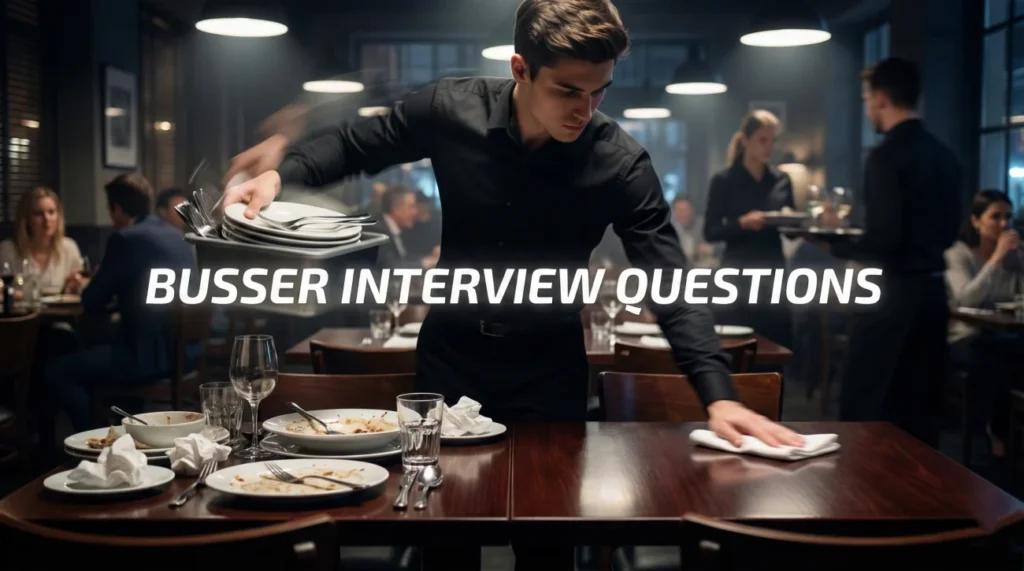
Busser interview questions are designed to find the hardest workers in the room. In 2025, a busser (or Dining Room Attendant) is not just a “cleaner.” You are the engine of the restaurant’s revenue. The speed at which you clean and reset a table directly determines how many guests can be seated in a night. Hiring managers are looking for candidates with boundless energy, an eye for detail (no crumbs left behind!), and the humility to support the entire team without ego.
This comprehensive guide covers the gritty reality of the role. We explore the mechanics of clearing (stacking plates silently), the sanitation protocols that keep guests safe, and the vital communication loop between you, the Host, and the Server. Whether this is your very first job or you are using it as a stepping stone to become a server, proving you have the “hustle” and the hygiene standards is your key to getting hired.
Speed, Efficiency & Table Turns
Time is money. Every minute a table sits dirty is a minute it isn’t generating revenue. Interviewers need to know you move with purpose.
Q: Why is “Table Turnover” so important to a restaurant?
Answer: Table turnover creates revenue. If a table sits dirty for 10 minutes, that is 10 minutes we can’t seat a waiting guest. Over a busy night, those minutes add up to lost covers and lost tips for the servers. My job is to minimize the “dead time” between guests so the restaurant can maximize its sales potential without rushing the diners.
Q: Describe your technique for clearing a table efficiently.
Answer: I use the “Stack and Scrape” method discreetly. I stack plates by size (largest on bottom) and scrape leftovers onto the top plate to prevent sliding. I place silverware securely on the top plate, not in cups where it can fall. I never overload my tray; it is faster to make two safe trips than to drop one heavy tray. I aim to clear the entire table in one go if safe, but safety always comes first.
Q: What is “Pre-bussing” and do you do it?
Answer: Pre-bussing is removing empty plates and glassware while the guests are still seated. Yes, I do it constantly. It keeps the table clean for the guest and makes the final reset much faster. However, I always ask permission first: “May I clear this plate for you?” or wait for a clear visual cue (napkin on plate) so I don’t make them feel rushed.
Q: How fast can you reset a table for 4 people?
Answer: I aim for under 2 minutes. This includes clearing the dirty dishes, sanitizing the surface, polishing the table, and placing new setups (cutlery/napkins) perfectly straight. Speed is good, but if the fork is crooked or the table is sticky, I have failed. I practice “Speed with Standards.”
Sanitation & Hygiene Standards
You are the first line of defense against germs. Interviewers will test your knowledge of proper cleaning protocols.
Q: What is the correct way to sanitize a table?
The Strategy: Two-Step Process.
Answer: I don’t just smear dirt around. First, I use a damp cloth to remove physical debris (crumbs/sauce). Then, I use the approved sanitizer spray. Crucially, I let the sanitizer sit for the required “contact time” (usually 10-30 seconds depending on the brand) before wiping it dry. This ensures bacteria are actually killed.
Q: How often do you change your sanitizer bucket/water?
The Strategy: Policy Adherence.
Answer: I change it at least every 2 hours, or sooner if the water becomes cloudy or the temperature drops (if using hot water). I check the concentration with test strips to ensure it is effective. Dirty water just spreads germs, so I am vigilant about keeping my tools clean.
Q: How do you handle broken glass on the floor?
The Strategy: Safety First.
Answer: I stand guard over the glass immediately to warn guests. I ask a teammate to bring the broom and dustpan. We sweep it up completely, checking a wide radius for shards. We use a wet paper towel to pick up microscopic slivers. We dispose of it in the designated “Broken Glass” bucket, never the regular trash where it could cut someone taking out the garbage.
Q: You see a lipstick stain on a “clean” glass. What do you do?
The Strategy: Quality Control.
Answer: I never put it on the table. I send it back to the dishwasher immediately. I then check the other glasses in the rack. If I find another one, I alert the manager or dishwasher because the machine might be malfunctioning or the water temperature is too low. I am the last quality check before the guest touches it.
Q: Where do you hold a clean wine glass?
The Strategy: Stemware Etiquette.
Answer: Always by the stem or the base. Never by the bowl (rim). Holding it by the bowl leaves fingerprints and looks unprofessional. It is also more hygienic to keep my hands away from where the guest’s mouth will be.
Q: What do you do if a guest spills a drink on the table?
The Strategy: Immediate Recovery.
Answer: I rush over with extra napkins. I help contain the spill so it doesn’t drip onto their clothes. I do not wipe at the guest, but hand them napkins for their person. Once contained, I bring a fresh tablecloth or reset the area. I communicate with the server to replace the drink immediately, usually on the house.
Teamwork & Communication
You work for everyone: the Host needs tables, the Server needs water, the Bar needs ice. Can you juggle it all?
Q: A Server asks you to clear Table 5, but the Host asks you to reset Table 8 immediately. Who do you prioritize?
Answer: I prioritize the Host (Table 8) because a waiting guest at the door is the most critical pressure point. I would quickly tell the Server: “I’m resetting 8 for the Host, then I’m right back to clear 5.” Communication manages the expectation so the server doesn’t think I’m ignoring them. If Table 5 is super messy and visible, I might ask a teammate to help.
Q: What do you do when you have nothing to do?
Answer: There is always something to do. If tables are clean, I stock the service stations (ice, glassware, napkins). I polish silverware. I sweep the floor in high-traffic areas. I ask the servers, “What do you need?” I never lean against the wall or look at my phone. My job is to prepare for the next rush.
Q: How do you communicate a “Reset” to the Host stand?
Answer: We usually have a signal (like a thumbs up) or I update the table status on the iPad/POS system if allowed. I make sure the table is 100% ready (chairs aligned, floor swept) before I signal. False alarms frustrate the Host and the guest, so I ensure it is perfect first.
Situational & Behavioral
These questions test your attitude. Can you stay positive when covered in food waste?
A guest asks you for a refill or the check, but you are not their server.
The Strategy: “Full Hands” Service.
Answer: I never say “That’s not my job.” If it is water or bread, I get it myself immediately. If it is alcohol or the check, I say, “I will let your server know right away.” Then I actually go find the server and tell them: “Table 12 needs the check.” I follow up to ensure it happens. The guest sees me as “The Restaurant,” not just “The Busser.”
You are overwhelmed and tables are dirty everywhere. What do you do?
The Strategy: Triage and Ask for Help.
Answer: I move faster, but I don’t panic. I focus on the “easiest/fastest” tables first to open up seats quickly. I ask for help: “Hey team, I’m buried in the back section, can anyone help me flip Table 4?” A good team will jump in. I stay focused on one table at a time rather than looking at the whole mess and freezing.
A customer leaves a large tip on the table while you are cleaning. What do you do?
The Strategy: Integrity.
Answer: I do not touch it. I find the server immediately and say, “Table 10 left cash on the table for you.” If the restaurant policy is to bring it to the cashier/manager, I follow that strictly. I know that bussers usually get “tipped out” (a percentage of sales) by the servers, so protecting their tips ensures they take care of me later.
Busser Skills Quiz
Test Your Busser IQ
1. “Flipping a table” means:
- Turning it upside down
- Cleaning and resetting it for the next guest
- Selling the table
- Moving it to another room
2. A “Bus Tub” is:
- A bathtub
- A plastic bin used to carry dirty dishes to the kitchen
- A bus ticket
- A type of soap
3. “Pre-bussing” helps because:
- It makes the guest leave faster
- It reduces the clutter for the guest and speeds up the final clean
- It allows the busser to eat the leftovers
- It is required by law
4. When carrying a tray, you should use:
- Both hands above your head
- Your shoulder/palm for balance, keeping your back straight
- Your fingertips only
- Your hip
5. “Mis en place” for a busser means:
- Cooking food
- Having your station stocked (towels, spray, cutlery) before the rush
- Leaving early
- Missing items
6. “BOH” stands for:
- Best Of House
- Back Of House (Kitchen/Dish pit)
- Big Old House
- Busser On Hour
7. If you break a glass in the ice bin, you must:
- Scoop around it
- “Burn the ice” (melt it all with hot water) and clean the bin completely
- Pick out the big pieces
- Ignore it
8. “Polishing” silverware involves:
- Painting it
- Using hot water/steam and a cloth to remove water spots
- Washing it with soap
- Throwing it away
9. “Tip Out” is:
- Advice given to you
- The percentage of tips servers give to support staff (bussers/runners)
- Leaving work
- Stealing tips
10. “Running Side Work” includes:
- Running around the block
- Refilling ice, stocking napkins, and sweeping during the shift
- Eating lunch
- Serving food
11. A “Crumber” is used to:
- Cut bread
- Sweep crumbs off a tablecloth
- Eat soup
- Open wine
12. “3-Sink Method” refers to:
- Washing hands
- Wash, Rinse, Sanitize (manual dishwashing protocol)
- Drinking water
- Bathroom sinks
13. The “Dish Pit” is:
- A dirty place
- The area where the dishwasher machine is located
- A hole in the ground
- The trash can
14. You should scrape plates:
- At the table
- In the dish pit (or discreetly on the tray, never loudly in the dining room)
- On the floor
- Into your pocket
15. “Resetting” a table implies:
- Moving it
- Putting it back to the standard setup for a new guest
- Fixing a wobble
- Buying a new table
16. “Pivot Point” system relates to:
- Basketball
- Numbering seats so food is delivered to the correct person without asking
- Balancing a tray
- Turning a corner
17. “Spot Sweeping” means:
- Looking for spots
- Quickly sweeping debris under/around a table between courses/guests
- Sweeping the whole room
- Washing the floor
18. If a child makes a mess, you:
- Scold the child
- Clean it up cheerfully, reassuring the parents “It happens all the time”
- Make the parents clean it
- Leave it there
19. “Sorting” silverware means:
- Playing with it
- Separating forks, knives, and spoons into buckets for the dishwasher
- Throwing it away
- Counting it
20. The most important tool for a busser is:
- A phone
- A clean towel/rag
- A knife
- A chair
❓ FAQ
💪 Is being a busser hard work?
Physically, yes. It is one of the most demanding jobs. You are lifting heavy tubs of dishes, bending, and walking 15,000+ steps per shift. It is a workout. You need to be fit and ready to sweat.
👟 What should I wear to the interview?
Dress neatly but practically. Black trousers and a white or black button-down shirt are standard. Wear polished shoes. Most importantly, look clean. Hygiene is part of the job description.
🚀 Can I become a server from this job?
Yes! It is the classic path. If you show you are reliable, learn the menu, and have good people skills, managers often promote bussers to servers within 6-12 months. It is the best way to learn the restaurant business from the ground up.
💵 Do bussers get tips?
Usually, yes. While you are paid an hourly wage, you typically receive a “Tip Out” from the servers (e.g., 1-2% of their total sales or 10-15% of their tips). This can significantly boost your take-home pay on busy nights.
⏳ Do I need experience?
Rarely. This is an entry-level position. Attitude counts for 90%. If you are energetic, polite, and eager to work, most restaurants will happily train you on the technical skills.
Final Thoughts
To succeed in answering busser interview questions, emphasize your work ethic and your team-player mentality. Don’t act like the job is “beneath” you; show that you take pride in a clean restaurant and a fast turnaround. Managers hire bussers who have hustle.
Highlight your physical stamina and your attention to detail. If you can prove you are the person who notices the dirty fork before the guest does, you are hired.
⚠️ Disclaimer: The interview strategies, sample answers, and negotiation tips provided in this guide are for educational purposes only. Hiring decisions are subjective and vary by company and industry. While these strategies are based on professional HR standards, they do not guarantee a specific job offer or result.