- What difficult customers usually need: They are often reacting to feeling unheard, powerless, disrespected, or anxious, so you solve the emotion first, not just the policy.
- Spot the pattern fast: Angry, chronic complainer, entitled, indecisive, know-it-all, or passive-aggressive each needs a different approach to calm things down.
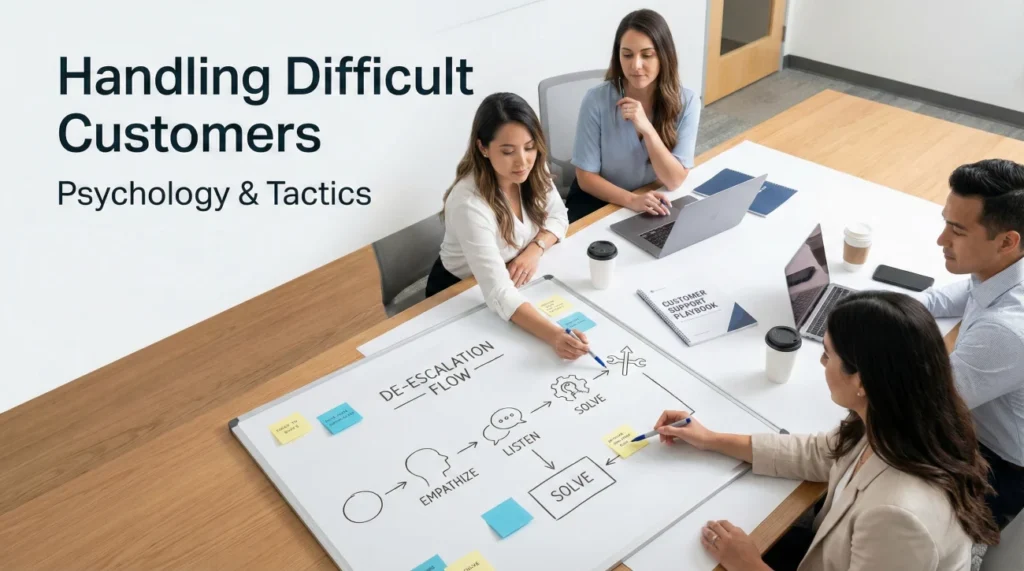
- A simple de-escalation sequence: Stay safe, stay calm, let them vent, validate feelings, apologize for the situation, then problem-solve together with clear next steps.
- Manage your own reactions: Know your triggers, pause before replying, use grounding and breathing, and reset after the interaction so you do not carry it into the next customer.
- Set boundaries and escalate when needed: Ask for respectful communication, protect personal space, pull in a manager for policy exceptions, and treat threats or sustained abuse as a safety issue.
The Psychology Behind Customer Behavior
Every service professional eventually faces difficult customers, such as those who yell, demand impossible solutions, blame you for organizational policies, or behave unreasonably despite your best efforts. Success in handling difficult customers requires understanding that challenging behavior usually stems from psychological needs rather than personal attacks. Customers become difficult when they feel unheard, powerless, disrespected, or anxious. These emotional states that logic and policy citations rarely resolve.
The challenge is maintaining professional composure when customers trigger your own emotional responses. Their anger activates your fight-or-flight instinct, their rudeness tempts defensive reactions, their unreasonable demands frustrate your desire for fairness. Yet responding emotionally escalates conflicts rather than resolving them. Professional service excellence demands recognizing customer behavior patterns, understanding psychological drivers, and deploying tactical responses that address emotional needs while maintaining appropriate boundaries.
This guide provides psychology-based frameworks for managing challenging customer interactions. You’ll learn to categorize difficult customer types by underlying psychology, apply systematic de-escalation techniques preventing emotional hijacking, regulate your own emotions under attack, and maintain professional boundaries without sacrificing service quality.
Understanding Difficult Customer Personalities
Recognizing customer personality types enables targeted responses addressing specific psychological needs driving difficult behavior.
Common Difficult Customer Categories
While every customer is unique, challenging behaviors typically fall into predictable patterns with distinct psychological motivations.
| Customer Type | Characteristics | Psychological Need | Effective Response |
|---|---|---|---|
| The Angry/Aggressive | Yelling, demanding, blaming, threatening | Feeling wronged, seeking justice, venting frustration | Let them vent without interruption, validate feelings, apologize sincerely, solve quickly |
| The Chronic Complainer | Nothing satisfies, finds fault everywhere, negative outlook | Attention-seeking, control, validation of worldview | Acknowledge concerns without agreeing with everything, set boundaries, focus on solvable issues |
| The Demanding/Entitled | Expects special treatment, ignores policies, “Do you know who I am?” | Status validation, control, exceptionalism | Acknowledge importance respectfully, explain constraints firmly, offer alternatives within policy |
| The Indecisive | Can’t make decisions, constant second-guessing, excessive questions | Fear of mistakes, anxiety, reassurance-seeking | Provide structure, limit options, confident recommendations, patience with process |
| The Know-It-All | Argues with expertise, corrects staff, dismisses suggestions | Intellectual superiority, control through knowledge | Acknowledge expertise, ask questions positioning them as expert, collaborate on solutions |
| The Silent/Passive-Aggressive | Appears compliant but sabotages, gives minimal feedback, complaints after fact | Conflict avoidance, indirect control, resentment expression | Ask direct questions, create safe space for honesty, address concerns proactively |
💡 Pro tip: Quickly identifying customer type in first 30 seconds allows deploying targeted approach rather than generic responses. Listen for emotional drivers beyond surface complaints. Anger usually masks hurt or fear, excessive demands often stem from anxiety about unmet needs, indecision reflects risk aversion. Address underlying psychology, not just surface behavior.
Situational Factors Amplifying Difficulty
Context often transforms normally reasonable customers into difficult ones. Recognize situational triggers creating challenging behavior.
- ⏰ Time pressure: Rushed customers become impatient, demanding faster service than possible
- 😰 High stakes: Important occasions (weddings, anniversaries, job interviews) increase anxiety
- 🔁 Repeated failures: Previous bad experiences create defensive posture expecting problems
- 💰 Financial stress: Expensive purchases or budget concerns heighten sensitivity to value
- 🌡️ Physical discomfort: Heat, hunger, pain, or fatigue reduces patience and emotional regulation
Expert advice: Remember that difficult customers aren’t necessarily difficult people. They’re people having difficult moments. Understanding this distinction prevents taking behavior personally and enables compassionate response even when treated poorly. Your professionalism during their worst moments often creates strongest loyalty because they remember you handled them gracefully when they weren’t their best selves.
Systematic De-escalation Framework
Professional conflict de-escalation steps transform potentially explosive situations into manageable interactions by following proven psychological principles.
The Six-Step De-escalation Process
Apply this systematic approach when facing angry, aggressive, or highly emotional customers.
| Step | Action | Psychological Principle |
|---|---|---|
| 1. Ensure Safety | Assess threat level, create physical distance if needed, involve security if appropriate | Personal safety overrides customer service; threatening behavior requires immediate protection |
| 2. Stay Calm | Regulate your breathing, maintain neutral facial expression, control vocal tone | Mirror neurons cause emotions to spread, so your calm helps customer regulate themselves |
| 3. Listen Actively | Let customer speak uninterrupted, maintain eye contact, use verbal acknowledgments | Venting releases emotional pressure; feeling heard reduces need to escalate for attention |
| 4. Empathize & Validate | Acknowledge feelings and perspective, separate validation from agreement | Validation meets psychological need for recognition, reducing defensive posture |
| 5. Apologize Genuinely | Express sincere regret for situation, take ownership without excuses | Apology satisfies justice need, shifts from blame to resolution |
| 6. Problem-Solve Together | Ask what would help, propose solutions, confirm satisfaction, follow through | Collaboration restores customer sense of control and agency |
Tactical De-escalation Phrases
Specific language patterns predictably reduce tension and encourage cooperation.
- Validating emotion: “I can see you’re really frustrated” acknowledges feeling without arguing facts
- Taking ownership: “I take responsibility for making this right” demonstrates accountability
- Expressing empathy: “If I were in your situation, I’d feel the same way” creates connection
- Offering control: “What would you like me to do?” restores customer agency
- Creating alliance: “Let’s work together to solve this” positions as partners not adversaries
- Committing action: “Here’s exactly what I’m going to do right now” provides concrete reassurance
Never tell upset customers to “calm down”; this phrase almost universally escalates anger. Instead, model calmness through your own demeanor and vocal tone. Similarly, avoid “It’s just our policy” which sounds dismissive. Explain policy purpose: “We have this guideline to ensure fairness for all customers, and here’s how we can work within it…”
Critical De-escalation Mistakes
Certain responses predictably worsen difficult situations despite good intentions.
- ❌ Arguing or defending: “Actually, you’re wrong about…” triggers oppositional response
- ❌ Interrupting venting: Cutting off emotion expression increases frustration
- ❌ Minimizing concerns: “It’s not that big a deal” invalidates their experience
- ❌ Matching emotion: Responding to anger with anger creates escalation spiral
- ❌ Using absolutes: “We would never…” invites examples proving you wrong
- ❌ Making impossible promises: Desperate commitments you can’t keep worsen situation later
Managing Your Own Emotions
Effective emotional regulation tactics enable professional composure despite customer attacks, preventing reactive responses that escalate conflicts.
Recognizing Your Triggers
Understanding what specifically triggers your emotional reactions enables proactive management rather than reactive damage control.
| Common Trigger | Emotional Response | Management Strategy |
|---|---|---|
| Personal attacks/insults | Defensiveness, hurt, desire to retaliate | Remind yourself they’re attacking role not you personally, maintain professional identity separation |
| Unfair blame | Frustration, injustice, need to explain | Accept that fairness isn’t achievable in moment, focus on resolution over vindication |
| Unreasonable demands | Irritation, exasperation, temptation to lecture | Recognize anxiety often drives unreasonable requests, address underlying fear |
| Disrespect/condescension | Anger, indignation, urge to assert authority | Maintain dignity through professionalism, don’t engage in power struggle |
| Repeated complaints | Exhaustion, impatience, dismissiveness | Treat each interaction fresh, avoid projecting frustration from previous encounters |
In-the-Moment Regulation Techniques
Deploy these immediate tactics when feeling emotional hijacking during difficult interactions.
- Controlled breathing: Deep breaths through nose, slow exhale activates parasympathetic nervous system
- Mental pause: Count to three before responding, preventing reactive statements you’d regret
- Physical grounding: Notice feet on floor, hands on counter, which anchors attention to present
- Perspective shift: Imagine watching interaction from outside, creates helpful emotional distance
- Reframing: See difficult customer as person having worst day, not personal adversary
- Micro-break: If possible, brief step away to reset: get water, check stockroom, compose yourself
Expert advice: Develop pre-shift mental preparation ritual setting intention for emotional regulation. Remind yourself before difficult shifts: “I will not take things personally, I will respond professionally regardless of treatment, I will focus on solutions not arguments.” This advance commitment strengthens resistance when tested by challenging customers during actual service.
Post-Interaction Recovery
Process difficult interactions constructively rather than ruminating or suppressing emotional impact.
- 🗣️ Debrief with colleague: Share experience with understanding coworker, release emotional pressure
- 📝 Document objectively: Note facts without emotion, creates closure and protects if escalated
- 🎯 Extract learning: Identify what worked, what didn’t, how to improve next time
- ✅ Acknowledge success: Recognize you handled situation professionally despite challenges
- 🔄 Physical reset: Walk, stretch, drink water to release stress stored in body
For comprehensive guidance on emotional management in interview contexts, explore professional preparation resources covering stress scenarios and composure under pressure.
Setting Boundaries and When to Escalate
While prioritizing customer service, you deserve professional respect and safety. Knowing boundary limits and escalation triggers prevents tolerating abuse.
Establishing Professional Boundaries
Communicate limits clearly and calmly when customers cross appropriate behavior thresholds.
| Boundary Type | Setting Language | Follow-Through |
|---|---|---|
| Respectful communication | “I want to help you, but I need us to communicate respectfully.” | If verbal abuse continues, involve manager or end interaction |
| Physical space | “Please step back and give me some space while I assist you.” | Move to public area, involve security if they don’t comply |
| Policy limitations | “I understand you want X, but that’s beyond what I can authorize. Let me get my manager.” | Escalate rather than repeatedly refusing, preventing circular arguments |
| Personal questions | “I prefer to keep our conversation focused on how I can help you today.” | Redirect to service topic, politely decline to answer inappropriate questions |
Recognizing Escalation Necessity
Some situations require manager intervention or security involvement rather than attempting further de-escalation.
- Threats or violence: Any physical aggression, threatening gestures, or credible threats; immediately involve security
- Extreme verbal abuse: Sustained profanity, slurs, or harassment after boundary-setting; manager intervention needed
- Intoxication: Customers under influence requiring assistance or removal; security handles
- Policy exceptions needed: Requests requiring authority you lack; escalate to decision-maker
- No progress after attempts: If situation doesn’t improve after multiple de-escalation attempts; a fresh perspective helps
- Personal safety concern: Any gut feeling about danger; trust instincts, seek help
💡 Pro tip: Frame escalation to manager positively: “I want to make sure you get the best possible resolution. Let me bring in my manager who has more authority to help with your situation.” This positions escalation as enhancing service rather than admitting defeat, preserving customer dignity while getting support you need.
❓ FAQ
🎯 How do I not take difficult customer behavior personally?
Remind yourself that angry customers are typically frustrated with situations, policies, or previous experiences, not you specifically. They’re attacking your role as company representative, not your personal worth. Develop mental separation between professional and personal identity. Practice thinking “They’re having a terrible day and taking it out on the nearest person” rather than “They hate me.” This cognitive reframing creates emotional distance enabling professional response despite poor treatment.
💼 What if I genuinely can’t solve their problem?
Acknowledge the limitation honestly while showing genuine effort to help: “I understand how important this is, and unfortunately I can’t [specific request]. What I can do is [alternatives].” If truly no solution exists within your control, express sincere regret, validate their disappointment, and escalate to someone with more authority. Sometimes best service is acknowledging you can’t help while making every effort to connect them with someone who might. Empathy matters more than solving impossible problems.
⏰ How do I handle difficult customers when overwhelmed with other work?
Acknowledge both the difficult customer and other waiting customers: “I want to give you my full attention to resolve this properly. I’m going to take a moment to help these other customers briefly, then I’ll be right back to focus on your situation.” This manages expectations for both parties. If customer objects, involve manager to either handle difficult situation or cover other customers. Never ignore difficult customers hoping they’ll leave, because this guarantees escalation.
📋 Should I apologize even when it’s not my fault?
Apologize for the customer’s experience and inconvenience, not necessarily for actions you didn’t commit. “I’m sorry you’ve had this frustrating experience” acknowledges their feelings without accepting blame. This differs from “I’m sorry I personally caused this problem” which admits fault unnecessarily. You can express genuine regret that they’re upset while maintaining factual accuracy about what occurred. Empathy doesn’t require accepting responsibility for things beyond your control.
✨ How do I demonstrate difficult customer handling during interviews?
Prepare detailed STAR examples showcasing successful de-escalation, emotional regulation under pressure, and professional boundary maintenance. Emphasize what you thought and felt during situations, not just what you did, showing self-awareness about emotional management. During role-play scenarios, demonstrate calm vocal tone despite aggressive prompting, empathetic language acknowledging emotion, systematic problem-solving, and appropriate escalation judgment. Your composure during interview itself, especially if interviewer deliberately tests you with challenging questions, provides real-time evidence of stress management capability.
Final Thoughts
Success in handling difficult customers requires recognizing that challenging behavior usually stems from unmet psychological needs rather than personal attacks on you. Understanding customer personality types and situational triggers enables targeted responses addressing underlying emotions rather than surface complaints. Systematic de-escalation techniques: active listening, validation, sincere apology, collaborative problem-solving that can transform potentially explosive situations into resolved outcomes when applied with genuine empathy and professional composure.
The challenge is maintaining this professional standard consistently despite emotional provocations triggering your own fight-or-flight responses. Sustainable performance demands developing self-awareness about personal triggers, practicing in-the-moment emotional regulation techniques, and establishing healthy boundaries protecting your well-being while serving others generously. Strong service professionals treat difficult interactions as psychology challenges requiring skilled response rather than personal affronts deserving retaliation.
Invest in understanding customer psychology, mastering systematic de-escalation frameworks, building emotional regulation capabilities, and knowing when escalation serves everyone better than continued solo attempts. These competencies transform difficult customers from dreaded encounters into opportunities demonstrating professional excellence under pressure, creating career advancement prospects and developing resilience benefiting all aspects of life, not just service work.
⚠️ Disclaimer: The interview strategies, sample answers, and negotiation tips provided in this guide are for educational purposes only. Hiring decisions are subjective and vary by company and industry. While these strategies are based on professional HR standards, they do not guarantee a specific job offer or result.