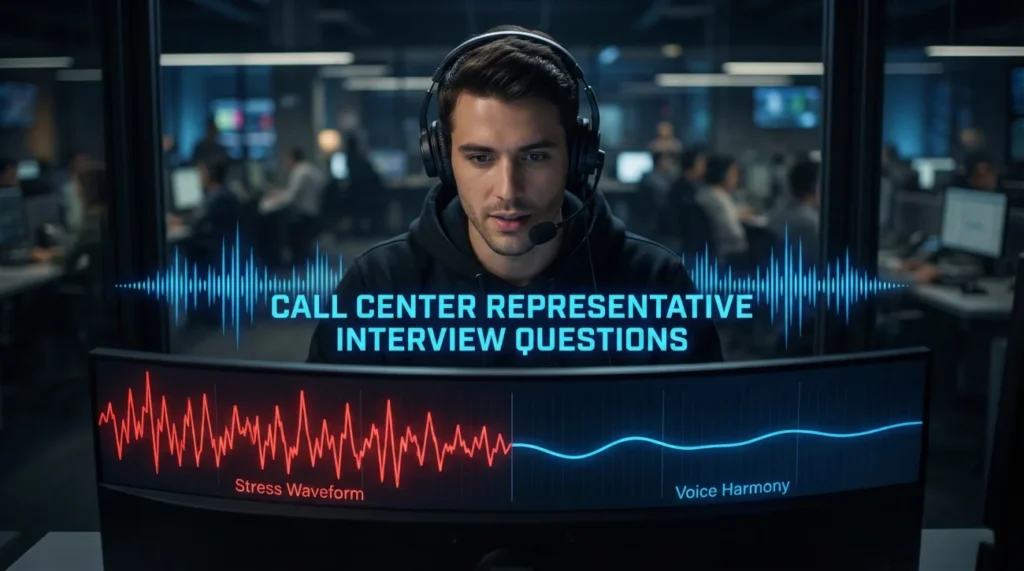
The Voice of the Brand
Call center representative interview questions are designed to test one thing above all else: your composure. In 2025, the role of a call center agent has evolved from simple script-reading to becoming a complex problem solver who navigates multiple screens while maintaining a warm, human connection over the phone. Hiring managers are looking for candidates who can handle high call volumes without sounding robotic and who understand the critical balance between speed (Average Handle Time) and quality (First Contact Resolution).
This guide dives deep into the metrics that drive the industry, the psychological techniques for de-escalating screaming customers, and the technical savvy required for modern remote setups. Whether you are applying for an inbound support role or an outbound sales position, proving you have the “thick skin” and the “soft touch” is essential to landing the job.
Understanding Call Center KPIs
In a call center, everything is measured. Interviewers will test if you understand the “math” behind your performance. You need to show that you are data-driven.
Q: What is the difference between AHT and FCR, and which is more important?
AHT (Average Handle Time) measures how long a call takes, while FCR (First Contact Resolution) measures if the issue was solved in that single call. While low AHT saves the company money, FCR is more important for customer loyalty. My strategy is to balance them: I work efficiently to keep AHT down, but I will never rush a caller off the phone if it means they have to call back (which hurts FCR). Solving it right the first time is actually the biggest time-saver in the long run.
Q: How do you handle “Adherence to Schedule”?
I understand that in a call center, coverage is everything. If I am late returning from lunch by even 2 minutes, it can increase the wait time for hundreds of customers in the queue. I treat my schedule with strict discipline. I log in 5 minutes early to boot up my systems, and I use my aux codes correctly so workforce management always knows my status.
Q: What is a “Quality Assurance” (QA) score, and how do you use it?
QA is the scorecard for my interactions, checking if I followed compliance scripts, verified identity, and used the right tone. I view QA feedback not as criticism but as a roadmap to my bonus. If my manager flags that I forgot to mention the survey at the end of the call, I write it on a sticky note on my monitor until it becomes a habit.
Q: Explain “Occupancy Rate” in your own words.
Occupancy rate is the percentage of time I am effectively working (talking or wrapping up) versus waiting for a call. High occupancy means it is busy. I thrive in high-occupancy environments because I stay in the “zone.” I know how to pace myself during back-to-back calls without letting the stress of the previous call bleed into the next one.
Handling Difficult Caller Profiles
You will deal with all types of personalities. This section demonstrates your ability to adapt your communication style instantly.
Q: How do you handle “The Yeller” (The Aggressive Caller)?
I never yell back. I lower my voice to force them to listen harder, which naturally calms the room. I use the “broken record” technique with empathy: “I hear that you are frustrated, and I want to help.” I wait for a pause in their rant before speaking. Most importantly, I don’t take it personally – I know they are mad at the situation, not me.
Q: How do you manage “The Talker” (The Rambling Caller)?
A rambling caller hurts my AHT. I politely interrupt with closed-ended questions to regain control. For example: “I appreciate that background, Mr. Smith. To get this fixed for you quickly, can you confirm the error code on your screen right now?” I guide the conversation firmly back to business without being rude.
Q: How do you assist “The Tech-Illiterate” Caller?
I avoid jargon. I don’t say “Open your browser”; I say “Look for the blue ‘e’ or the colorful circle icon.” I give instructions one step at a time and wait for confirmation before moving on. Patience is key here. I visualize what they are seeing and describe it in plain language, treating them with respect so they don’t feel embarrassed.
Q: How do you deal with “The Threatener” (Threatening Legal Action)?
If a caller threatens a lawsuit or media exposure, I stick strictly to the script and company policy. I do not get defensive. I say, “I understand your position. Since you’ve mentioned legal action, I must document this call accurately. Here is what I can do for you right now within our policy.” If they persist, I follow the escalation protocol to a supervisor.
Q: How do you handle “The Escalator” (Demands a Manager Immediately)?
I try to de-escalate once before transferring. I say, “I can certainly get a supervisor for you, but they will likely need the same information I am asking for. If you give me a chance, I might be able to resolve this for you right now without the hold time.” If they insist, I transfer warmly, briefing the manager so the customer doesn’t have to repeat themselves.
Q: How do you interact with “The Flirt” or Inappropriate Caller?
I remain professional and cool. I ignore the comments and pivot back to the issue: “Sir, I am here to help with your billing. Do you have the account number?” If they continue to be inappropriate or abusive, I give a clear warning: “I will have to end this call if the conversation remains unprofessional.” I then disconnect if needed and flag the account.
Remote Work & Technical Reliability
With many call center jobs moving home, you must prove you are self-sufficient and technically reliable. This “buffer” section also ensures our content flow remains engaging.
Q: Describe your home office setup for a remote call center role.
I have a dedicated, quiet room with a door that locks to ensure customer privacy. I use a noise-canceling headset (like Jabra or Plantronics) to block out background noise. My internet connection is hardwired via Ethernet, not Wi-Fi, to prevent call drops, and I have a backup mobile hotspot just in case. I understand that technical reliability is my responsibility.
Q: How do you stay motivated working from home without a supervisor nearby?
I thrive on autonomy. I set mini-goals for myself, like “Finish 10 calls before my next break.” I stay connected with my team via the group chat (Slack/Teams) to share tips or just say “good morning,” which keeps the energy up. I treat my home office exactly like a corporate office – I dress for work and stick to my scheduled breaks rigidly.
Q: How do you troubleshoot your own technical issues?
I am the first line of defense. If my CRM freezes, I know to clear my cache and cookies or restart the VPN client before calling IT. I always check if the issue is global (affecting everyone) or local (just me) by checking the team chat. I document the error message so if I do need IT help, I can give them the specific details to fix it fast.
Q: Are you comfortable being monitored via software?
Absolutely. I understand that screen recording and call monitoring are standard in this industry for compliance and training. I assume I am always being recorded. It keeps me accountable and protects me in case a customer makes a false claim about what I said.
Real-Time Scenario Simulations
These conversational questions test your judgment when the script doesn’t have the answer.
Your system crashes in the middle of a call with a customer. What do you do?
I stay calm and inform the customer immediately: “I apologize, my system is updating for just a moment. I am still here with you.” I don’t complain about the “junk computers.” I use the downtime to build rapport, asking them about their day or the weather, or summarizing what we have done so far. If it takes too long, I offer to call them back rather than wasting their time on hold.
You notice a coworker is marking calls as “bad number” just to hang up and improve their AHT. What do you do?
Call avoidance is a serious offense that hurts the team and the customers. I would not confront them directly as it might cause drama. Instead, I would privately mention to my supervisor that I noticed some odd patterns or frequent hang-ups in the queue report, framing it as a concern for the customer experience rather than “snitching” on a person. Integrity is non-negotiable.
A customer asks for a refund that is $5 above your authorization limit. The manager is busy.
I assess the value of the customer. If they are loyal, I might promise the refund pending approval: “I have submitted the request for the full amount. My manager just needs to sign off on it, which should happen by end of day.” Or, I offer my max limit now and a coupon for the difference. I focus on what I can do immediately to satisfy them.
Call Center Operations Quiz
Test Your Call Center IQ
1. “AHT” stands for:
- Agent Handle Time
- Average Handle Time
- After Hours Time
- Automated Help Tool
2. “FCR” is critical because:
- It saves paper
- It prevents customers from having to call back (First Contact Resolution)
- It makes the call longer
- It tracks employee breaks
3. “ACW” (After Call Work) refers to:
- Calling the customer back
- The time spent documenting the call after hanging up
- Taking a lunch break
- Cleaning the desk
4. When placing a customer on hold, you should first:
- Just press the button
- Ask for permission and explain why (“May I place you on a brief hold to check that?”)
- Hang up
- Sigh loudly
5. “IVR” stands for:
- Internal Voice Recording
- Interactive Voice Response (the automated menu system)
- Internet Video Relay
- Immediate Verification Required
6. “Adherence” measures:
- How fast you type
- How closely you stick to your assigned schedule (breaks/login times)
- How many sales you make
- How loud you speak
7. A “Warm Transfer” involves:
- Transferring to a tropical location
- Speaking to the next agent to brief them before connecting the customer
- Transferring blindly
- Asking the customer to call back
8. “Dead Air” is:
- A broken air conditioner
- Periods of silence on the call which can make customers anxious
- A dropped call
- A rude customer
9. The “Mute” button should be used when:
- You want to ignore the customer
- You need to cough or sneeze, but still want to hear the customer
- You want to eat lunch
- You are talking to a friend
10. “Escalation” usually means:
- Taking the elevator
- Sending the call to a supervisor or Tier 2 support
- Hanging up
- Lowering the price
11. “Wrap-up Code” or “Disposition” is used to:
- Delete the call
- Categorize the outcome of the call for reporting
- End the shift
- Rate the customer
12. “Omni-channel” agents handle:
- Only phone calls
- Phone, email, chat, and social media inquiries
- Only VIP customers
- Internal IT support
13. Which is a violation of “PCI Compliance”?
- Asking for the last 4 digits of a card
- Writing down the customer’s full credit card number and CVV on paper
- Transferring to a secure line
- Verifying the billing address
14. “Queue” refers to:
- The line of customers waiting to be answered
- A letter of the alphabet
- The break room
- The exit
15. “Empathy statements” are used to:
- Make the call longer
- Validate the customer’s feelings and build rapport
- Confuse the customer
- End the call
16. “Call Avoidance” includes:
- Answering calls quickly
- Staying in “After Call Work” too long to avoid the next call
- Taking scheduled breaks
- Helping coworkers
17. “Script Adherence” means:
- Reading like a robot
- Following the required compliance language while sounding natural
- Writing your own script
- Ignoring the rules
18. If you accidentally disconnect a call, you should:
- Hope they don’t notice
- Call them back immediately (if policy allows) or note it in the system
- Go to lunch
- Blame the customer
19. “Softphone” is:
- A phone made of cotton
- Software that allows you to make calls via the computer/internet
- A quiet phone
- A mobile app only
20. “Churn Rate” in a call center often refers to:
- How fast you speak
- The turnover rate of employees leaving the job
- The speed of the internet
- The number of successful sales
❓ FAQ
🗣️ Do I need a clear accent to work in a call center?
You don’t need to change your accent, but you do need enunciation. Clarity is king. If you speak clearly, at a moderate pace, and use positive language, customers will understand and respect you. Focus on being understood, not on hiding your voice.
🎧 What is the hardest part of being a call center agent?
The repetition and the negativity. You might say the same greeting 80 times a day, and many people only call when they are unhappy. The key is compartmentalization – leaving the stress of the last call behind as soon as you hang up.
💻 What computer skills do I need?
You need to be a multitasker. You will likely talk on the phone while navigating 3-4 different software windows (CRM, Knowledge Base, Email, Chat). Typing speed (at least 40 WPM) is crucial so you can document while listening.
📈 Can I make a career out of this?
Yes. Call centers are promotion machines. High performers often move into Team Lead, QA Analyst, Workforce Management, or Trainer roles within 1-2 years. It is one of the fastest paths to management without a degree.
🕒 How strict are the breaks?
Very strict. In a call center, staffing is calculated down to the minute. Being 5 minutes late can ruin the service level for the whole team. If you value flexibility over structure, this might not be the right role for you.
Final Thoughts
To succeed in answering call center representative interview questions, you need to show that you are the “pilot” of the call. You remain calm in turbulence, you follow the flight plan (script), and you land safely (resolution). Interviewers want to see resilience. They want to know that when a customer yells, you don’t crumble – you get curious and helpful.
Focus on your ability to use tools efficiently and your dedication to the schedule. If you can prove you are reliable and composed, you will be a top candidate. For a broader look at service roles, check out our guide to customer service interview questions to refine your empathy skills further.
⚠️ Disclaimer: The interview strategies, sample answers, and negotiation tips provided in this guide are for educational purposes only. Hiring decisions are subjective and vary by company and industry. While these strategies are based on professional HR standards, they do not guarantee a specific job offer or result.