Running the Floor Like a Business
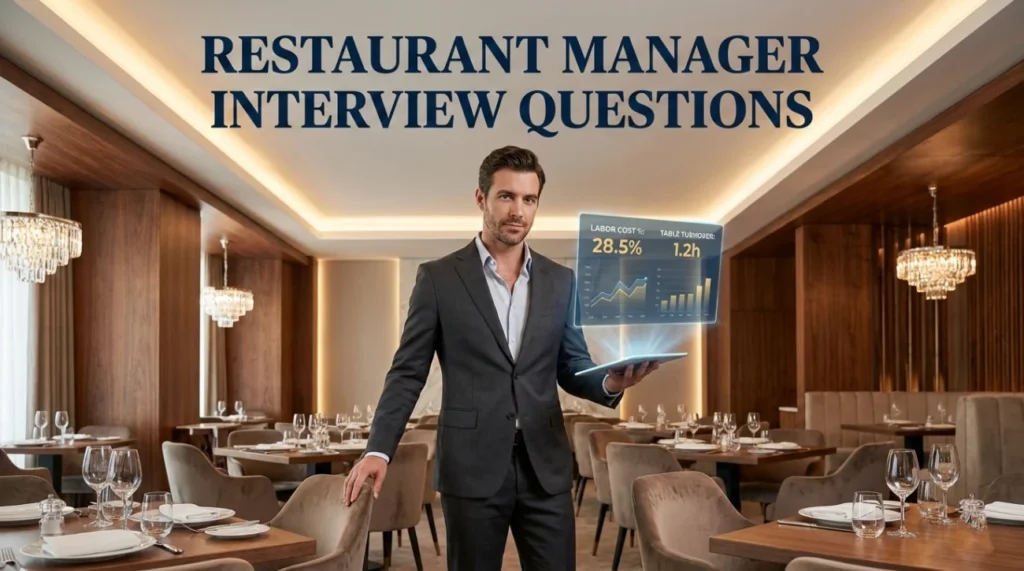
Restaurant manager interview questions are really a stress test. Can you protect the guest experience while you watch labor, inventory, and cash flow at the same time? When the dining room is full, the kitchen is behind, and a server just called out, the manager who keeps their head is the manager who gets hired.
Expect the interview to bounce between numbers and people. You will be asked about prime cost, scheduling, comping decisions, and how you coach a team through a rough shift without losing standards. Treat every answer like you are explaining your operating system, not just telling stories.
Financials, P&L, and KPIs
This is the “make or break” section. If you cannot speak the language of numbers, you cannot manage the business. Expect to do some math.
Q: What is “Prime Cost” and why is it the most critical number for a restaurant?
Answer: Prime Cost is the sum of Cost of Goods Sold (COGS) plus Total Labor Cost. It represents the biggest controllable expenses in a restaurant. I aim for a Prime Cost of 55% to 60% of total sales. If it creeps above 65%, the business is likely losing money. I track this weekly, not just monthly, because if I wait for the end-of-month P&L, it is too late to fix a labor blowout.
Q: Walk me through how you analyze a P&L statement to find opportunities.
Answer: I start with the “Big Three”: Sales, COGS, and Labor. First, I check if Sales are meeting projections. Then I look at COGS variances; if food cost is up 2%, is it waste, theft, or supplier inflation? I drill down into invoices. Next, I look at Labor efficiency. Did we cut staff fast enough on slow nights? Finally, I check operating expenses like linens and breakage. I look for trends, not just snapshots, comparing year-over-year data to spot anomalies.
Q: How do you control Labor Costs without sacrificing service quality?
Answer: I use “Smart Scheduling” based on historical sales data and reservations, not just gut feeling. I stagger start times (e.g., bringing servers in every 15 minutes) rather than bringing everyone in at 5 PM. During the shift, I monitor the “Sales Per Labor Hour” (SPLH). If the floor slows down, I cut staff proactively, asking for volunteers first. However, I never cut so deep that the guest experience suffers; losing a customer forever is more expensive than paying an hour of labor.
Q: How do you handle “Comps” and “Voids” to prevent revenue leakage?
Answer: I strictly separate them. A “Void” is for an item not made (mistake), while a “Comp” is for an item made but given away (promo/recovery). I audit the “Void/Comp Report” daily. If one server has unusually high voids, it might indicate training issues or theft (voiding cash tickets). I set a strict budget for Comps (usually 1-2% of sales) to empower staff to fix problems without blowing the budget.
Operations & Technology
Managing the physical building and the digital ecosystem is key. Interviewers want to see you are tech-savvy and organized.
Q: Which POS systems are you proficient with?
The Strategy: Tech Fluency.
Answer: I have extensive experience with cloud-based systems like Toast and Square for Restaurants, as well as legacy systems like Micros. I am comfortable with back-end programming: adding menu items, setting up modifiers, and pulling custom sales reports. I view the POS not just as a register, but as my primary data analytics tool for menu engineering.
Q: How do you prepare for a Health Inspection?
The Strategy: Always Ready.
Answer: I don’t “prepare” because we stay ready every day. I enforce a “Mock Inspection” daily during the pre-shift line check. We check temp logs, sanitizer concentrations, and dating labels. I cultivate a relationship with the inspector, treating them as a partner in safety, not an enemy. If they find a violation, I fix it immediately on-site if possible to show commitment.
Q: How do you manage reservation pacing with walk-ins?
The Strategy: Yield Management.
Answer: I use the reservation system (like OpenTable/Resy) to set strict “covers per 15 minutes” limits based on kitchen capacity, not just seat capacity. If the kitchen can only handle 40 mains every 15 minutes, I cap reservations there. I always leave a percentage of tables (10-20%) for walk-ins to keep the energy high and capture neighborhood foot traffic.
Q: Describe your approach to “Menu Engineering.”
The Strategy: Profit Maximization.
Answer: I categorize items into Stars (High Profit, High Popularity), Plowhorses (Low Profit, High Popularity), Puzzles (High Profit, Low Popularity), and Dogs (Low Profit, Low Popularity). I train staff to upsell the “Stars.” I try to rework the “Puzzles” (change description/placement) to sell more. I re-price the “Plowhorses” slightly higher, and I remove the “Dogs” entirely to streamline inventory.
Q: How do you handle third-party delivery apps (UberEats/DoorDash)?
The Strategy: Protecting the Brand.
Answer: Delivery is a necessary revenue stream but can disrupt dine-in. I set up a dedicated packing station away from the main pass to avoid clutter. I simplify the delivery menu to remove items that don’t travel well (like delicate fries or raw items). If the kitchen gets slammed, I am not afraid to “throttle” (pause) the tablets for 20 minutes to protect the experience of the guests sitting in the dining room.
Q: How do you manage inventory and supplier relationships?
The Strategy: Negotiation.
Answer: I treat suppliers as partners. I consolidate orders to minimize drops. I check prices weekly against competitors to keep them honest. I enforce strict receiving protocols: weighing proteins and checking produce quality at the door. I refuse to pay for air or ice. Good relationships mean they will rescue me with a rush delivery when I forget to order napkins on a Friday.
Leadership & HR Management
Staff retention is the biggest challenge in 2025. You must show you can build a culture where people want to work.
Q: How do you handle a toxic employee who is a “High Performer”?
Answer: This is the “Rockstar Virus.” Even if they are the best server or cook, if they are toxic, they cost me money by driving other staff away. I address the behavior privately: “Your sales are great, but your attitude towards the team is unacceptable.” I give them a chance to correct it. If they don’t, I terminate them. A cohesive team is more profitable than one toxic superstar.
Q: Describe your strategy for hiring and onboarding.
Answer: I hire for “Hospitality Gene,” not just experience. I can teach wine knowledge; I can’t teach empathy. During the interview, I ask behavioral questions. For onboarding, I don’t just throw them on the floor. I have a structured 5-day training plan with a manual, menu tests, and shadow shifts. I check in with them after 30 days to ensure they feel supported. Retention starts on Day 1.
Q: How do you run a Pre-Shift Meeting (Line Up)?
Answer: It must be short, energetic, and informative. I cover the “3 Ps”: Product (86 list, specials to push), Process (service focus for the night, e.g., “crumb the tables”), and People (shout-outs for good work yesterday). I include a tasting of a special or wine to get the team excited. I always end on a positive note to send them onto the floor with good energy.
Crisis & Guest Experience Scenarios
You are the “Firefighter in a Suit.” These questions test your ability to handle disasters without sweating.
A VIP guest posts a scathing 1-star review online. How do you respond?
The Strategy: Public Grace, Private Recovery.
Answer: I respond publicly within 24 hours. I thank them for the feedback, apologize for missing the mark (without making excuses), and invite them to contact me directly offline. “I would love the chance to make this right personally.” If they contact me, I listen, validate, and offer a specific invitation to return so I can oversee their experience. The goal is to show future readers that we care, not just to win back that one guest.
The kitchen crashes on Saturday night. Ticket times are 45 minutes.
The Strategy: Communication & Protection.
Answer: I go to the pass first to assess the bottleneck. I might jump in to expedite or plate. Then, I go to the floor. I instruct servers to stop taking orders for 10 minutes (“throttle the room”). I touch the tables personally: “Folks, the kitchen is overwhelmed, and I apologize. I’ve sent a round of appetizers/drinks on the house while you wait.” I buy the guest’s patience with hospitality before they get angry.
You suspect the bartender is stealing.
The Strategy: Verify then Act.
Answer: I don’t accuse without proof. I conduct a “Mid-Shift Audit” of the drawer and the liquor inventory. I review camera footage to match pours with rung-in items. I look for “No Sale” rings or excessive comping. Once I have concrete evidence, I terminate immediately in the presence of a witness. I maintain strict cash handling policies (blind drops) to prevent this from starting.
Restaurant Management Quiz
Test Your Management IQ
1. “Prime Cost” combines:
- Rent and Utilities
- COGS (Food/Bev Cost) + Total Labor Cost
- Marketing and Admin
- Food Cost and Rent
2. A healthy Prime Cost target is generally:
- 20-30%
- 55-60%
- 70-75%
- 10-15%
3. “COGS” stands for:
- Cost Of Great Service
- Cost Of Goods Sold
- Cash On Goods Service
- Count Of Guest Sales
4. “Table Turnover” rate helps measure:
- How fast tables spin
- How many times a specific table is occupied during a service period
- How many dishes are broken
- The speed of the servers
5. “RevPASH” stands for:
- Revenue Per Average Server Hour
- Revenue Per Available Seat Hour
- Review Past Annual Sales History
- Real Profit After Service Hour
6. A “P&L” statement is:
- Pickles and Lettuce list
- Profit and Loss Statement (Income Statement)
- People and Labor report
- Purchase and Lease agreement
7. “Menu Engineering” focuses on:
- Cooking food
- Analyzing popularity vs. profitability of menu items
- Printing menus
- Designing the kitchen
8. A “Cover” is:
- A lid
- A guest/customer served
- An entrance fee
- A tablecloth
9. “86” means:
- The item is $86
- Item is sold out/unavailable
- The table is leaving
- A VIP guest
10. “Labor Variance” is:
- Staff quitting
- The difference between scheduled labor cost and actual labor cost
- Overtime pay
- Hiring new staff
11. “Check Average” (or PPA – Per Person Average) is:
- The waiter’s tip
- Total Sales divided by Number of Covers
- The average time to eat
- The cost of the meal
12. “Contribution Margin” is:
- The tip left by guests
- Selling Price minus Item Food Cost (the cash profit per item)
- The total sales
- The cost of ingredients
13. “FOH” and “BOH” stand for:
- Full Of Hope / Back Of House
- Front Of House (Service) / Back Of House (Kitchen)
- First On Hand / Best On Hand
- Food On Heater / Beverage On House
14. “Inventory Turnover” measures:
- How fast staff quit
- How many times you sell through your inventory in a period
- Moving boxes around
- Spoiled food
15. “Comp” vs. “Void”:
- Same thing
- Comp is made but given free (promo); Void is not made/error (removed from bill)
- Comp is for staff only
- Void is illegal
16. “Safe Count” or “Bank” is:
- Counting guests
- Verifying the cash amount in the safe/registers daily
- Checking fire safety
- Depositing money
17. “Upselling” helps primarily to:
- Annoy guests
- Increase the Check Average and overall revenue
- Clear old stock
- Slow down service
18. “Theoretical Food Cost” is:
- A guess
- What the food cost should be based on recipes and sales mix (Ideal Cost)
- The actual cost
- The supplier price
19. A “Soft Opening” is:
- Opening the door quietly
- A practice run opening with limited guests/menu to train staff
- Opening for ice cream only
- A grand opening party
20. “Dram Shop Laws” relate to:
- Drama in the workplace
- Liability for serving alcohol to intoxicated persons who cause harm
- Coffee shop regulations
- Dress code laws
❓ FAQ
🎓 Do I need formal education to become a restaurant manager?
Not always. Many managers start as servers, bartenders, or shift leads and move up by mastering the business side. A degree can help with corporate paths, but what wins interviews is proof you can lead people, control costs, and run smooth service under pressure.
🕰️ What kind of schedule should I realistically expect?
Most roles include nights, weekends, and holidays. The busiest times are when you are needed most. Strong managers protect the team by planning ahead, delegating, and building routines so the operation does not rely on heroic overtime every week.
📊 Which metrics matter most in manager interviews?
Prime cost, labor percentage, food and beverage cost, comps and voids, guest recovery outcomes, and turnover. When you can explain what you track, why you track it, and what action you take when it moves, you sound like an operator.
🤝 How do I deal with an owner who changes the plan mid-shift?
Keep it calm and make it about outcomes. Confirm the goal, explain the trade-offs in plain language, and offer two workable options. Owners usually want the same thing you do, a strong night and happy guests, so framing it as a choice reduces conflict.
🚀 What is a smart next step after restaurant manager?
Common paths include general manager, multi-unit roles, or director of operations. Another strong move is taking on a larger volume concept or a bar-heavy venue to sharpen training, controls, and leadership across different service models.
Final Thoughts
A strong answer to restaurant manager interview questions sounds like leadership plus math. Show how you make decisions that protect the floor, keep the kitchen supported, and still hit targets on labor and cost. The interviewer is listening for confidence that you can run the room without chaos.
Close by highlighting culture, consistency, and accountability. When you can coach performance, handle guest recovery, and speak fluently about operations, you are hard to replace.
⚠️ Disclaimer: The interview strategies, sample answers, and negotiation tips provided in this guide are for educational purposes only. Hiring decisions are subjective and vary by company and industry. While these strategies are based on professional HR standards, they do not guarantee a specific job offer or result.