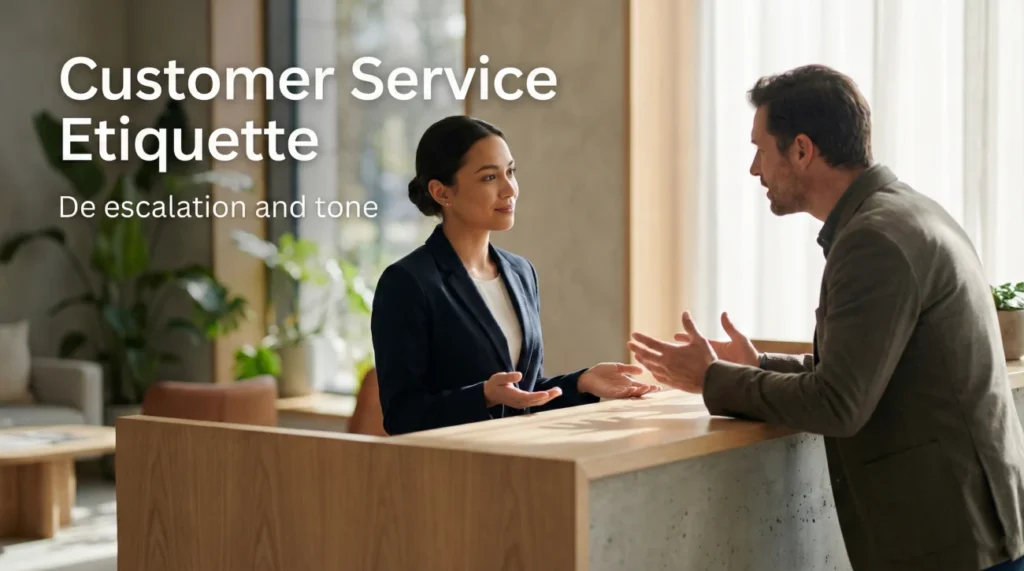
- Main point: Great customer service etiquette is mostly about tone, word choice, and composure, not just being “polite.”
- Tone control: Manage volume, pace, pitch, warmth, and energy so the same words land as helpful instead of cold or defensive.
- Positive wording: Swap “I can’t” for “Here’s what I can do,” take ownership, set clear expectations, and avoid corporate lines that feel fake.
- De-escalation: Let people vent, validate feelings, apologize without excuses, then solve with them using clear options and next steps.
- Boundaries: Stay warm without oversharing, protect your emotional energy, know when to escalate, and reset after tough interactions so the next customer gets your best.
The Language of Professional Service
Superior customer service etiquette extends far beyond polite greetings and forced smiles. It requires mastering tone of voice conveying warmth even when delivering unwelcome news, choosing words preventing defensive reactions, and maintaining professional composure when customers behave unreasonably. The difference between adequate and exceptional service often lies not in what you say but how you say it. Subtle shifts in phrasing, vocal inflection, and body language dramatically affect customer perception and emotional response.
The challenge is that service etiquette demands emotional labor, including projecting positivity despite personal stress, remaining patient with repetitive questions, and absorbing customer frustration without retaliating. Many service professionals master technical skills like operating POS systems or processing transactions but struggle with the interpersonal finesse distinguishing memorable service from transactional efficiency. Poor etiquette transforms neutral interactions into negative experiences while excellent etiquette converts even service failures into loyalty opportunities.
This guide establishes foundational service etiquette enabling professional excellence across hospitality and customer-facing roles. You’ll learn vocal tone techniques preventing escalation, positive language patterns encouraging cooperation, de-escalation frameworks for angry customers, and professional boundaries maintaining dignity while prioritizing customer satisfaction.
Professional Tone Management
Your professional tone management communicates attitude and intention more powerfully than words alone. Identical phrases delivered with different vocal qualities create completely opposite customer experiences.
Elements of Professional Vocal Tone
Effective service professionals control multiple vocal dimensions simultaneously to convey warmth, competence, and genuine engagement.
| Vocal Element | Professional Standard | Impact on Customer |
|---|---|---|
| Volume | Moderate, clearly audible without shouting, adjusted to environment noise | Confidence, attentiveness; too soft signals uncertainty, too loud feels aggressive |
| Pace | Moderate speed with deliberate slowing for important information | Comprehension, respect; rushing signals impatience, dragging wastes time |
| Pitch variation | Natural inflection avoiding monotone, upward at questions, downward at conclusions | Engagement, authenticity; monotone sounds robotic, excessive variation seems fake |
| Warmth | Friendly without excessive familiarity, genuine smile audible in voice | Approachability, comfort; coldness creates distance, over-friendliness feels insincere |
| Energy | Alert and present, matching customer energy level appropriately | Enthusiasm, capability; low energy signals disinterest, excessive energy overwhelms |
💡 Pro tip: Practice vocal tone by recording yourself delivering common service phrases, then listening critically. Notice whether you sound genuinely helpful or mechanically polite. Strong service professionals develop “vocal smile,” the audible warmth when speaking while actually smiling, which customers detect even over phone without visual cues.
Adapting Tone to Situations
Professional service requires adjusting vocal approach based on customer emotional state and interaction context.
- 😊 Routine interactions: Warm, efficient, moderately energetic to convey competence with friendliness
- 😤 Frustrated customers: Calm, measured, empathetic and project stability without condescension
- 😢 Upset or emotional: Soft, gentle, patient to demonstrate compassion without patronizing
- 🎉 Celebratory occasions: Enthusiastic, congratulatory, elevated energy to share genuine happiness
- ⚠️ Delivering bad news: Direct but compassionate, steady pace to balance honesty with empathy
Expert advice: Your tone conveys more than your words, and customers remember how you made them feel more than specific phrases used. When delivering service limitations, apologetic tone matters more than elaborate excuses. When resolving complaints, confident reassurance beats uncertain promises. Match emotional tone to situation while maintaining professional boundaries that preserve dignity for both parties.
Positive Language Patterns
Strategic word choice transforms negative situations into opportunities while maintaining honesty about limitations and managing expectations realistically.
Positive Phrasing Substitutions
Replace negative or limiting language with positive alternatives that focus on solutions rather than obstacles.
| Negative Phrasing | Positive Alternative | Why It Works Better |
|---|---|---|
| “I can’t do that” | “Here’s what I can do for you…” | Focuses on solutions rather than limitations, shows willingness to help |
| “That’s not my department” | “Let me connect you with the right person who can help” | Takes ownership of resolution rather than deflecting responsibility |
| “You’ll have to…” | “The next step would be…” | Collaborative language vs. demanding, positions as shared process |
| “We don’t have that” | “We have [alternative] that might work even better” | Offers solution instead of dead-end, redirects to available options |
| “You should have…” | “For future reference, you can…” | Educational without blame, forward-looking rather than past-focused |
Empowering Customer Language
Frame interactions to make customers feel valued, heard, and in control rather than powerless or dismissed.
- Acknowledge feelings: “I understand how frustrating that must be” validates emotion before solution
- Use customer’s name: Personalization throughout interaction, not just greeting
- Ask permission: “May I suggest…” respects autonomy vs. imposing solutions
- Confirm understanding: “So what I’m hearing is…” ensures alignment before proceeding
- Express gratitude: “Thank you for your patience” acknowledges cooperation
- Take responsibility: “I apologize for the inconvenience” owns organizational failures
Avoid empty corporate phrases that customers recognize as insincere: “Your call is important to us” while keeping them on hold indefinitely, “I apologize for any inconvenience” delivered robotically, “We value your feedback” with no follow-through. Authenticity matters more than polished scripts, because customers detect and resent mechanical politeness masking indifference.
Managing Expectations Through Language
Clear communication about timelines, limitations, and processes prevents disappointment while maintaining customer confidence.
- ⏰ Specific timeframes: “I’ll have this resolved by 2pm today” beats vague “as soon as possible”
- 🎯 Realistic commitments: Under-promise and over-deliver rather than optimistic timelines you can’t meet
- 📋 Process transparency: Explain what happens next so customers aren’t left wondering
- 🔄 Follow-up assurance: “I’ll personally ensure…” creates accountability and trust
De-escalation Techniques
Professional de-escalation techniques transform potentially explosive interactions into resolved situations by addressing emotional needs before logical solutions.
The Four-Step De-escalation Framework
Follow systematic approach when customers display anger, frustration, or aggressive behavior.
| Step | Action | Purpose | Example Language |
|---|---|---|---|
| 1. Listen Actively | Let customer vent without interruption, maintain eye contact, show attentiveness | Release emotional pressure, demonstrate respect, gather full context | “I’m listening…” “Please go on…” “I want to understand completely…” |
| 2. Empathize & Validate | Acknowledge emotion and perspective, separate from agreeing with facts | Reduce defensiveness, show human connection, de-personalize conflict | “I understand your frustration…” “That would upset me too…” “You have every right to feel that way…” |
| 3. Apologize Sincerely | Take ownership for failure or inconvenience, no excuses or blame-shifting | Accept responsibility, rebuild trust, shift toward solution | “I sincerely apologize…” “This should not have happened…” “I’m sorry we let you down…” |
| 4. Solve Collaboratively | Propose solution, ask for input, confirm satisfaction | Restore control to customer, demonstrate action, rebuild confidence | “Here’s what I can do immediately…” “Would that work for you?” “What else would help make this right?” |
Avoiding Escalation Triggers
Certain responses predictably escalate conflicts rather than resolving them. Avoid these common mistakes when handling upset customers.
- Arguing or defending: “Actually, our policy states…” invalidates feelings and creates opposition
- Interrupting: Cutting off venting signals dismissal and intensifies anger
- Minimizing concerns: “It’s not that big a deal” or “Calm down” enrages most people
- Passing blame: “That’s not my fault” or “Someone else should have…” avoids responsibility
- Using absolutes: “We never…” or “You always…” invites argument over exceptions
- Taking it personally: Responding emotionally to attacks rather than addressing needs
Expert advice: Remember that angry customers usually aren’t angry at you personally; they’re frustrated with situation, service failure, or organizational policies. Maintain professional detachment while showing human empathy. Your goal is resolving their problem, not winning arguments or defending organizational honor. Sometimes letting customers “win” minor points defuses tension enabling major resolution.
Knowing When to Escalate
Despite best de-escalation efforts, some situations require manager intervention or security involvement.
- ⚠️ Threats or violence: Any physical aggression or credible threats, so immediately involve security/management
- 🚫 Policy exceptions needed: Requests beyond your authority, so bring in decision-maker rather than saying no
- 🔄 Circular arguments: After 2-3 repetitions without progress; fresh perspective often helps
- 😤 Personal attacks: Sustained verbal abuse targeting you; it is acceptable to request manager assistance
For comprehensive guidance on handling customer service challenges in interview contexts, explore professional preparation frameworks covering difficult customer scenarios and behavioral response strategies.
Maintaining Professional Boundaries
Excellent service etiquette balances warmth and professionalism, helping customers generously while preserving dignity and appropriate boundaries.
Emotional Labor and Self-Protection
Service work demands projecting positivity despite personal circumstances, but sustainable performance requires protecting emotional well-being.
| Boundary Type | Healthy Practice | Warning Signs |
|---|---|---|
| Emotional investment | Care about customer experience without absorbing their emotions as your own | Ruminating about interactions after shifts, carrying customer stress home |
| Personal information | Friendly without sharing private details, redirect personal questions politely | Customers knowing your relationship status, living situation, financial details |
| Physical boundaries | Professional distance, polite deflection of inappropriate contact | Accepting unwanted touching, harassment rationalized as “part of the job” |
| Time boundaries | Efficient service without rushing, appropriate interaction length | Spending disproportionate time with demanding customers, neglecting others |
Post-Interaction Recovery
Develop practices releasing stress from difficult interactions rather than carrying emotional weight throughout shifts.
- Brief pause after challenging interactions, then do a physical reset before next customer
- Debrief with colleagues about difficult situations; shared experience reduces isolation
- Reframe negative interactions as learning opportunities rather than personal failures
- Celebrate successful de-escalations and positive outcomes to balance perspective
- Maintain interests and relationships outside work to prevent over-identification with role
💡 Pro tip: Create physical reset ritual between difficult interactions and next customer. Take three deep breaths, roll shoulders, paste genuine smile, mentally release previous situation. This conscious transition prevents carrying negative energy forward, ensuring each customer receives fresh professional attention rather than residual frustration from earlier encounters.
❓ FAQ
🎯 How do I maintain professional tone when customers are rude?
Separate customer behavior from personal worth; rudeness typically reflects their frustration with situation, not you specifically. Respond to emotion underlying rudeness rather than matching hostility. Maintain calm, steady vocal tone regardless of their volume or language. Use phrases like “I understand you’re upset” to acknowledge feeling without accepting abuse. If rudeness crosses into verbal abuse, politely establish boundary: “I want to help, but I need us to communicate respectfully.” Escalate to management if abuse continues.
💼 What if positive language feels fake or manipulative?
Authenticity matters more than perfect phrasing. Positive language works when genuinely intending to help, not as manipulation technique. Start with honest desire to serve customers well, then learn phrasing that communicates that intent clearly. Mechanical delivery of “positive” scripts sounds insincere. Instead, internalize principles: focus on solutions, take ownership, empower customers, then express naturally in your own voice. Your genuine care for customer outcomes makes language authentic rather than performative.
⏰ How do I de-escalate when I genuinely can’t help?
Honesty combined with empathy prevents escalation even when unable to provide desired solution. Acknowledge their need: “I understand why you’d want that.” Explain limitation clearly: “Unfortunately, our system doesn’t allow X because…” Offer alternatives: “What I can do is…” or “Have you considered…” If truly no alternatives exist, express genuine regret and validate disappointment: “I wish I could make that work for you.” Customers appreciate honest empathy more than false promises.
📋 Should I follow scripts exactly or adapt to situations?
Scripts provide framework ensuring consistent quality and legal compliance, but rigid adherence sounds robotic. Learn script intent, meaning what outcome it’s designed to achieve, then adapt language naturally to individual situations while maintaining key elements. Required compliance phrases (security disclosures, policy statements) need exact wording, but conversational portions benefit from authentic expression. Strong service professionals internalize script principles rather than memorizing verbatim text, enabling natural delivery matching customer energy and situation context.
✨ How do I demonstrate etiquette during service role interviews?
Your interview behavior provides real-time etiquette demonstration. Greet interviewer warmly, maintain appropriate eye contact, use their name naturally, listen actively without interrupting, acknowledge questions before answering, thank them genuinely. Prepare STAR examples showcasing de-escalation success, tone management under pressure, positive language preventing conflicts, and professional boundaries maintained despite challenges. During role-play scenarios, demonstrate calm vocal tone, empathetic language, and solution focus even when interviewer plays difficult customer intentionally testing composure.
Final Thoughts
Mastering customer service etiquette requires more than memorizing polite phrases or following prescribed scripts. Professional service excellence emerges from genuine desire to help customers combined with disciplined emotional regulation enabling warmth despite stress, strategic language choices focusing interactions toward solutions rather than obstacles, and systematic de-escalation techniques transforming potentially explosive situations into resolved outcomes.
The challenge is sustaining high etiquette standards throughout long shifts, across hundreds of interactions, with customers exhibiting every personality type and emotional state imaginable. This consistency demands developing habits rather than relying on momentary effort, including automatic vocal warmth, reflexive positive phrasing, instinctive empathy patterns that operate even when exhausted or personally stressed. Strong service professionals build these capabilities through deliberate practice until professional etiquette becomes natural expression rather than conscious performance.
Invest in developing tone management skills through recording practice and feedback, internalize positive language patterns until they feel natural rather than scripted, master de-escalation frameworks enabling confident composure with angry customers, and establish healthy boundaries protecting emotional well-being while serving others generously. These etiquette competencies distinguish exceptional service professionals from adequate performers, creating career opportunities and customer loyalty that compound throughout your hospitality career.
⚠️ Disclaimer: The interview strategies, sample answers, and negotiation tips provided in this guide are for educational purposes only. Hiring decisions are subjective and vary by company and industry. While these strategies are based on professional HR standards, they do not guarantee a specific job offer or result.