You Are the Person Who Fixes the Shift
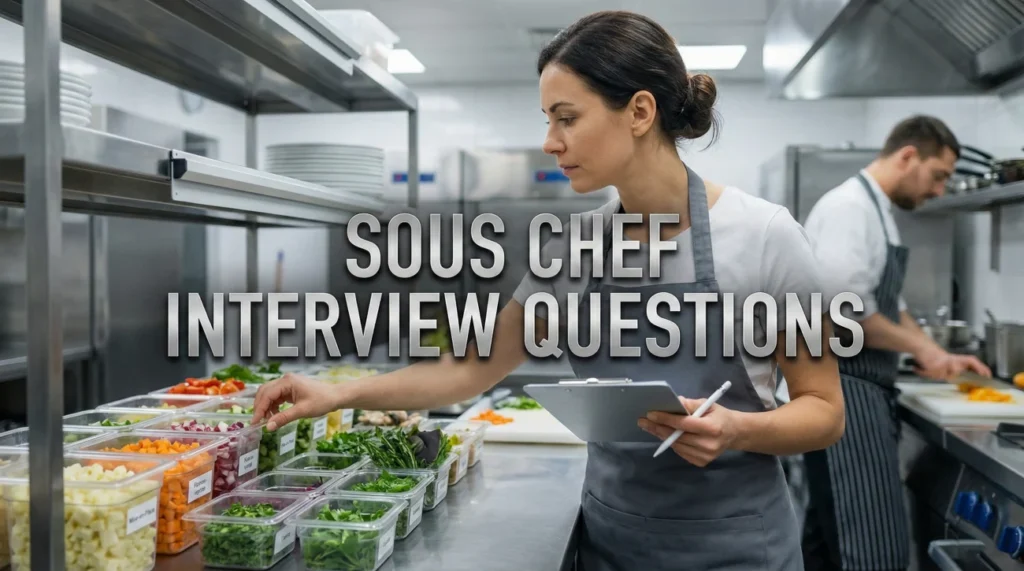
Sous chef interview questions are built to uncover one thing: can you keep the kitchen stable when everything is moving fast. The Executive Chef sets the vision. The Sous Chef makes sure it actually happens, plates leave the pass correctly, prep is ready, and the team stays focused.
Most hiring managers will probe your leadership habits, your inventory discipline, and how you run the pass under pressure. If you can describe how you prioritize, communicate, and correct mistakes without losing control, you sound like a real Sous Chef, not just a strong line cook.
Leadership & Staff Supervision
You are the direct supervisor of the line cooks. Interviewers need to know you can enforce standards without breaking morale. This section tests your management style.
Q: How do you handle a line cook who repeatedly sends out substandard food?
Answer: I address it immediately but constructively. I pull the plate back at the pass and show them exactly why it is wrong (e.g., “This sear is too light, the guest expects a hard crust”). I ask them to taste it if possible so they understand the gap in quality. Then, I demonstrate the correct technique once. If it continues, I pull them aside after service for a formal conversation to identify if it is a skill gap or an attitude problem. I do not let bad food leave the kitchen, but I also use it as a teaching moment rather than just screaming. Consistency is my responsibility.
Q: Describe your approach to training a new hire on the line.
Answer: I use the “Show, Do, Review” method to ensure retention. First, I have them shadow me while I explain the station setup, the “why” behind the recipes, and the expected pace. Then, I have them cook while I watch and correct their technique in real-time. Finally, I let them run the station solo but check every plate leaving their station. I also ensure they have a clear, updated prep list and recipe book. I believe that setting them up for success is my responsibility; if they fail because of poor training, I fail.
Q: The Executive Chef is away. How do you maintain their standards?
Answer: I act as their proxy and guardian of the vision. I know their flavor profile and plating standards inside out. I run the pre-shift briefing to set the tone and inspect uniforms. I taste all the mise-en-place (prep) before service starts, just as they would, to catch any seasoning issues early. I empower the team by reminding them: “Chef isn’t here, so we need to be even sharper today to show we’ve got this.” I maintain consistency so the guests never know the difference.
Q: How do you handle a conflict between two cooks during service?
Answer: I shut it down instantly. “Not now. We have tickets.” I separate them if possible (e.g., move one to prep or a different station). The priority is the service and the guest experience. After the rush, I sit them down together to mediate. I make it clear that personal beef stays outside the kitchen; inside, we are a brigade, and we respect the uniform and the team effort.
Operations: Inventory & Food Cost
The Sous Chef often handles the ordering and inventory. Interviewers test your ability to protect the profit margin through rigorous control.
Q: Explain “FIFO” and why it is critical.
The Strategy: Waste Prevention.
Answer: FIFO means “First In, First Out.” It is the golden rule of inventory management. When putting away a delivery, new stock goes behind the old stock on the shelf. This ensures we use the older product before it spoils. It reduces food waste (which kills food cost) and ensures guests are always eating fresh product. I spot-check the walk-in daily to ensure dates are visible and rotation is happening correctly.
Q: How do you determine “Par Levels” for ordering?
The Strategy: Data-Driven Decisions.
Answer: I don’t guess. I look at historical sales data and upcoming reservations. If we sell 20 steaks on a Tuesday and 50 on a Saturday, the Pars must reflect that variance. I also factor in lead time (how long it takes for the supplier to deliver). I adjust Pars seasonally. Ordering too much ties up cash and risks waste; ordering too little risks 86ing items during service. It is a balancing act I review weekly.
Q: How do you conduct an accurate inventory count?
The Strategy: Organization.
Answer: I organize the storage areas to match the inventory sheet (“Sheet-to-Shelf”) to speed up the process. I use two people: one to call out, one to write, to prevent recording errors. I weigh open proteins rather than guessing visually. I do it at the same time (e.g., Sunday night after service) to keep periods consistent. Accuracy here is vital because it determines our P&L (Profit and Loss) report accuracy.
Q: What do you do if you notice food cost is trending high?
The Strategy: Investigation.
Answer: I launch an investigation. I audit the garbage bins (to check for excessive waste or trimming errors). I check the portion sizes on the line (are cooks over-portioning protein?). I verify the incoming invoices (did supplier prices jump without us noticing?). I check for theft. I then implement an action plan: re-training on fabrication, adjusting portion scoops, or speaking to the Exec Chef about raising menu prices.
Q: How do you manage the “prep list” for the team?
The Strategy: Efficiency.
Answer: I don’t let cooks guess what to do. I create a master prep list based on the day’s reservations and current stock. I prioritize long-lead items (stocks, braises) first. I check the list mid-shift to ensure we are on track for service. A good prep list prevents the “in the weeds” panic at 7 PM and ensures labor hours are used efficiently.
Q: How do you handle a delivery that is short or damaged?
The Strategy: Gatekeeping.
Answer: I act as the gatekeeper. I check the invoice against the goods before the driver leaves. If tomatoes are crushed or fish is warm, I refuse that specific item. I mark the invoice “Short” or “Returned” and have the driver initial it. I call the rep immediately to get a credit note and arrange a replacement. I never accept sub-par product just to be nice; it affects our quality and cost.
Expediting & Quality Control
Running the pass is the Sous Chef’s main battle station. These questions test your ability to orchestrate the flow of service under extreme pressure.
Q: Describe your style of expediting (Expo).
Answer: I am calm, clear, and rhythmic. I call out tickets clearly and loudly: “Ordering: 2 Beef, 1 Salmon. Fire: Table 10.” I control the pace so the kitchen doesn’t get flooded. I am the final quality check – I wipe every rim and check every garnish. If it isn’t perfect, it doesn’t leave the pass. I communicate constantly with the FOH to coordinate pick-ups, ensuring food doesn’t die in the window.
Q: The kitchen is crashing (in the weeds). How do you recover?
Answer: I stop the noise and reset the room. I tell the servers to hold tickets for 2 minutes to let the kitchen breathe. I jump on the station that is drowning to help them clear the board or plate up. I simplify the calls to just “All Day” counts (e.g., “I need 5 Burgers all day, focus on that”). Once we clear the backlog, I reset the rhythm. Panic fixes nothing; leadership does.
Q: A dish comes back from the dining room (refire). What do you do?
Answer: It becomes priority #1. I call out “Refire on the fly!” to the station. I personally inspect the re-cooked dish to ensure it is perfect this time. I apologize to the server for the delay. After service, I investigate why it came back (Undercooked? Cold? Wrong side?) to prevent it from happening again. Every refire is a learning opportunity.
Crisis & Situational Scenarios
The kitchen is unpredictable. How do you handle emergencies when the Chef isn’t there?
The Health Inspector walks in during the lunch rush.
The Strategy: Professional Compliance.
Answer: I greet them politely and guide them. I assign a strong cook to cover my spot on the line. I walk with the inspector, answering questions honestly. I quietly signal the staff to do a “sanitation check” (change sani-buckets, wash hands, check temps). I treat it as an opportunity to show off our high standards, not as a threat. I know our scores are public, so a good inspection is marketing.
The walk-in cooler fails overnight and is warm in the morning.
The Strategy: Safety First.
Answer: I check the temperature log to see how long it has been out of the safe zone. If perishable items (meat, dairy) have been above 41°F for more than 4 hours, I discard them. It hurts the cost, but poisoning a guest destroys the business. I call the repair tech immediately. I modify the menu for the day based on what is safe/salvageable or rush order replacement stock from a local supplier.
You catch a server stealing food.
The Strategy: Integrity.
Answer: Theft is theft. I report it to the FOH Manager or General Manager immediately with details (time, item). I do not confront them aggressively in front of staff to avoid a scene, but I make it known that I watch the pass. I believe in feeding staff well (family meal) so they don’t feel the need to steal, but I have zero tolerance for dishonesty in the workplace.
Career Growth & Ambition
Employers want a Sous Chef who is ambitious but patient. They want to know you are invested in the industry.
Q: Where do you see yourself in 5 years?
Answer: I see myself running my own kitchen as an Executive Chef. My goal right now is to master the operational side – scheduling, costing, and mentorship – so that when I do take that step, I am fully prepared. I want to learn from you and this establishment to refine my management style.
Q: What is your favorite station to work and why?
Answer: I love the Saucier station because it is the heart of the kitchen’s flavor. It requires patience, precision, and timing. However, as a Sous Chef, I pride myself on being able to jump into Garde Manger or Grill with equal competence. My favorite station is wherever the team needs me most in that moment.
Kitchen Operations Quiz
Test Your Sous Chef IQ
1. “Par Level” means:
- A golf score
- The standard amount of stock needed on hand to get through a shift/day
- Partial level
- Party level
2. “All Day” call refers to:
- Working all day
- The total count of a specific item currently needed from all active tickets
- The breakfast menu
- A slow chef
3. “On the Fly” means:
- Served on a plane
- Need the item immediately (priority/rush)
- Throw the food
- Cooking with wine
4. “Behind” is used to:
- Insult someone
- Alert a coworker you are walking behind them to avoid collisions
- Ask for help
- Tell someone they are slow
5. “86” means:
- The price
- Item is sold out or removed from the menu
- 86 guests
- A special dish
6. “COGS” stands for:
- Cooking On Gas Stove
- Cost Of Goods Sold
- Count Of Goods Stored
- Chef On Grill Station
7. “Fire” (e.g., “Fire Table 4”) means:
- There is a fire
- Start cooking/finishing the main courses for that table
- Burn the food
- Kick the guests out
8. “Lowboy” is:
- A short chef
- A low, under-counter refrigerator
- A type of table
- A floor drain
9. “Day Dot” labels are for:
- Decoration
- Marking the prep date/expiry date for food safety rotation
- Counting staff
- Marking spicy food
10. “The Pass” is:
- The hallway
- The flat surface where finished plates are placed for the Chef/Expo to check and garnish
- A failing grade
- The entrance
11. “Flash” means:
- Take a photo
- Quickly reheat something in the oven or salamander
- Show off
- Use a flashlight
12. “Sandbagging” means:
- Building a wall
- Cooking food before it is ordered to get ahead (often frowned upon if quality suffers)
- Working slowly
- Hiding food
13. “Cover” refers to:
- A lid
- A customer/guest served
- A blanket
- A shift replacement
14. “Stage” (pronounced stah-zh) is:
- A performance platform
- An unpaid internship or working interview in a kitchen
- A level of cooking
- A type of sauce
15. “Baine Marie” is:
- A French chef
- A hot water bath used to keep food warm or melt ingredients gently
- A type of cheese
- A cleaning solution
16. “Cross-Contamination” is:
- Crossing the road
- Transferring bacteria/allergens from one food to another (e.g., raw chicken to lettuce)
- Mixing sauces
- Sharing recipes
17. “Walk-in” is:
- A customer
- A large room-sized refrigerator
- A type of shoe
- Leaving the job
18. “Family Meal” is:
- Cooking for your parents
- A meal cooked for the staff to eat together before service
- A kids’ menu item
- A large platter
19. “Cambro” is:
- A dance
- A brand of plastic food storage container used universally in kitchens
- A type of camera
- A soup
20. “Ticket Time” is:
- The time the restaurant opens
- The time elapsed since an order was placed until it leaves the kitchen
- The price of the ticket
- Break time
❓ FAQ
👔 What is the difference between Sous Chef and Chef de Cuisine?
Titles vary by restaurant, but the idea is similar: the Sous Chef is typically the second-in-command focused on execution and daily operations. A Chef de Cuisine often owns more of the creative side and administration, acting like the kitchen lead when there is an Executive Chef above. Always ask how the restaurant defines the roles.
⏳ How many hours does a Sous Chef work?
It is usually a demanding schedule, especially during busy seasons. You may open, close, or cover call-outs. Employers want to hear that you manage your stamina, stay organized, and keep standards high even late in the week when everyone is tired.
🔪 Do I still cook as a Sous Chef?
Yes, but your job shifts. You jump in where the kitchen is weakest: finishing plates, rescuing a broken sauce, covering stations, and expediting. The better you are at triage, the smoother the line runs.
📈 What is the career path after Sous Chef?
Many Sous Chefs move into Chef de Cuisine or Executive Chef roles, but the timing depends on your concept and leadership growth. If you want to level up faster, focus on the business side: ordering, food cost, scheduling, and training systems, not just cooking skill.
🧾 What should I bring to the interview or trial?
Bring a notebook, clean uniform basics, and your knife roll if a trial is possible. Be ready to talk through your prep organization, labeling habits, and how you run a pass. Showing structure matters as much as showing talent.
End With Accountability
The best sous chef interview questions answers do one thing: they take responsibility. Talk about protecting standards, coaching people, and keeping service moving. You are not selling yourself as the loudest person in the kitchen. You are selling yourself as the steady one.
If the role you want is a stepping stone to the top, it helps to understand what the next level is judged on. Read these executive chef interview questions and practice speaking about cost, culture, and consistency.
⚠️ Disclaimer: The interview strategies, sample answers, and negotiation tips provided in this guide are for educational purposes only. Hiring decisions are subjective and vary by company and industry. While these strategies are based on professional HR standards, they do not guarantee a specific job offer or result.