Safety Professionals Who Serve
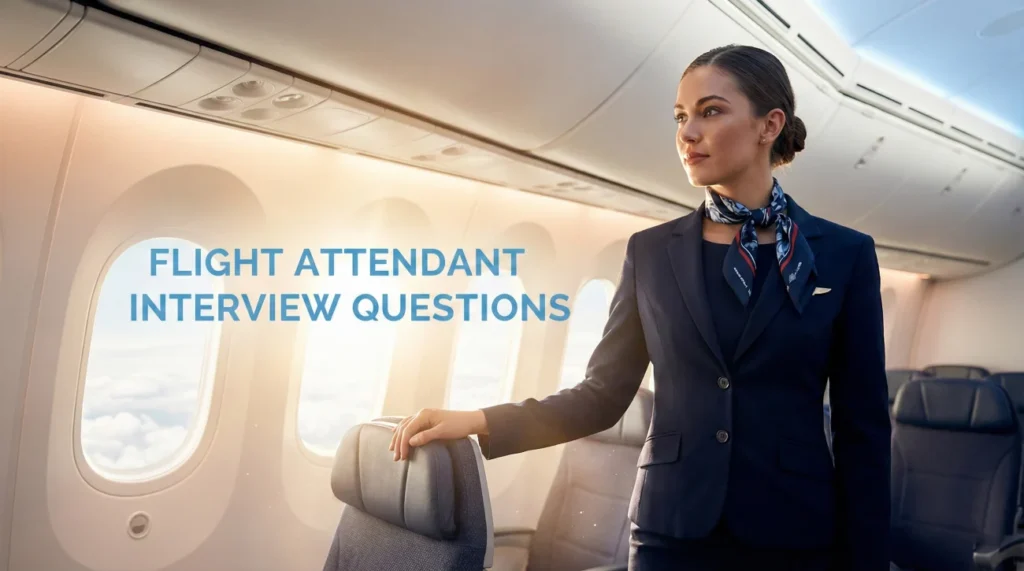
Flight attendant interview questions are designed to filter out those who just want a “free vacation” from those who are ready to save lives at 35,000 feet. In 2025, the aviation industry has shifted its hiring focus significantly. While a warm smile and impeccable grooming are still required, recruiters specifically look for resilience, situational awareness, and the ability to command authority during a crisis. You are not just a server in the sky; you are a firefighter, a nurse, a police officer, and a diplomat all rolled into one uniform.
This comprehensive guide will prepare you for the intense “Assessment Day” and the final one-on-one interview. We dive deep into the mandatory safety protocols, the psychological tactics for de-escalating aggressive passengers (a critical skill in the post-pandemic era), and the service standards required for First Class hospitality. Whether you are applying to a legacy carrier or a budget airline, proving that safety is your DNA is the only way to earn your wings.
Safety Procedures & Emergency Scenarios
This is the “Pass/Fail” section. If you cannot demonstrate a commitment to safety procedures, no amount of customer service skill will save you. Airlines need to know you can follow strict regulations (FARs) without hesitation.
Q: Safety is the airline’s number one priority. How would you handle a passenger who refuses to fasten their seatbelt during turbulence?
Answer: I approach this with a “Firm but Polite” attitude. I would make eye contact and say clearly, “Sir, for your safety and the safety of those around you, the Captain requires you to fasten your seatbelt immediately.” I don’t ask; I instruct. If they still refuse, I would issue a final warning that they are violating federal aviation regulations and will be met by authorities upon landing. I would then inform the Flight Deck and document the incident. I do not physically force them, but I ensure they understand the legal consequences.
Q: Describe your actions during a “Planned Emergency Landings” briefing.
Answer: Panic is contagious, so my calmness is my tool. I would follow the “TEST” protocol with the Captain (Type of emergency, Evacuation necessary, Signal to brace, Time available). In the cabin, I would secure the galley, instruct passengers to remove sharp objects/heels, and demonstrate the brace position clearly. I would identify and brief “Able-Bodied Passengers” (ABPs) to assist at the exits. My focus is on clear, loud commands to cut through the fear.
Q: You smell smoke in the rear galley. What is your immediate reaction?
Answer: Fire is the greatest threat on board. I would immediately grab the Halon extinguisher and the PBE (Protective Breathing Equipment). I would signal another crew member to notify the cockpit immediately using the specific emergency code. I would check for heat with the back of my hand before opening any compartments. Once the source is identified and extinguished, I would monitor the area for re-ignition and keep passengers calm/seated away from the area.
Q: What does “Pre-flight Check” mean to you?
Answer: It is the foundation of a safe flight. It means verifying that every piece of emergency equipment (oxygen bottles, life vests, megaphones) is present, secure, and operational before a single passenger boards. If I find a discrepancy (like a pressure gauge in the red), I report it to the Purser or Captain immediately. I never assume “the previous crew checked it.”
Handling Difficult & Unruly Passengers
With the rise of “air rage” incidents, recruiters focus heavily on your de-escalation skills. You must show you can control the cabin without escalating the violence.
Q: A passenger is visibly intoxicated and demands another drink. How do you handle it?
The Strategy: Use the “Traffic Light” system. This passenger is Red.
Answer: I will not serve them alcohol. It is illegal to serve an intoxicated passenger. I would crouch down to their eye level (to be less threatening) and say quietly, “I can’t serve you another whiskey right now, but I can get you a coffee or a sparkling water.” I offer an alternative rather than just a “No.” If they get aggressive, I alert the other crew members to be ready to assist and issue a formal warning card if necessary.
Two passengers are arguing loudly over a reclining seat. How do you intervene?
The Strategy: Be the Mediator, not the Referee.
Answer: I intervene quickly before it becomes physical. I introduce myself to break their focus on each other. “Excuse me folks, let’s lower our voices.” I listen to both sides briefly. I might suggest a compromise: “Sir, could you pull your seat up just an inch during the meal service?” If the tension remains, I look for an empty seat to move one of them. Separating them is the safest option.
Q: You see a passenger trying to smoke/vape in the lavatory.
The Strategy: Zero Tolerance for Fire Hazards.
Answer: This is a serious federal offense. I would knock firmly and ask them to step out. I would inspect the lavatory immediately to ensure the cigarette is extinguished safely (not in the trash bin). I would then inform the passenger that smoking is strictly prohibited and that police will meet the aircraft. I must confiscate the device/lighter if safety permits and document the event in the cabin log.
Q: A passenger complains that a baby is crying and asks you to “shut it up.”
The Strategy: Empathy for both parties.
Answer: I understand the noise is frustrating, but the parent is likely more stressed than anyone. I would offer the complaining passenger earplugs or move them if possible. I would tell them, “I know it’s tough, but the parents are doing their best.” Then, I would offer the parents assistance – maybe warm water for a bottle or a toy to distract the child. My goal is to support the parent, not shame them.
Q: You suspect a case of Human Trafficking onboard. What are the signs and actions?
The Strategy: Observe and Report (Silent Action).
Answer: I look for signs: the passenger looks fearful, has no control over their ID/passport, is not allowed to speak for themselves, or is dressed inappropriately for the weather. I would not confront the trafficker. I would note the seat numbers and descriptions, inform the Captain silently, so they can radio ahead for law enforcement to meet the flight upon arrival. Crew coordination is key.
Q: A passenger is having a panic attack during takeoff.
The Strategy: Reassurance and Oxygen Management.
Answer: I would stay with them if I am not in my jumpseat (safety permitting). I would speak in a calm, low voice, instructing them to take deep breaths with me. “Look at me, breathe in… breathe out. You are safe. The noise you hear is just the landing gear.” I would offer water and a cool towel. I monitor them closely to ensure it isn’t a heart attack or other medical issue.
In-Flight Service & Teamwork
Service is your “routine” job. Airlines want to know you can work efficiently in a tiny galley and deliver premium hospitality even when exhausted.
Q: How do you handle a meal choice shortage (e.g., ran out of chicken)?
Answer: I apologize sincerely but positively. Instead of saying “We have no chicken,” I say “I have a delicious pasta option available, or I can check with the crew in the back to see if they have any spare meals.” I might offer a complimentary drink or snack to make up for it. It is about how you frame the alternative options.
Q: Describe a time you went above and beyond for a passenger.
Answer: (STAR Method) On a previous flight, an elderly couple was traveling for their 50th anniversary but were seated apart. The flight was full. I made an announcement asking for volunteers to switch, and offering a free bottle of wine to anyone who would help. A young man volunteered. I moved the couple together, gave them a card signed by the crew and a glass of champagne. They were in tears of joy. It cost the airline nothing but created a lifelong memory.
Q: You are working with a crew member who is lazy and not doing their share. What do you do?
Answer: I don’t let the service suffer. I would first ask if they are feeling okay – maybe they are sick. If they are just slacking, I would use direct, encouraging communication: “Hey, if you can handle the beverage cart, I’ll tackle the trash collection so we can finish the service faster.” I focus on the shared goal. I would not argue in the galley where passengers can hear. If safety is compromised, I report it later; otherwise, I carry the load for the sake of the passengers.
Q: How do you manage your fatigue during long-haul flights?
Answer: I take personal responsibility for my rest. Before the flight, I ensure I am well-rested. On board, I stay hydrated (water, not just coffee) and eat light meals. During my crew rest break, I disconnect completely – eye mask, earplugs – to get quality sleep. I know that a tired flight attendant is a safety risk, so I manage my energy to be alert for landing.
The Lifestyle & Behavioral Fit
The airline lifestyle is not for everyone. These questions test if you can handle the loneliness, the schedule, and the strict grooming standards.
Why do you want to be a flight attendant? (Beyond travel)
The Strategy: Connect service to lifestyle.
Answer: While travel is a perk, I am drawn to the dynamic nature of the work. I thrive in environments where no two days are the same. I love the challenge of turning a stressful travel day into a positive experience for people. I also value the camaraderie of the crew community – working intensely with a team to achieve a safe flight is very rewarding to me.
Are you willing to relocate or work on holidays/weekends?
The Strategy: Total Flexibility.
Answer: Absolutely. I understand that in this industry, seniority dictates the schedule. I have already looked at your base locations and am prepared to move to [Base City] if needed. I don’t have commitments that prevent me from working Christmas or weekends. I see it as part of the adventure and the dues I pay to have this career.
How do you maintain grooming standards on a 14-hour flight?
The Strategy: Brand Ambassador Mindset.
Answer: I view my uniform as the brand’s image. I bring a “refresh kit” with me – toothbrush, deodorant, touch-up makeup, and a fresh shirt if needed. Before landing, I always go to the lavatory to freshen up. I want the passengers to see the same professional crew member upon landing as they saw during boarding. It inspires confidence.
Aviation Knowledge & Safety Quiz
Test Your Wings
1. What does “ABP” stand for?
- Always Be Polite
- Able-Bodied Passenger (someone who can help in an emergency)
- Airline Boarding Pass
- Automated Baggage Process
2. “Cross-check” means:
- Checking the passenger list
- Verifying that the door slide mode (armed/disarmed) has been changed by another crew member
- Checking the meal count
- Walking across the aisle
3. What is “Sterile Cockpit”?
- Cleaning the cockpit
- A rule prohibiting non-essential communication with pilots below 10,000 feet
- A cockpit with no pilots
- A medical emergency
4. The airport code for Los Angeles International is:
- LGA
- LAX
- LOS
- LSA
5. “Deadheading” means:
- Sleeping on the job
- A crew member flying as a passenger to get to their next assignment
- Flying an empty plane
- Retiring from the airline
6. In the 24-hour clock, 5:00 PM is:
- 1500
- 1700
- 1900
- 0500
7. “IOE” stands for:
- Internal Office Exam
- Initial Operating Experience (training flights)
- International Operations Entry
- In-flight Oxygen Equipment
8. What is the “Brace Position”?
- Standing up
- A body position adopted to minimize injury during a crash landing
- Holding hands
- Running to the exit
9. “Zulu Time” or “UTC” is used because:
- It sounds cool
- It provides a standard time reference across all time zones for aviation
- It is the time in New York
- It is the time in Paris
10. A “Red-eye” flight is:
- A flight with a lot of turbulence
- An overnight flight that arrives the next morning
- A flight that is cancelled
- A flight with a medical emergency
11. “Galley” refers to:
- The aisle
- The kitchen/prep area of the aircraft
- The cockpit
- The cargo hold
12. “Turbulence” is caused by:
- Bad pilots
- Changes in air pressure, wind shear, or jet streams
- Heavy luggage
- Engine failure
13. “Ditching” means:
- Leaving a passenger behind
- An emergency landing on water
- Landing in a field
- Quitting the job
14. What is a “Jumpseat”?
- A trampoline
- The folding seat used by flight attendants during takeoff and landing
- The pilot’s seat
- A seat for children
15. “Final Approach” means:
- The last meal service
- The last leg of the flight path before landing
- Walking to the hotel
- Saying goodbye
16. If a pilot says “Easy Vector,” they are referring to:
- A smooth landing
- A type of plane
- A crew meal
- This is a trick; it’s not a standard term (trick question)
17. “Fuselage” is:
- The fuel tank
- The main body of the aircraft
- The wings
- The wheels
18. “Arming the slide” means:
- Cleaning the slide
- Engaging the mechanism so the emergency slide inflates if the door is opened
- Locking the door
- Testing the slide
19. “Bulkhead” is:
- A large head
- A dividing wall or partition in the cabin
- The overhead bin
- The captain’s hat
20. “Non-Rev” (Non-Revenue) passenger is:
- A paying customer
- An airline employee or guest flying for free/discounted
- A VIP
- A prisoner
❓ FAQ
📏 Is there a height requirement?
Yes. It is about safety, not looks. You must be tall enough to reach the overhead bins (often a “reach test” of 212cm/83 inches on tiptoes) to access emergency equipment, but not so tall that you can’t stand in the cabin. Check each airline’s specific limits.
🏊 Do I have to know how to swim?
Yes, it is mandatory. You will be tested on swimming 50 meters (sometimes in clothes) and treading water. This is for the “ditching” scenario. If you cannot swim, enroll in lessons immediately before applying.
🎨 Can I have tattoos?
Policies are relaxing (some airlines now allow visible arm tattoos), but most legacy carriers still require tattoos to be covered by the uniform. Face/neck tattoos are generally a disqualification. Always declare them honestly during the interview.
🌐 Do I need a second language?
It is a huge asset (“Language of Destination” speaker) and can get you higher pay and better routes, but it is not mandatory for domestic airlines. For international carriers, English is mandatory, and a second language puts you at the top of the pile.
🎓 Do I need a degree?
No, a high school diploma is the minimum. However, a degree in hospitality, communications, or psychology can help you stand out. Previous experience in customer service (waiter, hotel, retail) is often more valuable than a degree.
Final Thoughts
To succeed in answering flight attendant interview questions, remember the hierarchy: Safety, then Service. When asked a behavioral question, always scan your memory for a story that shows you following rules, staying calm in a crisis, or protecting someone. That is what the recruiters want.
Prepare for the long days of the Assessment Center by practicing your smile and your posture. Be the person everyone wants to work with in a small metal tube for 12 hours. For more tips on service excellence, review our guide to customer service interview questions to polish your hospitality skills.
⚠️ Disclaimer: The interview strategies, sample answers, and negotiation tips provided in this guide are for educational purposes only. Hiring decisions are subjective and vary by company and industry. While these strategies are based on professional HR standards, they do not guarantee a specific job offer or result.