The Consultation Is the Real Audition
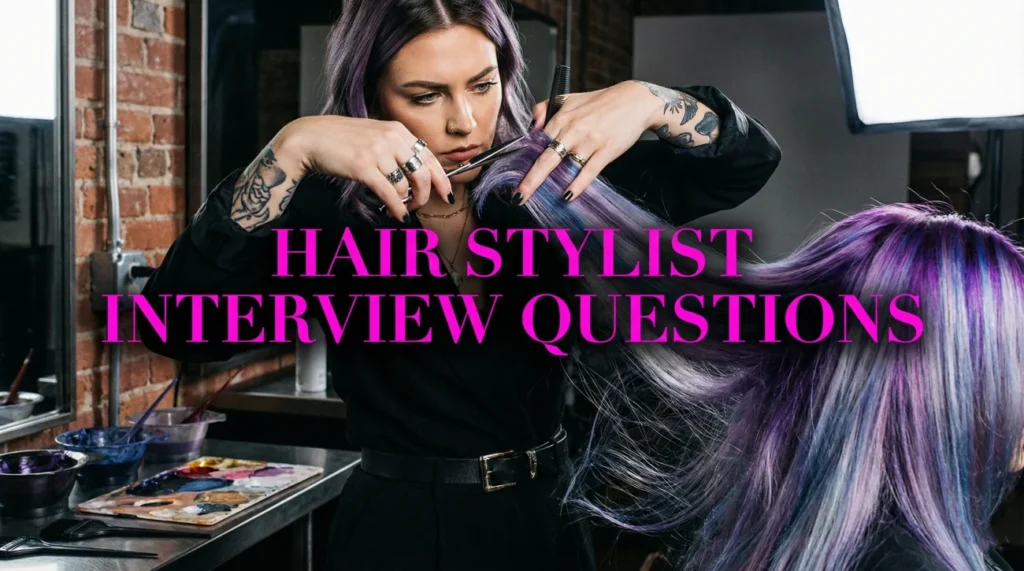
Hair stylist interview questions are less about memorized rules and more about how you think on your feet. Owners watch the small things first: how you greet, how you ask questions, how you protect the client, and how you handle a reference photo that is unrealistic for their texture or maintenance budget.
Bring your craft and your judgment. Talk through your cut plan, your color logic, and your sanitation habits in plain language. When you can match creativity with honesty and follow-through, you look like the stylist who keeps clients loyal, not just impressed on day one.
Precision Cutting & Texturizing
The foundation of any style is the cut. Interviewers want to know your philosophy on structure, movement, and tools.
Q: Explain the difference between “Point Cutting” and “Blunt Cutting.” When do you use each?
Answer: Blunt Cutting cuts the hair straight across (0 degrees or perpendicular) to create weight, hard lines, and density. I use it for bobs or creating a strong perimeter line on fine hair. Point Cutting involves cutting into the ends of the hair at an angle. I use this to remove bulk, soften lines, and add texture/movement to layers. For a modern shag or textured lob, point cutting is essential to avoid the “triangle” look.
Q: How do you handle a client with a strong cowlick in their fringe (bangs) area?
Answer: I identify the growth pattern while the hair is wet and dry. I leave extra length/weight in the cowlick area to weigh it down; cutting it too short will make it jump up. I use “tension-free” cutting techniques around the erratic growth. During the style out, I teach the client how to blow-dry it immediately from wet (using the “X” motion) to confuse the root and force it to lay flat.
Q: What is your approach to cutting curly hair?
Answer: I respect the curl pattern. I often utilize dry cutting for curly clients because shrinkage is unpredictable when wet (up to 4 inches). I cut each curl individually (visual cutting) rather than pulling it straight with high tension. I focus on creating a shape that allows the curls to stack properly without creating a “pyramid” effect. I also use hydration-focused products during the wash to minimize frizz before I even pick up the shears.
Q: Describe how you texturize thick, heavy hair without making it frizzy.
Answer: I avoid using thinning shears near the root or the very ends, which creates flyaways. Instead, I use “internal layering” or “slide cutting” (slithering) to remove weight from the mid-shaft. This creates “invisible layers” that collapse the bulk while maintaining the solid perimeter length. The goal is movement, not frizz.
Color Theory & Chemistry
Color is where the money is, and also where the biggest risks are. You must prove you understand the chemistry.
Q: A blonde client wants to go back to dark brown. What is the process?
The Strategy: Repigmentation (Filling).
Answer: I never just put the brown dye on; it will turn muddy or green. I must “Fill” the hair first. I replace the missing underlying pigments (warm gold/copper/red) that were bleached out. I apply a demi-permanent filler first, process and rinse, and then apply the target dark brown shade. This ensures the color is rich, true to tone, and doesn’t fade immediately.
Q: Explain the difference between Balayage and Foiliage.
The Strategy: Technique Precision.
Answer: Balayage is a freehand painting technique (open air) creating a soft, sun-kissed, natural lift, usually 2-3 levels lighter. Foiliage combines the painting application of balayage with the heat conduction of foils. I use Foiliage when the client has dark hair and wants a high-contrast platinum blonde (lifting 5+ levels) that open-air processing can’t achieve.
Q: A client has “Hot Roots.” How do you fix it?
The Strategy: Correction.
Answer: Hot roots happen when the heat from the scalp processes the color faster than the mid-lengths, making the roots lighter/warmer. To fix it, I apply a formulation that is one level darker and cooler (ash/blue base) to the root area only to neutralize the warmth and deepen the level. Next time, I would use a lower volume developer on the roots.
Q: What determines which Volume Developer (10, 20, 30, 40) you use?
The Strategy: Lift vs. Deposit.
Answer: 10 Vol is for deposit only (going darker/toning). 20 Vol gives 1-2 levels of lift and is standard for grey coverage. 30 Vol gives 2-3 levels of lift. 40 Vol gives 3-4 levels (high lift). I rarely use 40 Vol with bleach on the scalp as it causes chemical burns. I choose based on the starting level, target level, and hair integrity.
Q: How do you handle a “Box Dye” correction request?
The Strategy: Setting Expectations.
Answer: I require a consultation and a “Strand Test” first. Box dye contains metallic salts and unpredictable pigments. I explain to the client: “We cannot go from black box dye to platinum blonde in one session. It will take 3-4 sessions to maintain the health of your hair.” I quote pricing by the hour, not by the service, as corrections are unpredictable.
Q: What is a “Toner” (Glaze/Gloss) and why is it necessary?
The Strategy: Refinement.
Answer: Bleach only removes pigment; it leaves the hair raw (yellow/orange). A Toner is a demi-permanent color used to neutralize those unwanted warm tones or add a specific hue (icy, beige, caramel). It also closes the cuticle to add immense shine. I sell it to clients as the “Top Coat” that seals and perfects the color.
The Consultation & Client Psychology
The consultation is the most important 15 minutes of the appointment. This is where you align the client’s fantasy with reality.
Q: A client brings a photo of a celebrity with thick, filtered hair, but she has fine, thin hair. What do you say?
Answer: I validate the vibe, not the literal copy. “I love this look on her! Since her hair texture is quite different from yours, if we cut it exactly this length, it might look flatter on you. However, we can achieve this style by keeping your length a bit shorter to maximize volume and using a texturizing spray. Would you be open to that modification?” I focus on what is possible for her hair.
Q: What questions do you ask during a new client consultation?
Answer: 1. “What do you love about your hair right now?” 2. “What drives you crazy about it?” 3. “How much time do you spend styling it in the morning?” (If they say 5 minutes, I won’t give them a high-maintenance cut). 4. “How often can you come in for maintenance?” (This determines if I do a root smudge or a high-maintenance full highlight).
Q: How do you handle a client who is unhappy with the result?
Answer: I stay calm and don’t take it personally. I ask specific questions: “Is it too dark, or just different than you expected?” If it is a technical error (e.g., uneven tone), I offer to fix it for free within a week (the “redo” policy). If it is exactly what they asked for but they just don’t like it on themselves, I charge for the product to adjust it. I want them to leave happy, but I also value my time.
Business Building: Retail & Retention
You are an entrepreneur renting a chair (or working commission). You must drive sales.
How do you sell retail products without feeling “pushy”?
The Strategy: Education.
Answer: I educate as I style. “I am applying this heat protectant now because hot tools will fade your beautiful new color.” I put the bottle in their hand so they can smell it and feel the packaging. At the desk, I say: “To keep this color looking fresh like today, I recommend taking the purple shampoo home.” I am solving their problem (fading), not just selling a bottle.
What is your strategy for “Pre-Booking” (Re-booking)?
The Strategy: Professional Recommendation.
Answer: I don’t ask “Do you want to book?” I say: “To maintain this length/color, I need to see you in 6 weeks, which puts us around mid-October. Evenings fill up fast, so let’s get you on the books now so you get the time you want.” I frame it as securing their spot in my schedule.
How do you use social media to grow your clientele?
The Strategy: Portfolio & Personality.
Answer: My Instagram is my digital portfolio. I post high-quality “After” photos in natural light. I use local hashtags (#CityHairStylist) to attract nearby clients. I also post “Educational Reels” showing how to curl hair or why professional shampoo matters. This establishes me as an expert. I engage with comments to build relationships before they even sit in my chair.
Cosmetology Knowledge Quiz
Test Your Stylist IQ
1. The “Level System” in hair color ranges from:
- 1 to 5
- 1 (Black) to 10 (Lightest Blonde)
- 10 to 1
- A to Z
2. “Balayage” is a French word meaning:
- To bleach
- To sweep or paint
- To foil
- Blonde hair
3. Which developer volume is best for gray coverage?
- 10 Volume
- 20 Volume (provides ideal lift and deposit for stubborn gray)
- 40 Volume
- Zero Lift
4. A “Bob” haircut typically features:
- Long layers
- Weight line around the jaw/neck level
- Shaved sides
- Pixie length
5. “Porosity” refers to:
- Hair color
- The hair’s ability to absorb and hold moisture/color
- Hair thickness
- Hair length
6. “Olaplex” or “Bond Builders” are used to:
- Dye hair faster
- Repair/protect disulfide bonds during chemical services
- Straighten hair
- Cut hair
7. “Elevation” in cutting determines:
- The color
- The graduation or layering (lifting hair away from the head)
- The price
- The parting
8. To neutralize unwanted “Orange” tones, you use:
- Red shampoo
- Blue pigment (based on the color wheel)
- Purple shampoo (for yellow)
- Green pigment
9. A “Consultation” should happen:
- After the cut
- Before every single service, even for regulars
- Only for new clients
- Never
10. “Barbicide” is used for:
- Styling hair
- Disinfecting combs, shears, and non-porous tools
- Washing towels
- Cleaning floors
11. “Over-direction” is used to create:
- Even length
- Length and weight increase in the opposite direction of the pull
- Shorter layers
- Bangs
12. A “Patch Test” checks for:
- Hair quality
- Allergic reactions to hair color (usually 24-48 hours prior)
- Split ends
- Dandruff
13. “Density” vs. “Texture”:
- Same thing
- Density is hairs per square inch; Texture is the diameter of individual strands (Fine/Coarse)
- Texture is curly/straight
- Density is weight
14. A “Root Smudge” or “Shadow Root”:
- Is a mistake
- Blurs the line between natural root and highlighted hair for a softer grow-out
- Is for gray coverage only
- Is a haircut
15. “Keratin Treatment” primarily:
- Curls hair
- Smooths frizz and reduces curl temporarily
- Colors hair
- Damages hair
16. “Thinning Shears” have:
- Two sharp blades
- One straight blade and one notched/toothed blade
- No blades
- Lasers
17. “Ombré” means:
- A man
- Shaded/Graduated (Darker roots fading to lighter ends)
- Striped
- All one color
18. To cut a blunt “One-Length” line, use:
- High elevation
- Zero elevation (natural fall)
- 90 degree elevation
- A razor
19. “Clarifying Shampoo” removes:
- Color
- Product buildup, minerals, and impurities
- Dandruff only
- Volume
20. The most profitable service per hour is usually:
- Men’s cuts
- Hair Color / Chemical Services
- Blowouts
- Kids cuts
❓ FAQ
🧑🤝🧑 What usually happens in a salon “bench test”?
It depends on the salon, but expect a practical: a blowout, a haircut, or a color application on a model or mannequin. They are checking sectioning, timing, cleanliness, and whether your result matches the consultation.
🧪 How can I explain developer volumes without sounding technical?
Use the lift-and-deposit idea. Lower volume is for gentle deposit or toning, mid volume is for coverage and modest lift, higher volume is for stronger lift and higher risk. Then add that you choose based on hair integrity, target level, and scalp safety.
📷 What should I include in my portfolio?
Only your best work, photographed in good light. Show variety, but keep it curated: before-and-after, clean blonding, a few textured cuts, and at least one correction that proves your problem-solving. Owners want consistency more than quantity.
🖤 What should I wear to a stylist interview?
Dress like you already work there: polished, comfortable, and camera-ready. Neutral tones are common, but the real rule is this: your hair, nails, and hygiene should signal you are serious about standards.
🗓️ How do I talk about prebooking without sounding salesy?
Make it a maintenance recommendation. Tie timing to the service: trim cycles, root grow-out, toner refresh, or blonding health. When you explain it as the path to keeping their hair looking good, it sounds like care, not a pitch.
Final Thoughts
A salon owner hires the person they trust with their reputation. When you answer hair stylist interview questions, keep your focus on the consultation, clean technique, and realistic expectations. That is what prevents complaints, refunds, and awkward redo appointments.
End by showing you understand the business side too: retention, retail education, and a steady rebooking rhythm.
⚠️ Disclaimer: The interview strategies, sample answers, and negotiation tips provided in this guide are for educational purposes only. Hiring decisions are subjective and vary by company and industry. While these strategies are based on professional HR standards, they do not guarantee a specific job offer or result.