Your Section Is Where You Prove You Belong
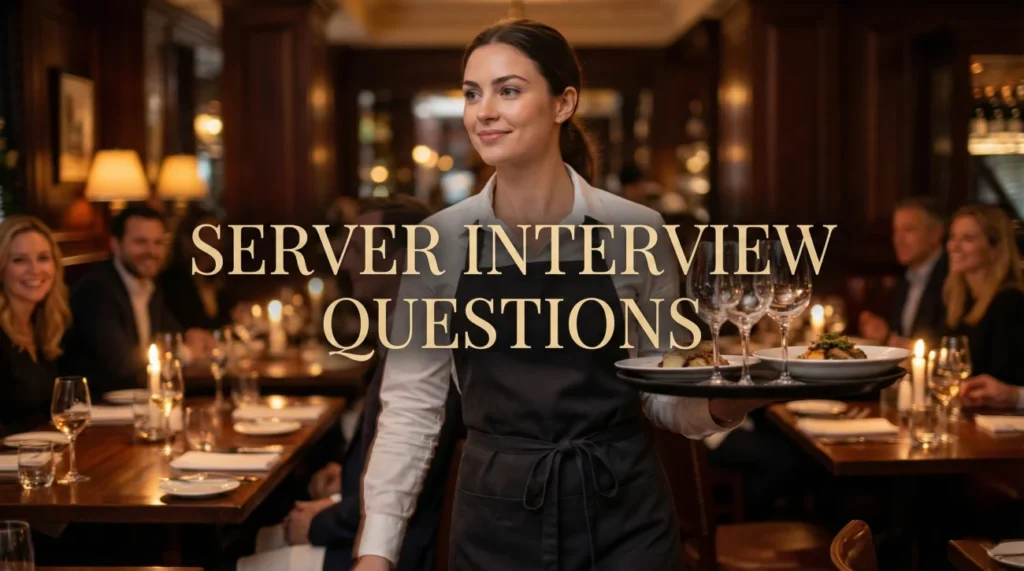
Server interview questions are not really about carrying plates. They are about keeping five things moving at once: reading the room, protecting guest safety (allergies, modifications), staying tight with the kitchen, and still selling with a smile. Anyone can drop food. A great server can run a busy section without letting the guests feel the stress.
Expect the interview to sound like a shift: menu knowledge, pacing, recovery when something goes wrong, and the small habits that keep service smooth (pre-bussing, check-backs, and clear communication). If you can explain your system and show you stay calm under pressure, you will stand out fast.
The Steps of Service & Efficiency
Efficiency equates to turnover, and turnover equates to revenue. Interviewers need to know you have a system.
Q: Explain the “Two-Minute Check” (or Two-Bite Check).
The Strategy: Quality Control.
Answer: After delivering the main course, I return within two minutes or two bites to ask, “Is everything prepared to your liking?” This allows me to catch a mistake (steak undercooked, cold soup) immediately. If I wait 10 minutes, the guest sits there hungry and angry, and we lose the chance to fix it before the rest of the table finishes eating.
Q: What does “Full Hands In, Full Hands Out” mean?
The Strategy: Maximum Efficiency.
Answer: It means never walking empty-handed. When I go to the kitchen, I take dirty dishes (pre-bussing) from any table, not just mine. When I leave the kitchen, I run food or refill water pitchers. This reduces the total steps taken during a shift and ensures the dining room stays clean and the food goes out hot.
Q: How do you prioritize when you are “double-seated” (two tables sat at once)?
The Strategy: Consolidation.
Answer: I greet them both quickly. I might tell the second table: “Welcome, I’ll be right with you to get drinks started.” I take drink orders for both tables consecutively, then ring them all in at once. I treat the two tables as one large party in my head for the initial loop. This prevents me from running back and forth to the bar twice.
Q: What is “Pre-bussing” and why is it crucial?
The Strategy: Table Maintenance.
Answer: Pre-bussing is removing empty plates, straw wrappers, and glassware throughout the meal, not waiting for the end. It keeps the table uncluttered for the guest and makes the final cleanup much faster, allowing us to flip the table for the next seating sooner. A cluttered table subconsciously makes guests feel rushed or messy.
Q: How do you handle a “Camper” (guest staying too long) on a busy night?
The Strategy: Subtle Hints.
Answer: I never rush them rudely. I continue to offer water refills and clear every single item off the table so it is just bare wood/cloth. I might drop the check and say, “No rush at all, just leaving this for whenever you are ready.” If they still stay and we have a waitlist, I might ask a manager to intervene diplomatically, but usually, removing all “reasons to stay” (plates/drinks) works.
Q: Describe how you present the specials.
The Strategy: Storytelling.
Answer: I don’t just list ingredients; I sell the “sizzle.” Instead of “We have a fish special,” I say: “The Chef just got in some fresh Halibut this morning, and he’s pan-searing it with a lemon-caper butter that is incredible.” I describe the texture and flavor, and I mention the price clearly if required, or integrate it if it’s a high-end venue.
Suggestive Selling (Upselling)
Restaurants operate on thin margins. You add value by increasing the check average intelligently.
Q: Sell me a side dish to go with a burger.
Answer: “The burger comes with our standard fries, but have you tried the truffle parmesan fries? They are a game-changer and great for sharing.” I assume the sale (“great for sharing”) and use descriptive words (“truffle,” “game-changer”) rather than just asking “Do you want to upgrade?”
Q: How do you upsell liquor without being pushy?
Answer: I offer specific choices. If a guest asks for a “Gin and Tonic,” I don’t just say okay. I ask: “Do you have a preference on the gin? We have Hendrick’s or Bombay Sapphire which are excellent.” Most guests will pick the premium option if presented with a name they recognize. It empowers them to choose quality rather than feeling sold to.
Q: When is the best time to sell dessert?
Answer: Before they are fully stuffed. I plant the seed halfway through the main course: “Save a little room, our lava cake takes 15 minutes but it’s worth it.” Then, when clearing the main plates, I don’t ask “Do you want dessert?” I place the dessert menu on the table and say, “I’ll just leave this here to tempt you while I grab some fresh coffee.” Visuals sell better than words.
Situational Scenarios
The dining room is unpredictable. These conversational questions test your grace under fire.
You spilled a drink on a guest. What do you do?
The Strategy: Apologize & Act.
Answer: I am mortified, but I don’t freeze. I immediately grab napkins to help (without invading their personal space inappropriately). I apologize sincerely: “I am so terribly sorry.” I get a manager immediately to offer to pay for dry cleaning. I do not let the guest pay for that round of drinks or their meal, depending on the severity. Accidents happen, but the recovery defines the service.
The kitchen is backed up and food is taking 45 minutes. Guests are looking around.
The Strategy: Communication Loop.
Answer: I don’t hide in the server station. I approach the table before they complain. “Folks, the kitchen is slammed right now, and I apologize for the wait. Your food is coming up in about 10 minutes. Can I bring you a complimentary basket of bread or refill your drinks while you wait?” Keeping them informed reduces the anxiety of “Did they forget us?”
A guest sends back a steak claiming it is overcooked, but it looks perfect to you.
The Strategy: The Guest is Right (about their taste).
Answer: I don’t argue with their perception. I simply say, “I am sorry that isn’t cooked to your liking. Let me get that fixed for you right away.” I take it away immediately. I ask the Chef to re-fire it (usually on the fly). Even if they are wrong technically, arguing will only lose a customer and a tip. I focus on getting them what they want to eat.
Server Knowledge Quiz
Test Your Service IQ
1. “86” means:
- The item is on special
- The item is out of stock/sold out
- The price is $86
- Table 86 needs service
2. “In the Weeds” means:
- Smoking outside
- Being overwhelmed with too many tables/tasks at once
- Serve salad
- Working in the garden
3. “On the Fly” means:
- There is a fly in the soup
- Need an item immediately (usually to fix a mistake)
- Served on an airplane
- Served quickly
4. What is a “Runner”?
- A guest who leaves without paying
- A staff member whose primary job is to deliver food from kitchen to table
- A rug on the floor
- A type of tablecloth
5. “Mise en place” is a French term for:
- Missing in place
- Everything in its place (preparation/setup before service)
- Messy place
- Menu in place
6. “Cover” refers to:
- A lid for a pot
- A guest/customer (e.g., “We did 100 covers tonight”)
- A napkin
- A shift cover
7. “Comp” means:
- Complaint
- Complimentary (free) item given to a guest
- Complex order
- Computer system
8. “Top” (as in “4-top”) means:
- The best table
- A table with 4 guests
- The manager
- The top shelf liquor
9. “Expo” (Expeditor) is:
- The exit
- The person managing the flow of food from kitchen to dining room
- Expensive wine
- Extra portion
10. “Behind” is shouted to:
- Scare someone
- Warn a coworker you are walking behind them (safety)
- Tell someone they are slow
- Ask for help
11. “SOS” in a restaurant usually implies:
- Help!
- Sauce On Side
- Serve On Sunday
- Soup Or Salad
12. “Turning a table” means:
- Physically rotating the table
- The process of a guest leaving, cleaning, and seating a new guest
- Flipping the table in anger
- Cleaning under the table
13. “Check back” should happen:
- Never
- Within a few minutes of food delivery
- After the guest pays
- When they wave at you
14. “Cut” means:
- You are fired
- You are finished with new tables and can start side work/go home
- You cut your finger
- Discounting the price
15. “Corner” is shouted when:
- You are in timeout
- Turning a blind corner to avoid collision
- You see a manager
- You drop a plate
16. “Campers” are:
- Guests who eat outside
- Guests who stay at a table for a long time after paying
- Guests with tents
- Children
17. “All Day” refers to:
- Working all day
- The total count of a specific item currently on order (e.g., “5 Steaks All Day”)
- Breakfast menu
- Happy hour
18. “Void” vs “Comp”:
- Same thing
- Void removes item from bill (not made/mistake); Comp is made but given free
- Void is for drinks, Comp is for food
- Comp is illegal
19. “Sidework” involves:
- Working on the side of the building
- Tasks like rolling silverware, filling salt shakers, cleaning station
- Serving only side dishes
- Taking a second job
20. “POS” stands for:
- Point of Service
- Point of Sale (computer system)
- Piece of Steak
- Plate of Salad
❓ FAQ
👕 What should I wear to a server interview?
Dress one level above the restaurant’s vibe. For casual dining, clean dark pants and a simple button-up or blouse works well. For upscale, go more polished: pressed clothing, minimal accessories, and shoes you can walk in confidently. You want to look professional and ready to work, not like you are going to a party.
⏳ Do I need experience to get hired as a server?
Not always. Many places will train the right personality. If you are new, lean on transferable skills: reliability, communication, teamwork, and speed. Share a short example of handling pressure (retail rush, busy shift, customer conflict) and explain how you would learn the menu quickly.
🍷 Do I need to know wine and cocktails?
You do not need to sound like a sommelier, but you should be comfortable with the basics: common varietals, house pours, and how to make simple pairing suggestions. A strong move is saying you learn the top sellers first, then build your knowledge dish by dish and drink by drink.
👟 What shoes are best for serving?
Non-slip is the priority. Choose closed-toe shoes that support your feet for long shifts. Many restaurants require black shoes for uniform consistency, and some have brand or style rules. If you are unsure, ask during the interview so you show you take safety and standards seriously.
😤 How do I handle a rude guest?
Stay calm, do not mirror their tone, and focus on solving the problem. Use simple language like, “I hear you, let me fix that.” If the situation escalates or becomes disrespectful, involve a manager early. Employers want to know you can protect the guest experience without creating drama on the floor.
Walk In Like You Are Already On the Floor
If you want to ace server interview questions, talk in systems, not vibes. Explain how you greet, how you pace a section, how you confirm allergies, and how you recover when the kitchen falls behind. Managers hire the person who sounds safe, steady, and easy to trust on a busy night.
One more edge: show you understand hospitality is communication. If you want to tighten that side of your answers, review these guest-service question ideas and practice responding in a calm, confident voice.
⚠️ Disclaimer: The interview strategies, sample answers, and negotiation tips provided in this guide are for educational purposes only. Hiring decisions are subjective and vary by company and industry. While these strategies are based on professional HR standards, they do not guarantee a specific job offer or result.