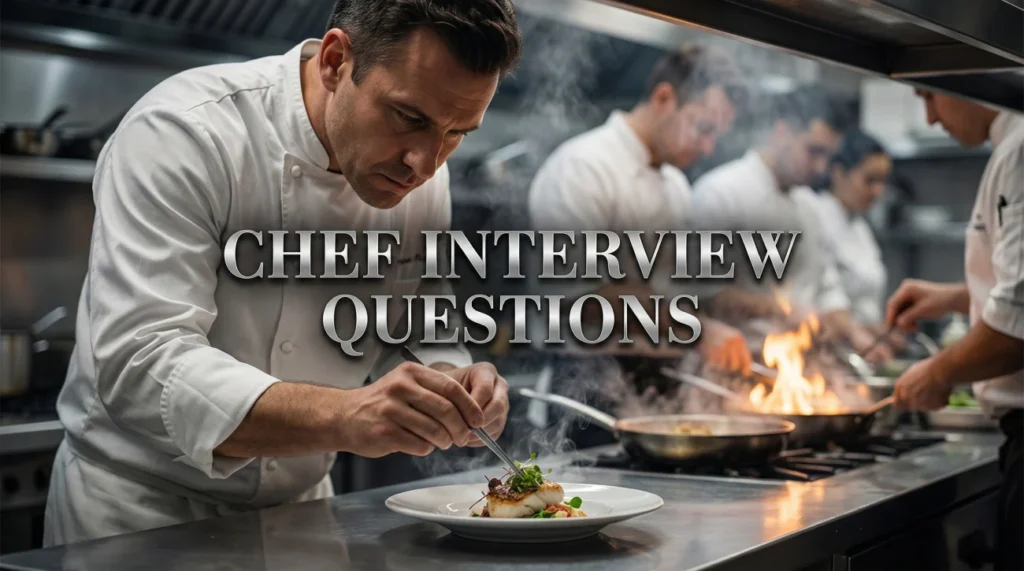
A Chef Interview Is a Taste Test and a Leadership Test
Chef interview questions can sound simple, but the subtext is heavy: can you lead a team, keep standards consistent, and protect the business, not just cook a great dish. Hiring managers listen for decision-making, organization, and how you respond when something breaks mid-service.
Expect a mix of craft and operations. You may be asked about menu development, kitchen culture, cost control, and what you would cook in a tasting. Strong candidates speak in specifics: technique, timing, and how they run a clean, calm pass.
Culinary Philosophy & Menu Development
Your food is your identity. Interviewers want to know your style, your inspiration, and how you translate that into a cohesive menu that sells.
Q: Describe your culinary style and philosophy in three words.
Answer: “Seasonal, Technique-driven, Honest.” I believe in letting the ingredients speak for themselves rather than masking them with heavy sauces. My philosophy is rooted in respecting the produce – if I have a perfect tomato, I want to do as little as possible to it to highlight its flavor. I use classic French techniques as a foundation but apply them to local, seasonal ingredients to create something modern and approachable.
Q: Walk me through your process for creating a new seasonal menu.
Answer: It starts with the suppliers. I ask my farmers and fishmongers what will be at peak quality in 4 weeks. Once I have the core ingredients, I draft dishes that balance texture, acidity, and color. Then comes the “Costing Phase” – I calculate the theoretical food cost for each dish. If a dish is delicious but costs 50% to make, I re-engineer it. Finally, we do a “Kitchen Tasting” where the team critiques the dishes, and we refine the plating and workflow before printing the menu.
Q: How do you balance “Artistic Expression” with “Customer Demand”?
Answer: I follow the “80/20 Rule.” 80% of the menu should be approachable crowd-pleasers that pay the bills (like a perfect steak frites or a signature burger), executed flawlessly. The other 20% is where I push boundaries with avant-garde techniques or unusual flavor combinations for the adventurous foodie. This keeps the restaurant profitable while keeping the kitchen team creatively stimulated.
Q: What is your approach to sustainability and “Zero-Waste” cooking?
Answer: Sustainability is a responsibility, not a trend. I practice “Root-to-Stem” cooking. For example, if we use cauliflower florets for a main dish, we puree the stems for a soup or pickle them for a garnish. We use vegetable scraps to make stocks before composting. I also partner with suppliers who use ethical farming practices. Reducing waste directly improves our bottom line.
Kitchen Management & Leadership
A Chef who cannot lead is just a cook. These questions test your ability to manage the chaos of the “pass” and the personalities in the brigade.
Q: How do you handle a line cook who is consistently underperforming?
The Strategy: Coach first, discipline second.
Answer: I pull them aside privately, never during service. I ask, “I’ve noticed your station is lagging. Is it a training issue or a personal issue?” Often, they just need better tools or a clearer prep list. I demonstrate the standard I expect, then watch them do it. If it is an attitude problem after coaching, I document it and follow progressive discipline. My goal is to lift them up, but I protect the standards of the kitchen above all.
Q: Describe your leadership style during a stressful Friday night service.
The Strategy: The “Eye of the Storm.”
Answer: I am the calmest person in the room. If the Chef panics, the brigade collapses. I use clear, concise communication (Standard Call-outs). Instead of shouting, I lower my voice to force the team to listen harder. I control the flow of tickets at the pass/expo station so the line doesn’t get buried. My job is to maintain the rhythm, not add to the noise.
Q: How do you handle conflict between the Back of House (BOH) and Front of House (FOH)?
The Strategy: One Team Mentality.
Answer: I have a zero-tolerance policy for the “Us vs. Them” mentality. If a server makes a mistake, we fix the food first and discuss it later. I hold pre-shift briefings with the FOH manager to let servers taste the specials so they can sell them confidently. Mutual respect is key; I ensure my cooks respect the servers’ role in selling our food.
Q: How do you retain staff in an industry with high turnover?
The Strategy: Culture & Growth.
Answer: Cooks leave bad bosses, not bad kitchens. I prioritize a culture of respect and teaching. I create a “Skill Progression Plan” for every cook. I rotate stations so they don’t get bored. I also ensure they get their breaks and eat decent staff meals. When they feel they are learning and cared for, they stay.
Q: What is your experience with the “Brigade System”?
The Strategy: Structure & Hierarchy.
Answer: I respect the classic Escoffier brigade system for its efficiency. I clearly define roles: Saucier, Entremetier, Garde Manger, etc. Everyone knows their specific responsibility. However, in smaller modern kitchens, I adapt it to a “Cross-Functional” model where cooks support each other. The hierarchy exists for order, not for ego.
Q: How do you ensure food safety and hygiene standards (HACCP)?
The Strategy: Daily Discipline.
Answer: Sanitation is non-negotiable. I enforce “Clean as you go.” We have strict labeling protocols (Day Dots) for every container. I conduct spot checks on fridge temperatures logs twice a day. If I see a cutting board that isn’t sanitized properly, I stop the line to correct it immediately. I lead by example; my station is always the cleanest.
Business Acumen: Cost Control & Inventory
A restaurant is a business. Interviewers need to know you can make money, not just food.
How do you calculate and manage Food Cost Percentage?
The Strategy: The Math of Success.
Answer: Food Cost % = (Cost of Goods Sold / Total Food Sales). I aim for a target between 28-32%, depending on the concept. I manage this by costing every single recipe down to the garnish. I track high-cost items (proteins) daily. If prices spike (e.g., beef goes up), I adjust the menu mix or portion sizes immediately, rather than waiting for the end-of-month P&L statement to show a loss.
Describe your inventory management process.
The Strategy: Consistency.
Answer: I count inventory at the same time every week/month to ensure accuracy. I organize the walk-in and dry storage to match the inventory sheet (“Sheet-to-Shelf”) to speed up the process. I analyze the “Variance” report to spot theft or waste. If we bought 10 tenderloins but only sold 8 and have none left, we have a problem to investigate immediately.
How do you handle supplier relationships?
The Strategy: Partnership.
Answer: I treat suppliers as partners, not just vendors. I am loyal to those who give me quality and consistency, but I keep them honest by checking prices against competitors quarterly. I check every delivery personally for quality. If the fish isn’t fresh, it goes back on the truck. I never accept sub-par product just because we are busy.
The Practical: The Tasting Test
The “Stage” or Tasting is where you walk the walk. This is often the final step of the interview process.
Q: What would you cook for a tasting if given a “Mystery Basket”?
Answer: I would fall back on technique. I wouldn’t try a recipe I’ve never done. I would look at the proteins and vegetables and decide on a cooking method that highlights them (e.g., pan-roasting the protein, glazing the vegetables). I would ensure there is a balance of flavor (Salt, Fat, Acid, Heat) and texture. A perfectly cooked piece of fish with a well-balanced vinaigrette beats a complicated foam that fails.
Q: Why did you choose this specific dish for your tasting today?
Answer: “I chose this dish because it represents who I am as a Chef. It uses a humble ingredient (pork belly) but elevates it through technique (slow braising then searing). It shows I understand cost control, patience, and flavor balance. It is also a dish that can be executed consistently during a busy service, which is crucial for the menu.”
Situational & Behavioral
The kitchen is a high-pressure environment. How do you react when things go wrong?
The gas goes out or the combi-oven breaks mid-service. What do you do?
The Strategy: Adapt and Overcome.
Answer: I don’t stop service. I immediately pivot the menu. If the ovens are down, we switch to sauté and grill items only. I communicate with the FOH to inform guests that “Roasted Chicken” is unavailable but the “Grilled Ribeye” is ready. I call the repair technician immediately, but in the moment, I focus on what we can cook, not what we can’t.
A prominent food critic is seated in the dining room.
The Strategy: Consistency is King.
Answer: I tell the team, “Business as usual, but eyes open.” We don’t change the recipes or give them a “special” bigger portion, as that is dishonest and critics spot it. However, I personally check every plate leaving the pass to ensure it is 100% perfect standard. We treat every guest like a critic, so the critic should just get our best normal service.
Culinary Terminology Quiz
Test Your Kitchen IQ
1. “Mise en place” translates to:
- Missing in place
- Everything in its place (setup/prep)
- My place
- Measuring plates
2. Which is NOT one of the 5 French Mother Sauces?
- Béchamel
- Marinara
- Velouté
- Hollandaise
3. “Sous Vide” cooking involves:
- Frying in deep oil
- Vacuum-sealing food and cooking it in a precise temperature water bath
- Cooking over open fire
- Steam pressure
4. A “Roux” is a mixture of:
- Egg and flour
- Fat (butter/oil) and Flour, used as a thickener
- Cream and butter
- Cornstarch and water
5. “FIFO” stands for:
- Fly In Fly Out
- First In, First Out (Inventory rotation)
- Fit In Fit Out
- Fast In Fast Out
6. The “Pass” or “Window” is:
- The exit door
- The area where cooks place finished food for servers to pick up
- A break time
- The dishwashing area
7. “Julienne” is a knife cut that looks like:
- Small cubes
- Matchsticks (thin strips)
- Large chunks
- Rounds
8. “HACCP” stands for:
- Hot Air Cooking Control Point
- Hazard Analysis Critical Control Point (Food safety system)
- High Acid Cooking Critical Plan
- Head Chef Control Plan
9. A “Salamander” in a kitchen is:
- A lizard
- A high-heat overhead broiler used for browning/melting
- A type of knife
- A fire extinguisher
10. “Deglazing” is:
- Cleaning a window
- Adding liquid to a hot pan to release caramelized food bits (fond)
- Freezing food
- Removing the glaze from a donut
11. The “Danger Zone” for bacteria growth is:
- 0°F to 32°F
- 41°F to 135°F (5°C to 57°C)
- 150°F to 200°F
- There is no danger zone
12. “Emulsification” is:
- Cutting meat
- Mixing two liquids that don’t normally mix (like oil and vinegar)
- Boiling water
- Freezing sauce
13. A “Chef de Partie” is:
- The party planner
- A station chef in charge of a specific section (e.g., Grill, Sauté)
- The head chef
- The dishwasher
14. “Confit” means:
- Confused
- Cooked slowly in its own fat
- Cooked in water
- Served raw
15. “Chiffonade” is used for:
- Potatoes
- Leafy herbs/vegetables (cut into thin ribbons)
- Meat
- Bread
16. “86” means:
- The price
- Item is sold out/unavailable
- Table number
- Employee ID
17. “Resting” meat allows:
- The chef to take a break
- The juices to redistribute throughout the meat so it stays moist
- The meat to cool down completely
- Bacteria to die
18. A “Walk-in” is:
- A guest without a reservation
- A large room-sized refrigerator/freezer
- A type of shoe
- The entrance
19. “Al Dente” means:
- Mushy
- “To the tooth” (firm to the bite), usually for pasta
- Raw
- Burnt
20. The “Expeditor” (Expo) is responsible for:
- Cooking the food
- Coordinating timing and garnishing plates before they go to the dining room
- Washing dishes
- Ordering supplies
❓ FAQ
🔪 Do I need to bring my own knives?
For a stage or tasting, yes, bring your own knives and a small roll with essentials you trust. It shows professionalism and protects your workflow. If the venue needs specialty equipment, they will usually provide it, but your personal kit should cover the basics.
🎓 Is culinary school required?
Not always. Many chefs build their career through apprenticeships and consistent performance. School can accelerate fundamentals, but employers ultimately care about results: timing, cleanliness, flavor, and how you operate under pressure. If you did not attend school, highlight your training path and what standards you hold yourself to.
⭐ How do I get a Michelin Star?
You do not chase the star directly. You chase consistency, hospitality, and an unforgettable plate every service. If you are early in your career, focus on learning in great kitchens, mastering technique, and building leadership habits. Stars follow systems, not wishes.
🦵 Is the job physically demanding?
Yes. Long hours, heat, and constant movement are normal. What helps is discipline: hydration, smart station setup, and clean prep lists that prevent last-minute panic. The more organized the kitchen is, the less punishing the work feels.
🍽️ What should I cook for a tasting?
Pick something that shows control, not ego. Choose a dish you can execute perfectly, explain clearly, and repeat consistently. A simple protein cooked flawlessly with balanced seasoning beats a complicated idea that falls apart under time pressure.
Close the Interview Like a Chef, Not a Hobbyist
To land the role, treat chef interview questions like a kitchen briefing. Speak in standards, timing, and leadership. Show how you build a menu that sells, how you train people without breaking them, and how you keep quality high even when the line is drowning.
If you are interviewing for a senior kitchen role, it also helps to understand how the second-in-command runs daily operations. Review these sous chef interview notes and borrow the language around inventory, discipline, and expediting.
⚠️ Disclaimer: The interview strategies, sample answers, and negotiation tips provided in this guide are for educational purposes only. Hiring decisions are subjective and vary by company and industry. While these strategies are based on professional HR standards, they do not guarantee a specific job offer or result.