White-Glove Standards, Real-World Pace
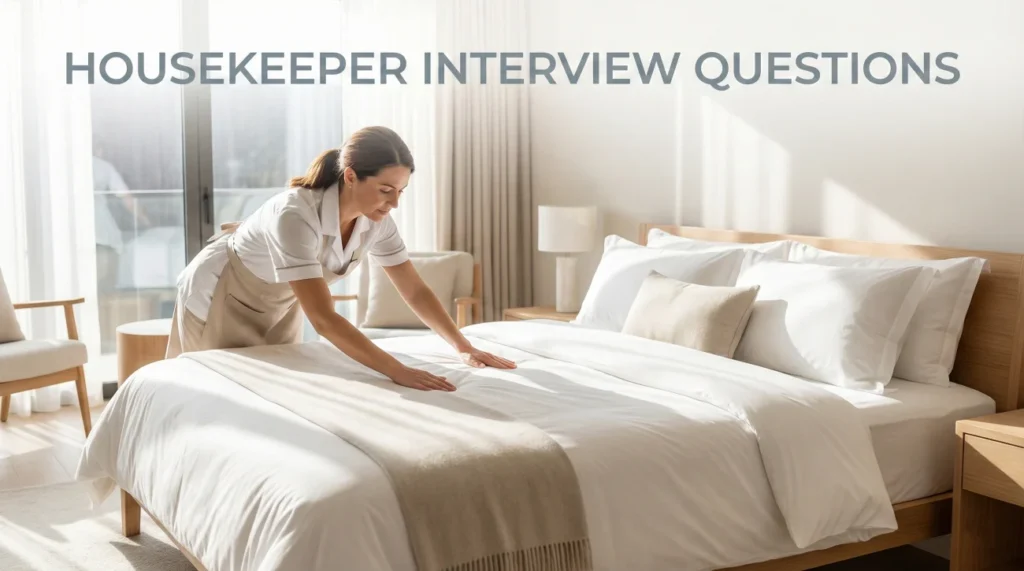
Housekeeper interview questions are not about fancy words. They check whether you can protect a guest’s comfort with repeatable habits: clean hands, clean tools, clean sequence. In a hotel room, one missed detail is not “small” to the person sleeping there. That is why managers listen for discipline, stamina, and pride that shows up in the little things.
You will see questions that let you show your workflow, your hygiene boundaries, and your judgment under time pressure. Talk about your order of operations, how you prevent cross-contamination, and how you handle guest property without shortcuts. The goal is simple: deliver a room that feels safe, fresh, and consistent, every time.
Cleaning Process & Standards
Cleaning is a science. Interviewers want to know you follow a logical, efficient sequence to ensure no surface is missed.
Q: Walk me through your step-by-step process for cleaning a checkout room.
Answer: I follow a systematic flow to avoid cross-contamination. 1. Strip all linens and remove trash immediately. 2. Spray chemicals in the bathroom to let them dwell/soak. 3. Dust the bedroom from top to bottom (high dusting first) while the bathroom soaks. 4. Clean the bathroom (cleanest to dirtiest: sink, shower, then toilet). 5. Make the bed with fresh linens (hospital corners). 6. Vacuum and mop starting from the far corner backing out to the door. 7. Final Inspect before locking the door.
Q: What is “Cross-Contamination” and how do you prevent it?
Answer: Cross-contamination is spreading germs from one area to another. I prevent it by using a color-coded rag system (e.g., Red for toilets, Yellow for sinks, Blue for glass, Green for dusting). I never use the toilet rag on the drinking glasses. I change gloves between cleaning the bathroom and making the bed. Hygiene is my top priority.
Q: How do you inspect a bed for cleanliness?
Answer: I check the mattress protector for stains or hair first. When making the bed, I check every layer of linen against the light. I look for tears, stains, or stray hairs. The bed is the focal point of the room; it must be crisp, tight, and inviting. If a sheet has even a tiny dot, I reject it and send it back to laundry.
Q: Explain the difference between “Cleaning” and “Sanitizing.”
Answer: Cleaning removes visible dirt and debris (using soap/water). Sanitizing reduces bacteria to a safe level (using chemicals). You cannot sanitize a dirty surface. I always clean first to remove the grime, then apply the sanitizer and let it sit for the required contact time to kill the germs. Doing both ensures the room is truly safe.
Speed & Time Management (MPR)
You have a quota. Can you clean 16 rooms in 8 hours without cutting corners?
Q: What is your average “Minutes Per Room” (MPR)?
The Strategy: Industry Benchmark.
Answer: For a standard stayover, I average 15-20 minutes. For a checkout room, I average 30-45 minutes depending on the size and condition. I pace myself to maintain energy throughout the shift. I know that speed comes from efficiency (fewer steps), not rushing.
Q: How do you organize your cart to save time?
The Strategy: Preparation.
Answer: I stock my cart fully in the morning so I don’t have to run back to the linen closet. I arrange linens in the order I use them. I check my chemicals are full. A well-stocked cart is my mobile office; if I have to leave the floor for supplies, I am losing money/time.
Q: The room is exceptionally dirty (trashed). How do you handle it?
The Strategy: Communication.
Answer: I call the Floor Supervisor immediately. I might take photos if required by policy for an extra cleaning fee. I ask for help or permission to spend extra time there. I do not let one bad room ruin my schedule for the other 15 rooms. If it is hazardous (blood/needles), I do not touch it and wait for the specialized cleanup team.
Q: How do you prioritize your board (list of rooms)?
The Strategy: Guest Flow.
Answer: I prioritize “Early Arrival” requests first. Then, I clean “Checkouts” to get inventory back to the Front Desk for new guests. I do “Stayovers” later in the day since they already have a room. However, if a stayover guest requests early service, I adjust. Flexibility is key.
Q: What is a “Deep Clean” cycle?
The Strategy: Maintenance.
Answer: Deep cleaning happens periodically (e.g., once a quarter). It involves moving heavy furniture, flipping mattresses, washing curtains, and scrubbing grout. It goes beyond the daily surface clean. I treat deep clean days as an opportunity to reset the room to “brand new” condition.
Q: How do you handle fatigue physically?
The Strategy: Ergonomics.
Answer: I use proper lifting techniques (lift with legs, not back). I alternate tasks so I’m not doing the same motion for 8 hours (e.g., I don’t scrub 10 tubs in a row; I mix in dusting). I wear supportive shoes and stay hydrated. Keeping my body healthy ensures I don’t call in sick.
Integrity & Guest Privacy
You work alone in people’s private spaces. Trust is the most important qualification.
Q: You find a guest’s expensive watch left behind in a checkout room.
Answer: I treat it like cash. I bag it immediately, label it with the room number and date, and bring it to the “Lost and Found” department or Housekeeping Manager instantly. I never put it in my pocket “for safekeeping.” Fast reporting allows the Front Desk to call the guest before they leave the building.
Q: A guest has a “Do Not Disturb” (DND) sign up, but it is 3 PM.
Answer: I do not knock. I respect the sign absolutely. I slide a “We missed you” card under the door indicating how they can request fresh towels. I note it on my assignment sheet. If the sign stays up for more than 24-48 hours (depending on hotel policy), I alert security/management to do a welfare check, but I never enter myself.
Q: A guest is in the room when you enter (you knocked, but they didn’t hear).
Answer: I apologize immediately and back out. “I am so sorry! I will come back later.” I do not stay to chat. I close the door and wait for them to leave or call for service. I make a note to knock louder next time and announce “Housekeeping!” clearly before opening the door.
Situational & Behavioral
These questions test your attitude and problem-solving skills.
A guest accuses you of stealing money from their room.
The Strategy: Professionalism & Procedure.
Answer: I stay calm and do not get defensive or angry. I direct them to the Manager or Security immediately. “I understand you are upset. Please speak with my Manager who can help you investigate.” I cooperate fully with the lock interrogation (key card audit). I know my integrity is intact, so I let the process prove it.
You break a lamp while dusting.
The Strategy: Honesty.
Answer: Accidents happen. I clean up the glass safely so no one gets hurt. Then I report it to my Supervisor immediately so they can replace it before the next guest arrives. I never try to hide it or glue it back together. Hiding it creates a safety hazard and looks dishonest.
A guest asks you for extra amenities (shampoo/towels) in the hallway.
The Strategy: Service with a Smile.
Answer: I give it to them happily. “Absolutely! Here are some extra towels.” I don’t make them feel like they are begging. If I don’t have it on my cart, I say, “Let me run to the closet and get that for you right now.” It is a small gesture that leads to great reviews (and often tips).
Housekeeping Skills Quiz
Test Your Cleaning IQ
1. “Turndown Service” is:
- Refusing service
- Evening service to prepare the room for sleep (open bed, chocolate, close curtains)
- Turning the mattress
- Cleaning the floor
2. “DND” stands for:
- Do Not Dust
- Do Not Disturb
- Dinner N Drinks
- Daily Night Duty
3. The standard “MPR” (Minutes Per Room) for a checkout is roughly:
- 10-15 mins
- 30-45 mins (depending on star rating)
- 60-90 mins
- 5 mins
4. “Stayover” means:
- The guest is leaving
- The guest is staying another night (requires lighter cleaning)
- The staff stays overnight
- The room is out of order
5. “Strip the bed” means:
- Jump on the bed
- Remove all dirty linens (sheets, pillowcases) to be laundered
- Clean the mattress
- Move the bed
6. You should dust:
- Bottom to Top
- Top to Bottom (so dust falls on uncleaned surfaces)
- Randomly
- Only visible areas
7. “Amenity” refers to:
- A problem
- Consumable items for the guest (Soap, Shampoo, Coffee, Water)
- The bill
- The cleaning cart
8. “Hospital Corner” is:
- A nearby hospital
- A specific neat fold used to tuck sheets tightly under the mattress
- A dirty corner
- A medical kit
9. “Room Status” update involves:
- Calling your mom
- Dialing a code or using an app to tell the Front Desk the room is Clean/Ready
- Locking the door
- Checking the minibar
10. “Lost and Found” items should be:
- Thrown away
- Logged, bagged, and tagged immediately
- Kept by the finder
- Left in the room
11. “Deep Cleaning” includes:
- Making the bed
- Heavy tasks like carpet shampooing, flipping mattresses, and high dusting
- Cleaning the pool
- Emptying trash
12. “Par Level” for linen means:
- Golf score
- The standard amount of linen needed in circulation (usually 3 par: 1 in room, 1 in pantry, 1 in laundry)
- The quality of sheets
- The size of the bed
13. “Biohazard” involves:
- Dust
- Blood, bodily fluids, or needles (requires special handling)
- Water
- Soap
14. When vacuuming, you should start:
- At the door
- At the furthest corner and work your way back to the door
- In the bathroom
- In the hallway
15. “Checking the Minibar” involves:
- Drinking it
- Noting consumed items for billing and restocking
- Cleaning it only
- Removing it
16. “Caddy” is:
- A golf helper
- A handheld carrier for cleaning supplies
- A type of soap
- A trash bin
17. If a guest asks for extra pillows, you check:
- The floor
- The closet (often stored there) or the housekeeping pantry
- Under the bed
- The front desk
18. “Ragging out” means:
- Getting angry
- Discarding old/stained linen to be used as cleaning rags
- Cleaning fast
- Leaving work
19. The “Inspection” is done by:
- The guest
- The Floor Supervisor (to verify cleanliness before releasing the room)
- The cook
- The police
20. “Public Areas” refers to:
- Guest rooms
- Lobby, corridors, elevators, and public restrooms
- The street
- The staff room
❓ FAQ
🧺 What are managers really listening for in this interview?
They want proof you follow standards even when nobody is watching. Share how you work in a consistent sequence, how you check your own work, and how you report issues instead of hiding them.
🧤 How do I talk about speed without sounding careless?
Connect speed to preparation, not rushing. Mention cart setup, fewer back-and-forth trips, and batching tasks while chemicals dwell so you stay efficient and still thorough.
🕰️ What should I say about Minutes Per Room (MPR)?
Give a realistic range for stayovers versus checkouts and explain what changes that number, like room size or condition. Then add the key line: quality comes first, and you escalate when a room needs extra time.
🧴 How do I stay safe with cleaning chemicals?
Say you follow labels, wear gloves, ventilate, and never mix products. Mention that you respect contact times for disinfectants and you report missing PPE or unclear products immediately.
📈 Is there a promotion path in housekeeping?
Yes. Many people move into floor supervisor, inspector, or executive housekeeping tracks. The fastest route is reliability: low rework, clean inspections, and strong communication with the floor lead.
Final Thoughts
To succeed in answering housekeeper interview questions, speak like someone who treats cleanliness as a safety system. Explain what you do first, what you never compromise on, and how you catch small misses before a guest does. Employers hire the person who can be trusted in a private space.
Close by showing you understand the hotel is one team, not separate departments. Your handoff affects the lobby experience, too.
⚠️ Disclaimer: The interview strategies, sample answers, and negotiation tips provided in this guide are for educational purposes only. Hiring decisions are subjective and vary by company and industry. While these strategies are based on professional HR standards, they do not guarantee a specific job offer or result.