When the Timeline Starts Sliding
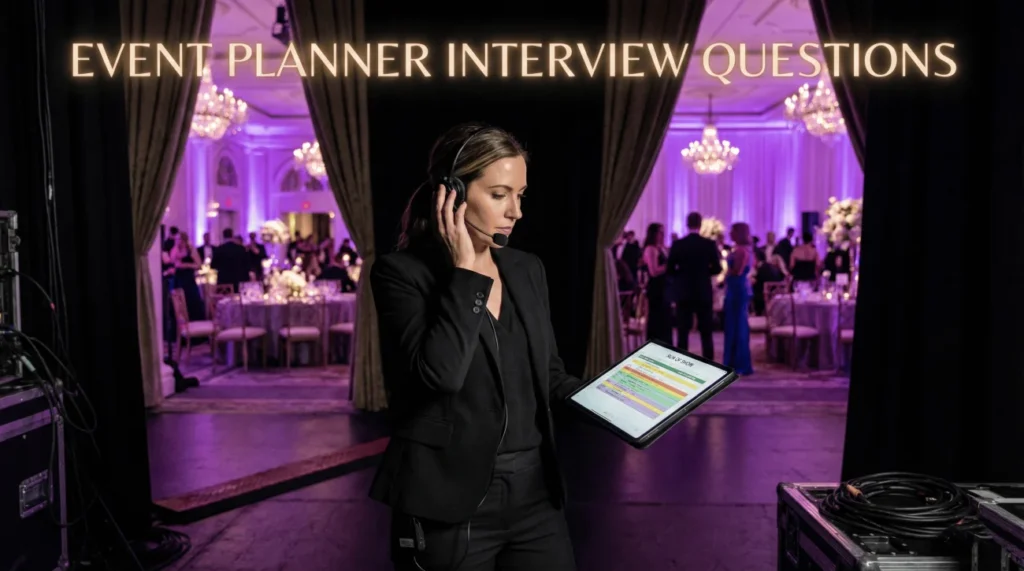
Event planner interview questions are not about centerpieces. They are about the moment a vendor truck is late, the client is anxious, and the banquet captain needs a decision right now. In hotels, resorts, and banquet halls, the Event Planner sits at the intersection of sales promises and operational reality. Hiring managers want someone who can protect the experience while guarding the budget, the floor plan, and the staff’s time.
Expect the interview to drill into the mechanics: how you write a bulletproof Banquet Event Order (BEO), how you keep a room flip on schedule, and how you stay calm when Plan A disappears. You will also be tested on the business side, like handling attrition conversations, negotiating with vendors, and presenting upgrades in a way that feels helpful, not pushy.
The BEO & Operational Logistics
The “Banquet Event Order” is the holy scripture of events. If it isn’t on the BEO, it doesn’t happen. Interviewers will test your attention to detail here.
Q: Explain the importance of a BEO (Banquet Event Order) and what it must include.
Answer: The BEO is the contract between the client and the venue, and the roadmap for the internal team. It must include the timeline, menu details (dietary restrictions specifically), beverage packages, room setup (diagram), A/V requirements, and staffing levels. If I write “Chicken Dinner” on a BEO, the kitchen fails. I must write “Grilled Herb Chicken, Sauce on Side, No Dairy.” Precision prevents disasters.
Q: How do you conduct a “Pre-Con” (Pre-Conference/Event) meeting?
Answer: The Pre-Con is where I introduce the client to the operations team (Chef, Banquet Captain, Housekeeping). I walk through the BEO line-by-line. I ask the hard questions: “What happens if the keynote speaker runs late?” “Do we have a rain call for the patio reception?” It is the final synchronization to ensure the Operations team understands the Client’s vision perfectly.
Q: Describe your process for creating a floor plan / room diagram.
Answer: I use software like Social Tables or AllSeated. I don’t just drop tables in a square. I calculate “flow.” I ensure there is enough clearance for servers to walk between chairs (at least 24 inches). I check line-of-sight for the projector screens. I locate the power outlets for the DJ. A pretty floor plan is useless if it creates a bottleneck at the buffet or a fire hazard at the exit.
Q: How do you handle “Attrition” clauses with a client?
Answer: Attrition is the fee paid if the client fails to fill their blocked rooms or hit their food and beverage minimum. I handle this proactively. I monitor their pickup rate weekly. If they are falling behind 3 months out, I alert them: “We are at 50% pickup; let’s release some rooms back to inventory now to minimize your penalty.” I act as their partner to save them money, while protecting the hotel’s revenue.
Vendor Management & Negotiation
You can’t do it alone. You need florists, DJs, and decorators. Interviewers want to know how you manage these external variables.
Q: A vendor (e.g., Florist) is late for setup. Guests arrive in 30 minutes.
The Strategy: Contingency & Calm.
Answer: I call the vendor immediately for an ETA. If they are stuck, I activate Plan B. I pull in-house decor (centerpieces, candles) from our storage to ensure the tables aren’t bare. I instruct the Banquet Captain to dim the lights to hide imperfections. When the florist arrives, I direct them to the back door to set up stealthily. I shield the client from the panic until it is resolved.
Q: How do you vet a new vendor for your “Preferred Vendor List”?
The Strategy: Quality Assurance.
Answer: I look for three things: Insurance, Style, and Reliability. I require proof of liability insurance (to protect the hotel). I review their portfolio to see if it matches our luxury standard. Most importantly, I call references from other venues to ask: “Do they clean up after themselves? Are they on time?” A vendor reflects on me; if they are rude, the guest blames the hotel.
Q: A client wants to bring their own outside caterer. How do you handle it?
The Strategy: Policy & Revenue.
Answer: Generally, we do not allow it for food safety and revenue reasons. I explain: “To guarantee the quality and safety of your meal, we require you use our culinary team.” However, if it is for religious reasons (Kosher/Halal) that we cannot support, I negotiate a “Buy-out Fee” or “Kitchen Usage Fee” and require the outside caterer to sign a strict liability waiver and provide insurance.
Q: The DJ blows a fuse and the music stops. Action?
The Strategy: Technical Troubleshooting.
Answer: I always know where the breaker box is. I send Engineering to reset it immediately. While it is silent, I might ask the best man to make a speech or I engage the crowd to keep the energy up. I ensure future setups distribute power loads correctly (not plugging lights and sound into the same circuit) to prevent this.
Q: How do you negotiate with vendors to get better pricing for clients?
The Strategy: Volume Leverage.
Answer: I leverage the volume of the venue. “I have 40 weddings this year. If you can give my clients a 10% discount or a free upgrade, I will make you my primary recommendation.” This creates a win-win: the vendor gets volume, the client gets a deal, and I look like a hero.
Q: A vendor damages the venue walls during load-out.
The Strategy: Accountability.
Answer: I document the damage immediately with photos. I inform the vendor before they leave the property. I bill the client’s master account for the repairs (as per their contract) but provide them with the evidence so they can recoup it from the vendor. I protect the asset of the hotel first.
Weddings & Social Events
Social events are emotional. Interviewers need to know you can handle high-stress brides and demanding parents.
The Bride is having a meltdown because it is raining. What do you do?
The Strategy: Empathy & Authority.
Answer: I validate her feelings, then I take charge. “I know this isn’t what you pictured, and I am so sorry. However, our rain backup in the Ballroom is stunning. I have the team lighting extra candles and moving the arch right now. It is going to be intimate, romantic, and dry. Trust me.” I sell the Plan B as if it were Plan A.
A guest at the wedding is visibly intoxicated and aggressive.
The Strategy: Discreet Intervention.
Answer: I do not make a scene on the dance floor. I alert the Banquet Captain to cut off alcohol service to that individual. I find a “handler” from the guest list (Best Man, Father of the Groom) and ask them to help manage their friend. “Mr. Smith is having a bit too much fun; could you help me get him some water or a cab?” If he becomes violent, I call security, but I try to keep it “in the family” first.
The speeches are running 45 minutes long. Dinner is drying out.
The Strategy: Timeline Management.
Answer: I signal the MC or DJ to wrap it up. I might walk up to the head table and whisper to the Best Man: “The Chef is ready to serve the steak perfectly right now; let’s save the last two speeches for dessert.” I protect the food quality. If they insist on continuing, I inform the client: “We can continue, but the meal service will be delayed and the quality may suffer.” I let them choose, but I warn them.
Sales & Upselling
You are a revenue generator. How do you increase the Average Check?
Q: How do you upsell a client who is on a budget?
Answer: I focus on “High Impact, Low Cost” items. I might say: “I respect the budget. However, upgrading to the Chiavari chairs for $5 each completely transforms the room photos. It is a small spend for a huge visual impact.” Or I suggest a signature cocktail instead of a full open bar to save money while adding a personalized touch. I help them spend their money smarter.
Q: Describe your strategy for selling “Shoulder Dates” (Sundays/Fridays).
Answer: I create value-add packages. “Saturday requires a $20,000 minimum. However, if you are flexible with a Friday or Sunday, the minimum is only $10,000 and I can include a complimentary upgrade to the Bridal Suite.” I sell the savings and the exclusivity of having the venue on a quieter day.
Event Planning Knowledge Quiz
Test Your Event IQ
1. “BEO” stands for:
- Best Event Organization
- Banquet Event Order
- Big Event Opening
- Bar and Eating Order
2. “Attrition” refers to:
- A type of decoration
- A penalty fee for failing to meet the contracted number of rooms/guests
- The food menu
- The guest arrival
3. A “Guarantee Count” is usually due:
- On the day of the event
- 48 to 72 hours before the event
- 1 month before
- After the event
4. “Plus Plus” (++) refers to:
- Good service
- Service Charge and Tax added to the base price
- Extra food
- A double upgrade
5. “Flip” a room means:
- To clean the ceiling
- To change the setup from one format (e.g., Ceremony) to another (e.g., Reception) quickly
- To cancel the room
- To sell the room
6. “Rounds” usually seat:
- 2 people
- 8 to 10 people (standard 60″ or 72″ round tables)
- 20 people
- 4 people
7. “Open Bar” means:
- The bar has no door
- Guests drink for free (host pays by the hour or consumption)
- Guests pay for their own drinks
- The bar is outside
8. “Corkage Fee” is charged when:
- The hotel provides the wine
- The guest brings their own wine to be served
- A cork breaks
- The bar is closed
9. “F&B Minimum” is:
- The smallest plate size
- The minimum amount the client must spend on food and beverage to secure the space
- A discount
- The chef’s salary
10. “Load-in” refers to:
- Eating fast
- The time allotted for vendors to bring in equipment/decor
- The guests arriving
- Loading the dishwasher
11. “Pax” is short for:
- Packages
- Passengers / People / Guests
- Payments
- Paperwork
12. “Breakout Room” is used for:
- Escaping the hotel
- Smaller group sessions splitting off from a main conference
- Breakfast only
- Storage
13. “Run of House” (ROH) rooms mean:
- The best rooms only
- Whatever rooms are available at check-in (no specific view/type guaranteed)
- The guest can run anywhere
- Suite upgrades
14. “Site Inspection” or “Site Visit” is:
- The health inspector coming
- A potential client visiting the venue to decide if they want to book it
- Checking the website
- Cleaning the site
15. “Set” refers to:
- A tennis match
- The capacity of a room in a specific configuration (e.g., “Set for 100”)
- The menu
- The DJ list
16. “Pipe and Drape” is used to:
- Fix plumbing
- Divide a room or hide ugly walls using fabric curtains on frames
- Decorate a cake
- Serve drinks
17. “Strike” means:
- To hit something
- To dismantle and remove all equipment/decor after an event
- To start the event
- To fire the staff
18. “Master Account” is:
- The boss’s bank
- The main bill where all authorized event charges are posted
- The key card
- A VIP guest
19. “Classroom Style” setup involves:
- Round tables
- Long tables with chairs on one side, facing the front (for note-taking)
- Standing only
- Bean bags
20. The “Banquet Captain” is:
- The boat driver
- The operational supervisor running the floor during the actual event
- The sales manager
- The chef
❓ FAQ
🕒 Do event planners actually work the event?
Most of the planning happens during business hours, but execution is where you earn your reputation. If the client is on-site, you are usually on-site too, especially for weddings, galas, and high-stakes corporate programs.
🗂️ What should I bring to prove I can do the job?
Bring something concrete: a sample timeline, a room diagram, a redacted BEO, or a run-of-show checklist. Interviewers trust evidence more than promises, and operational work is easiest to judge when you show the paperwork.
🌧️ Will they ask about disaster scenarios?
Yes. Expect questions about weather pivots, vendor no-shows, A/V failures, and guest behavior. The best answers are practical: confirm facts, activate a backup, communicate clearly, and protect the client from panic.
🎤 What skills matter more than “being creative”?
Documentation, time management, and communication. Creativity helps, but the interview usually rewards candidates who can run a timeline, coordinate departments, and keep details consistent across sales, kitchen, and banquet teams.
💵 Is the pay mostly salary or performance-based?
It depends on the role. Planning and operations positions are often salary-based, while catering sales roles may include commission or bonuses tied to food and beverage revenue, room rental, or upsell performance.
Final Thoughts
If you want to stand out in event planner interview questions, speak like the person who keeps the room running when the pressure spikes. Show that you can translate a client’s vision into a BEO the kitchen can execute, a floor plan the staff can move through, and a timeline that protects the food quality.
Lean into the unglamorous details: attrition math, vendor accountability, and how you communicate a Plan B without sounding unsure.
⚠️ Disclaimer: The interview strategies, sample answers, and negotiation tips provided in this guide are for educational purposes only. Hiring decisions are subjective and vary by company and industry. While these strategies are based on professional HR standards, they do not guarantee a specific job offer or result.