The Healer with a Business Mindset
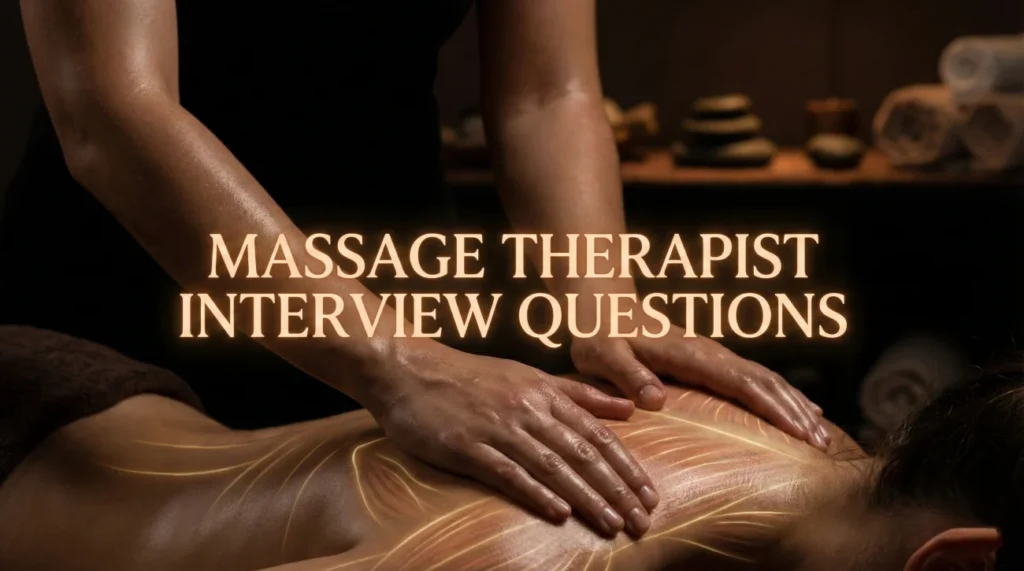
Massage therapist interview questions bridge the gap between medical science and hospitality. In 2025, a Massage Therapist (LMT/RMT) is not just a pair of hands; you are a wellness consultant. Hiring managers at top spas and clinics are looking for candidates who can explain the insertion point of the Levator Scapulae muscle, demonstrate impeccable draping techniques, and rebook a client for a 6-week treatment plan all in one hour.
This comprehensive guide dissects the interview process for manual therapists. We cover the Practical Exam (the hands-on audition), the critical knowledge of Contraindications (when not to massage), and the delicate soft skills required to maintain Ethical Boundaries. Whether you are fresh out of massage school or a seasoned veteran of the resort circuit, proving you have the touch, the knowledge, and the stamina is your pathway to a full schedule.
Anatomy, Physiology & Modalities
You cannot fix what you do not understand. Interviewers will test your anatomical knowledge to ensure you treat the root cause, not just the symptom.
Q: Explain the difference between Swedish and Deep Tissue massage to a client.
Answer: I explain it in terms of goals. “Swedish massage uses long, gliding strokes (effleurage) towards the heart to increase circulation and promote relaxation. It is great for stress relief. Deep Tissue focuses on the deeper layers of muscle and fascia. It uses slower, firmer pressure to release chronic tension and break up scar tissue (adhesions). Swedish feels good; Deep Tissue fixes problems.” This helps manage their expectations regarding pressure and potential soreness.
Q: A client complains of “Sciatica.” Which muscles do you target?
Answer: While true sciatica is a nerve impingement often at the spine, false sciatica is often caused by a tight Piriformis muscle compressing the sciatic nerve. I would focus on the gluteal group, specifically the Piriformis, using trigger point therapy or stripping techniques. I would also work on the hamstrings and lower back (QL) to relieve compensating tension, while being careful not to put direct pressure on the nerve itself.
Q: What are the “Endangerment Sites” you avoid?
Answer: These are areas where nerves and blood vessels are exposed and vulnerable. I avoid deep pressure in the Popliteal Fossa (behind the knee), the Axilla (armpit), the Anterior Triangle of the neck (throat/carotid artery), and the Inguinal region (groin). I work around these areas carefully but never apply direct, heavy compression to avoid nerve damage or blocking blood flow.
Q: How do you handle a client with “Varicose Veins”?
Answer: This is a local contraindication. I do not massage directly over varicose veins as it could dislodge a blood clot (DVT), which is life-threatening. I would use very light feather strokes over the area or avoid it entirely, focusing on the rest of the leg. I would elevate the legs if possible to assist venous return without mechanical pressure.
The Practical Interview (Hands-on)
You can talk anatomy all day, but can you massage? The practical is where you get hired.
Q: How do you prepare for the practical demo?
The Strategy: Professionalism.
Answer: I treat the hiring manager like a VIP client. I arrive early to set up the table (if needed). I wash my hands thoroughly. I conduct a full intake interview: “Do you have any injuries or pressure preferences today?” I check in regarding pressure within the first 2 minutes. I demonstrate my best mechanics, showing I can generate power from my legs/core, not just my thumbs.
Q: Demonstrate proper “Draping” technique.
The Strategy: Client Security.
Answer: Draping builds trust. I ensure the client never feels exposed. I use the “diaper drape” or secure leg draping when working on glutes/legs to ensure modesty. I keep the sheet tight and secure so there are no drafts or slips. My rule is: “If I am not working on it, it is covered.” Safe draping allows the client to relax completely.
Q: Describe your flow for a 50-minute full body massage.
The Strategy: Time Management.
Answer: I divide the body: 10 mins back (prone), 10 mins legs (prone), 10 mins legs (supine), 10 mins arms/neck/shoulders (supine). This leaves 5 mins for intake and 5 mins for transition/closure. I transition smoothly between areas without breaking contact. I customize the time split if the client has a specific focus area, but I always watch the clock to ensure I don’t rush the ending.
Q: How do you protect your thumbs/wrists?
The Strategy: Body Mechanics.
Answer: I limit thumb use to detail work only. For broad pressure, I use my forearms, elbows, and knuckles. I keep my wrists stacked (neutral position), not bent. I lunge with my legs to apply pressure rather than pushing with my shoulders. Career longevity depends on joint stacking and using the larger muscle groups.
Q: What if the interviewer asks for “More Pressure” but you are at your max?
The Strategy: Leverage.
Answer: I lower my table height (if hydraulic) to use gravity. I switch tools – moving from hands to elbows. I check my stance to ensure I am leaning in with my body weight. If I am truly at my physical limit, I communicate honestly: “I am using my maximum safe pressure right now. Is this depth effective for the trigger point?”
Q: How do you end the massage?
The Strategy: The “Grounding” Finish.
Answer: I end with a “nerve stroke” (light, long stroke) or a gentle hold on the feet or head to signal completion. I whisper, “I will leave you to dress; take your time getting up.” I ensure they have water waiting. The ending should be as deliberate as the beginning, avoiding a jarring stop.
Ethics, Boundaries & SOAP Notes
The therapy room is a vulnerable space. You must prove you are a safe, ethical practitioner.
Q: How do you handle a client who makes an inappropriate comment or sexual advance?
Answer: I have a zero-tolerance policy, but I handle it professionally. If it is a subtle comment, I ignore it once or redirect. If it is overt or physical, I stop the massage immediately. I step back, break contact, and say firmly: “The session is over. I will leave the room while you dress.” I report the incident to management immediately and document it in the client notes. Safety comes before revenue.
Q: What are SOAP notes and why are they important?
Answer: SOAP stands for Subjective (what the client says/feels), Objective (what I observe/palpate), Assessment (what I did/results), and Plan (future recommendations). They are crucial for tracking progress, legal protection, and insurance billing. If a client returns in 6 months, I can look at my notes and know exactly which shoulder was tight.
Q: A client asks you to work on an area you are not certified in (e.g., Craniosacral).
Answer: I stay within my Scope of Practice. I say, “I am not certified in Craniosacral therapy, so I cannot perform that specific technique safely. However, I can focus on the neck and scalp muscles to relieve tension.” I refer them to a specialist if they need medical-grade work. I never “wing it” on techniques I haven’t been trained in.
Situational & Client Retention
Massage is a recurring business. How do you keep them coming back?
A client arrives 15 minutes late for a 60-minute session.
The Strategy: Boundary Setting.
Answer: I greet them warmly but set expectations immediately. “Welcome! Since we are starting a bit late and I have another client right after you, we will have to end at the scheduled time to be fair to everyone. That gives us 45 minutes of hands-on time. Would you like to focus on a specific area to make the most of it?” I do not run late and punish the next innocent client.
How do you rebook a client without being “salesy”?
The Strategy: Treatment Planning.
Answer: I frame it as a health plan. “I felt a lot of tension in your rhomboids today. We made some progress, but to really resolve it, I recommend seeing you again in 2 weeks. Does that Tuesday work for you?” When I present it as a prescription for their wellbeing, they value it. I also hand them water and walk them to the desk to facilitate the booking.
A client complains of pain during the massage.
The Strategy: Immediate Adaptation.
Answer: “Pain” is a red flag. Discomfort (“good pain”) is okay; sharp pain is not. I stop immediately and ask, “On a scale of 1-10, where is the pressure?” I adjust instantly. I use more oil or broad strokes to soothe the area. I check in frequently after that. Ignoring pain can cause tissue damage and ensures the client never returns.
Massage Therapy Knowledge Quiz
Test Your Therapist IQ
1. “Effleurage” involves:
- Pinching
- Long, gliding strokes used to warm up muscles and apply oil
- Hacking/chopping
- Deep pressure points
2. A “Contraindication” means:
- A contract
- A condition or symptom that makes massage unsafe or inadvisable
- A discount
- A referral
3. The “Piriformis” muscle is often associated with:
- Headaches
- Sciatica (compression of the sciatic nerve)
- Tennis elbow
- Carpal tunnel
4. “Petrissage” involves:
- Gliding
- Kneading, lifting, and squeezing muscle tissue
- Shaking
- Tapping
5. “Body Mechanics” are important for:
- Fixing the table
- Preventing therapist injury and burnout through proper posture
- The client’s comfort only
- Billing insurance
6. “Trigger Points” are:
- Acupuncture spots
- Hyperirritable spots in skeletal muscle that cause referred pain
- Broken bones
- Lymph nodes
7. “Decolletage” refers to:
- The feet
- The upper chest, neck, and shoulder area
- The lower back
- The face
8. “Scope of Practice” defines:
- Where you can work
- The legal limits of what a licensed professional can do (e.g., no diagnosing)
- Your salary
- The type of oil used
9. “Lymphatic Drainage” requires:
- Deep pressure
- Very light, rhythmic pumping strokes
- Hot stones
- Fast movements
10. “Referred Pain” is:
- Pain referred by a doctor
- Pain felt in a part of the body other than its actual source
- Fake pain
- Pain that goes away
11. A “Bolster” is used to:
- Clean the table
- Support the client’s knees or ankles to relieve back strain
- Cover the face
- Hold oil
12. “Fascia” is:
- Skin
- Connective tissue that surrounds and holds every organ/muscle in place
- Fat
- Bone marrow
13. “Tapotement” includes:
- Sleeping
- Percussive strokes like hacking, cupping, and pounding
- Stretching
- Holding still
14. “Hypertonicity” means:
- Too much water
- Excessive muscle tension or tightness
- Loose muscles
- High energy
15. “Supine” position is:
- Face down
- Face up (lying on back)
- Side lying
- Sitting
16. “Prone” position is:
- Face up
- Face down (lying on stomach)
- Standing
- Kneeling
17. “Endangerment Sites” contain:
- Thick muscle
- Major nerves, arteries, or veins that are unprotected
- Bones only
- Hair
18. “Proprioception” relates to:
- Smelling oil
- The body’s ability to sense its position and movement in space
- Hearing music
- Paying the bill
19. “Acute” injury means:
- Old injury
- Recent, sudden onset injury (usually with inflammation)
- Small injury
- Chronic injury
20. “Grounding” helps the therapist:
- Sit down
- Maintain focus, stability, and separate their energy from the client’s
- Clean the floor
- Calculate tips
❓ FAQ
📜 Do I need a license?
Yes. In most states/countries, you must complete a certified program (500+ hours) and pass a board exam (like the MBLEx in the USA) to practice legally. Working without a license is illegal and dangerous.
💪 How many massages can I do in a day?
A full-time load is often considered 4-5 hands-on hours per day (20-25 per week). Doing more leads to rapid burnout and injury. Quality drops significantly after the 5th massage in a row.
🛡️ Do I need insurance?
Yes. Professional liability insurance (malpractice) is essential to protect you if a client claims you injured them. Organizations like AMTA or ABMP provide this.
💰 Do therapists get tips?
Yes, tipping is standard in the spa industry (15-20%). However, in medical or chiropractic settings, tipping is less common. Clarify the compensation structure during the interview.
🤕 What are common injuries for therapists?
Carpal tunnel, tendonitis, and lower back pain. Self-care is not optional; it is part of the job. Regular stretching, receiving massages, and proper body mechanics are required to survive.
Final Thoughts
To succeed in answering massage therapist interview questions, you need to show you are a “Safe Pair of Hands.” The manager needs to know you won’t injure a client, won’t cross ethical boundaries, and won’t burn out in month. Confidence in your anatomy knowledge is your strongest asset.
Highlight your ability to listen to the client’s body and your commitment to professional growth. If you can prove you are a skilled healer who understands the business of retention, you will have a long career.
⚠️ Disclaimer: The interview strategies, sample answers, and negotiation tips provided in this guide are for educational purposes only. Hiring decisions are subjective and vary by company and industry. While these strategies are based on professional HR standards, they do not guarantee a specific job offer or result.