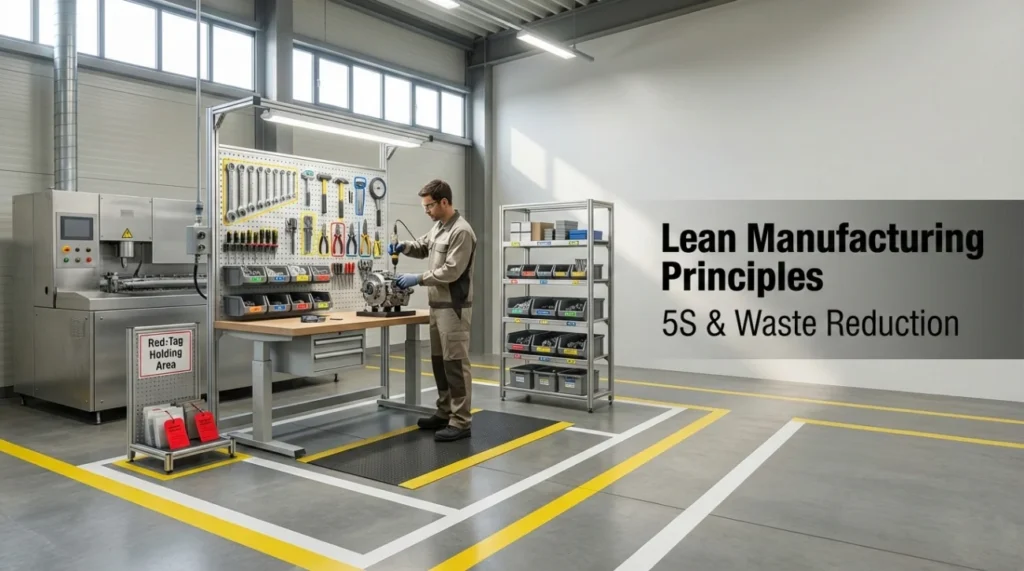
- Lean Mindset: Treat waste and inefficiency as fixable systems problems, not “normal,” and use that thinking to drive daily improvement.
- Eight Wastes (DOWNTIME): Defects, Overproduction, Waiting, Non-utilized talent, Transportation, Inventory, Motion, Excess processing are the main targets to eliminate.
- 5S Foundation: Sort, Set in Order, Shine, Standardize, Sustain create visual, organized workspaces that improve safety, quality, and speed.
- Kaizen And PDCA: Build continuous improvement through small experiments, measure results, standardize wins, and repeat so learning compounds over time.
- Tools And Roadblocks: Use value stream mapping, standardized work, root-cause methods, kanban, poka-yoke, and TPM, while managing resistance and preventing backsliding with audits and clear metrics.
Why Lean Thinking Transforms Manufacturing Efficiency
Understanding lean manufacturing principles separates modern competitive manufacturers from operations relying on outdated mass production thinking that accepts waste, inefficiency, and quality problems as inevitable rather than systematically eliminating them through disciplined continuous improvement. Lean methodology emerged from Toyota’s revolutionary production system demonstrating that relentless focus on waste elimination, process optimization, and worker empowerment creates sustainable competitive advantages that traditional manufacturing approaches cannot match.
Manufacturing professionals who grasp lean thinking contribute immediately to operational improvement rather than merely executing assigned tasks without questioning efficiency or quality. During candidate evaluation, employers assess whether you understand lean fundamentals and demonstrate continuous improvement mindset because these capabilities signal professional value beyond basic job requirements. The workers who advance consistently in manufacturing careers apply lean principles daily, identifying waste, proposing improvements, and driving incremental gains that compound into significant operational advantages.
The Eight Wastes of Lean Manufacturing
Effective 5S methodology implementation begins with recognizing the eight categories of waste that lean thinking systematically targets for elimination because these non-value-adding activities consume resources without benefiting customers.
Identifying Waste Categories
Lean methodology identifies eight waste types using the acronym DOWNTIME: Defects requiring rework or scrap, Overproduction creating excess inventory, Waiting for materials or equipment, Non-utilized talent leaving worker knowledge untapped, Transportation of materials adding no value, Inventory beyond immediate needs, Motion wasting worker movement, and Excess processing beyond customer requirements. Every manufacturing activity falls into either value-adding work that customers pay for or waste that lean thinking eliminates systematically through process improvement.
| Waste Type | Description | Common Examples |
|---|---|---|
| Defects | Quality problems requiring rework or scrap | Rejected parts, customer returns, inspection failures |
| Overproduction | Making more than needed or before needed | Excess inventory, premature production, batch sizes too large |
| Waiting | Idle time due to delays or bottlenecks | Machine downtime, material shortages, unbalanced workflows |
| Non-Utilized Talent | Failing to leverage worker knowledge and ideas | Top-down decisions ignoring operator insights, no improvement systems |
| Transportation | Moving materials without adding value | Excessive material handling, poor layout, remote storage |
| Inventory | Excess raw materials, WIP, or finished goods | Large batches, buffer stocks, obsolete materials |
| Motion | Unnecessary worker movement | Poor workstation layout, searching for tools, excessive reaching |
| Excess Processing | Work beyond customer requirements | Overengineered processes, redundant inspections, unnecessary features |
Practical Waste Identification
Train yourself to see waste by observing production flows asking whether each activity directly adds value customers pay for or represents waste requiring elimination. Watch for workers waiting, materials moving unnecessarily, inventory accumulating, defects occurring, or processes including steps that don’t transform products toward customer requirements. This waste recognition becomes automatic with practice, transforming how you view manufacturing operations from accepting inefficiency as normal to constantly questioning why processes consume resources without adding proportional value.
Expert advice: The most valuable lean practitioners recognize that waste elimination isn’t about working harder or faster but rather systematically removing non-value-adding activities so value-adding work flows smoothly without interruption or inefficiency.
5S Workplace Organization Methodology
Understanding lean waste reduction includes mastering 5S as foundational workplace organization system creating visual management, standardization, and discipline that enable all other lean improvements.
The Five S Steps
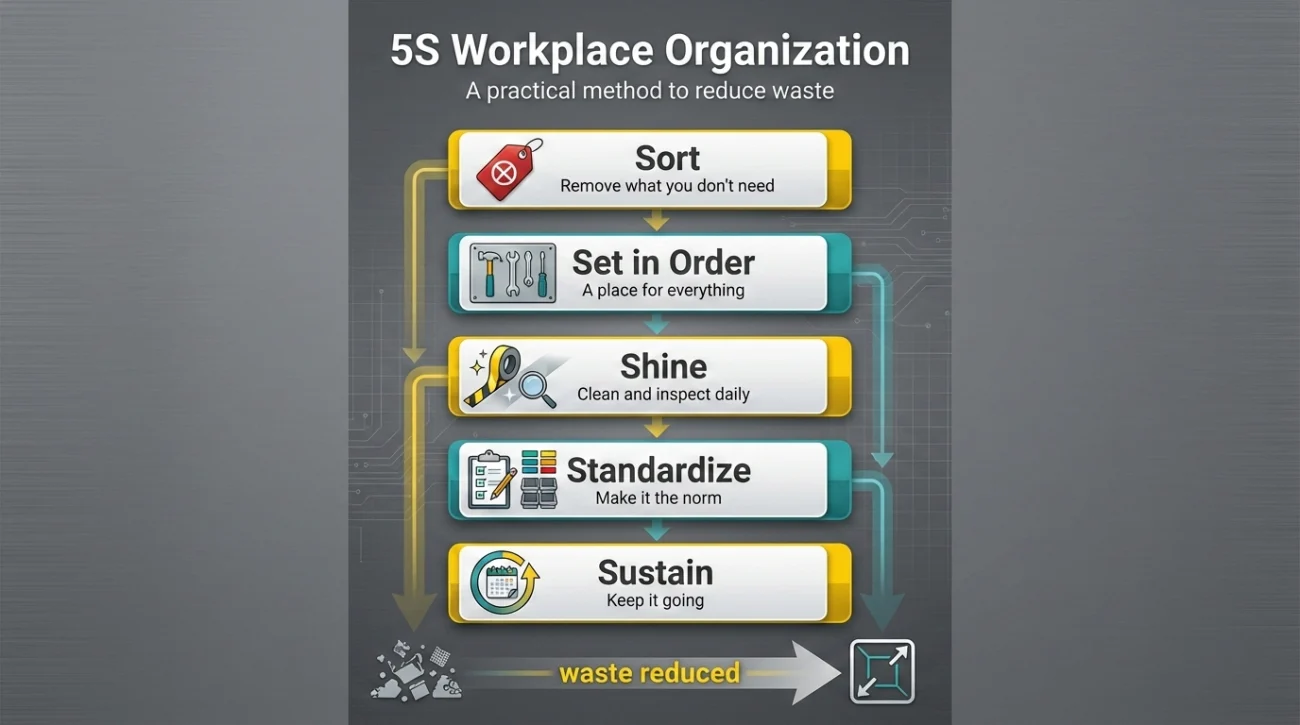
5S progresses through five sequential steps: Sort (remove unnecessary items), Set in Order (organize needed items for easy access), Shine (clean and inspect workspace), Standardize (establish consistent practices), and Sustain (maintain discipline over time). Each S builds on previous steps creating progressively more organized, efficient, and safe work environments that expose problems immediately rather than hiding issues behind clutter and disorganization.
- 🗂️ Sort (Seiri): Remove unnecessary items, red-tag unneeded materials for disposal
- 📐 Set in Order (Seiton): Organize needed items, visual controls, shadow boards, labeling
- ✨ Shine (Seiso): Clean workspace, inspect equipment, identify abnormalities
- 📋 Standardize (Seiketsu): Establish consistent practices, checklists, procedures
- 🔄 Sustain (Shitsuke): Maintain discipline, audits, continuous adherence
Visual Management Integration
5S creates visual workplaces where normal versus abnormal conditions appear immediately through color coding, shadow boards showing tool locations, floor markings defining pathways and storage areas, and visual indicators revealing inventory levels, equipment status, or quality issues. This visual management allows anyone to understand workplace status within seconds rather than requiring special knowledge or inspection to discover problems. Visual systems also make violations immediately apparent, creating peer pressure for compliance that supervisor monitoring alone cannot achieve.
5S Benefits Beyond Organization
While 5S appears superficially about cleanliness and organization, deeper benefits include improved safety through hazard elimination and clear pathways, enhanced quality by exposing defects immediately, increased efficiency through reduced searching and motion waste, better equipment reliability through regular cleaning revealing mechanical issues, and creating foundation for advanced lean practices requiring stable organized environments. Organizations with strong 5S implementation outperform competitors because workplace organization enables productivity gains that cluttered disorganized facilities cannot achieve regardless of worker skill or equipment quality.
Kaizen Continuous Improvement Philosophy
Strong kaizen continuous improvement practices embed systematic incremental enhancement into daily work rather than relying on occasional dramatic transformations that disrupt operations while delivering uncertain results.
Continuous Improvement Mindset
Kaizen literally means “change for better” representing philosophy that small incremental improvements implemented consistently produce greater long-term gains than sporadic breakthrough innovations. This mindset encourages everyone regardless of role to identify improvement opportunities, test solutions quickly, standardize successes, and continue refining processes perpetually. Kaizen cultures value attempting many small improvements with some failures over avoiding experimentation fearing mistakes, recognizing that learning compounds through iteration even when specific attempts fail.
| Kaizen Principle | Implementation Approach |
|---|---|
| Incremental Change | Small frequent improvements rather than large infrequent transformations |
| Employee Involvement | All workers contribute ideas, not just management or engineers |
| Rapid Testing | Quick PDCA cycles, learning through experimentation, fail fast |
| Standardization | Document improvements, train others, prevent backsliding |
| Visual Results | Display metrics, celebrate gains, maintain improvement momentum |
PDCA Cycle Application
Kaizen employs Plan-Do-Check-Act (PDCA) cycle for systematic improvement: Plan identifies problem and develops countermeasure hypothesis, Do implements change on small scale, Check measures results against predictions, and Act either standardizes successful improvements or revises plans based on learning. This scientific approach prevents implementing changes without verification while enabling rapid iteration learning from both successes and failures. Multiple small PDCA cycles weekly prove more valuable than slow elaborate planning producing infrequent large changes with unpredictable outcomes.
Frontline Worker Engagement
Successful kaizen cultures recognize that frontline workers possess invaluable knowledge about process details, waste sources, and improvement opportunities that distant managers or engineers cannot see from their removed perspectives. Creating suggestion systems, improvement teams, and recognition programs that capture and implement worker ideas unleashes tremendous improvement capacity that traditional top-down management wastes. The workers closest to problems often develop best solutions when organizations provide frameworks channeling their insights productively.
💡 Pro tip: Track your own kaizen contributions through photos, metrics, or documentation showing before/after improvements; this portfolio demonstrates continuous improvement mindset that manufacturing employers value highly during interviews and performance reviews.
Essential Lean Tools and Techniques
Comprehensive lean production techniques include diverse tools supporting waste elimination and process optimization beyond 5S and kaizen fundamentals.
Value Stream Mapping
Value stream maps visualize entire production flows from raw materials through customer delivery, documenting processing times, wait times, inventory levels, and information flows. This comprehensive view reveals waste invisible when examining individual process steps in isolation. Maps show where value actually gets added versus where materials sit waiting, where information disconnects create problems, and which improvement opportunities offer greatest impact. Creating current state maps followed by future state designs drives strategic improvement efforts toward systemic gains rather than localized optimizations that may worsen overall performance.
Standardized Work Development
Standardized work establishes best-known methods for each task, documenting sequence, timing, and work-in-process levels that optimize safety, quality, and efficiency. This standardization doesn’t stifle improvement but rather creates stable baseline enabling systematic enhancement. Without standards, comparing improvement attempts proves impossible since inconsistent methods prevent isolating actual changes from random variation. Standards also facilitate training, problem-solving, and capturing improvements once validated through kaizen activities.
- Value stream mapping revealing system-level waste and improvement priorities
- Standardized work establishing best practices and improvement baselines
- Root cause analysis identifying true problem sources rather than symptoms
- Pull systems and kanban preventing overproduction waste
- Poka-yoke error-proofing eliminating defect opportunities
- TPM (Total Productive Maintenance) maximizing equipment reliability
Structured Problem-Solving Methods
Lean problem-solving employs systematic approaches like 5 Whys asking “why” repeatedly until root causes emerge rather than accepting superficial symptoms, or fishbone diagrams organizing potential causes by category facilitating thorough investigation. These structured methods prevent jumping to solutions before understanding problems fully, a common mistake creating ineffective countermeasures that fail addressing actual issues. Disciplined problem-solving distinguishes professionals who eliminate recurring problems from those firefighting symptoms perpetually without achieving lasting improvement.
Never implement lean tools mechanically without understanding underlying principles; 5S becomes housekeeping theater rather than foundation for improvement when practiced without connection to waste elimination and visual management purposes.
Overcoming Lean Implementation Obstacles
Successful lean transformation requires navigating predictable challenges that derail many well-intentioned improvement initiatives through poor change management or unrealistic expectations.
Addressing Cultural Resistance
Workers and managers often resist lean changes fearing job losses, increased workload, or disruption to familiar comfortable routines. Overcoming resistance requires explaining improvement benefits clearly, involving workers in solution development rather than imposing changes, demonstrating management commitment through resource allocation and participation, celebrating early wins building momentum, and addressing legitimate concerns honestly rather than dismissing resistance as obstinacy. Sustainable lean cultures develop through patient persistent effort building trust that improvements benefit everyone rather than threatening employment or wellbeing.
Preventing Backsliding
Many organizations achieve initial lean improvements only to revert slowly to previous inefficient practices when attention shifts elsewhere. Sustaining gains requires standardizing improvements through documented procedures and training, conducting regular audits maintaining discipline, visually displaying performance metrics revealing backsliding immediately, refreshing lean training continuously, and embedding improvement into daily management systems rather than treating kaizen as special periodic events. Leadership commitment determines whether lean becomes organizational culture or temporary program eventually abandoned under production pressure.
❓ FAQ
🎯 Do I need lean certification to apply lean principles?
Certifications demonstrate knowledge but practical application matters more. Focus on understanding core concepts and implementing improvements in your current role. Document specific waste reduction or efficiency gains you’ve achieved. Employers value demonstrated continuous improvement mindset over credentials without practical results.
💼 How do I suggest lean improvements without seeming critical?
Frame suggestions positively as improvement opportunities rather than criticizing current practices. Use data showing potential gains. Involve others in solution development. Start small with quick wins building credibility. Acknowledge constraints while proposing realistic changes. Present improvements as team contributions, not personal achievements.
⏰ What if management doesn’t support lean initiatives?
Implement improvements within your control sphere, building track record demonstrating value. Document results with metrics. Gradually expand influence as successes accumulate. Sometimes persistence and proven results eventually overcome initial skepticism. If organization fundamentally opposes improvement culture, consider whether long-term fit exists.
📋 Should I mention lean experience in interviews if limited?
Yes, discuss any kaizen participation, 5S implementation, or waste reduction contributions even if informal. Demonstrate understanding of lean principles and improvement mindset. Express eagerness to learn and apply lean thinking. Entry-level candidates win through genuine continuous improvement attitude rather than extensive lean expertise.
✨ How long does lean transformation typically require?
Lean is journey not destination; continuous improvement never finishes. Initial results appear within weeks for focused improvements. Cultural transformation requires years of sustained effort. Set realistic expectations understanding that lean thinking develops gradually through practice, not overnight through training or quick fixes.
Final Thoughts
Lean manufacturing principles represent fundamental competitive advantage distinguishing world-class manufacturers from operations accepting waste, inefficiency, and quality problems as inevitable rather than systematically eliminating them through disciplined continuous improvement. Organizations embracing lean thinking create sustainable performance gains through waste elimination, process optimization, and worker empowerment that traditional manufacturing approaches cannot match regardless of capital investment or technology adoption.
Mastering lean manufacturing principles transforms how you view production operations from accepting current processes as given to constantly questioning waste sources and improvement opportunities. Understand the eight waste categories that lean thinking targets systematically, implement 5S workplace organization creating foundation for advanced improvements, embrace kaizen continuous improvement contributing ideas regardless of role, and develop structured problem-solving skills addressing root causes rather than symptoms. This comprehensive lean capability signals professional value beyond basic job requirements, positioning you as contributor to operational excellence rather than merely task executor following assigned procedures without questioning efficiency or quality. The manufacturing professionals who advance consistently demonstrate continuous improvement mindset applying lean principles daily, identifying waste, proposing solutions, and driving incremental gains that compound into significant competitive advantages.
⚠️ Disclaimer: The interview strategies, sample answers, and negotiation tips provided in this guide are for educational purposes only. Hiring decisions are subjective and vary by company and industry. While these strategies are based on professional HR standards, they do not guarantee a specific job offer or result.