
What Makes Decisions Actually Difficult
Many candidates misunderstand what interviewers mean by making a difficult decision. They describe decisions that were emotionally uncomfortable but had obvious right answers, or decisions that were complex but ultimately low-stakes. These stories don’t demonstrate the leadership judgment interviewers want to evaluate.
Truly difficult decisions share specific characteristics: incomplete information where you must act without knowing everything, competing valid priorities where choosing one means sacrificing another, significant consequences where being wrong carries real cost, and uncertainty where reasonable people could disagree about the right path.
When interviewers ask about difficult decisions, they want to see how you navigate these challenges. Do you gather appropriate information before acting? Can you weigh competing priorities rationally? Do you make decisions when needed rather than avoiding them? Do you take responsibility for outcomes? Your answer reveals your judgment process, which is more valuable than whether any particular decision worked out.
Types of Difficult Decisions
Decisions Under Uncertainty
You must act with incomplete information. Analysis could continue forever, but timing requires decision now. The challenge is determining when you have enough information to decide versus when continued analysis is just avoiding commitment.
Tradeoff Decisions
Competing valid priorities where you can’t optimize everything. Speed versus quality. Short-term versus long-term. One stakeholder’s needs versus another’s. These decisions have no objectively correct answer because the “right” choice depends on values and priorities.
People Decisions
Choices affecting individuals’ careers, livelihoods, or relationships. Hiring, firing, promoting, restructuring. These carry emotional weight beyond their strategic dimension because real people are affected.
Ethical Decisions
Situations where the easy path conflicts with your values or where different ethical frameworks suggest different actions. These test character as much as judgment.
| Decision Type | What Makes It Difficult | What Interviewers Assess |
|---|---|---|
| Uncertainty | Must act without complete information | Information gathering, risk tolerance, decisiveness |
| Tradeoff | Competing priorities, no perfect option | Priority clarity, stakeholder management, communication |
| People | Affects real individuals’ lives | Empathy, fairness, courage, communication |
| Ethical | Values conflict with expedience | Integrity, moral reasoning, courage |
Decision Stories That Demonstrate Leadership Judgment
Resource Allocation Under Pressure
The most difficult business decision I made involved allocating engineering resources when we couldn’t do everything. We had three critical projects competing for the same team: a new product launch the CEO had publicly committed to, a security vulnerability that needed fixing before it became public, and a major client’s integration request that would determine whether they renewed their contract.
None of these could be fully delayed. All had legitimate urgency. Resources were finite. There was no solution that satisfied all stakeholders.
I started by quantifying the stakes for each option. The product launch had reputational commitment but revenue impact was speculative. The security fix had potential legal and customer trust exposure that I estimated could cost significantly more than the other projects combined if exploited. The client integration would preserve eight hundred thousand dollars in annual revenue if completed, lose it if not.
I recommended prioritizing security first as the highest-stakes risk, then client integration for concrete revenue protection, then product launch with a revised timeline. This required difficult conversations: telling the CEO his public commitment would slip, telling the product team their work was being deprioritized.
The security issue was resolved before it became a problem. The client renewed. The product launch happened six weeks late but successfully. Looking back, I’m confident the prioritization was right even though it created short-term frustration.
This story demonstrates data-driven prioritization, stakeholder management, and willingness to deliver unwelcome news to leadership.
Terminating a Respected Team Member
The most emotionally difficult decision I made was terminating someone who was well-liked and had been with the company since nearly the beginning. His role had evolved beyond his capabilities as we scaled, and despite significant investment in coaching and development, he wasn’t able to grow into what we needed.
What made this genuinely difficult was that he was a good person working hard, not someone with attitude or effort problems. His colleagues liked him. His institutional knowledge was valuable. Previous managers had avoided the decision because it felt unfair to penalize someone for the company outgrowing them.
I gathered input from HR and my leadership to ensure I wasn’t missing options. I explored alternative roles that might fit his capabilities, but none existed that wouldn’t have created similar problems. I reviewed our performance documentation to ensure we had given him fair opportunity to improve.
Ultimately, I concluded that keeping him in a role he couldn’t succeed in wasn’t kind to him or fair to teammates picking up his gaps. I made the decision to transition him out with generous severance and job search support.
The conversation was hard. He was hurt and surprised despite prior feedback. Some colleagues questioned the decision initially. But over time, the team’s performance improved, and the person I had to let go found a role at another company better suited to his skills. He actually thanked me later for pushing him toward a better fit, though I’m not sure he fully meant it.
Choosing Integrity Over Expedience
The decision that tested my character most involved discovering that our sales team was promising features to clients that engineering couldn’t deliver in the timeframes being quoted. Sales leadership was pressuring me to “just make it work” because the deals were signed.
The expedient choice was to overpromise to engineering, then manage client disappointment later when we missed dates. This was the path of least immediate resistance. Sales would be happy. Leadership wouldn’t have to address the systematic issue.
Instead, I insisted on honest communication with affected clients about realistic timelines, and I escalated the systematic issue to leadership even though it created conflict with the sales team. Two clients reduced their orders when they learned true timelines. Sales leadership was angry.
But we built trust with clients who appreciated honesty over false promises. And leadership eventually addressed the sales-engineering alignment issue that had been causing problems for years. The short-term cost was real, but the alternative would have damaged client relationships and perpetuated a broken process.
Reflection: Difficult decisions often have no clear right answer in the moment. What matters is the reasoning process, the courage to decide, and the willingness to take responsibility for outcomes.
The Decision-Making Process
Interviewers want to see a systematic approach to difficult decisions, not just good outcomes. Articulating your process demonstrates that you can apply judgment consistently.
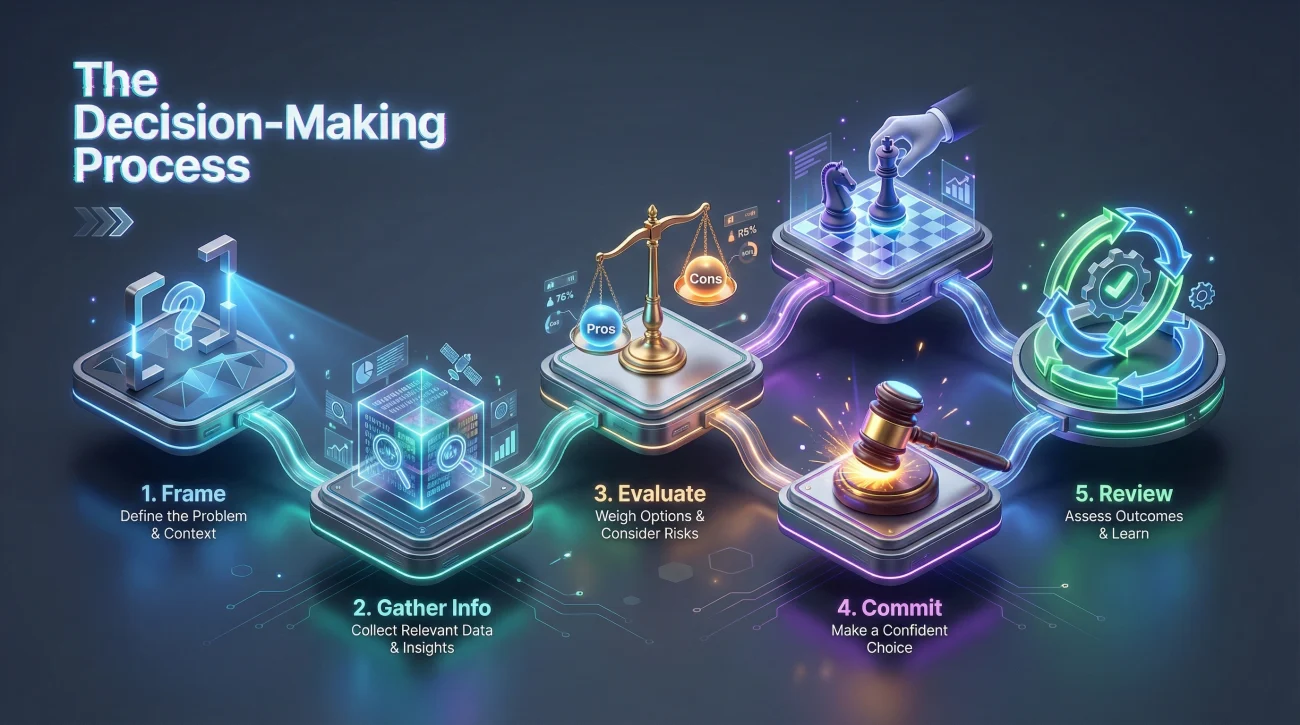
Frame the Decision Clearly
What exactly needs to be decided? What are the real options? Often, difficulty comes from unclear framing. Time spent clarifying the actual decision makes subsequent steps more productive.
Gather Relevant Information
What data exists? What perspectives should be consulted? What don’t you know that matters? Avoid analysis paralysis, but don’t decide without sufficient information. The judgment is knowing how much information is “enough” given timing constraints.
Evaluate Options Against Criteria
What matters most? How does each option perform against your priorities? Make tradeoffs explicit rather than implicit. Document your reasoning, both for accountability and for learning.
Make the Call and Commit
Decide when you have enough information, not when you have all information. Communicate the decision clearly. Take responsibility. Avoid the trap of endless deliberation that avoids commitment.
Review and Learn
After outcomes become clear, assess what worked and what didn’t. Would you decide differently with what you now know? Use learning to improve future decision-making.
For more on demonstrating leadership capabilities, see our comprehensive behavioral interview guide.
Structuring Your Answer
Sample Answer Structure
“The most difficult decision I made was [brief description of the decision context]. What made it difficult was [specific characteristics: incomplete information, competing priorities, significant stakes, ethical dimension].”
“My process was [describe how you gathered information, evaluated options, consulted stakeholders]. I ultimately decided to [describe the choice] because [specific reasoning].”
“The outcome was [what happened]. Looking back, I would [confirm the decision was right or explain what you learned]. This experience taught me [insight about decision-making].”
Keep the story focused on your reasoning process. Interviewers care more about how you think than whether any particular decision worked out.
❓ FAQ
🎯 What if my difficult decision had a bad outcome?
Bad outcomes don’t disqualify a story if your reasoning was sound. Explain what you learned and what you would do differently with hindsight. Demonstrating learning from mistakes can be as valuable as showcasing successes. However, choose success stories when possible for this particular question.
💼 How personal should the decision be?
Focus on professional decisions unless specifically asked about personal ones. Business decisions demonstrate judgment relevant to the role. Personal decisions may be appropriate for questions about character or values, but keep them professional-context relevant.
⏰ Should I describe decisions I made alone or collaboratively?
Either works. For collaborative decisions, be clear about your specific contribution to the process. Good leaders consult others; that’s not weakness. But you should be able to articulate the reasoning behind the ultimate choice and take ownership of it.
📋 What if I’m early in my career and haven’t made major decisions?
Scale the story to your experience level. A difficult decision for someone early in career might involve project tradeoffs, resource allocation within a team, or how to handle a challenging situation. The principles of good decision-making apply regardless of scope.
✨ How long should this answer be?
Two to three minutes is typical. Spend time proportionally: brief context, moderate time on reasoning process, clear outcome, and reflection. Don’t rush the reasoning section, as that’s what interviewers most want to understand.
Decisions Define Leaders
Answering questions about making a difficult decision effectively means showing your judgment process under pressure. Choose a decision with genuine difficulty: uncertainty, competing priorities, significant stakes, or ethical dimensions. Walk through your reasoning: how you gathered information, evaluated options, and reached your conclusion. Take responsibility for outcomes while demonstrating learning. Leaders are defined by their decisions. Your answer shows interviewers how you’ll handle the difficult calls their organization will inevitably require.
⚠️ Disclaimer: The interview strategies, sample answers, and negotiation tips provided in this guide are for educational purposes only. Hiring decisions are subjective and vary by company and industry. While these strategies are based on professional HR standards, they do not guarantee a specific job offer or result.