

The Bottleneck Problem
The most talented individual contributor I ever hired nearly destroyed his team within six months of becoming their manager. His technical skills were exceptional. His delegation skills were nonexistent. Every decision flowed through him. Every deliverable required his review. Every problem waited for his attention.
His team stopped growing because he did everything himself. Projects slowed because he was the bottleneck for every task. His own development stalled because he had no capacity for strategic work. Eventually, two strong performers left for opportunities where they could actually grow. The situation only improved after executive coaching focused specifically on delegating tasks as a core leadership capability.
This pattern is remarkably common. Many new managers were promoted because they excelled at individual work. Nobody taught them that leadership success requires enabling others to do excellent work. When interviewers ask about delegation, they’re evaluating whether you can make this critical transition from doing to enabling.
Why Smart Leaders Struggle to Delegate
Understanding the psychological barriers to delegation helps you address them honestly in interviews. These barriers affect most new leaders and persist for some throughout their careers.
The Quality Concern
“I can do it better myself” is technically true for many tasks, especially early in your leadership career. You probably can produce higher quality work in areas where you have deep expertise. But this thinking misses two critical points: your job is no longer just quality work in your functional area, and your team will never develop if they never get opportunities.
A manager’s job is multiplying capability across the team, not maximizing personal output. Accepting eighty percent quality from a developing team member while investing in coaching them to improve serves your organization better than doing everything yourself at one hundred percent.
The Speed Concern
“It’s faster to do it myself than to explain it” is often true for any individual task. Teaching someone takes longer than doing. But this calculation ignores repetition. Yes, explaining takes longer once. But if you keep doing that task forever, you’ve made a terrible efficiency trade. The time investment in delegation pays returns every time someone else handles that work in the future.
The Control Concern
Some leaders struggle with delegation because releasing control feels uncomfortable. They built their identity and success on personal competence. Trusting others with important work requires tolerating uncertainty about outcomes. This discomfort is real but must be managed. Leadership inherently involves achieving results through others, which requires giving up some control.
The Identity Concern
“This is what I’m good at” can trap leaders in work they should delegate. Your identity may be built around being the technical expert or the person who handles the hard problems. Delegating that work can feel like losing what made you valuable. But your value has changed. You’re now valuable for developing a team that can handle hard problems, not for solving them all yourself.
| Barrier | What You Tell Yourself | The Reframe |
|---|---|---|
| Quality | “I can do it better” | “My job is building team capability, not personal output” |
| Speed | “It’s faster myself” | “Time invested now saves time forever” |
| Control | “I need to make sure it’s right” | “Leadership requires trusting others” |
| Identity | “This is what I’m good at” | “My value is now in enabling others” |
The Four-Step Delegation Process
Effective delegation follows a structured approach that maximizes success probability while developing team members. This framework turns delegation from an uncomfortable necessity into a powerful development tool.
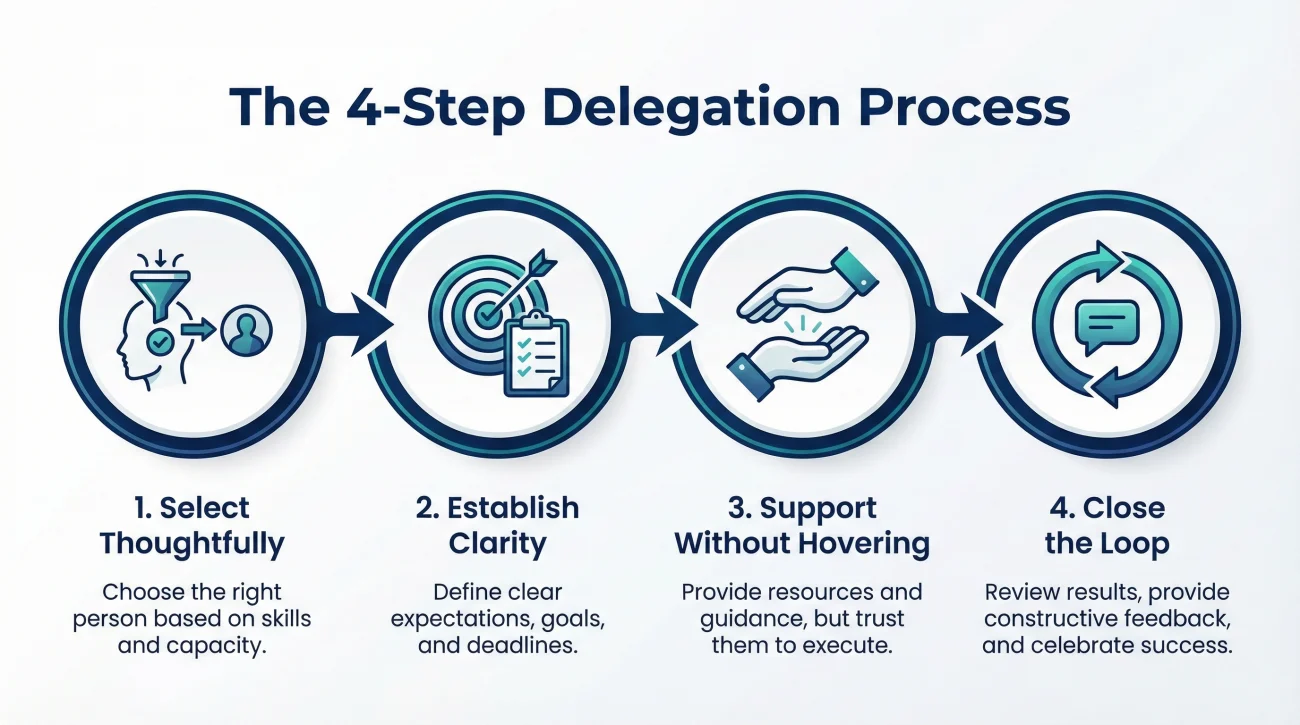
Step One: Select Thoughtfully
Choosing the right person for each delegation involves weighing capability, capacity, and development opportunity. Consider:
- Who has the skills or adjacent skills to succeed with appropriate support?
- Who has capacity to take this on without sacrificing other commitments?
- Who would benefit most from the growth opportunity this represents?
- Where does this fit in someone’s development trajectory?
Avoid always delegating to the same reliable person. This overloads your strongest performers while denying development opportunities to others. Spread delegation strategically to build capability across your team.
Step Two: Establish Absolute Clarity
Most delegation failures trace back to unclear expectations at the start. Before delegating, ensure alignment on:
- 🎯 Success criteria: What specific outcomes define success?
- ⏰ Timeline: When is this needed and are there intermediate milestones?
- 🔧 Resources: What budget, tools, or support is available?
- 🚦 Authority: What decisions can they make independently versus requiring your input?
- 📊 Reporting: How and when will you stay informed of progress?
Invest time upfront in this clarity conversation. It feels slower initially but prevents misalignment that wastes far more time later.
Step Three: Support Without Hovering
The space between delegation and completion is where many leaders fail. Some disappear entirely, leaving delegated work unsupported. Others hover constantly, undermining the autonomy that makes delegation developmental. Neither extreme works.
Effective support means:
- Scheduling check-in points in advance rather than checking randomly
- Being available for questions without initiating constant contact
- Removing obstacles when they arise
- Providing coaching when someone is stuck
- Resisting the urge to take back work when it’s not progressing exactly as you would do it
Taking back delegated work damages trust and teaches your team that you don’t actually mean it when you delegate. Reserve takeback for genuine emergencies, not discomfort with different approaches.
Step Four: Close the Loop
Delegation isn’t complete when the work is done. Close the loop by reviewing outcomes together, acknowledging success, discussing what could improve, and connecting the experience to future development. This conversation transforms delegation from task distribution into intentional growth.
Questions for closing conversations:
- “What went well that you want to repeat?”
- “What was harder than expected?”
- “What would you do differently next time?”
- “What support from me would have helped?”
- “What skills did this help you develop?”
Delegation Stories That Demonstrate Growth
The Project That Taught Me to Let Go
Early in my management career, I delegated a client presentation to a senior analyst while staying heavily involved in every detail. I reviewed every slide multiple times, rewrote sections she had written, and insisted on attending the rehearsals to give feedback. I thought I was being supportive.
The presentation went fine, but my analyst was demoralized. She told me later: “I never felt like it was my presentation. You assigned it to me but then did most of the work yourself. I didn’t learn anything because you didn’t actually let me own it.”
That feedback changed how I delegate. I learned that true delegation means genuinely transferring ownership, not just assigning tasks while retaining control. It means accepting that someone might do things differently than you would, and that different isn’t necessarily worse.
Delegation as Development Strategy
I now think of delegation primarily as my most powerful development tool. Every task I delegate is an opportunity for someone to grow. I match assignments deliberately to development goals, not just to whoever has capacity.
One of my engineers wanted to develop client-facing skills. I started delegating client interactions that I would normally handle myself, beginning with low-stakes meetings and progressing to more significant ones as she built confidence. Another wanted deeper technical challenges. I delegated architectural decisions I could have made myself, providing coaching while letting him own the outcomes.
Both of these people have been promoted since, partly because delegation gave them stretch experiences they couldn’t have gotten if I kept doing everything myself.
Mindset shift: When you see delegation primarily as task distribution, you delegate reluctantly. When you see it primarily as team development, you delegate strategically and generously.
What to Keep and What to Delegate
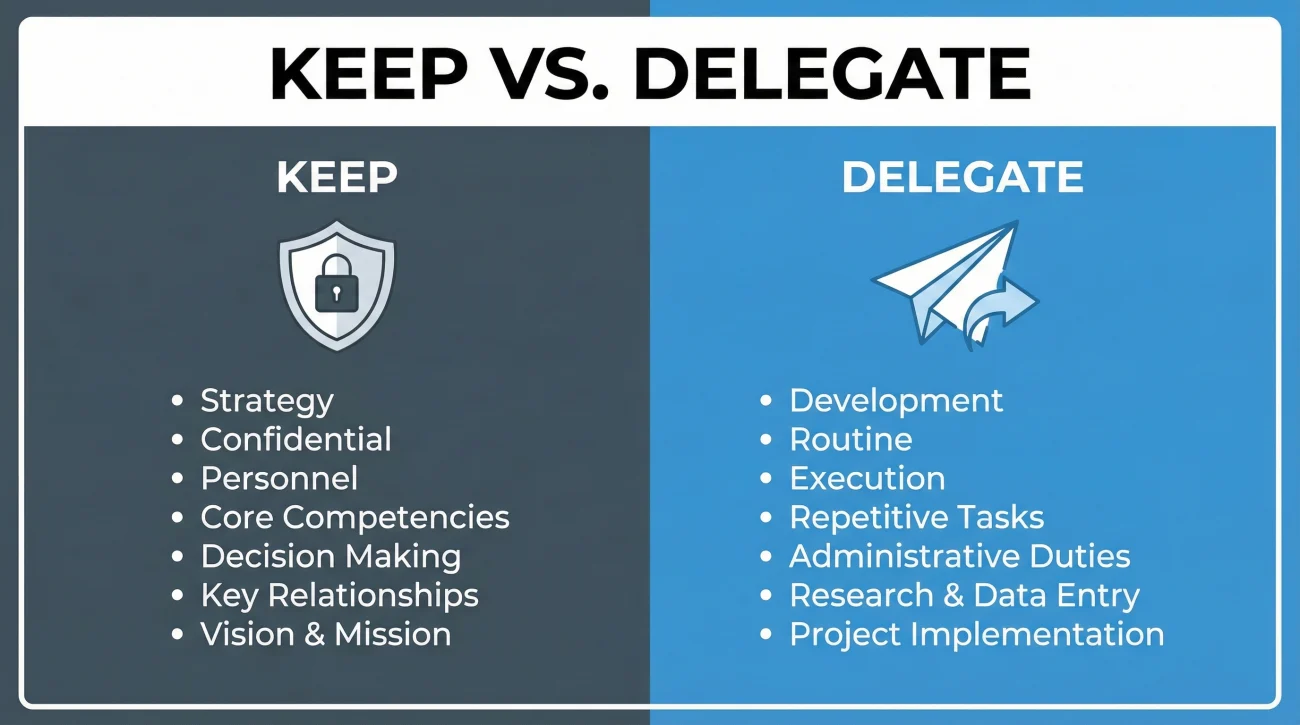
Not everything should be delegated. Understanding the boundaries helps you apply this effective delegation process appropriately.
Generally Keep
- Personnel decisions affecting team members’ careers
- Confidential matters requiring your specific authority
- Final accountability for critical commitments to leadership
- Relationship building with key stakeholders that requires your level
- Strategic decisions that shape team direction
Generally Delegate
- Tasks that develop team members’ capabilities
- Work that others could do with appropriate support
- Decisions that are reversible and learning opportunities
- Operational execution once direction is clear
- Anything that creates bottlenecks when it stays with you
For more frameworks on leadership development, explore our complete guide to behavioral interview questions.
❓ FAQ
🎯 What if someone fails at a delegated task?
Failure is a learning opportunity if handled well. Discuss what happened without blame, identify what would prevent it next time, and adjust your support approach for future delegations. Some failure is inevitable when stretching people. The question is whether you create conditions for productive failure that builds capability rather than destructive failure that damages confidence.
💼 How do I delegate when I genuinely can do it faster myself?
Remember that you’re optimizing for team capability, not personal efficiency. Yes, it’s faster now to do it yourself. But if you do it yourself forever, you’ve made a terrible long-term trade. The time invested in delegation compounds through all future instances when someone else handles that work.
⏰ What tasks should I never delegate?
Keep tasks requiring your specific authority, confidential personnel matters, final accountability for critical commitments, and strategic decisions that shape team direction. Most other tasks can be delegated appropriately with the right selection, clarity, and support.
📋 How do I avoid becoming a bottleneck while staying informed?
Schedule regular check-ins rather than ad-hoc checking. Define clearly what decisions require your input versus what can proceed autonomously. Create systems for visibility that don’t require constant communication. Trust your setup and resist the urge to intervene between scheduled touchpoints.
✨ How do I delegate to someone more experienced than me in that area?
Focus on outcomes and constraints rather than methods. Experienced people need less direction about how to do work but still need clarity about what success looks like and what boundaries exist. Leverage their expertise by giving them room to apply it rather than trying to direct it.
Delegation Is Leadership
Answering questions about delegating tasks effectively means showing you understand that leadership success comes through enabling others, not doing everything yourself. Describe the barriers you’ve overcome, the process you follow, and the development outcomes you’ve achieved. When interviewers see someone who delegates strategically as a growth mechanism rather than reluctantly as task distribution, they see someone ready to scale their leadership impact.
⚠️ Disclaimer: The interview strategies, sample answers, and negotiation tips provided in this guide are for educational purposes only. Hiring decisions are subjective and vary by company and industry. While these strategies are based on professional HR standards, they do not guarantee a specific job offer or result.