

The Leadership Multiplier
A director I worked with had an unusual metric on her wall: “Seventeen promotions.” Not her own career moves, but the number of people she had developed who went on to be promoted during or after working with her. When I asked about it, she said: “My individual contribution has natural limits. The people I develop continue contributing long after our work together ends. That’s how you multiply your impact.”
When interviewers ask about mentoring someone, they’re evaluating whether you think this way. Do you see developing others as core to leadership, or as a nice extra when you have time? Leaders who prioritize people development build stronger teams, retain top talent, and create organizational capability that outlasts any individual contributor.
This question also reveals character. Candidates who light up when discussing someone else’s growth demonstrate the orientation that makes great managers. Candidates who struggle to recall development examples often prioritize personal achievement over enabling others. Your answer tells interviewers which type you are.
Mentoring vs Managing vs Coaching
Before crafting your answer, understand the distinctions interviewers may be probing:
| Activity | Focus | Relationship | Timeframe |
|---|---|---|---|
| Managing | Performance and results | Formal authority | Ongoing, role-based |
| Coaching | Specific skill development | Can be any relationship | Targeted, time-limited |
| Mentoring | Broader career and growth | Often informal, chosen | Extended, relationship-based |
The best mentoring answers demonstrate all three dimensions: specific skill coaching, performance guidance, and broader career development. Even if the question uses “mentoring” specifically, show that you understand development happens through multiple approaches.
Mentoring Stories That Demonstrate Real Impact
Turning Around an Underperformer
My most meaningful mentoring experience involved an analyst named Marcus who was on the verge of being fired. His work was consistently late, error-prone, and required heavy revision. Previous managers had documented his issues but hadn’t invested in understanding or addressing root causes. HR was preparing a performance improvement plan that everyone expected to lead to termination.
I asked for ninety days to work with him before starting the formal process. I suspected his performance issues might have causes beyond capability, and I wanted to understand before we acted.
In our first few conversations, I discovered that Marcus was overwhelmed by unclear expectations and terrified of asking questions. His previous managers gave vague assignments and then criticized results. He had developed a pattern of avoidance: delaying work he wasn’t sure about, then rushing at the last minute and making errors. Fear was driving failure more than lack of ability.
I restructured how I worked with him. For every assignment, I provided explicit success criteria: what “done” looked like, what quality meant specifically, what the timeline was. I scheduled brief daily check-ins where he could ask questions without feeling like he was admitting weakness. I gave feedback immediately after reviewing work rather than accumulating criticisms for formal reviews.
The change took about six weeks to become visible. His work started coming in on time. Quality improved because he understood expectations and could ask for clarification without shame. Within three months, his performance was above average. Within a year, he was training new analysts himself. He’s now a senior analyst at another company, and he still sends me thank-you notes occasionally.
This story demonstrates investing in someone others had given up on, diagnosing root causes rather than assuming deficiency, and creating specific conditions for success.
Developing a High Performer for Promotion
Not all mentoring involves struggling performers. I mentored a talented engineer named Priya who was technically excellent but kept being passed over for leadership roles. She was frustrated and considering leaving for a company that would “recognize her contributions.”
I observed that Priya’s technical skills were clearly senior-level, but her visibility and communication weren’t. She did great work but didn’t communicate impact to leadership. She solved problems but didn’t bring others along in her thinking. She had strong opinions but expressed them in ways that felt dismissive to colleagues.
We created a development plan together. I found opportunities for her to present technical decisions to leadership, coaching her on executive communication beforehand and giving feedback afterward. I helped her reframe strong opinions as proposals for discussion rather than declarations. I encouraged her to document and share her problem-solving process, not just solutions.
The shift in perception was gradual but significant. Leadership started seeing her as a potential team lead rather than just a technical expert. Colleagues started describing her as “thoughtful” rather than “difficult.” She was promoted to senior engineer within a year and became a team lead the following year.
What made the difference wasn’t developing new skills. It was helping her see how existing capabilities were being perceived and adjust her approach accordingly.
Peer Mentoring Without Authority
Mentoring doesn’t require being someone’s manager. Early in my career, I mentored a colleague who joined our team during a chaotic period. Sarah had strong skills but was struggling to navigate our complex organization. Nobody had capacity to properly onboard her, and she was drowning in unwritten rules she didn’t understand.
I started having weekly coffee conversations where she could ask questions without judgment. I introduced her to key people across the organization. I explained decision-making dynamics that weren’t documented anywhere: who actually had influence, which processes were mandatory versus just traditional, how to get things approved efficiently.
Within three months, Sarah was operating as effectively as people who had been at the company for years. She later told me that our mentoring relationship was the difference between staying and leaving. She ended up being promoted before I was, which I consider one of my proudest outcomes.
Key principle: The best mentoring often involves sharing knowledge that isn’t written down anywhere: organizational navigation, unspoken expectations, how things really work. This contextual knowledge can be as valuable as skill development.
Elements of Effective Mentoring
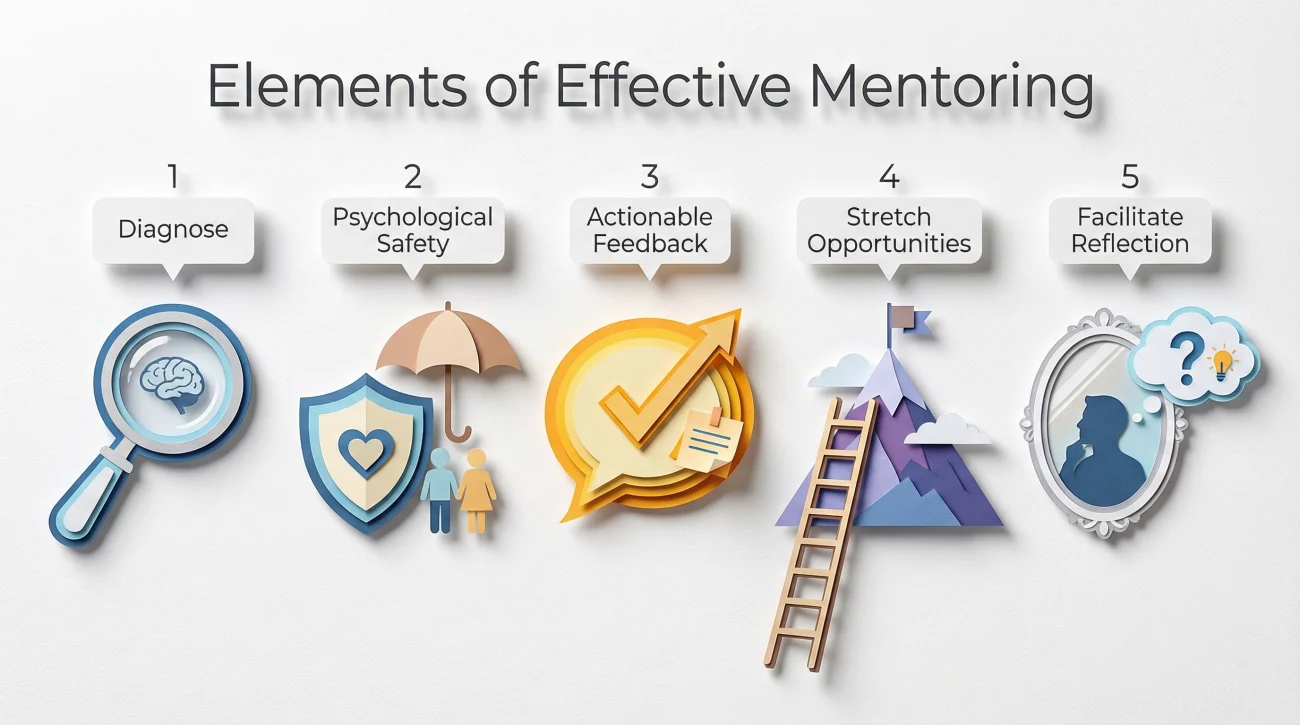
Diagnose Before Prescribing
Effective mentors understand what someone actually needs rather than applying generic advice. This requires asking questions, observing patterns, and understanding root causes. What looks like a skill gap might actually be a confidence issue, a clarity issue, or an environmental obstacle.
Create Psychological Safety
People develop best when they can take risks without fear of judgment. Mentors create environments where questions are welcomed, mistakes become learning opportunities, and vulnerability feels safe. This often means being explicit: “There are no stupid questions here” or “Mistakes are expected when you’re learning.”
Provide Specific, Actionable Feedback
Vague feedback like “be more confident” or “communicate better” is useless. Effective mentoring feedback is specific and actionable: “In that meeting, you qualified your recommendation three times before stating it. Next time, lead with your conclusion and let your analysis support it.”
Create Stretch Opportunities
Growth happens through challenge. Mentors create opportunities for mentees to practice new skills, take on stretch assignments, and build confidence through progressive success. This often means advocating for opportunities the mentee might not receive otherwise.
Facilitate Reflection
Much development happens through reflecting on experience rather than just having it. Mentors ask questions that prompt insight: “What worked well? What would you do differently? What did you learn about yourself?” These conversations turn experiences into transferable learning.
For more on demonstrating people development skills, explore our interview success strategies.
Structuring Your Mentoring Answer
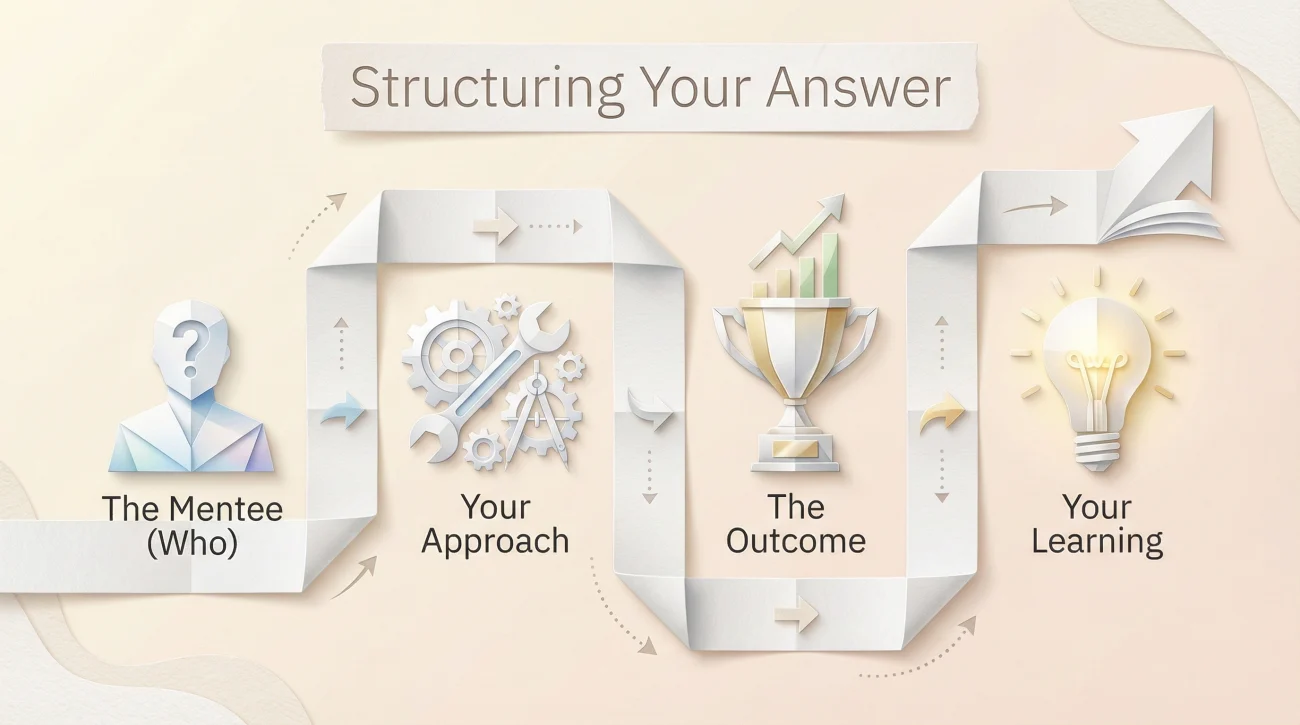
Describe Who You Mentored and Context
Briefly introduce the person and situation. What was their role? What brought you into a mentoring relationship? What challenges or opportunities were they facing?
Explain Your Approach
What did you specifically do to develop this person? How did you diagnose their needs? What development activities did you create or facilitate? How did you adapt to their individual situation?
Share the Outcome
What changed as a result of your mentoring? Use concrete evidence: promotions, improved performance, new capabilities, career progression, feedback they shared. Connect outcomes directly to your mentoring actions.
Reflect on What You Learned
Great mentoring answers often include what the experience taught you about developing others. This demonstrates continuous improvement in your own mentoring capability.
❓ FAQ
🎯 What if I’ve never been a formal mentor?
Mentoring happens informally constantly. Have you helped a colleague learn something? Guided someone through a challenge? Onboarded a new hire? Shared knowledge that helped someone succeed? These are all mentoring stories worth telling.
💼 Should I mention mentoring that didn’t work out?
For this question, choose a success story. If asked specifically about mentoring challenges, you can discuss difficulties while demonstrating learning. But lead with a positive outcome that proves your development capability.
⏰ How do I show mentoring impact without taking credit for their success?
Focus on what you did to create conditions for their growth. The person developed themselves; you enabled and supported that development. Language like “I helped create opportunities for her to develop” acknowledges both your role and their agency.
📋 Is peer mentoring as valuable as mentoring direct reports?
Absolutely. Peer mentoring demonstrates development capability without relying on positional authority. Some interviewers specifically value it because it shows you develop others by choice, not just because it’s part of your job description.
✨ How recent should my mentoring example be?
Recent examples within three to five years are ideal. Very old examples may suggest you haven’t prioritized development recently. If your best story is older, connect it to how you’ve continued developing others since.
Develop Others, Multiply Impact
Answering questions about mentoring someone effectively means showing you see people development as core to leadership. Choose a story that demonstrates real investment in another person’s growth. Describe your specific approach: how you diagnosed needs, created development opportunities, provided feedback, and enabled success. Connect your mentoring to concrete outcomes for the person you developed. Leaders who genuinely care about others’ growth attract and retain talent, build stronger teams, and create impact that extends far beyond their individual contributions.
⚠️ Disclaimer: The interview strategies, sample answers, and negotiation tips provided in this guide are for educational purposes only. Hiring decisions are subjective and vary by company and industry. While these strategies are based on professional HR standards, they do not guarantee a specific job offer or result.