
The Visibility Problem
A manager I coached struggled after her team went fully remote. “I don’t know what anyone is doing anymore,” she told me. “When we were in the office, I could see people working. Now I just have to trust that things are happening.” She was considering implementing time tracking and screen monitoring software.
I asked her a question that changed her perspective: “When you saw people at their desks, did you actually know what they were doing? Or did you just feel like you knew?” She paused. “I guess I just felt like I knew.” That realization was the beginning of better managing remote teams practices.
Remote leadership isn’t harder than in-person leadership. It’s different. The practices that create visibility, connection, and accountability must be intentional rather than incidental. You can’t rely on hallway conversations, casual observation, or proximity-based relationships. Everything you want to happen must be designed into your systems and rhythms.
Output Over Hours: The Remote Leadership Mindset
The fundamental shift in remote team leadership is measuring output rather than activity. In an office, presence can masquerade as productivity. Remote work strips away that illusion, which is actually a gift if you embrace it.
Define What Done Looks Like
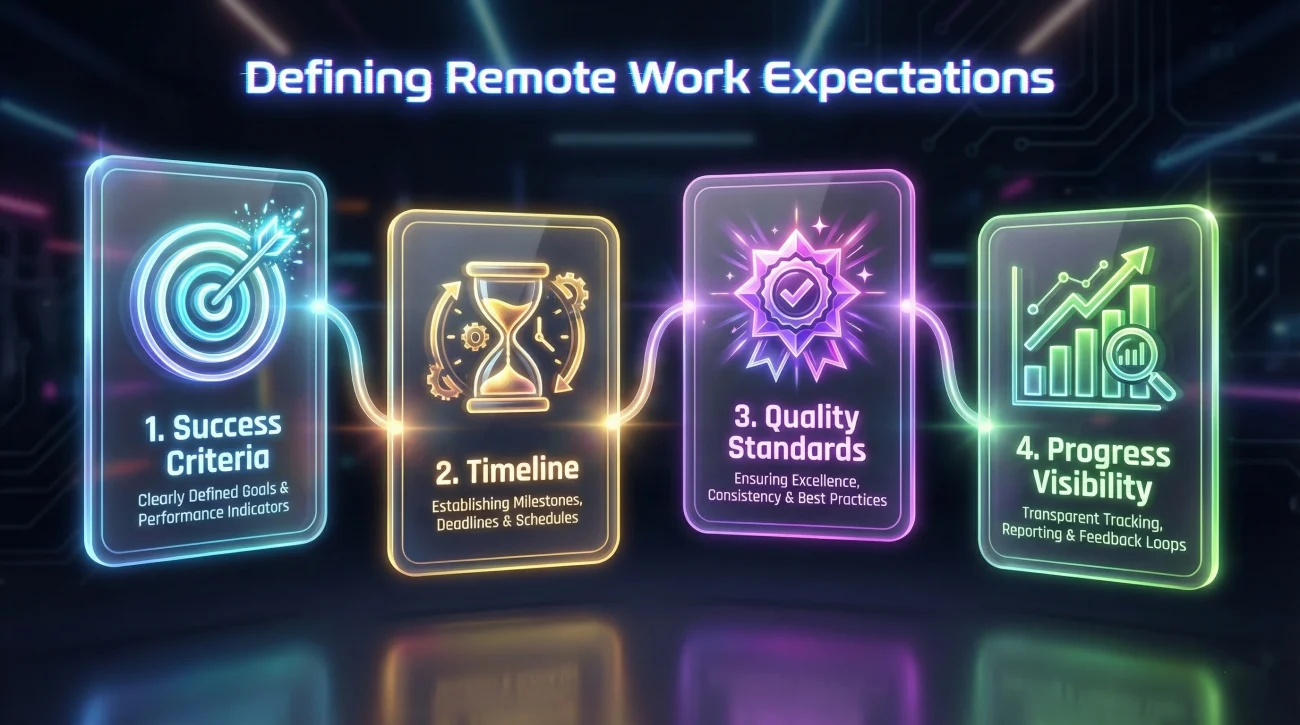
Remote teams need explicit clarity about expectations because you can’t monitor progress through observation. For every significant project or deliverable, establish:
- 🎯 Success criteria: What specifically constitutes completion?
- ⏰ Timeline: When is it due, and what are intermediate milestones?
- 📊 Quality standards: What level of quality is expected?
- 🔄 Progress visibility: How will we track progress between now and completion?
This clarity investment pays dividends because it reduces ambiguity that leads to misaligned work and prevents the need for constant check-ins that feel like micromanagement.
Trust Until Given Reason Not To
Remote leadership requires default trust. Assume people are working productively unless outcomes suggest otherwise. Surveillance signals distrust and damages engagement. The employees most likely to leave when monitored heavily are usually your best performers, the ones with the most options.
If someone consistently misses deadlines or delivers poor quality work, address that performance issue directly. But don’t implement surveillance systems that treat everyone as suspects because of one person’s issues.
Research insight: Studies consistently show that employee monitoring correlates with decreased engagement, increased turnover, and no measurable improvement in productivity. Trust-based management produces better outcomes than surveillance.
Communication Architecture for Distributed Teams
Remote teams need intentional communication systems that replace the incidental communication that happens naturally in offices. Design these systems deliberately rather than letting them emerge haphazardly.
Synchronous Communication: Less but Better
Meetings should be fewer and more purposeful in remote contexts. Every meeting should have a clear purpose, defined outcomes, and be the right format for that purpose.
| Meeting Type | Purpose | Typical Frequency | Key Practices |
|---|---|---|---|
| Team standup | Progress visibility, blocker identification | Daily or several times weekly | Time-boxed, structured format, async option for updates |
| One-on-ones | Relationship, coaching, feedback | Weekly | Never cancel, agenda owned by report, video on |
| Team planning | Alignment, priority setting | Weekly or biweekly | Pre-work distributed, decisions documented |
| Retrospective | Process improvement, team health | Biweekly or monthly | Safe space, anonymous input option, action items tracked |
Asynchronous Communication: The Remote Superpower
Asynchronous communication is the underutilized advantage of remote work. When done well, async communication reduces meeting overload, creates documentation naturally, enables deep work, and accommodates different schedules and time zones.
Effective async communication requires:
- Clear channels: Where do different types of communication belong?
- Response time expectations: What’s the expected turnaround for different message types?
- Complete context: Messages should include enough information for people to respond without back-and-forth
- Documentation culture: Important decisions and discussions should be captured in persistent places
Overcommunicate Context
In offices, context travels through observation and overheard conversations. Remote teams need explicit context-sharing that would feel excessive in person. Share strategy updates, leadership decisions, company news, and team changes more frequently and more explicitly than you think necessary.
A good test: if you’ve said something once, you’ve probably communicated it to about a third of your team. Say important things multiple times through multiple channels.
Building Culture Across Distance
Remote culture doesn’t happen accidentally. The water cooler conversations, lunch outings, and casual connections that build in-person culture require intentional substitutes in virtual team management.
Create Connection Opportunities
Schedule non-work interactions deliberately:
- Virtual coffee chats: Random pairing for informal conversation
- Team social time: Optional but protected time for non-work discussion
- Celebration moments: Acknowledge birthdays, milestones, achievements
- Interest channels: Spaces for hobbies, pets, families, shared interests
These shouldn’t feel forced, but they need to be created. Without intentional spaces for human connection, relationships become purely transactional.
Invest Heavily in Onboarding
Remote onboarding requires more structure than in-person onboarding. New hires can’t absorb culture through observation or build relationships through proximity. Design onboarding that explicitly teaches culture, creates relationship-building opportunities, and provides clear paths to productivity.
Assign onboarding buddies. Schedule introduction calls with key collaborators. Create explicit documentation of unwritten norms. Check in more frequently during the first months. The investment pays off in faster productivity and better retention.
Make Work Visible
Remote teams benefit from visibility systems that make progress tangible:
- Shared project boards showing status and ownership
- Regular demo sessions where people show work in progress
- Written updates summarizing accomplishments
- Recognition channels where achievements are celebrated publicly
Visibility serves both accountability and recognition. When people can see what others are accomplishing, it motivates contribution and creates appreciation for colleagues’ work.
Employee Isolation
Some team members thrive remotely; others struggle with isolation. Watch for signs: decreased engagement, withdrawal from optional interactions, quality changes, missed deadlines. Address concerns directly in one-on-ones and adjust support as needed.
Some solutions: increased one-on-one frequency, collaboration opportunities, optional coworking stipends, team gatherings if geography allows.
Time Zone Coordination
Distributed teams across time zones require thoughtful scheduling. Rotate meeting times so the same people don’t always take inconvenient hours. Leverage async communication to reduce synchronous requirements. Record important meetings for those who can’t attend live.
Performance Issues
Address performance concerns directly rather than assuming they’re caused by remote work. Clear expectations, regular feedback, and documented conversations apply regardless of location. Remote work can expose performance issues that were hidden in office environments, but the solution is performance management, not surveillance.
For additional strategies on demonstrating leadership capabilities, explore our interview answer examples.
Sample Interview Answers
Communication-Focused Answer
“My approach to managing remote teams centers on intentional communication systems. I establish clear channels for different types of communication, set response time expectations, and overcommunicate context that would travel naturally in an office. I run fewer but more purposeful meetings, leverage async communication for updates and non-urgent discussions, and create documentation habits that keep everyone informed without constant synchronous contact. The key is designing systems rather than relying on proximity.”
Trust-Focused Answer
“I manage remote teams by focusing on outcomes rather than activity. I establish clear expectations for deliverables, set visible milestones, and trust people to manage their own time and approach. I avoid surveillance tools because they signal distrust and drive away top performers. If someone consistently misses expectations, I address that as a performance conversation, not a remote work problem. This approach has consistently produced high engagement and strong results across distributed teams I’ve led.”
❓ FAQ
🎯 How do I know if remote employees are actually working?
You know by whether they deliver results, not by whether you can see them. Define clear expectations, track output through visible systems, and trust competent adults to manage their time. If output is satisfactory, working hours are irrelevant. If output is unsatisfactory, address that directly.
💼 How do I build team culture remotely?
Create intentional spaces for connection that would happen naturally in offices: virtual social events, interest-based channels, celebration moments, random coffee pairing. Invest in onboarding that explicitly teaches culture. Make work visible so people appreciate colleagues’ contributions.
⏰ How many meetings should remote teams have?
Fewer but more purposeful than you might think. Leverage async communication to reduce synchronous requirements. Each meeting should have clear purpose and defined outcomes. Protect blocks for deep work. The right number depends on the team, but err toward fewer meetings with better async systems.
📋 Should I require cameras on during meetings?
Consider making it default-on for relational meetings like one-on-ones and team discussions, but flexible for informational meetings. Forcing cameras constantly creates fatigue. The goal is human connection, not surveillance. Discuss norms with your team and find what works for your context.
✨ How do I manage across multiple time zones?
Rotate meeting times so the same people don’t always take inconvenient hours. Maximize async communication to reduce synchronous requirements. Record important meetings. Create overlapping core hours when possible. Be explicit about expectations for response times across zones.
Design for Distance
Answering questions about managing remote teams effectively means showing you understand that remote leadership requires intentional design. Describe how you create visibility through output focus rather than activity monitoring. Explain your communication architecture: the balance of synchronous and asynchronous, the rhythms of connection, the documentation practices that keep everyone informed. Show how you build culture deliberately rather than relying on proximity. Leaders who thrive remotely design systems for what offices provide accidentally. That intentional approach creates teams that outperform regardless of location.
⚠️ Disclaimer: The interview strategies, sample answers, and negotiation tips provided in this guide are for educational purposes only. Hiring decisions are subjective and vary by company and industry. While these strategies are based on professional HR standards, they do not guarantee a specific job offer or result.