What Onboarding Specialist Interviews Test
Onboarding specialist interview questions focus on whether you can turn a signed offer into a confident, productive employee who wants to stay. A great onboarding specialist designs the journey before Day 1, removes friction in the first week, and makes managers actually do their part. Your interview needs to show both systems thinking and real empathy.
In this guide, you will cover pre-boarding, the first 30-60-90 days, cultural integration, and the metrics that prove your program works. Speak in concrete moments: what you send, what you schedule, what you track, and how you adjust when something breaks.
Designing the Onboarding Journey
Onboarding is a product, and the new hire is the customer. Interviewers want to know if you can design a user-centric experience.
Q: What is the difference between Orientation and Onboarding?
Orientation is an event; Onboarding is a process. Orientation is the “Day 1” logistics: badge, laptop, benefits paperwork, and a compliance overview. It answers “Where do I sit?” Onboarding is a multi-month journey of integration. It includes role-specific training, cultural immersion, building a social network, and understanding performance expectations. Orientation gets them compliant; Onboarding gets them productive and committed.
Q: Describe your strategy for “Pre-boarding” (the time between offer acceptance and start date).
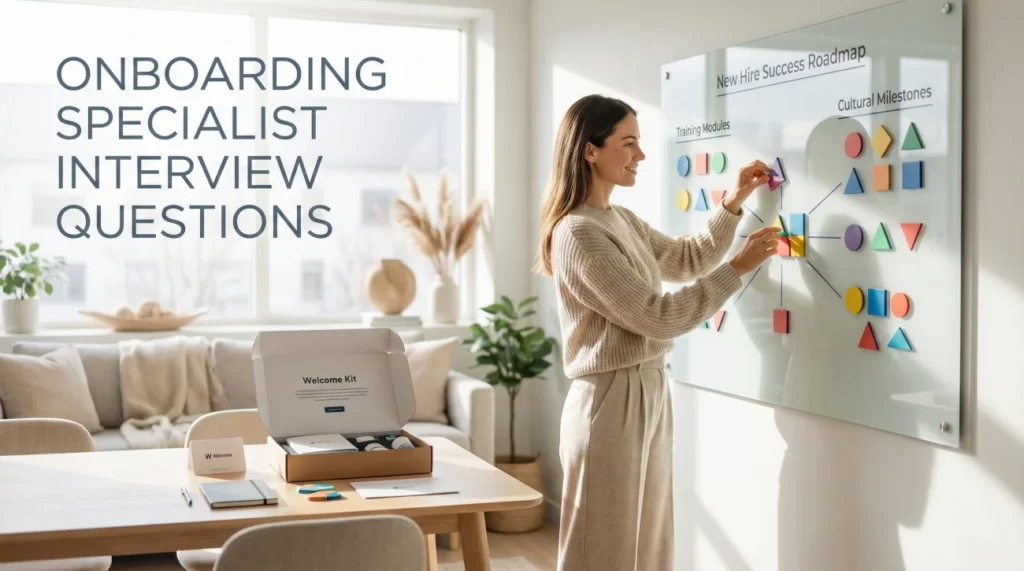
The period between signing and starting is a vulnerable window for counter-offers and drop-off. My strategy is high-touch engagement. I send a “Welcome Box” (swag) to their home quickly. I have the hiring manager send a personal welcome video. I grant access to a “New Hire Portal” where they can complete tedious paperwork before Day 1, so their first day is about celebration, not administration. This builds excitement and reinforces their decision to join.
Q: How do you structure the “First 90 Days” plan?
I use a staged framework for the first few months. Early stage (Learn): Focus on soaking up information, meeting key stakeholders, and understanding the product/culture. Success looks like completing training modules. Middle stage (Contribute): Start taking on small projects with guidance. Success looks like shipping their first task. Later stage (Own): Operate independently and suggest improvements. Success looks like full role proficiency. I ensure there are check-in milestones at each stage to course-correct if needed.
Q: How do you customize onboarding for different roles (e.g., Sales vs. Engineering)?
While the “Company Core” (Culture, HR, Benefits) is the same for everyone, the functional track must differ. For Sales, I focus heavily on product knowledge, pitch certification, and shadow calls. For Engineering, I focus on the tech stack setup, code repository access, and a “first commit” buddy system. I partner with department heads to build these specific tracks because a generic “one size fits all” approach leaves technical hires frustrated and unproductive.
Cultural Integration & Belonging
If a new hire feels lonely, they leave. You need to show you can engineer social connection.
Q: How do you create a sense of belonging for remote new hires?
Remote isolation can hurt retention. I combat this by manufacturing serendipity. I set up “Virtual Coffee Roulettes” where new hires are randomly paired with veterans for non-work chats. I create a dedicated Slack channel for each “New Hire Cohort” so they can bond and ask “dumb questions” safely together. I also ensure their manager announces their arrival with a personal bio (hobbies, pets), not just a job title, to give colleagues conversation starters.
Q: What makes a successful “Buddy Program”?
A Buddy is different from a Mentor or Manager. A Buddy is a peer who answers the “cultural” questions: “Where do we get lunch? Is it okay to wear jeans? How do I use the printer?” Success requires structure. I select high-performing, culturally aligned employees to be Buddies. I provide them with a checklist (for example, a first-day welcome and a follow-up check-in soon after). I acknowledge their service in performance reviews so it is seen as a leadership opportunity, not a burden.
Q: How do you handle a new hire who is struggling to fit in?
I intervene early. If I notice a new hire is quiet in orientation or missing from social events, I reach out for a 1:1 “pulse check.” I ask open questions: “How is the pace feeling? Is the role what you expected?” Often, it is Imposter Syndrome. I normalize it: “It is okay not to know everything yet.” I might discreetly ask their Buddy to increase engagement. If it is a skills mismatch, I flag it to the manager immediately to adjust the training plan.
Manager Enablement
A common reason onboarding fails is a disengaged manager. You must prove you can coach managers to step up.
Q: A hiring manager says they are “too busy” to handle onboarding tasks. What do you do?
I use data to persuade them. I explain that poor onboarding increases turnover risk and wastes the time and cost invested in hiring. I then make it easy for the manager. I provide “Manager Toolkits” – email templates to send to the team, a First Week Schedule template, and a checklist of discussion topics. I do the heavy lifting on logistics so they can focus on the relationship.
Q: How do you ensure managers are actually having early-stage check-ins?
I automate the accountability. I set up automated triggers in our HRIS or Slack that ping the manager: “It is time for the next check-in for Sarah. Here is a template for your check-in conversation.” I require them to log a brief summary of the conversation in the system. If they miss it, I follow up personally. I frame it as “setting them up for success,” not “HR policing.”
Q: What should be covered in the “Manager’s Welcome Email” to the new hire?
This email sets the tone. It should go out shortly before the start date. It must include: 1. A warm personal welcome (“We are so excited you are joining”). 2. Logistics (Start time, dress code, parking/Zoom link). 3. A rough agenda for Day 1 so they know what to expect. 4. Contact info for any urgent questions. I provide a template, but I insist the manager customize the personal intro.
Measuring Success & ROI
How do you know your program works? You need to move beyond “surveys” to “business impact.”
Q: What metrics do you track to evaluate onboarding effectiveness?
I track a mix of leading and lagging indicators. Leading: New Hire Satisfaction Score (via an early and a follow-up survey), Training Completion Rates. Lagging: Time to Productivity (for example, how quickly a salesperson ramps to meaningful output), early turnover rate, and longer-term retention. If satisfaction is high but productivity is low, the culture is good but the training is bad. If productivity is high but retention is low, we are burning them out.
Q: How do you collect feedback from new hires?
I use a “drip survey” approach. Early survey: Focuses on logistics and welcome (“Did you get your laptop?”). First-month survey: Focuses on training and role clarity (“Do you understand your goals?”). Later survey: Focuses on culture and long-term fit (“Do you see a future here?”). I also conduct qualitative focus groups with cohorts after they have been on the job long enough to get deeper insights that surveys miss.
Behavioral Scenarios
A new hire quits soon after starting. How do you handle the post-mortem?
This is a “Quality of Hire” failure or an “Onboarding” failure. I conduct an immediate, honest Exit Interview. I ask, “Was the job different from what was described in the interview?” If yes, I work with the Recruiter to fix the job description (Realistic Job Preview). If they left because of the manager or culture, I address that with leadership. I treat early attrition as a critical defect in our process that must be root-caused to prevent a repeat.
You have a large cohort of new hires starting soon, and the system crashes at the last minute. What is your contingency plan?
I switch to manual override without letting the new hires see the panic. I have a “Offline Onboarding Kit” ready – PDFs of the handbook, printed schedules, and manual I-9 forms if needed. I communicate with the new hires via personal email if corporate email isn’t set up, reassuring them that “Tech issues happen, but we are ready for you!” I focus on the human element – welcome breakfast, team intros – which requires no technology. We can backfill the data entry later; we cannot redo the first impression.
Onboarding Specialist Quiz
Test Your Onboarding IQ
1. “Time to Productivity” measures:
- How long it takes a new hire to reach full performance
- How fast they type
- How long the orientation lasts
- How early they arrive at work
2. A “Buddy” is primarily responsible for:
- Assigning work tasks
- Social integration and answering informal cultural questions
- Evaluating performance
- Processing payroll
3. “Pre-boarding” happens:
- After the first week
- Between offer acceptance and the start date
- During the interview
- When an employee quits
4. The “90-Day Review” is crucial for:
- Firing the employee
- Assessing role fit and transitioning from onboarding to regular employment
- Giving a raise
- Planning a party
5. “Orientation” focuses on ____, while “Onboarding” focuses on ____.
- Compliance/Logistics; Integration/Performance
- Fun; Work
- Managers; Employees
- Leaving; Staying
6. Which document must be completed early in employment within the required timeframe?
- W-4
- I-9 (employer verification step)
- Direct Deposit
- Emergency Contact
7. “Early Attrition” typically refers to leaving within:
- 5 years
- The first several months to a year
- The first week only
- Retirement
8. “Job Shadowing” allows a new hire to:
- Hide in the shadows
- Observe an experienced employee performing the job duties
- Work in the dark
- Take a nap
9. “Role Clarity” prevents:
- Clear vision
- Confusion about responsibilities and overlap with other team members
- Promotions
- Hiring
10. “Swag” (branded merchandise) helps with:
- Improving code quality
- Building employer brand pride and belonging
- Saving money
- Cleaning the office
11. A “Realistic Job Preview” (RJP) during hiring helps reduce:
- The salary
- Expectation mismatch and early turnover
- The number of applicants
- Interview time
12. “Compliance Training” (e.g., Harassment prevention) should be done:
- Never
- Early in the onboarding process (often Week 1)
- After 1 year
- Only if someone complains
13. “IT Provisioning” involves:
- Buying lunch
- Setting up accounts, email, and hardware access
- Fixing the printer
- Writing code
14. “Socialization” in onboarding refers to:
- Posting on Facebook
- Helping the new hire understand the culture, values, and norms
- Talking too much
- Social distancing
15. A “Cohort” model of onboarding involves:
- Onboarding one person at a time
- Starting a group of new hires on the same day to foster community
- Hiring only friends
- Military training
16. “Imposter Syndrome” is common in new hires and is:
- A fake disease
- Feeling like a fraud or not qualified for the job despite evidence of success
- Lying on a resume
- Stealing identity
17. “Stay Interviews” are conducted to:
- Understand why employees stay and what might make them leave
- Force them to stay
- Interview for a new job
- Exit the company
18. “Knowledge Transfer” is critical when:
- Buying a book
- An experienced employee leaves or a new one joins (handovers)
- Moving desks
- Eating lunch
19. “Gamification” in onboarding can:
- Make work a joke
- Increase engagement with boring tasks (like policy reading) through points/badges
- Cost too much money
- Replace managers
20. The “Honeymoon Phase” typically ends after:
- 1 day
- the first few months (as the role becomes more real)
- 10 years
- Never
❓ FAQ
🎉 How do I explain orientation vs onboarding quickly?
Orientation is the Day 1 logistics and compliance event. Onboarding is the multi-week process that builds capability and belonging. In an interview, give one example of what happens in each so it feels real.
📦 What should pre-boarding include?
Anything that reduces Day 1 friction and builds confidence: paperwork links, first-week schedule, access requests, and a warm welcome message. Mention that pre-boarding lowers drop-off risk and makes the first day feel intentional.
🧑🤝🧑 How do I build belonging for remote hires?
Create structured connection. Talk about buddy pairing, cohort channels, short virtual coffees, and manager check-ins that are on the calendar. The goal is to prevent isolation before it becomes a retention problem.
📏 Which metrics show onboarding is working?
Use a mix: completion and satisfaction as leading signals, then time to productivity and early retention as outcome signals. Explain what you would change if satisfaction is high but ramp is slow, or if ramp is fast but retention is weak.
🚧 What is a smart contingency plan when systems fail?
Keep an offline kit and a human-first plan. You can still deliver welcome, introductions, and role clarity while IT recovers. Then you backfill data and access later, because the first impression is the part you cannot redo.
Closing Thoughts for Onboarding Specialists
Strong answers to Onboarding specialist interview questions sound like a plan you could launch tomorrow. Explain how you pre-board, how you structure the first weeks, and how you get managers to show up. If you can describe your checkpoints and your fallback plans, you will feel credible fast.
Finish with the outcome you care about most: faster ramp, early retention, and a first impression that actually sticks. If you need more prompts to sharpen your examples, open the interview questions hub and practice until your stories land cleanly.
⚠️ Disclaimer: The interview strategies, sample answers, and negotiation tips provided in this guide are for educational purposes only. Hiring decisions are subjective and vary by company and industry. While these strategies are based on professional HR standards, they do not guarantee a specific job offer or result.