What Personal Assistant Interviews Test
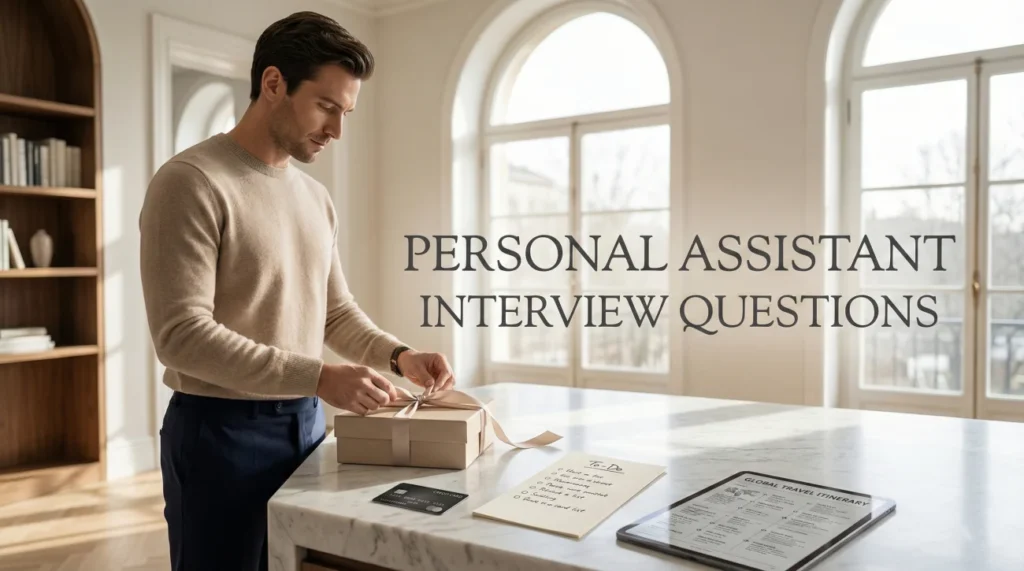
Personal assistant interview questions assess your ability to manage the chaos of a high-net-worth individual’s private life. While an Executive Assistant (EA) focuses on business strategy, a Personal Assistant (PA) focuses on life strategy. Today, this role often includes higher-touch coordination and discretion. Hiring managers look for candidates who can manage moving parts in a household, plan personal travel, and handle sensitive requests in a calm, professional way.
This guide focuses on the core pillars of the modern PA role: Lifestyle Management (keeping daily life organized), Resourcefulness (finding solutions under constraints), Confidentiality (protecting the family’s privacy), and Logistics Mastery (coordinating personal schedules and travel). You want to show both practical service mindset and strong organization for bigger projects.
Lifestyle Management & Errands
Your job is to give the principal their time back. Interviewers need to know you can handle a diverse range of tasks without supervision.
Q: How do you manage a complex household with multiple staff members?
I treat the household like a small business. I create a “Household Manual” that outlines standard operating procedures (SOPs) for key roles like housekeeping, childcare, and maintenance. I use a shared calendar to track staff schedules and vendor appointments. I hold brief check-ins to align on priorities for the week and upcoming events. If a staff member is underperforming, I handle the feedback professionally so the principal doesn’t have to manage daily friction. My goal is a smooth, predictable operation.
Q: The principal asks for a reservation at a fully booked Michelin-star restaurant for tonight. What do you do?
I stay calm and work the problem. First, I contact the restaurant directly to ask about waitlists, late cancellations, or any flexibility. If that fails, I use available reservation channels and trusted contacts to look for openings. In parallel, I prepare a strong backup plan: a comparable alternative restaurant, a later seating, or an at-home option such as a private chef. I present solutions, not excuses.
Q: How do you handle gift-buying for people who “have everything”?
I focus on personalization and experiences over material goods. I keep a “Gift Log” tracking what was given to whom in previous years to avoid repeats. I also capture preferences as they come up so I can spot patterns. For the person who has everything, I look for thoughtful items, personalized pieces, or curated experiences. I present a few options with clear tradeoffs, timing, and any practical constraints.
Q: Describe your system for tracking personal expenses and receipts.
I use a dedicated expense process linked to the household payment method. I capture receipts as purchases happen and reconcile statements on a regular cadence to catch errors early. I categorize expenses clearly so reporting is simple. I also manage a small petty cash fund for tips and cash-only vendors, logging withdrawals and receipts consistently.
Personal Travel & Event Planning
Personal travel is often more complex than business travel because it involves family members, pets, and leisure preferences.
Q: Walk me through how you plan a multi-generational family vacation.
I start with a “Needs Assessment” for every traveler. I confirm travel documents are valid, and I check accessibility and pacing based on who is traveling. I build a clear itinerary that includes flights, lodging, key bookings, and intentional downtime. I keep essential information organized and easy to access, and I have a basic contingency plan in case plans change.
Q: How do you manage a last-minute change to a personal trip?
I stay calm and act fast. If they decide to extend a trip, I first secure lodging so there is no gap. Then I adjust flights and any dependent bookings. I check the impact on upcoming appointments and reschedule what needs to move. I communicate the update clearly with the new plan and any follow-ups, and I handle the domino effect so they can focus on the trip.
Q: You are organizing a private dinner party at the principal’s home. What is your checklist?
I manage it like a professional event. 1. Guest List: I send invites and track RSVPs and dietary restrictions. 2. Staffing: I book the caterer, bartender, and cleaning crew. 3. Ambiance: I arrange flowers, select a playlist, and check the lighting. 4. Logistics: I coordinate entry details so guests arrive smoothly. 5. Execution: During the event, I stay in the background (or “invisible mode”) to manage the staff and ensure glasses are full, handling any spills or issues so the host can focus entirely on their guests.
Confidentiality & Trust
You are in their home and their inbox. Trust is the only currency that matters.
Q: You overhear a family argument while working. How do you react?
I become invisible. I continue my work quietly or, if possible, move to a different room to give them privacy. I do not react, intervene, or acknowledge it later unless explicitly spoken to. If a friend or colleague asks, “Is everything okay at the house?”, I say, “Everything is great,” and change the subject. My loyalty is to the family’s privacy. What happens in the house stays in the house. I treat their personal life as private information.
Q: How do you handle requests for money or access from the principal’s friends or extended family?
I act as the “Bad Cop” to protect the principal. I refer to a pre-agreed policy. If a cousin asks for a loan or a friend asks to stay at the vacation home, I say, “I manage the calendar/finances, and unfortunately, that isn’t possible right now due to [neutral reason].” I never say “The principal said no.” I take the blame: “I can’t fit it in the schedule.” This preserves the principal’s personal relationships while enforcing their boundaries.
Q: What measures do you take to secure the principal’s digital privacy?
I follow strong security and privacy practices for their personal life. I encourage secure account access practices, use a password manager where appropriate, and apply the organization’s privacy standards for handling sensitive information. I keep access tight, document what needs documenting, and avoid sharing personal details unnecessarily.
Behavioral Scenarios & Adaptability
PA roles are unpredictable. Interviewers want to see how you handle the weird, the difficult, and the unexpected.
The principal calls you outside working hours in a panic because they lost their passport before a flight. What do you do?
I answer immediately; this is an emergency. First, I calm them down. “Don’t worry, we will fix this.” Second, I check my records – I keep digital color copies of all passports in a secure cloud folder. I email that to them instantly so they have identification. Third, I assess the timeline. If the flight is tomorrow morning, they can’t fly internationally. I rebook the flight for Monday. I then research the nearest emergency passport agency and book the earliest appointment for them, preparing the application forms for them to sign. I turn a crisis into a managed process.
You are asked to do a task that feels demeaning. How do you handle it?
I view no task as “beneath me” if it helps the principal, but I also value my time efficiency. If it is a one-off situation, I handle it professionally because I am there to support the principal. However, if it becomes a recurring task that pulls me away from higher-impact responsibilities, I propose a solution: we can assign it to the right resource (staff, vendor, or service) so my time stays focused on coordination and problem prevention. I solve the problem with a plan, not with attitude.
Personal Assistant Skills Quiz
Test Your PA IQ
1. “Lifestyle Management” refers to:
- Managing a diet
- Handling all non-business aspects of a principal’s life (home, travel, family)
- Buying clothes
- Decorating a room
2. A “Household Manual” is used to:
- Press flowers
- Document SOPs, codes, and preferences for household staff
- List recipes only
- Record TV shows
3. When a principal is “High Profile,” your primary duty is:
- Getting their autograph
- Protecting their privacy and security
- Posting about them online
- Asking for a raise
4. “Gatekeeping” for a PA involves:
- Fixing the garden gate
- Screening calls, visitors, and requests to protect the principal’s time
- Locking the fridge
- Hiring security
5. If you lose the principal’s credit card, you should:
- Wait to see if it turns up
- Freeze/Cancel it immediately and notify the principal
- Hide the mistake
- Use your own card instead
6. “Vendor Management” in a home setting includes:
- Selling vegetables
- Supervising contractors, housekeepers, and landscapers
- Buying vending machines
- Driving the car
7. A “Rider” in a contract often refers to:
- A person on a horse
- Specific additional requirements (e.g., hospitality needs for an event)
- A type of insurance only
- A travel document
8. Trusted traveler programs can help with:
- Checking bags for free
- Faster airport security screening
- Booking flights
- Getting upgrades
9. “Petty Cash” should be reconciled:
- Never
- Regularly with receipts for every transaction
- Once a year
- When it runs out
10. “Concierge Service” means:
- Cleaning the floor
- Providing high-touch, personalized assistance for bookings and requests
- Guarding the door
- Parking cars
11. A “Preferences Sheet” tracks:
- The PA’s likes
- The principal’s dietary needs, seat choices, and favorite brands
- Stock prices
- Weather trends
12. “NDA” stands for:
- No Dinner Available
- Non-Disclosure Agreement
- New Dog Arrival
- National Doctors Association
13. To secure a “Last Minute Reservation,” you should:
- Give up
- Leverage contacts, use waitlists, or call directly and be polite
- Yell at the host
- Go to a fast food place
14. “Errand Running” requires:
- Running shoes
- Efficient route planning and prioritization
- A fast car
- A GPS only
15. “Event Production” involves:
- Making a movie
- Managing all logistics (catering, decor, guest list) for a function
- Attending a party
- Buying a dress
16. “Calendar Tetris” is:
- A game on the phone
- Fitting complex appointments into a busy schedule efficiently
- Buying a calendar
- Deleting meetings
17. “Inbox Management” for a PA involves:
- Reading emails for fun
- Filtering, flagging, and responding to emails on the principal’s behalf
- Deleting everything
- Changing passwords
18. A “Fixer” mentality means:
- Breaking things
- Finding solutions to difficult problems quickly and discreetly
- Being a mechanic
- Glueing things together
19. “Travel Logistics” includes:
- Watching travel vlogs
- Flights, ground transport, accommodation, and visas
- Buying a suitcase
- Learning a language
20. “Soft Skills” critical for a PA include:
- Typing speed only
- Empathy, adaptability, and emotional intelligence
- Coding
- Accounting
❓ FAQ
🕒 Is this a 9-to-5 job?
Rarely. A Personal Assistant role is lifestyle-driven. You are often expected to be “on call” for emergencies (like a burst pipe or missed flight) on weekends or evenings. Boundaries must be negotiated, but flexibility is a core requirement.
📜 Do I need a degree?
Not necessarily. While a degree helps, experience in hospitality, event planning, or high-level customer service is often more valuable. Being “street smart” and resourceful counts for more than academic theory in this role.
💻 What is the difference between PA and EA?
An EA (Executive Assistant) focuses on business needs (board meetings, corporate travel). A PA (Personal Assistant) focuses on personal needs (family vacations, household staff, gifts). A PA works in the home; an EA works in the office. However, hybrid roles exist.
💰 Is it well-paid?
It can be well-paid. Compensation depends on the principal, scope of responsibility, location, and schedule expectations. The pay reflects the level of trust, discretion, and responsiveness required.
🚀 What is the career path?
You can advance to Estate Manager (managing multiple properties and staff) or Chief of Staff (managing the principal’s entire personal and business ecosystem). Some PAs start their own lifestyle management agencies.
Final Thoughts
To succeed in answering personal assistant interview questions, you need to show that you are the ultimate problem solver. You don’t just do tasks; you manage a life. Interviewers want to see that you are calm under pressure, impeccably organized, and loyal to the core.
Focus on your resourcefulness. Tell the story of how you found that sold-out toy for Christmas or how you fixed a travel disaster from 3,000 miles away. If you can demonstrate that you make the principal’s life easier and stress-free, you will be the indispensable partner they are looking for. For more insights on support roles, explore our hub on administrative and hr interview questions.
⚠️ Disclaimer: The interview strategies, sample answers, and negotiation tips provided in this guide are for educational purposes only. Hiring decisions are subjective and vary by company and industry. While these strategies are based on professional HR standards, they do not guarantee a specific job offer or result.