What HR Generalist Interviews Test
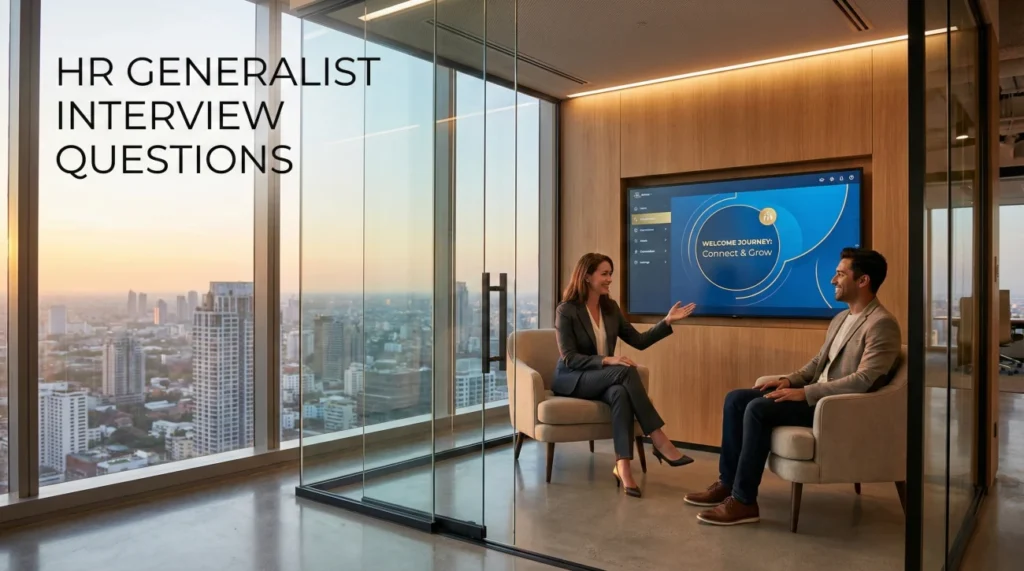
HR generalist interview questions are designed to test your versatility. Unlike specialists who focus on one silo, a Generalist is the “Swiss Army Knife” of the HR department. Today, the role has evolved from administrative paperwork to being a key architect of the day-to-day Employee Experience (EX). Hiring managers are looking for someone who can pivot instantly from running a joyful new hire orientation to conducting a serious disciplinary meeting without missing a beat.
This comprehensive guide covers the four critical operational domains you must master: Onboarding & Offboarding (the bookends of the employee journey), Employee Relations (handling the daily friction of human interaction), Benefits & Compliance (the technical backbone), and HR Operations (the systems that keep the lights on). You need to demonstrate that you are organized enough to manage the details but empathetic enough to care about the people behind the paperwork.
Onboarding & The Employee Lifecycle
First impressions matter. Interviewers want to know if you can design an onboarding process that not only handles compliance but also accelerates productivity and belonging.
Q: Walk me through your ideal onboarding process for a new hire’s first week.
I view onboarding as a 90-day journey, but the first week is critical for “belonging.” Day 1 is about the “Wow” factor: their laptop is ready, their email works, and there is a welcome kit (swag/handbook) waiting. I conduct a culture-focused orientation, not just reading policies. Days 2-3 involve role-specific training and meetings with key stakeholders I have pre-scheduled. By Friday, I ensure they have a casual “check-in” to answer questions. My goal is that they go home on Friday thinking, “I made the right choice joining this company.” I track the success of this via a “New Hire Survey” sent at the 30-day mark.
Q: How do you handle an offboarding meeting (Exit Interview)?
I approach offboarding with two goals: protecting the company assets/security and gathering honest feedback. Operationally, I have a checklist: revoke IT access, collect badges/laptops, and explain COBRA/benefits continuation clearly to reduce their anxiety. Relationally, I conduct the interview by creating a safe space. I ask open-ended questions like “What would have made you stay?” rather than “Why are you leaving?” I aggregate this data quarterly to report trends to leadership, turning departures into actionable retention insights.
Q: A new hire is struggling to adapt to the culture. How do you intervene?
I intervene early, usually around the 30-day mark if I see warning signs (isolation, missed deadlines). I set up a casual coffee chat to see how they are feeling. Often, it is a lack of clarity or “imposter syndrome” rather than incompetence. I might pair them with a “culture buddy” (a peer, not their boss) to help them navigate unwritten rules. I also check in with their manager to ensure they are providing sufficient direction. My job is to bridge the gap before it becomes a performance issue.
Q: How do you ensure remote employees feel included during onboarding?
Remote onboarding requires “over-communication.” I create a digital “Welcome Hub” (using tools like Notion or SharePoint) containing everything they need so they don’t feel lost. I schedule specific “virtual meet and greets” so they aren’t staring at a silent Slack channel. I also ensure their physical equipment arrives 3 days before their start date. Nothing kills morale faster than starting a job without a computer. I prioritize video calls for the first week to build face-to-face rapport.
Employee Relations (Day-to-Day)
Unlike an HR Manager who handles high-level strategy, a Generalist handles the daily “triage” of employee complaints. You need to show you can solve problems before they escalate.
Q: An employee complains that their manager is “micromanaging” them. How do you handle it?
I listen to validate their feelings but remain neutral. “Micromanagement” is often subjective, so I ask for specific examples: “Can you tell me about a specific time this happened?” Often, the root cause is a misalignment of expectations. I usually coach the employee on how to “manage up” by proactively providing updates to reassure the manager. If the manager’s behavior is truly problematic (e.g., messaging at 10 PM demanding replies), I will have a separate coaching conversation with the manager about respecting boundaries and focusing on outcomes, not constant surveillance.
Q: Two employees are having a loud argument in the open office. What do you do?
I act immediately to stop the disruption. I walk over and calmly ask both of them to pause and join me in a conference room. I separate them if tensions are too high. I speak to them individually to get their side of the story. I make it clear that while conflict is normal, unprofessional behavior in a shared space is a violation of our code of conduct. I document the incident. Depending on the severity (e.g., if slurs or threats were used), it might escalate to a formal warning, but my first priority is restoring safety and order to the workspace.
Q: How do you handle a request for a raise outside of the annual review cycle?
I manage expectations while keeping the door open. I explain our compensation philosophy and the standard review cycle timeline to ensure fairness. However, I don’t just say “no.” I check if there has been a material change in their role (e.g., taking on a departed colleague’s workload). If so, I might advocate for an “off-cycle adjustment” with their manager. If not, I coach the employee on how to document their achievements so they are in the strongest possible position when the review cycle arrives.
Benefits Administration & Compliance
This is the “technical” side of the role. You must prove you understand the laws well enough to keep the company out of court.
Q: How do you explain Open Enrollment to employees who find insurance confusing?
I simplify the jargon. Instead of just sending a 50-page PDF, I hold “Benefits 101” webinars where I explain the difference between an HMO and a PPO using real-life scenarios (e.g., “If you break your leg, here is what Plan A costs vs. Plan B”). I create a “FAQ one-pager” addressing the top 10 questions. I also make myself available for 1-on-1 office hours. I know that for many employees, healthcare is their most important benefit, and confusion breeds dissatisfaction.
Q: What is your process for maintaining I-9 compliance?
I take I-9s very seriously because the fines for errors are steep. I ensure Section 1 is completed by the employee on or before their first day. I verify their original documents (physically or via authorized representative for remote staff) within the required timeframe for Section 2. I conduct a self-audit annually to catch missing signatures or expired work authorizations. I store I-9s separately from the general personnel file to facilitate easier auditing by the relevant agency if ever requested.
Q: An employee asks for FMLA leave. Walk me through your steps.
First, I express empathy, people usually take FMLA for serious health or family reasons. Operationally, I confirm their eligibility (tenure and hours requirements under FMLA). I provide the “Notice of Eligibility” and “Rights & Responsibilities” forms within the required timeframe. I track their deadline to return the medical certification. During their leave, I coordinate with their manager on coverage but ensure we do not pressure the employee to work. I also handle the benefits premium payments during the unpaid leave period.
Behavioral Scenarios & HR Ops
You made a mistake on someone’s payroll (underpaid them). How do you fix it?
I own the mistake immediately. Payroll errors affect people’s livelihood, so speed and transparency are key. I contact the employee to apologize and explain exactly what happened and when it will be fixed. I don’t wait for the next pay cycle if it causes hardship; I request an off-cycle manual check or wire transfer immediately. I then audit my process to see how the error occurred (e.g., data entry error, missed timesheet) and implement a “double-check” step to ensure it never happens again to them or anyone else.
A manager keeps ignoring your emails about completing performance reviews. What do you do?
I stop emailing and start calling or visiting. I try to understand the blocker, are they too busy, or do they not value the process? I emphasize the risk: “Without this review, we cannot legally justify a bonus or promotion for your team member, and we leave ourselves open to liability if we ever need to terminate.” I make it as easy as possible for them, perhaps offering to sit with them for 30 minutes to talk through the feedback while I take notes. I position myself as a partner helping them solve a problem, not a policeman nagging them.
How do you prioritize when you have 5 urgent tasks (payroll, employee crisis, interview, report, open enrollment)?
I prioritize based on impact and irreversibility. Payroll is always #1 because it’s a legal obligation and affects trust. Employee Crisis (e.g., harassment allegation) is #2 because of immediate risk. Interviews are #3 because candidate experience matters, but they can be rescheduled if absolutely necessary. Reports and Open Enrollment setup (if not the deadline day) can be blocked for later. I communicate delays proactively so stakeholders aren’t left wondering.
HR Generalist Knowledge Quiz
Test Your HR Ops Knowledge
1. The “I-9 Form” verifies:
- Identity and employment authorization in the US
- Tax withholding status
- Direct deposit information
- Criminal background history
2. “COBRA” allows employees to:
- Keep their company laptop
- Temporarily continue group health coverage after leaving a job
- Receive severance pay
- File for unemployment
3. “Open Enrollment” typically happens:
- Once a year
- Every month
- Whenever an employee wants
- Every 5 years
4. An employee working over 40 hours in a week must be paid overtime if they are:
- Exempt
- Non-Exempt
- A Manager
- Salaried (meeting duties test)
5. “ATS” stands for:
- Automatic Tax System
- Applicant Tracking System
- Annual Training Schedule
- Admin Time Sheet
6. A “Qualifying Life Event” (QLE) allows changes to benefits:
- Outside of the Open Enrollment period
- Only during Open Enrollment
- Never
- Whenever the boss approves
7. Which is an example of a QLE?
- Getting a pet
- Marriage or birth of a child
- Buying a car
- Getting a promotion
8. “EEOC” enforces laws against:
- Tax evasion
- Workplace discrimination
- Unsafe working conditions
- Insider trading
9. “PTO” stands for:
- Payroll Time Over
- Paid Time Off
- Personal Tax Option
- Public Training Officer
10. “Onboarding” aims to improve:
- How fast an employee can quit
- New hire retention and time-to-productivity
- The complexity of paperwork
- The number of meetings
11. A “Handbook” generally contains:
- Secret company codes
- Company policies, procedures, and expectations
- A list of all employee salaries
- The CEO’s biography only
12. “HRIS” stands for:
- Human Rights Investigation System
- Human Resources Information System
- Hiring Recruitment Internal Software
- High Risk Insurance Strategy
13. “ADA” requires employers to provide:
- Free lunch
- Reasonable accommodations for employees with disabilities
- Transportation to work
- gym memberships
14. “Background Checks” typically look for:
- Favorite movies
- Criminal history, employment verification, and education
- Medical history
- Political affiliation
15. “Performance Reviews” are usually conducted:
- Weekly
- Annually or semi-annually (traditionally)
- Only when firing someone
- Never
16. “Compensation Benchmarking” ensures:
- Salaries are competitive with the market
- Everyone gets paid the same
- Salaries are kept secret
- The company pays the lowest possible wage
17. “Confidentiality” in HR is critical for:
- Hiding illegal activities
- Building trust and protecting sensitive employee data
- Making HR seem mysterious
- Avoiding talking to employees
18. “OSHA” is primarily concerned with:
- Office furniture aesthetics
- Workplace safety and health
- Overtime pay
- Discrimination
19. “Exit Interviews” help the company:
- Convince the employee to stay
- Gather data on why employees leave to improve retention
- Argue with the employee
- Recover the cost of training
20. A “Job Description” should include:
- The name of the previous employee
- Essential duties, responsibilities, and qualifications
- Only the salary
- Impossible requirements
❓ FAQ
🕒 What is a typical day for an HR Generalist?
There is no “typical” day, which is the beauty of the role. You might start by running a new hire orientation, then pivot to answering benefits questions, mediating a dispute between coworkers before lunch, running a report on overtime hours in the afternoon, and ending the day organizing a team-building event. Adaptability is your most important tool.
📜 Do I need the SHRM-CP or PHR certification?
While not strictly mandatory for entry-level, having a SHRM-CP (Certified Professional) or PHR (Professional in Human Resources) is highly valued for Generalist roles. It proves you understand the legal and technical landscape (compliance, labor law) which reduces risk for the employer.
💻 What software do I need to know?
You should be comfortable with an HRIS (like Workday, BambooHR, or ADP) for data management and an ATS (like Greenhouse or Lever) for recruiting. Proficiency in Excel (VLOOKUP, Pivot Tables) is also crucial for analyzing compensation and turnover data.
⚖️ How do you stay neutral in employee disputes?
It takes practice. You must remember you represent the company’s values and policies, not any individual side. Stick to facts, document everything, and avoid getting emotionally involved. Your goal is a fair process, not necessarily a “happy” outcome for everyone.
🚀 What is the difference between a Generalist and a Specialist?
A Specialist goes “deep” into one area (e.g., a Recruiter only hires, a Benefits Manager only handles insurance). A Generalist goes “wide,” handling a bit of everything. Generalist roles are excellent for building a foundation to eventually become an HR Director or VP.
Final Thoughts
To succeed in answering HR generalist interview questions, you need to show that you are the steady hand on the wheel. You are the person employees come to when they are confused about their benefits or upset about a coworker. Interviewers want to see that you are approachable, legally savvy, and obsessively organized.
Focus on your problem-solving process. Whether it is fixing a payroll error or designing a better onboarding checklist, show that you take ownership of the result. By demonstrating that you can handle the operational noise, you prove you are ready to help build a better workplace.
⚠️ Disclaimer: The interview strategies, sample answers, and negotiation tips provided in this guide are for educational purposes only. Hiring decisions are subjective and vary by company and industry. While these strategies are based on professional HR standards, they do not guarantee a specific job offer or result.