What HRBP Interviews Test
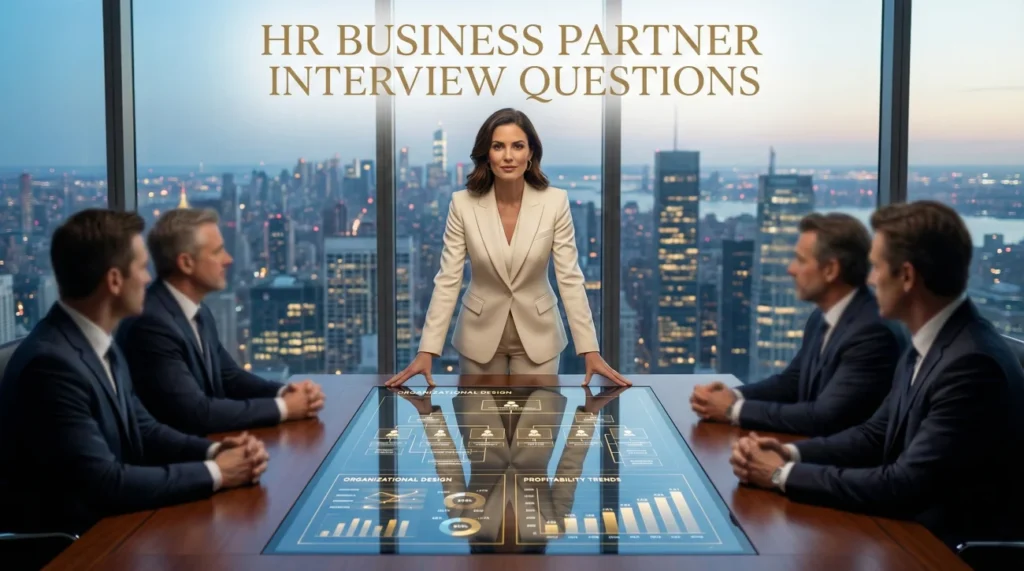
HR business partner interview questions assess your ability to bridge the gap between “People” and “Profit.” Unlike an HR Generalist who manages operations, an HRBP sits at the leadership table. Today, hiring managers are looking for a “Business Leader who specializes in HR.” They want to know if you can read a P&L statement, diagnose organizational inefficiencies, and have the courage to challenge a VP’s decision when it contradicts the company’s long-term strategy.
This guide covers the four critical competencies of a high-impact HRBP: Strategic Alignment (connecting talent strategy to business goals), Organizational Design (structuring teams for efficiency), Change Management (guiding teams through transformation), and Executive Coaching (influencing without authority). You must demonstrate that you are not just a service provider, but a strategic consultant.
Strategic Alignment & Business Acumen
This is the defining characteristic of the role. Interviewers need to verify that you understand the business first, and HR second.
Q: How do you align your HR strategy with the business goals of the division you support?
I start by immersing myself in the business. I attend sales forecast meetings and product roadmap reviews, not just HR meetings. If my division’s goal is “expand into the Asian market,” my HR strategy focuses on identifying leaders with regional experience, designing expat packages, and conducting cultural competency training. I build my OKRs (Objectives and Key Results) to mirror theirs. If they fail to hit revenue targets because of open headcount, I consider that my failure too.
Q: How do you measure the ROI of an HR initiative?
I move beyond “activity metrics” (like number of trainings held) to “impact metrics.” For example, if we implemented a new sales onboarding program, I don’t just measure completion rates. I measure “Time to First Deal” or “Quota Attainment in the early ramp period” compared to the previous cohort. I correlate engagement scores with customer satisfaction ratings to show that happier employees lead to happier customers. Speaking the language of data is the only way to get budget approval.
Q: Describe a time you used data to influence a business decision.
My Sales VP wanted to mandate a “Return to Office” policy because he felt productivity was dropping. Instead of arguing opinions, I pulled the data. I analyzed CRM activity logs and revenue numbers, which showed that productivity indicators were actually up in remote setups, but “burnout risk” markers were high. I presented this dashboard to him. We agreed on a compromise: a “team anchor day” on a regular cadence for collaboration, keeping the other days flexible to protect the productivity gains we found in the data.
Q: How do you conduct a Talent Review or Succession Planning session?
I facilitate a “9-Box Grid” session, but I ensure it doesn’t become a popularity contest. I challenge leaders to differentiate between “High Performance” (today’s results) and “High Potential” (ability to scale). I ask probing questions: “If this person left tomorrow, what is the business impact?” “Who is ready now vs. ready later?” The output isn’t just a chart; it is a specific development plan for the successors and a retention strategy for the key players.
Organizational Design & Change Management
HRBPs are often the architects of restructuring. You must show you can handle the complexity of changing how work gets done.
Q: Walk me through your approach to a restructuring or layoff.
My focus is on three phases: Design, Execution, and Recovery. In Design, I work with leadership to define the “Future State” organization chart based on capabilities needed, not names of people. We identify the gaps legally and ethically. In Execution, I ensure the communication is clear, humane, and scripted to minimize ambiguity. In Recovery, which is often skipped, I focus on the “survivors.” I increase visibility, re-recruit the remaining top talent, and clarify the new vision so the team moves from anxiety to action quickly.
Q: How do you manage resistance to change?
I use the ADKAR model (Awareness, Desire, Knowledge, Ability, Reinforcement). Resistance often stems from a lack of “Awareness” (why are we doing this?) or “Ability” (I don’t know how to use the new tool). I identify the root cause. If it is a skill gap, I provide training. If it is a mindset issue, I find “Change Champions” within the team to model the new behavior. I also advise leadership to over-communicate the “Why,” because in the absence of information, people invent the worst-case scenario.
Q: A team is underperforming. How do you diagnose the problem?
I use the “Star Model” or simply look at Skill vs. Will vs. System. Is it a Skill issue (they need training)? Is it a Will issue (motivation/culture)? Or is it a System issue (bottlenecks, bad tools, unclear roles)? I conduct focus groups and one-on-one interviews to gather qualitative data. Often, leaders blame “Will” (people are lazy) when it is actually a “System” problem (conflicting priorities). My job is to reveal the systemic blocker so we solve the right problem.
Executive Coaching & Influence
You will be the confidant and coach to senior leaders. Interviewers check if you can tell truth to power.
Q: How do you coach a leader who has low emotional intelligence (EQ)?
I focus on the business impact of their behavior. I don’t say “You are rude.” I say, “When you interrupt your team in meetings, I observe them shutting down. We missed two innovative ideas yesterday because people were afraid to speak up. That limits our innovation pipeline.” I hold up a mirror. I might suggest a 360-feedback process to give them objective data points. If they care about results, they have to care about the environment that produces them.
Q: A VP wants to fire someone immediately without documentation. How do you handle it?
I play the role of “Risk Manager.” I explain, “I understand your frustration, but firing without cause puts the company at risk for a wrongful termination suit which could be expensive and damage our brand.” I propose an alternative: “Let’s put them on a short, formal PIP. Either they turn it around (win), or they fail and we have the paperwork to exit them safely (win).” This frames compliance as a strategic move, not a bureaucratic hurdle.
Behavioral Scenarios
You disagree with a strategic direction proposed by your business unit leader. What do you do?
I challenge privately but support publicly. In our one-on-one, I would ask probing questions to test their assumptions: “Have we considered the impact on our engineering headcount if we pivot this fast?” or “Data shows our attrition is already high; this might break the team.” I provide alternatives. However, once the decision is made, if it is not illegal or unethical, I commit to the strategy and help them execute it. My role is to stress-test the strategy, not to block it indefinitely.
Describe a time you had to deliver bad news to senior leadership.
I discovered that our pay equity analysis showed a significant gap for women in the Engineering department. This was going to be expensive to fix and politically sensitive. I prepared a detailed analysis with legal counsel. I presented the data directly to the C-Suite, focusing on the risk of inaction (legal, reputational) vs. the cost of correction. I proposed a phased adjustment plan to manage the budget impact. It was a tense meeting, but by focusing on the data and the solution, we got approval to rectify the gaps.
HRBP Knowledge Quiz
Test Your Strategic HR IQ
1. The “9-Box Grid” assesses talent based on:
- Age and Tenure
- Performance and Potential
- Salary and Grade
- Attendance and Punctuality
2. “Change Management” is best described as:
- Changing the payroll provider
- A structured approach to transitioning individuals and organizations to a desired future state
- Firing managers
- Updating the employee handbook
3. “Succession Planning” focuses on:
- Identifying and developing internal people to fill key business leadership roles
- Planning the company holiday party
- Hiring interns
- Calculating retirement benefits
4. Which is a “Lagging Indicator” in HR?
- Turnover Rate (people have already left)
- Employee Engagement Score
- Training Participation
- Pipeline Candidate Volume
5. “Strategic Workforce Planning” involves:
- Creating the shift schedule for next week
- Aligning future people needs (skills/count) with the long-term business strategy
- Buying new office furniture
- Planning team lunches
6. “Organizational Design” determines:
- Structures, processes, and roles that best support the business strategy
- The color of the office walls
- The logo design
- The dress code policy
7. “Employee Engagement” is linked to:
- How much coffee employees drink
- Discretionary effort and emotional commitment to the organization
- Only the salary amount
- The number of hours worked
8. A “Flight Risk” is:
- An employee who travels a lot
- A high-value employee who is likely to leave the organization
- A pilot
- A safety hazard
9. “Span of Control” refers to:
- How much budget a manager has
- The number of direct reports a manager supervises
- The size of the office
- The length of a meeting
10. “Talent Density” means:
- How many people are in the office
- The ratio of high performers to total employees
- The weight of the employee handbook
- The number of open roles
11. “Matrix Organization” structure implies:
- Employees report to no one
- Employees have dual reporting lines (e.g., functional and project)
- A virtual reality workplace
- A hierarchy with only one boss
12. “Center of Excellence” (CoE) in HR provides:
- Free snacks
- Specialized expertise (e.g., Compensation, L&D) to the rest of HR and the business
- General administrative support
- Customer service
13. “Performance Calibration” ensures:
- Everyone gets the same rating
- Consistency and fairness in performance ratings across different managers
- Calculators work correctly
- Reviews are done quickly
14. “Leading Indicators” help HR to:
- Predict future trends (e.g., engagement drop predicting turnover)
- Look at past mistakes only
- Calculate last year’s budget
- Write job descriptions
15. “Cultural Alignment” is crucial in:
- Ordering office supplies
- Mergers & Acquisitions (M&A) integration
- Data entry
- IT maintenance
16. “Total Cost of Workforce” (TCOW) includes:
- Only salaries
- Salaries, benefits, taxes, facilities, and HR support costs
- Marketing budget
- Sales revenue
17. “Restructuring” typically involves:
- Painting the office
- Changing reporting lines, roles, or headcount to better align with strategy
- Hiring more interns
- Changing the lunch hour
18. “HR Service Delivery Model” defines:
- How HR services are delivered (e.g., Shared Services, HRBP, CoE)
- How mail is delivered
- The cafeteria menu
- The dress code
19. “Siloed” departments are a problem because:
- They are too quiet
- They lack collaboration and information sharing with other parts of the business
- They have too many windows
- They are too efficient
20. “Influence without Authority” is:
- Being a dictator
- The ability to persuade stakeholders to act without having direct command over them
- Begging for favors
- Ignoring the chain of command
❓ FAQ
🕒 HR Manager vs. HR Business Partner?
An HR Manager typically focuses on the function: compliance, team management, and operations across the company. An HRBP focuses on the client: they are embedded in a specific business unit (e.g., Sales or Engineering) to act as a consultant to that unit’s leadership. The HRBP role is less operational and more strategic.
📜 Do I need an MBA to be an HRBP?
Not always, but strong business acumen is non-negotiable. Many top HRBPs have an MBA or come from business roles outside of HR (like Operations or Sales). Certifications like SHRM-SCP or SPHR are also standard markers of senior-level competence.
💻 What tools do HRBPs use?
Beyond standard HRIS (Workday, Oracle), HRBPs live in data visualization tools (Tableau, PowerBI) to analyze workforce trends. They also use organizational design software (OrgVue) and engagement platforms (Culture Amp, Glint) to diagnose cultural health.
💰 What is the biggest challenge for HRBPs?
Balancing the tension between being an employee champion and a business partner. You must support the workforce while sometimes executing tough business decisions like layoffs. Maintaining trust on both sides requires high emotional intelligence and integrity.
🚀 What is the career path?
HRBPs often advance to Senior HRBP, then Director of HRBP, or VP of People. Because of their deep business understanding, some HRBPs even cross over into operational leadership roles like Chief of Staff or General Manager.
Final Thoughts
To succeed in answering HR business partner interview questions, you need to think like a CEO, not just an HR professional. The “seat at the table” isn’t given; it is earned by proving you understand how the company makes money and how people strategy accelerates that. Interviewers want to see courage, data fluency, and a solution-oriented mindset.
Focus on your impact. Don’t just list your responsibilities; tell stories of how you turned a dysfunctional team into a high-performing one or how you helped a leader navigate a crisis. If you can show that you are the engine behind the business’s success, you will win the role.
⚠️ Disclaimer: The interview strategies, sample answers, and negotiation tips provided in this guide are for educational purposes only. Hiring decisions are subjective and vary by company and industry. While these strategies are based on professional HR standards, they do not guarantee a specific job offer or result.