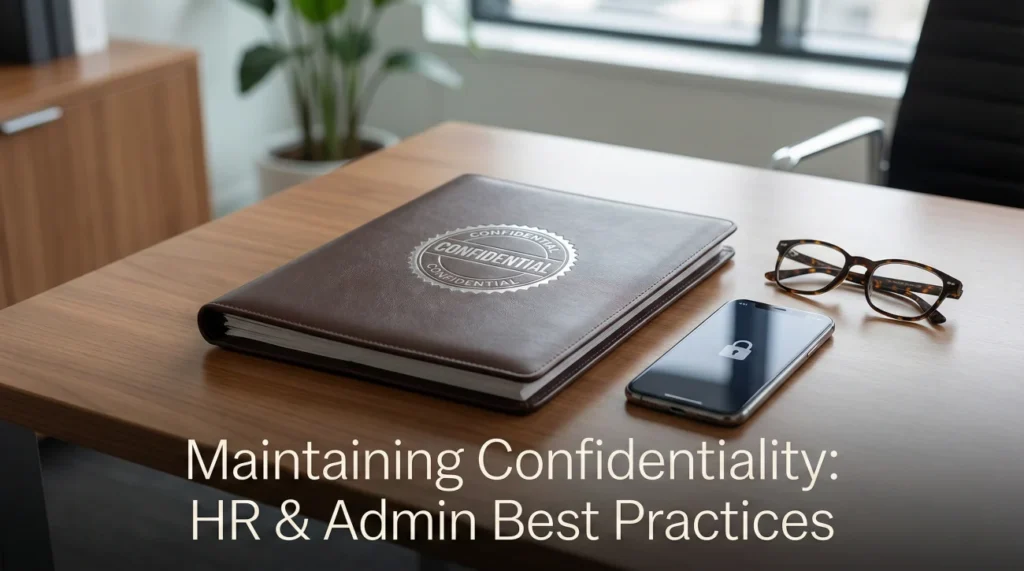
- Why confidentiality is career-critical: Administrative and HR roles handle pay, performance, strategy, and personal employee issues, and one careless moment can destroy trust fast.
- What information stays protected: Compensation details, personnel actions, personal or health information, strategic plans, and executive communications, plus gray areas like overheard conversations and rumors.
- How to refuse without burning relationships: Say no quickly, redirect to the right source, acknowledge the frustration, and offer process-level help without sharing specifics.
- How to handle real-life situations: Keep the same boundaries after hours and with workplace friends, and treat accidental exposure as “do not repeat”, notify the right person, and follow reporting channels if serious.
- What builds a strong reputation: Avoid gossip, secure documents and screens, stay calm about what you know, because consistent discretion unlocks higher-trust roles while breaches follow you for years.
The Trust Foundation of Administrative Work
Administrative and HR professionals earn access to information most employees never see – compensation data, performance evaluations, strategic plans, personal employee matters, executive communications. This privileged access exists because organizations trust these roles to handle sensitive information with absolute discretion. Yet maintaining confidentiality proves challenging when colleagues ask seemingly innocent questions, when you overhear concerning information, or when remaining silent feels like withholding help from friends.
The difficulty is that confidentiality violations rarely involve deliberate malice. Instead, they occur through casual conversations where you reveal slightly more than appropriate, through commiseration sessions where venting about work crosses boundaries, or through well-intentioned attempts to help colleagues navigate organizational politics. A single breach destroys trust that took months or years to build, potentially ending careers regardless of otherwise strong performance.
This guide establishes practical workplace discretion standards enabling you to navigate common confidentiality challenges without destroying relationships or appearing unhelpful. You’ll learn what information requires protection, how to deflect inappropriate questions diplomatically, strategies for handling accidentally overheard information, and techniques for maintaining professional boundaries even with close workplace friends.
Understanding Confidentiality Boundaries
Effective discretion requires knowing exactly which information demands protection and which can be shared appropriately.
Categories of Protected Information
Certain information types always require confidentiality regardless of context or relationship with requestor.
| Information Category | What It Includes | Why It’s Protected |
|---|---|---|
| Compensation data | Individual salaries, bonuses, raises, pay structures, budget allocations | Legal requirements, equity concerns, privacy expectations, strategic sensitivity |
| Personnel matters | Performance issues, disciplinary actions, terminations, investigations, accommodations | Legal liability, individual privacy, investigation integrity, defamation risk |
| Personal information | Health conditions, family situations, financial problems, personal crises | Privacy rights, trust relationships, dignity, potential discrimination |
| Strategic plans | Reorganizations, acquisitions, product launches, business strategy | Competitive advantage, market impact, premature disclosure consequences |
| Executive communications | Private discussions, correspondence, calendar details, decision rationale | Leadership effectiveness, political sensitivity, strategic timing |
Navigating Gray Areas
Some information exists in ambiguous territory where confidentiality requirements aren’t immediately obvious. When uncertain, err toward discretion.
- ❓ Public but not widely known: Information technically accessible but not commonly circulated – treat with discretion
- 🤐 Overheard information: Conversations you weren’t meant to hear – don’t repeat regardless of sensitivity
- 📊 Aggregated data: Statistics that don’t identify individuals – usually shareable with appropriate context
- 📅 Meeting attendance: Who attended confidential meetings – often itself considered confidential
- 💭 Speculation and rumors: Unverified information – never repeat even when tempting
Expert advice: When someone asks you to share information and you’re unsure whether it’s appropriate, use this test: “Would I be comfortable explaining to my manager why I shared this information with this person?” If the answer is no or you hesitate, default to “I’m not able to discuss that.” Protecting confidentiality when unnecessary causes minimal harm, but one inappropriate disclosure can end your career.
Handling Inappropriate Information Requests
The most challenging aspect of handling sensitive information isn’t keeping secrets – it’s managing relationships when refusing to answer seemingly harmless questions from colleagues or friends.
Common Inappropriate Request Scenarios
Certain questions appear predictably in administrative and HR roles, requiring prepared responses rather than improvised deflection.
| Scenario | Why It’s Inappropriate | Effective Response |
|---|---|---|
| “What does [colleague] make?” | Compensation is strictly confidential | “I can’t discuss anyone’s compensation. Have you talked to HR about salary benchmarking for your role?” |
| “Did you hear [executive] is leaving?” | Spreads unverified rumors, violates trust | “I don’t discuss personnel matters or repeat rumors. If there’s news to share, leadership will communicate it.” |
| “What’s happening in the executive meeting?” | Strategic discussions require confidentiality | “Those meetings are confidential. If decisions affect your team, your manager will communicate them.” |
| “Is [colleague] getting fired?” | Personnel matters are private, speculation harmful | “I wouldn’t discuss that even if I knew. Performance and employment matters are confidential.” |
| “You must know what’s really going on…” | Fishing expedition for insider information | “My role gives me access to confidential information I can’t share. I have to protect that trust.” |
💡 Pro tip: Respond to inappropriate questions immediately and definitively rather than hedging or appearing to consider sharing. Quick, firm refusal communicates clear boundaries: “I can’t discuss that.” Hesitation invites negotiation or suggests you might share under different circumstances, encouraging future inappropriate requests.
Diplomatic Deflection Techniques
Maintain relationships while protecting confidentiality through responses that acknowledge the person without sharing protected information.
- Redirect to appropriate source: “That’s a question for HR/your manager/the communications team.”
- Acknowledge without confirming: “I understand that uncertainty is frustrating, but I can’t discuss personnel matters.”
- Express boundaries clearly: “My role requires strict confidentiality. I hope you understand I can’t make exceptions.”
- Offer general guidance: “While I can’t discuss specifics, here’s how our process generally works…”
- Use humor carefully: “Nice try, but you know I can’t tell you that!” (only with established friendly relationships)
Managing Persistent Requestors
Some colleagues won’t accept initial refusals, requiring escalating firmness while preserving working relationships.
- 🔁 First request: Polite but firm refusal with brief explanation
- 🔁 Second request: Restate boundaries more directly, note you won’t discuss further
- 🔁 Third request: Express concern about continued pressure, suggest they’re putting you in uncomfortable position
- ⚠️ Continued pressure: Document pattern, notify manager or HR about inappropriate behavior
Building a Reputation for Discretion
Your reputation for confidentiality best practices becomes one of your most valuable professional assets, opening opportunities requiring trusted individuals.
Demonstrating Trustworthiness
Actions beyond refusing to share confidential information build your reputation for discretion over time.
- Never participate in workplace gossip, even when not technically confidential
- Redirect conversations away from speculation about personnel matters
- Protect physical documents through secure storage and proper disposal
- Use appropriate digital security measures (screen locks, encrypted communication)
- Demonstrate discretion about your own matters as model for handling others’ information
- Acknowledge when asked about confidential topics without appearing smug about insider knowledge
Career Impact of Confidentiality Standards
Organizations explicitly seek proven discretion when filling senior administrative and HR roles because confidentiality failures create enormous liability and dysfunction.
| Career Stage | Confidentiality Expectations | Opportunities Requiring Trust |
|---|---|---|
| Entry level | Follow basic policies, don’t gossip, protect documents | Access to sensitive filing, attendance at some meetings |
| Mid level | Demonstrate judgment about gray areas, maintain boundaries under pressure | Compensation administration, performance review support, strategic project access |
| Senior level | Model discretion, mentor others, handle most sensitive matters | Executive assistant roles, CHRO positions, board-level work, crisis management |
💡 Pro tip: Your discretion reputation follows you throughout your career, appearing in reference checks and informal networking conversations. Organizations specifically ask references about trustworthiness and confidentiality. A single serious breach can haunt you for years, while consistent discretion opens doors to prestigious roles requiring absolute trust. Treat every confidentiality decision as potentially career-defining.
❓ FAQ
🎯 What if maintaining confidentiality damages my workplace friendships?
True friends respect professional boundaries and don’t pressure you to violate confidentiality. If friendships suffer because you won’t share protected information, those relationships were based on improper access rather than genuine connection. Explain your boundaries clearly early in relationships: “I really value our friendship, and I need you to understand I can’t discuss certain work matters regardless of our relationship.” Friends who can’t accept this aren’t respecting your professional obligations or your judgment.
💼 How do I handle situations where not sharing information seems unkind?
Remaining silent when you know someone faces termination or reorganization feels harsh, but warning them violates confidentiality and can damage both their situation and yours. Your role is protecting organizational information, not managing others’ careers. Instead, focus on being generally supportive without revealing specifics: listening when colleagues express concerns, suggesting they document their work, encouraging open communication with managers. Kindness doesn’t require confidentiality violations.
⏰ Should I confirm or deny information that’s already public knowledge?
Even when information becomes public, avoid confirming insider knowledge before official announcement. Your confirmation from a position of access carries different weight than external speculation. Respond with: “I’ve heard those rumors too, but I don’t have anything to add beyond what’s been officially communicated.” This protects you from appearing to leak information even when the substance is already known.
📋 What if I accidentally shared confidential information?
Report the breach immediately to your manager or appropriate authority. Explain what you shared, with whom, and circumstances of the disclosure. Don’t try to cover it up – discovered cover-ups typically result in termination while honest mistakes might result in warnings and additional training. Contact the person you told and request they not share the information further. Document the incident. Learn from it and implement safeguards preventing similar future breaches.
✨ How do I demonstrate discretion during interviews without examples?
Discuss your understanding of confidentiality without revealing protected information from previous employers. Explain situations where you maintained boundaries: “A colleague once asked about another employee’s salary, and I explained I couldn’t discuss anyone’s compensation.” Describe your approach to document security, digital safeguards, and professional boundaries. Your refusal to share specific details from previous roles actually demonstrates discretion – interviewers notice and appreciate appropriate boundaries even during interviews.
Final Thoughts
Success in maintaining confidentiality requires more than knowing policies exist – it demands consistent judgment about what to protect, courage to refuse inappropriate requests despite relationship pressure, and wisdom to distinguish helping colleagues from violating trust. Administrative and HR professionals who master discretion build reputations opening doors throughout their careers, while those who share “just this once” often find single breaches destroying years of credibility.
The challenge is that confidentiality obligations often conflict with natural desires to help friends, participate in workplace social dynamics, or demonstrate insider knowledge. Strong professionals develop systematic approaches to these tensions: clear boundaries communicated early, prepared responses to common inappropriate requests, and genuine commitment to protecting information regardless of personal cost. This discipline transforms confidentiality from burdensome obligation into professional competitive advantage.
Remember that every confidentiality decision potentially affects your career trajectory. Organizations explicitly seek proven discretion when filling roles requiring trust. Reference checks specifically probe confidentiality lapses. One serious breach can haunt you for years, while consistent discretion positions you for opportunities requiring absolute trustworthiness. Treat every piece of sensitive information as if your professional reputation depends on protecting it – because it does.
⚠️ Disclaimer: The interview strategies, sample answers, and negotiation tips provided in this guide are for educational purposes only. Hiring decisions are subjective and vary by company and industry. While these strategies are based on professional HR standards, they do not guarantee a specific job offer or result.