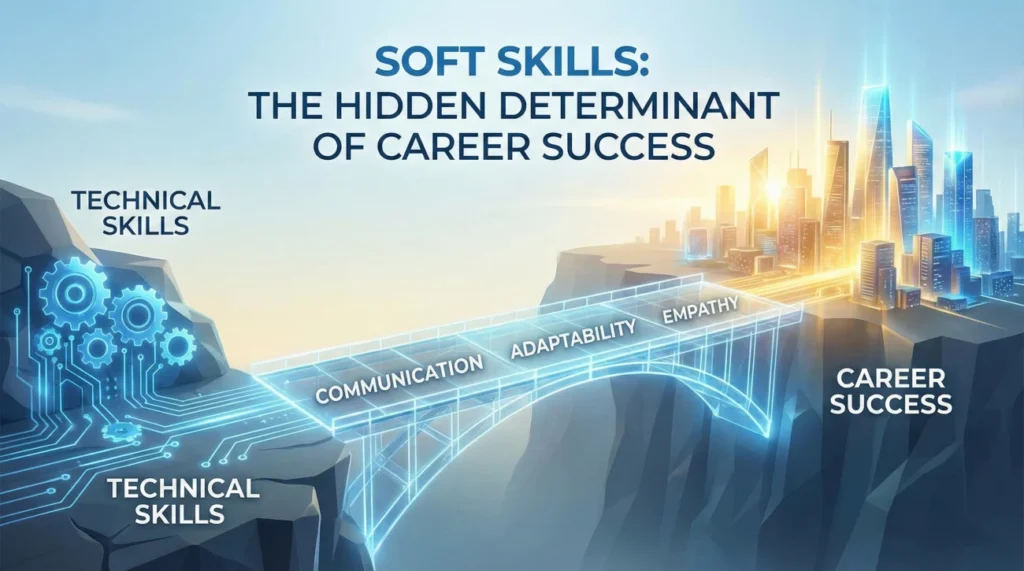
- Big idea: Soft skills often decide who gets trusted, promoted, and kept in the room, even when technical ability is similar.
- Communication: Strong professionals match the message to the audience and channel, listen deeply, ask clarifying questions, and confirm understanding before acting.
- Difficult moments: Growth comes from handling feedback, conflict, and “no” conversations calmly, with clear points and a specific outcome in mind.
- Adaptability: Modern work changes constantly, so showing learning agility, fast recovery, and constructive change behavior matters more than perfect comfort.
- EQ and culture: Self-awareness, empathy, and inclusive habits build durable relationships, and interviews reward candidates who can explain these skills through real examples.
Professional Communication Mastery
Superior professional communication skills mean more than speaking clearly or writing grammatically – they require adapting messages to audiences, timing communications strategically, and recognizing unspoken dynamics affecting reception.
Mastering Multiple Communication Modes
Different situations demand different communication approaches. Strong professionals adapt style to context rather than using one approach universally.
| Communication Mode | When to Use | Key Success Factors |
|---|---|---|
| Formal written (email, memos) | Official requests, documentation, complex information, multiple recipients | Clear subject lines, professional tone, concise structure, error-free execution |
| Informal written (chat, messages) | Quick questions, status updates, casual coordination | Brevity, appropriate informality, timely responses, emoji moderation |
| Face-to-face conversation | Sensitive topics, relationship building, complex discussions, immediate feedback | Active listening, body language awareness, emotional attunement, privacy consideration |
| Phone/video calls | Remote collaboration, screening interviews, quick synchronous discussion | Clear audio, minimal background noise, visual professionalism (video), agenda focus |
| Presentations | Group updates, training delivery, project proposals, executive briefings | Audience analysis, visual clarity, engagement techniques, confident delivery |
Active Listening and Understanding
Communication effectiveness depends as much on listening quality as speaking clarity. Most misunderstandings stem from inadequate listening rather than poor explanation.
- 👂 Full attention: Eliminate distractions, maintain eye contact, resist interruption urges
- 🔄 Paraphrasing: “So what you’re saying is…” confirms understanding, demonstrates engagement
- ❓ Clarifying questions: Ask before assuming, surface ambiguity early, verify interpretation
- 📝 Note-taking: Capture key points, demonstrate importance, enable accurate follow-through
- ⏸️ Comfortable silence: Allow thinking time, don’t fill every pause, let ideas develop
Expert advice: The most effective communicators master the 70/30 rule – listening 70% of the time, speaking 30%. This ratio applies particularly to administrative and HR roles where understanding needs accurately matters more than demonstrating your own knowledge. Executives value assistants who truly hear requests rather than jumping to solutions prematurely. Colleagues appreciate HR professionals who listen fully before offering advice.
Navigating Difficult Conversations
Professional growth requires comfort having uncomfortable conversations – delivering criticism, addressing conflicts, declining requests, setting boundaries.
| Conversation Type | Approach | Common Mistakes to Avoid |
|---|---|---|
| Delivering criticism | Specific behaviors, impact focus, improvement suggestions, private setting | Personal attacks, vague complaints, public criticism, sandwich method insincerity |
| Receiving criticism | Listen fully, ask clarifying questions, thank for feedback, reflect before responding | Immediate defensiveness, excuses, deflecting blame, dismissing concerns |
| Saying no diplomatically | Acknowledge request, explain constraints, offer alternatives when possible | Over-apologizing, making excuses, leaving hope when answer is definite no |
| Addressing conflicts | Focus on issues not personalities, seek understanding first, collaborative solutions | Avoiding confrontation entirely, emotional escalation, keeping score, involving others unnecessarily |
💡 Pro tip: Before difficult conversations, write down your main points and desired outcome. This preparation prevents emotional reactivity from derailing productive discussion. During the conversation, refer to notes if needed rather than relying on memory under stress. Preparation demonstrates professionalism and increases likelihood of achieving constructive resolution.
Adaptability and Change Management
Modern workplaces change constantly – new leadership, organizational restructuring, technology platforms, process modifications, strategic pivots. Workplace adaptability means thriving amid uncertainty rather than merely surviving disruption.
Productive Change Response Patterns
How you respond to change significantly impacts both your effectiveness and how colleagues and managers perceive you.
- Acknowledge discomfort honestly: Recognize change creates stress without dwelling in negativity
- Seek to understand rationale: Ask questions about reasoning, even if you disagree with decisions
- Focus on controllables: Invest energy in your response rather than lamenting circumstances
- Identify learning opportunities: View change as skill development rather than pure disruption
- Support colleagues struggling: Help others adapt while managing your own transition
- Provide constructive feedback: Share implementation concerns through proper channels
Building Flexibility and Resilience
Adaptability isn’t personality trait but developed capability strengthened through deliberate practice.
| Flexibility Practice | How to Develop | Workplace Application |
|---|---|---|
| Comfort with ambiguity | Take on projects with unclear parameters, resist premature closure on decisions | Navigate reorganizations, handle evolving priorities, work with incomplete information |
| Multiple perspective-taking | Deliberately consider situations from stakeholder viewpoints before forming judgments | Understand change impacts across departments, mediate conflicts, anticipate concerns |
| Recovery speed | Practice acknowledging setbacks briefly then moving forward without rumination | Bounce back from criticism, adapt to rejected proposals, handle project failures |
| Learning agility | Actively seek skill development, volunteer for unfamiliar assignments, study new tools | Master new software quickly, adapt to process changes, take on stretch assignments |
Adaptability doesn’t mean accepting everything without question or suppressing legitimate concerns. Strong professionals balance openness to change with thoughtful evaluation of implementation approaches. The goal is constructive engagement rather than blind compliance or stubborn resistance.
Expert advice: Organizations increasingly value adaptability over specific technical skills because business environments change faster than training cycles. An administrative professional who quickly masters unfamiliar software proves more valuable than one with deep expertise in legacy systems who resists new platforms. During interviews, emphasize examples of rapid skill acquisition and positive change response rather than just current technical proficiency.
For comprehensive interview preparation covering adaptability scenarios, explore professional development resources on behavioral competencies and change management examples.
Emotional and Cultural Intelligence
Technical skills and work ethic matter, but office culture fit and emotional awareness often determine whether you build productive relationships enabling career advancement.
Emotional Intelligence in Practice
Emotional intelligence means recognizing emotions in yourself and others, then managing those emotions productively rather than being controlled by them.
- 🧠 Self-awareness: Notice your emotional triggers, recognize stress signals, understand personal limitations
- ⚙️ Self-regulation: Pause before reactive responses, choose productive reactions, manage stress constructively
- 🎯 Motivation: Maintain enthusiasm despite setbacks, find meaning in work, pursue long-term goals
- 👥 Empathy: Recognize others’ emotional states, consider perspectives different from yours, respond compassionately
- 🤝 Social skills: Build rapport naturally, navigate political dynamics diplomatically, influence without authority
Cultural Awareness and Inclusivity
Modern workplaces bring together diverse backgrounds, communication styles, work approaches, and cultural norms requiring conscious awareness and adaptation.
| Cultural Dimension | Awareness Areas | Inclusive Practices |
|---|---|---|
| Communication styles | Direct vs. indirect, formal vs. casual, high-context vs. low-context preferences | Adapt your style to audience, clarify when uncertain, don’t assume one approach fits all |
| Work-life boundaries | After-hours availability expectations, personal sharing comfort, socializing preferences | Respect varying boundaries, don’t pressure participation, accommodate different needs |
| Decision-making approaches | Hierarchical vs. consensus, quick vs. deliberate, individual vs. collective | Understand organizational norms, value diverse approaches, adjust your style appropriately |
| Feedback preferences | Public recognition comfort, criticism delivery expectations, coaching styles | Ask how individuals prefer feedback, adapt delivery, provide multiple feedback channels |
Strategic Relationship Building
Professional success requires cultivating productive working relationships across hierarchical levels and functional boundaries.
- Build relationships before you need them – don’t only connect when requesting help
- Invest in cross-functional connections beyond your immediate team
- Remember personal details colleagues share and follow up appropriately
- Offer assistance without expecting immediate reciprocity
- Maintain relationships with former colleagues and contacts from other organizations
- Participate authentically in organizational culture while maintaining professional boundaries
💡 Pro tip: Keep a simple contact database with notes about colleagues’ interests, family situations, and career goals. Brief notes like “daughter starting college fall 2025” or “training for marathon” enable natural conversation starters and demonstrate genuine interest beyond transactional interactions. This practice transforms superficial professional relationships into genuine connections.
❓ FAQ
🎯 How can I improve soft skills without formal training?
Soft skills develop through practice and feedback. Request specific feedback from managers and colleagues about communication effectiveness, ask trusted contacts to flag when you interrupt or dominate conversations, record yourself in presentations to identify habits, observe colleagues who excel at skills you want to develop and note their approaches. Read books on emotional intelligence and communication, but focus on implementing practices rather than just consuming information. Small consistent improvements compound over time.
💼 What if my personality doesn’t fit workplace culture?
Distinguish between authentic personality differences and learnable professional behaviors. Introverts can develop strong communication skills without becoming extroverts. Direct communicators can learn diplomatic phrasing without becoming inauthentic. However, fundamental value misalignment or toxic cultures requiring you to violate personal ethics signal wrong organizational fit. Develop professional versatility within your authentic self rather than forcing personality changes, and seek cultures appreciating your natural strengths.
⏰ How do I handle conflicts without damaging relationships?
Address issues early before resentment builds, focus on specific behaviors rather than character attacks, approach with curiosity about their perspective before asserting yours, use “I” statements describing impact rather than accusations, and propose solutions collaboratively. Most workplace conflicts stem from misunderstandings or competing priorities rather than malicious intent. Assume good faith, seek to understand before being understood, and preserve relationship while addressing legitimate concerns. Document serious ongoing issues through proper channels.
📋 Can soft skills really compensate for technical weaknesses?
Soft skills don’t eliminate need for basic technical competence in your role, but they dramatically influence advancement opportunities and job satisfaction. Entry-level positions may prioritize technical skills, but leadership roles increasingly weight emotional intelligence, communication, and adaptability. Organizations tolerate moderate technical gaps in employees who build strong relationships, communicate effectively, and navigate change gracefully. Conversely, brilliant technical performers who alienate colleagues rarely advance beyond individual contributor roles.
✨ How do I demonstrate soft skills during interviews?
Prepare STAR method examples highlighting communication challenges overcome, conflicts resolved diplomatically, changes navigated successfully, and relationships built across differences. During interviews, demonstrate active listening by not interrupting, asking clarifying questions, and incorporating interviewer comments into your responses. Show adaptability through openness to different interview formats and graceful handling of unexpected questions. Display emotional intelligence by reading room dynamics and adjusting communication style appropriately. Your interview behavior provides real-time soft skills demonstration.
Final Thoughts
Mastering soft skills for workplace success requires ongoing development rather than one-time achievement. Communication excellence, adaptability, emotional intelligence, and cultural awareness improve through deliberate practice, honest feedback, and continuous self-reflection. These capabilities increasingly differentiate professionals advancing to leadership roles from those plateauing at technical contributor levels, regardless of industry or functional specialty.
The challenge is that soft skills receive less structured development attention than technical training, often requiring you to seek feedback proactively and implement improvements independently. Organizations rarely provide formal communication training or adaptability workshops, expecting professionals to develop these capabilities through experience. This gap creates opportunity for those deliberately cultivating interpersonal effectiveness while many peers drift through careers without examining relationship patterns or communication habits.
Invest in systematic soft skills development: request specific feedback about communication effectiveness, practice difficult conversations before stakes are high, study how respected colleagues navigate organizational politics, and continuously expand your cultural awareness and emotional intelligence. These investments compound over time, opening opportunities requiring trusted relationships, enabling influence without formal authority, and building sustainable careers resilient to technical skill obsolescence. Your soft skills ultimately determine career trajectory more than any technical certification or specialized expertise.
⚠️ Disclaimer: The interview strategies, sample answers, and negotiation tips provided in this guide are for educational purposes only. Hiring decisions are subjective and vary by company and industry. While these strategies are based on professional HR standards, they do not guarantee a specific job offer or result.