What Training Manager Interviews Test
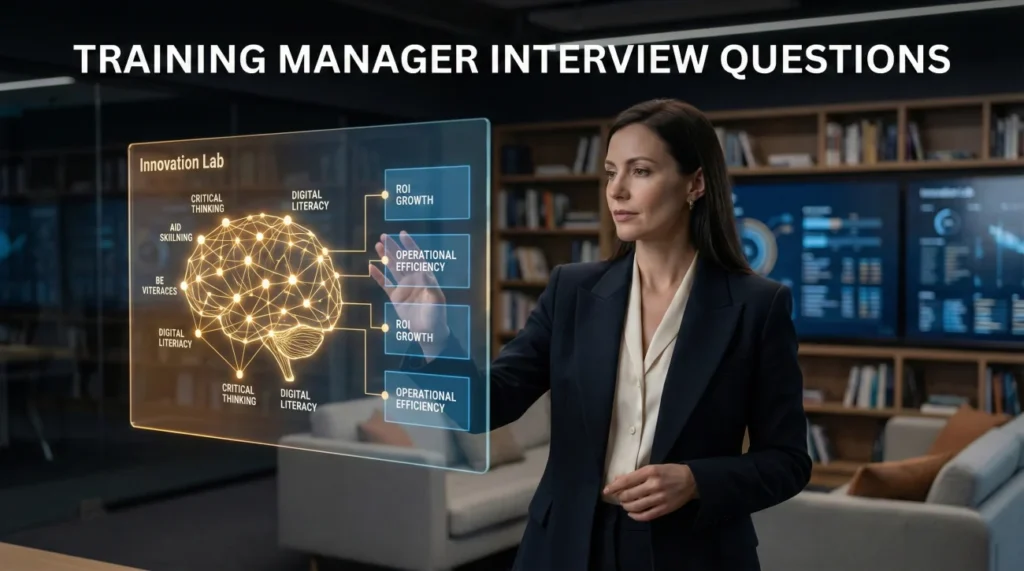
Training manager interview questions operate at the intersection of psychology, business strategy, and data science. Today, the role has evolved beyond simply organizing workshops to becoming a core driver of the organization’s capability. Hiring managers are rarely impressed by candidates who simply say they “like teaching.” They are looking for strategic partners who can diagnose business pain points, prescribe learning interventions that actually change behavior, and prove the financial return on those investments.
This guide goes beyond the basics. It covers the core pillars of modern L&D leadership: Strategic Alignment (transforming business goals into learning pathways), Advanced Instructional Design (moving beyond ADDIE to Agile methodologies), Learning Technologies (leveraging LXP and AI), and Impact Measurement (calculating ROI and Level 4 results). You must demonstrate that you can build a “Skills-Based Organization” that is resilient to market changes.
Strategic L&D & Business Consulting
The most common trap for Training Managers is becoming an “Order Taker.” These questions test your ability to push back, analyze root causes, and align training with the P&L.
Q: A VP demands “Resilience Training” because their team is burning out. How do you respond?
I resist the urge to say “yes” immediately. Instead, I put on my consultant hat to conduct a root cause analysis. I ask probing questions: “Is the burnout coming from a lack of personal resilience skills, or is it a result of unrealistic workloads and broken processes?” If the data shows burnout is driven by chronic understaffing or broken processes, a resilience workshop is unlikely to help and can even backfire. In that case, I would advise against training and suggest an organizational design review. Training solves skill gaps, not operational dysfunction. My goal is to protect the credibility of the L&D function by only deploying it where it can succeed.
Q: How do you build a learning culture in a company that is “too busy to learn”?
I shift the paradigm from “Learning as an Event” to “Learning in the Flow of Work.” I implement a microlearning strategy where content is broken into short, searchable chunks that employees can access at the point of need. I also work with leadership to create “psychological permission.” If the CEO admits to taking an hour a week to learn, it signals to the organization that development is work, not a distraction from work. I might pilot protected learning time, for example a recurring block where teams focus on upskilling. Culture is behaviors at scale, so I incentivize learning behaviors through recognition and career progression pathways.
Q: How do you prioritize your training budget when requests exceed resources?
I use a “Business Impact vs. Effort” matrix. I align every dollar to the company’s most important strategic goals for the fiscal year. For example, if the company goal is “Digital Transformation,” then technical upskilling on our new ERP system takes priority over generic soft skills training. I also look for “force multipliers.” Training 10 managers on how to coach their teams effectively has a higher ROI than training 100 individual contributors once. I am deliberate about sunsetting “legacy programs” that no longer serve a business purpose to free up budget for strategic initiatives.
Q: What is your philosophy on the “Skills-Based Organization”?
I believe the future of work is about skills, not job titles. My strategy involves mapping a dynamic “Skills Taxonomy” for the organization. Instead of hiring for a static “Project Manager” role, we identify the specific skills needed (e.g., Agile methodology, stakeholder negotiation, JIRA proficiency). This allows us to assess our current workforce against those skills to find gaps. I then build personalized learning pathways to close those gaps. This agility allows the company to redeploy talent quickly as market demands change, rather than firing and rehiring.
Advanced Instructional Design & Delivery
This section delves into the “Science of Learning.” You need to show that you understand Andragogy (adult learning principles) and can design experiences that stick.
Q: Compare ADDIE vs. SAM. When would you use each?
ADDIE (Analyze, Design, Develop, Implement, Evaluate) is the waterfall model of L&D. It is rigorous and linear. I use ADDIE for high-stakes, compliance-heavy training (like Safety or Anti-Harassment) where accuracy is non-negotiable and we cannot afford to iterate live. SAM (Successive Approximation Model) is Agile. It involves rapid prototyping and iterating. I use SAM for software training or sales enablement where the content changes fast. In a fast-paced tech environment, waiting too long to launch a perfect course via ADDIE can mean the content is outdated by launch day, so SAM is often the better business choice.
Q: How do you apply the 70-20-10 model practically?
The model suggests most learning happens through experience, reinforced by social learning, with a smaller portion coming from formal instruction. Many L&D teams spend 100% of their time on the 10%. I flip this. For a leadership development program, the formal piece is a workshop where we introduce concepts. The social piece is a structured peer-coaching circle or mentorship where people discuss challenges. The experiential piece is a stretch assignment or cross-functional project where they apply the skills on real work. I design job aids and manager discussion guides to support that 70%, ensuring the learning transfers from the classroom to the desk.
Q: What is your strategy for combatting “The Forgetting Curve”?
Without reinforcement, people forget a large share of what they learn surprisingly quickly. To combat this, I design “Spaced Repetition” campaigns. After a workshop, learners receive spaced “boosters” via email or Slack (a quiz question, a short video refresher, or a challenge) on a planned cadence over time. I also equip managers with “toolkit” questions to ask in 1:1s to force active recall. If we don’t design for retention, we are essentially pouring water into a bucket with a hole in the bottom.
Q: How are you using AI in Instructional Design?
I use AI as a force multiplier for my design team, not a replacement. I use generative AI tools to draft learning objectives, create scenarios for role-plays, and generate quiz questions, which can reduce development time meaningfully. I also use AI video generation (like Synthesia) to create training videos that can be easily updated without reshooting. However, I maintain strict human oversight for accuracy and bias. AI handles the first draft; my instructional designers handle the polish, context, and company-specific nuance.
Metrics, Analytics & ROI
This is the differentiator for senior candidates. You must move beyond “Vanity Metrics” (attendance) to “Impact Metrics” (behavior change).
Q: Deep dive into Kirkpatrick Level 3 and Level 4. How do you measure them?
Level 1 (Reaction) and Level 2 (Learning) are easy. Level 3 measures Behavior Change. I measure this by sending surveys to the learner’s manager after enough time has passed for behavior to show up on the job, asking specific questions: “Have you observed [Employee] using the negotiation techniques taught in the workshop?” I also look for proxies, such as an increase in the use of a specific software tool. Level 4 measures Business Results. I look at the KPI we tried to move. If we did Sales Training, did the conversion rate increase? If we did Safety Training, did the accident rate drop? I always use a “control group” if possible to isolate the training impact from market factors.
Q: Walk me through a specific ROI calculation you have performed.
We ran a “Customer Service De-escalation” workshop. The Cost included trainer fees, materials, and employee time away from day-to-day work. To calculate Benefit, we tracked the “refund rate” given to angry customers. Pre-training, refunds were consistently high. Post-training, refunds declined meaningfully, creating a measurable monthly and annual savings.
ROI Formula: (Net Benefit / Cost) x 100.
Using the same formula with our measured savings, we demonstrated a strong positive ROI within the first year.
Presenting this math to the CFO secured my budget for the next year.
Q: How do you present training data to the C-Suite?
Executives don’t care about “completion rates” or “average quiz scores.” They care about capability and risk. I present a “Capability Dashboard.” Instead of saying “50 people took the Cyber Security course,” I say “We have reduced our human-error risk profile meaningfully.” Instead of “We trained 10 managers,” I say “We have built a stronger leadership bench for critical roles, reducing our succession risk.” I connect every data point back to a strategic risk or opportunity.
Behavioral Scenarios & Conflict
L&D often involves influencing without authority. These questions test your ability to navigate politics and resistance.
A Subject Matter Expert (SME) gives you slides that are 100% text and refuses to change them. How do you handle it?
I approach this with empathy but firmness on design principles. I explain, “Your expertise is incredible, and my goal is to make sure the audience actually absorbs it. Cognitive load theory suggests it’s hard for people to read dense text and listen effectively at the same time.” I propose a compromise: “Let’s keep your slides as the ‘Pre-Read’ or ‘Handout’ document for reference. For the live presentation, let’s strip the text and use images to support your speaking points.” I frame it as making them look better as a speaker, rather than criticizing their slides. If they still refuse, I might run a small pilot with a test audience to show them the disengagement data firsthand.
You launch a mandatory training program, and compliance is low. What is your plan?
I avoid the “nasty email” approach initially. First, I audit the communication. Did the employees know why this matters, or did it look like spam? Second, I look at the friction. Is the LMS login broken? Is the course too long? I remove barriers. Third, I leverage social proof and competition. I publish a leaderboard of “Department Completion Rates” to the executive team. No VP wants their department to be at the bottom of the list. They will naturally apply the pressure for me. Finally, for persistent non-completion, I align on an escalation path with leadership and HR, using stronger measures only as a last resort.
Training Manager Proficiency Quiz
Test Your L&D Knowledge
1. The “K” in the VARK model stands for:
- Knowledge
- Kinesthetic (Physical learning)
- Keynote
- Karma
2. Which is a Level 2 evaluation method?
- A pre-test and post-test to measure knowledge gain
- A survey asking if they liked the food
- Checking sales numbers
- Observing behavior on the job
3. “Synchronous Learning” implies:
- Self-paced videos
- Reading a PDF
- Instructor and learners interacting in real-time (live or virtual)
- Learning while swimming
4. What does “LXP” focus on compared to “LMS”?
- Compliance and admin tracking
- User experience, content curation, and social learning
- Payroll integration
- Hardware maintenance
5. “Cognitive Load Theory” suggests:
- Learning is hampered if working memory is overwhelmed with too much info
- People learn better under stress
- More information is always better
- Brains work like muscles
6. A “Job Aid” is:
- An assistant you hire
- A tool (checklist, cheat sheet) available at the moment of need
- A training video
- A recruiting website
7. “Scaffolding” in instruction means:
- Building a classroom
- Providing temporary support that is removed as the learner becomes competent
- Punishing mistakes
- Grouping students by age
8. The “Ebbinghaus Forgetting Curve” suggests that without reinforcement:
- Nothing is forgotten
- Forgetting is not a factor
- A large share is forgotten quickly (without reinforcement)
- Memory improves automatically
9. “Social Learning” theory was proposed by:
- Sigmund Freud
- Albert Bandura
- Ivan Pavlov
- B.F. Skinner
10. “Train the Trainer” (TTT) is essential for:
- Scaling training by equipping SMEs or managers to deliver content
- Teaching dogs tricks
- Evaluating software
- Hiring new staff
11. A “Needs Assessment” should distinguish between:
- Wants and Desires
- Training problems (skill) vs. Non-training problems (motivation/environment)
- Cheap and Expensive
- Morning and Afternoon
12. “Just-in-Time” learning provides content:
- Years in advance
- Exactly when the learner needs to use it
- Only on weekends
- When the trainer arrives
13. “Storyboard” in design is:
- A bedtime story
- A visual blueprint of the course content and flow
- A list of students
- The final exam
14. “Accessibility” (A11y) in e-learning ensures:
- Content is usable by people with disabilities (screen readers, captions)
- The course is cheap
- The wifi is fast
- The door is open
15. “Virtual Reality” (VR) is best used for:
- Reading PDFs
- Simulating high-risk or expensive environments (e.g., surgery, flight)
- Checking email
- Spreadsheets
16. “Beta Testing” a course helps to:
- Save money
- Identify bugs and gather user feedback before full rollout
- Skip the design phase
- Make the course longer
17. “Emotional Intelligence” (EQ) training targets:
- IQ scores
- Self-awareness, empathy, and social skills
- Coding ability
- Math skills
18. “Coaching” differs from “Training” because coaching is:
- One-to-many and directive
- One-to-one, non-directive, and focused on unlocking potential
- Only for sports
- Done by computers
19. “Knowledge Management” involves:
- Capturing, distributing, and effectively using organizational knowledge
- Deleting old files
- Memorizing facts
- Managing the library
20. “Turnover Rate” reduction is a key metric for:
- Safety training
- Onboarding and Leadership Development programs
- Software training
- Sales training
❓ FAQ
🕒 CPTM vs. APTD – Which certification is better?
The CPTM (Certified Professional in Training Management) focuses on the business management of the training function – budgeting, strategy, and alignment. The APTD (Associate Professional in Talent Development) focuses more on the tactical execution of talent development. For a Manager role aiming for Director, CPTM is often more aligned with strategic responsibilities.
📜 How do I handle training for a global team?
Cultural localization is key. You cannot just translate the language; you must adapt the examples, humor, and delivery style. I use “Asynchronous First” principles for content delivery to accommodate time zones and reserve synchronous time (live meetings) for Q&A and community building, ensuring no region feels like an afterthought.
💻 What is the biggest trend in L&D right now?
Skills-based organizations. Companies are moving away from defining roles by job titles and towards defining them by skills. L&D Managers are now tasked with mapping skill taxonomies and creating personalized upskilling pathways to close specific capability gaps, allowing for more fluid internal mobility.
💰 How do I get budget approval for expensive training?
Speak the CFO’s language. Don’t sell “engagement” or “happiness”; sell “cost savings” or “revenue generation.” For example, show that the spend is likely to reduce turnover costs meaningfully, supported by internal data and a pilot result where possible. Build a business case with clear metrics and a pilot program success story.
🚀 What is the career path?
Common next steps include Director of Learning & Development, Head of Talent Management, or Chief Learning Officer (CLO). Some Training Managers pivot to Organizational Development (OD) or specialized HR Business Partner roles, leveraging their deep understanding of organizational capability.
Final Thoughts
To succeed in answering training manager interview questions, you need to be a business leader first and an educator second. While your passion for learning is essential, your ability to align that passion with the company’s bottom line is what will get you hired. Interviewers want to see a strategic thinker who measures success not by how many people attended a course, but by how much the business improved because of it.
Focus on your adaptability. The tools (AI, VR, LXP) are changing fast. Show that you are a lifelong learner yourself who can guide the organization through the future of work.
⚠️ Disclaimer: The interview strategies, sample answers, and negotiation tips provided in this guide are for educational purposes only. Hiring decisions are subjective and vary by company and industry. While these strategies are based on professional HR standards, they do not guarantee a specific job offer or result.