What HR Manager Interviews Test
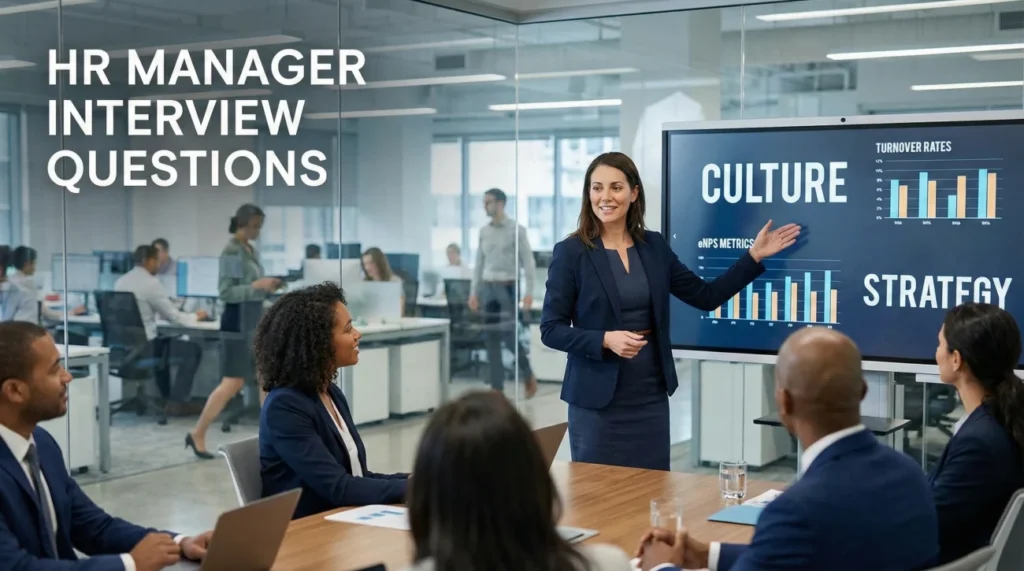
Human resources manager interview questions assess your ability to transition from a tactical administrator to a strategic business partner. Today, companies are not just looking for someone to process payroll and enforce the dress code. They want an HR leader who can align the workforce with business goals, navigate hybrid work cultures, and use data to spot retention risk early.
This guide covers the four pillars of modern HR leadership: Culture & Strategy (building an environment where people thrive), Employee Relations (navigating conflict and legal risk), Talent Acquisition (hiring the right people, not just filling seats), and People Operations (efficiency and compliance). You must demonstrate that you have the empathy to support employees and the backbone to protect the company.
Culture, Strategy & Leadership
Strategic HR is about the “Why” behind the “What.” Interviewers want to know how you influence the C-Suite and drive organizational change. They are looking for evidence that you can translate business objectives into people initiatives.
Q: How do you define company culture, and how do you measure it?
I define culture as “what happens when no one is looking.” It is the shared set of values, beliefs, and behaviors that drive decision-making across the organization. To measure it, I look beyond the annual engagement survey, which is often a lagging indicator. I track leading metrics like eNPS (Employee Net Promoter Score), voluntary turnover rates (specifically amongst high performers), and internal promotion ratios. I also conduct “stay interviews” with key talent to understand their motivations and monitor Glassdoor reviews to get unfiltered qualitative data on employee sentiment. A decline in eNPS can signal rising turnover risk ahead, giving us time to intervene proactively.
Q: How do you align HR strategy with business goals?
I start by understanding the business P&L and key objectives for the year. HR does not operate in a silo. If the company’s goal is strong revenue growth through new market expansion, my HR strategy focuses on building sales recruitment capacity, designing competitive commission structures, and identifying leaders for new regions. If the goal is profitability and efficiency, I pivot to auditing our tech stack, automating manual workflows, and identifying skills gaps for training. Every HR initiative must solve a specific business problem; otherwise, it is just administrative overhead.
Q: What is your approach to managing a hybrid or remote workforce?
I focus on “output over hours.” The biggest mistake in hybrid management is trying to replicate office surveillance digitally. Instead, I advocate for clear performance metrics (OKRs or KPIs) so managers can evaluate results rather than visibility. To maintain culture, I implement intentional connection points – virtual town halls, quarterly in-person retreats, and random “coffee chat” pairings. I also train managers specifically on “proximity bias” to ensure that remote workers are not disadvantaged in promotion cycles simply because they are seen less often.
Q: How do you handle a toxic high-performer?
I believe that what you permit, you promote. A high performer who destroys culture is a net negative liability to the organization. Their results may look good on a spreadsheet, but the “cultural tax” they levy – through driving away other talent and lowering team morale – is far more costly. I would have a direct coaching conversation, making it clear that behavioral values are as important as revenue targets. I would set clear expectations and a reasonable window for behavioral improvement. If the behavior doesn’t change, I would manage them out. Keeping them signals to the rest of the team that values are optional.
Employee Relations & Conflict Resolution
This is the “firefighting” aspect of the role. You need to show you can de-escalate tension, investigate fairly, and minimize legal exposure while maintaining human dignity.
Q: Walk me through how you conduct an internal investigation for a harassment complaint.
I follow a strict, consistent protocol: Listen, Protect, Investigate, Decide. First, I interview the complainant in a safe, private setting to get specific details (dates, times, witnesses), ensuring they feel heard and explicitly protecting them against retaliation. Depending on the severity, I may place the accused on paid administrative leave to ensure safety and neutrality. I then interview the accused and any credible witnesses, documenting everything verbatim – facts only, no opinions or interpretations. I review digital evidence such as emails, Slack messages, or camera footage. Finally, I consult with legal counsel to determine the outcome based on our policy and precedent. I close the loop with both parties discreetly, communicating the resolution without breaching confidentiality.
Q: How do you deliver a Reduction in Force (Layoff) message?
With dignity, clarity, and preparation. I ensure the business rationale is sound and legally defensible (checking for WARN Act compliance and conducting an adverse impact analysis to ensure no protected group is disproportionately affected). In the meeting, I get straight to the point: “Today is your last day.” I don’t “sandwich” the bad news with false praise or apologies that center my own feelings. I focus entirely on the support we are providing – severance packages, COBRA information, outplacement services, and reference letters. My goal is to treat the departing employees so well that the remaining employees feel their colleagues were respected, which is crucial for maintaining morale post-layoff.
Q: A manager wants to fire an employee immediately for “poor performance” but has no documentation. What do you do?
I put on the brakes immediately. Firing without a paper trail is a wrongful termination lawsuit waiting to happen. I explain to the manager that we need due process to protect the company. I help them draft a Performance Improvement Plan (PIP) with clear, measurable goals and a realistic timeline. I coach the manager on how to deliver feedback effectively. This process serves two purposes: it gives the employee a genuine chance to correct the behavior (which is the ideal outcome), and if they fail, it provides the necessary documentation to justify termination legally and ethically.
Q: How do you handle a dispute between two department heads that is affecting their teams?
I act as a mediator, not a judge. I meet with each leader individually to understand their perspective and identify the root cause of the conflict – is it resource allocation, unclear roles, or a personality clash? I then facilitate a joint meeting where we focus on shared business goals. I use a “start, stop, continue” framework to agree on behavioral protocols for how they will interact. I make it clear that while they don’t have to be friends, professional collaboration is a non-negotiable performance expectation. I then follow up to ensure the agreed-upon behaviors are being practiced.
Talent Acquisition & People Analytics
Hiring is expensive; getting it wrong is even more expensive. Interviewers look for data-driven approaches to recruitment and retention strategies that go beyond “posting and praying.”
Q: How do you reduce “Time to Hire” without sacrificing quality?
I approach recruitment like a sales funnel. I identify bottlenecks in the process. Often, the delay is not in sourcing candidates but in scheduling interviews or getting feedback. I streamline this by setting strict SLAs (Service Level Agreements) with hiring managers – for example, requiring prompt feedback on resumes and interviews within clearly defined turnaround times. I also invest in a strong ATS (Applicant Tracking System) to automate scheduling and communication. Furthermore, I build “talent pipelines” for critical roles before they become open, engaging passive candidates so we aren’t starting from scratch when a vacancy occurs. I train interviewers on structured interviewing techniques so they can make decisions based on scorecards rather than “gut feeling,” which reduces hesitation.
Q: How do you use data (People Analytics) to improve retention?
I analyze turnover data to find the “leaky bucket.” I look for trends: Is turnover concentrated in a specific department? Under a specific manager? At a specific tenure point (for example, around a common anniversary)? If I see early-tenure turnover, it can suggest a mismatch in the hiring process or weak onboarding. If it clusters later, it often points to career progression or role design issues. I use this data to target specific interventions – like leadership training for a specific manager, revamping the onboarding process, or launching a mentorship program – rather than applying a blanket solution that might not address the root cause.
Q: What is your philosophy on Compensation and Benefits?
I believe in “Total Rewards” transparency. It is not just about base salary; it is about equity, benefits, flexibility, and professional growth. I benchmark our roles regularly against reputable market data to ensure we remain competitive, using a consistent target philosophy that fits our talent strategy and budget. I also believe in educating employees on the full value of their package. Often, employees undervalue benefits like healthcare coverage or 401k matching because they don’t see the dollar figure. Providing “Total Compensation Statements” helps them understand their “hidden paycheck,” which increases perceived value and retention.
Q: How do you handle a counter-offer situation?
In many cases, employees who accept counter-offers still leave later because the underlying reasons for looking (culture, manager, growth) haven’t changed. Therefore, I focus on prevention. I train managers to have regular career conversations so we address dissatisfaction before an employee gets another offer. If a key employee does resign, I assess their value and the cost of replacement. If we do make a counter-offer, it must be accompanied by a plan to address their non-monetary concerns. However, I am cautious not to break our internal equity structure just to save one person, as that creates long-term pay disparity issues.
Behavioral Scenarios & Ethics
You discover the CEO is having a consensual relationship with a subordinate. What do you do?
This is a critical conflict of interest that exposes the company to significant liability. Even if consensual now, the power dynamic creates immense risk for claims of favoritism, coercion, or sexual harassment if the relationship ends. I would consult the company’s “Fraternization Policy” and legal counsel immediately. I would have a confidential, firm conversation with the CEO to explain the risk. Typically, the subordinate would need to be moved to a different reporting line where the CEO has no influence over their pay or performance, or one party may need to leave the organization. I would document the disclosure and the steps taken to mitigate the conflict to protect the firm from future litigation.
An employee confides in you about a mental health struggle but asks you not to tell anyone. Their performance is slipping. How do you handle it?
I balance empathy with performance accountability. I honor the confidentiality while addressing the performance issue. I would not share the specific medical details with their manager. Instead, I would guide the employee to available support resources, such as an Employee Assistance Program (EAP), and discuss leave options if they need time to recover. To the manager, I would advise that “we are managing a personal situation” and focus on adjusting timelines or workload temporarily as a reasonable accommodation, without disclosing the diagnosis. The goal is to support the human while ensuring the business needs are met.
You notice a pattern of lack of diversity in a specific department’s hiring. How do you address it?
I approach this with data, not accusation. I would pull the hiring funnel data for that department to see where the drop-off is happening. Is it top-of-funnel sourcing (not getting diverse applicants)? Or is it in the interview stage (bias in selection)? Once I identify the bottleneck, I propose specific solutions. This might include expanding our sourcing channels to reach underrepresented groups, implementing “blind resume” reviews, or requiring diverse interview panels. I would frame this to the department head as a strategy to access a wider talent pool and improve team performance through cognitive diversity.
HR Management Knowledge Quiz
Test Your HR Leadership IQ
1. “eNPS” stands for:
- employee New Payroll System
- effective Net Profit Strategy
- estimated New People Source
- employee Net Promoter Score
2. Which Act governs mass layoffs and plant closings?
- FMLA
- WARN Act
- OSHA
- HIPAA
3. A “PIP” is best described as:
- A structured plan to help an underperforming employee improve
- A tool to fire someone immediately
- A promotion incentive plan
- A payroll integration protocol
4. “Adverse Impact” refers to:
- A bad marketing campaign
- An employee getting injured
- A neutral policy having a discriminatory effect on a protected group
- Losing money in a quarter
5. The “9-Box Grid” is used for:
- Organizing office supplies
- Scheduling shifts
- Talent management and succession planning (Performance vs. Potential)
- Calculating taxes
6. “Onboarding” effectiveness is best measured by:
- Time to productivity and early retention
- How fast paperwork is signed
- The cost of the welcome kit
- The number of emails sent
7. “Total Rewards” includes:
- Salary only
- Salary, Benefits, Work-Life Balance, Recognition, and Development
- Free coffee
- The holiday party budget
8. “At-Will Employment” means:
- Employees must sign a long fixed contract
- Employers can only fire for “just cause”
- Either party can terminate the relationship at any time, for any legal reason
- Employees work for free
9. Which question is illegal to ask in an interview?
- “Can you work weekends?”
- “Are you authorized to work in the US?”
- “Do you plan to have children soon?”
- “Do you have a reliable way to get to work?”
10. “DEI” stands for:
- Diversity, Equity, and Inclusion
- Direct Employee Investment
- Department of External Intelligence
- Daily Earnings Index
11. A “Stay Interview” is conducted to:
- Fire an employee
- Understand why high performers stay and what might make them leave
- Interview candidates for a job
- Discuss exit paperwork
12. “Succession Planning” focuses on:
- Planning the holiday party
- Hiring interns
- Identifying and developing internal people to fill key leadership roles
- Calculating success bonuses
13. “Exempt” employees are:
- Exempt from paying taxes
- Not entitled to overtime pay (typically salaried)
- Not required to come to work
- Paid hourly
14. “Employer Branding” is primarily about:
- The logo on the building
- Reputation as a place to work and value proposition to candidates
- Selling products to employees
- The CEO’s personal brand
15. “FMLA” provides eligible employees with:
- Paid vacation
- Free health insurance
- Unpaid, job-protected leave for family/medical reasons
- Flexible working hours
16. “Cost per Hire” calculation includes:
- Only the recruiter’s salary
- Advertising, agency fees, recruiter costs, and travel expenses / Number of Hires
- The new hire’s salary
- The cost of the laptop
17. “Benchmarking” in compensation means:
- Setting salaries based on gut feeling
- Comparing internal pay rates against external market data
- Sitting on a bench to negotiate
- Paying everyone minimum wage
18. “Unconscious Bias” training aims to:
- Teach employees to be biased
- Help employees recognize and mitigate hidden prejudices in decision making
- Make everyone think the same way
- Avoid hiring diverse candidates
19. “HRBP” stands for:
- Human Resources Benefit Plan
- High Risk Business Person
- Human Resources Business Partner
- Hiring Recruitment Best Practice
20. “Constructive Discharge” occurs when:
- An employee is fired for stealing
- Work conditions are so intolerable that a reasonable person feels forced to resign
- An employee retires happily
- A construction worker is laid off
❓ FAQ
🕒 What certifications are most valuable for HR Managers?
The SHRM-SCP (Senior Certified Professional) and SPHR (Senior Professional in Human Resources) are widely recognized for senior roles. They demonstrate mastery of strategic HR and employment law. For specialized roles, certifications like CCP (Compensation) or CEBS (Benefits) are highly regarded.
💼 HR Generalist vs. HR Manager?
An HR Generalist focuses on the “doing” – daily operations, paperwork, and individual employee queries. An HR Manager focuses on the “leading” – strategy, policy creation, team management, and advising senior leadership. The Manager role requires a shift from tactical execution to strategic thinking.
💻 How is AI changing HR?
AI is automating routine tasks like resume screening, payroll queries (chatbots), and scheduling. This frees up HR Managers to focus on high-touch activities like coaching, culture building, and complex conflict resolution. Understanding how to leverage HR tech stack is now a core competency.
⚖️ How do you handle the emotional toll of HR?
HR often deals with “bad news” (layoffs, investigations). Successful managers practice compartmentalization and self-care. They build a network of HR peers for support because they often cannot vent to colleagues within their own company due to confidentiality.
🚀 What is the career path?
The next step is typically HR Director, then VP of People/CHRO. Some Managers specialize and move into roles like Head of Talent Acquisition, Head of Total Rewards, or Diversity & Inclusion Director. Many organizations are elevating “Chief People Officer” roles with broader strategic influence.
Final Thoughts
To succeed in answering human resources manager interview questions, you must balance the “human” with the “resources.” You are the guardian of the company culture, but you are also a steward of its bottom line. Hiring managers want to see that you can make tough decisions with compassion and back up your strategies with data.
Focus on your ability to be a trusted advisor. Whether you are navigating a complex legal issue or designing a new remote work policy, show that you can lead with confidence and integrity.
⚠️ Disclaimer: The interview strategies, sample answers, and negotiation tips provided in this guide are for educational purposes only. Hiring decisions are subjective and vary by company and industry. While these strategies are based on professional HR standards, they do not guarantee a specific job offer or result.