What Virtual Assistant Interviews Test
Virtual assistant interview questions test whether you can be dependable without being physically present. Clients and managers cannot see you working, so they look for signals of structure: how you plan your day, how you communicate progress, and how you keep work moving when instructions are incomplete.
A strong VA comes across as calm, proactive, and technically comfortable. You do not need to know every tool on earth, but you should be able to describe how you use a few core tools to manage tasks, protect access, and keep updates clear. In short, they want someone who can run remote operations without constant supervision.
Remote Tools & Technology Stack
Your tools are your office. Interviewers need to know you can set up and run a digital workspace seamlessly.
Q: Which project management tools are you proficient in, and how do you use them?
I am proficient in Asana, Trello, and ClickUp. For example, in Asana, I use “Board View” to visualize task stages (To Do, In Progress, Done) for my clients. I set up automated recurring tasks for weekly reports so nothing slips. I use dependencies to ensure I don’t start a task until the client provides the necessary assets. My goal is to create a “Single Source of Truth” so the client never has to ask, “What is the status of this?”
Q: How do you use AI to increase your productivity as a VA?
I use AI as a support tool. I use it to draft email responses, summarize long meeting transcripts, or generate social media captions. I also use writing and transcription tools when appropriate, and I always review the output for accuracy and tone. Used well, AI can save meaningful time on routine tasks, allowing me to focus on higher-value work.
Q: How do you manage passwords securely for multiple clients?
I strictly use a password manager like LastPass or 1Password. I never ask a client to email me a password in plain text. I ask them to share access via the secure sharing feature within the tool. This way, I avoid handling passwords directly, and they can revoke my access quickly if our contract ends. Security is my top priority to protect their business assets.
Q: Describe your setup for remote work to ensure reliability.
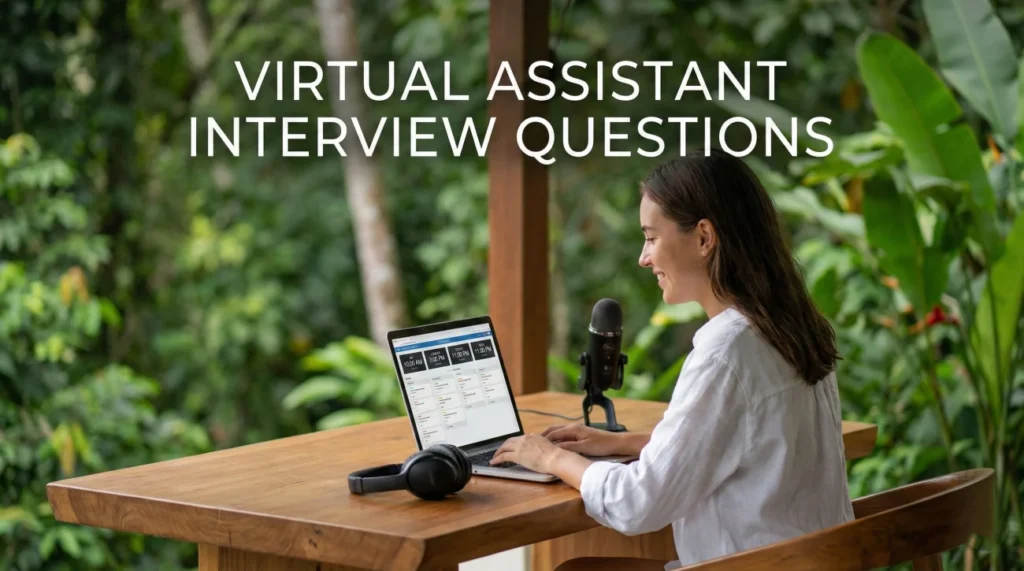
I have a dedicated home office with a noise-canceling headset for professional calls. I set up my workspace to be reliable and efficient. Crucially, I keep a backup connection option (like a mobile hotspot) in case my primary internet fails. I treat my setup like a business infrastructure because my clients rely on my uptime.
Time Management & prioritization
Without a boss looking over your shoulder, discipline is key. You need to show you can structure your day for maximum output.
Q: How do you handle working for a client in a different time zone?
I view time zones as an advantage, not a hurdle. I practice “Asynchronous Work.” I send updates at the end of my day so they are waiting for the client when they wake up. I use time zone tools to find a practical overlap window for live meetings. I am clear about my “online hours” for urgent responses but flexible enough to take a late call if a crisis occurs. Clear boundaries prevent burnout while ensuring service.
Q: How do you track your billable hours accurately?
I use time-tracking software like Toggl or Harvest. I track in real-time rather than guessing at the end of the day. I categorize time by project (e.g., “Social Media Mgmt” vs. “Inbox Support”) so I can provide the client with a detailed report of where their money is going. If I notice a task is taking longer than expected, I communicate that early so there are no surprises on the invoice.
Q: Describe how you prioritize when everything is “Urgent.”
I use the Eisenhower Matrix to triage. I categorize tasks into: Do First (Urgent/Important), Schedule (Important/Not Urgent), Delegate (Urgent/Not Important), and Delete. If a client sends 5 “urgent” tasks at once, I ask for clarification: “I received these 5 requests. I can finish the travel booking and the report today. Which one is the absolute priority for this morning?” This forces the client to pause and prioritize, aligning our expectations.
Q: How do you prevent procrastination when working from home?
I use the “Pomodoro Technique” (25 minutes of focus work, 5 minutes of break) to maintain momentum. I start my day by “eating the frog” – doing the hardest task first. I also block social media sites using a browser extension during work hours. I treat my home office as a professional space; when I close the door, I am “at work,” which helps switch my mindset into productivity mode.
Remote Communication & Trust
You can’t walk into their office to ask a question. You must be proactive and clear in your digital communication.
Q: How do you build trust with a client you have never met in person?
Trust is built through consistency and visibility. I send an EOD (End of Day) update summarizing what I accomplished, what is pending, and any blockers. I am responsive during agreed working hours. I also turn my camera on during video calls to build a human connection. Most importantly, I own my mistakes immediately. If I miss a detail, I say “I missed that, here is how I fixed it,” rather than making excuses. Reliability breeds trust.
Q: How do you handle vague instructions from a busy client?
I don’t guess. Guessing wastes billable hours. I use a “clarifying framework.” I reply, “I want to make sure I get this exactly right. My understanding is you want X. Do you prefer format A or B? When do you need this by?” If they are too busy to reply, I start with a draft or an outline and send it for a quick “thumbs up” check before investing hours in the final product. I train my clients on how to delegate to me effectively over time.
Q: What is your approach to “Inbox Management” for a client?
I use a system of “Folders and Flags.” I create folders like “Urgent,” “To Read,” and “Awaiting Reply.” I unsubscribe them from junk lists. I draft responses for routine inquiries and save them in a “Drafts” folder for their review. I aim to touch every email once – either deleting, archiving, or actioning it. My goal is for the client to open their inbox and only see the handful of emails that truly require their attention.
Q: How do you handle a miscommunication over Slack or email?
Text lacks tone, so misunderstandings happen. If I sense friction or confusion, I switch channels immediately. I say, “I think this might be easier to resolve quickly on a quick call. Are you free now?” Getting on video or voice humanizes the interaction and allows us to clarify intent much faster than typing paragraphs back and forth. I always assume positive intent and focus on the solution.
Behavioral Scenarios & Ethics
These scenarios test your resilience and integrity in a remote environment.
A client is unhappy with your work on a project. How do you handle the feedback?
I listen without getting defensive. Remote feedback can feel harsher because it lacks tone, so I assume positive intent. I ask specific questions to understand the gap: “Can you point out exactly which part of the report wasn’t deep enough?” I then correct the work quickly and align on what “good” looks like going forward. I also update my “Client SOP” (Standard Operating Procedure) document to include this new preference so I never make the same mistake twice. I view feedback as a calibration tool, not a personal attack.
Your internet goes down in the middle of a deadline. What do you do?
I activate my contingency plan immediately. I switch to my mobile hotspot to send a quick message to the client: “My primary ISP is down, switching to backup. I might be slightly slower but am still working.” If the hotspot fails, I relocate to a reliable backup workspace I have pre-identified. I communicate the delay proactively. Being a VA means being resourceful and communicating early when constraints appear.
A client asks you to do something unethical (e.g., leave fake reviews). What do you do?
I politely but firmly decline. I say, “I am not comfortable performing that task as it violates platform policies and ethical standards. However, I can help you gather legitimate reviews by setting up an automated email campaign for your satisfied customers.” I offer a legal alternative. If they persist, I re-evaluate the client relationship. My reputation is my business, and I cannot afford to compromise it.
Virtual Assistant Skills Quiz
Test Your VA IQ
1. “Asynchronous Communication” means:
- Talking at the same time
- Communicating without expecting an immediate response (e.g., email)
- Video calling
- Talking to yourself
2. Which tool is best for password sharing?
- Email text
- LastPass or 1Password
- Sticky note
- WhatsApp message
3. “Inbox Zero” aims to:
- Delete all emails instantly
- Keep the inbox empty by processing emails into tasks or archives
- Never receive email
- Send zero emails
4. “Pomodoro Technique” helps with:
- Cooking pasta
- Time management (25 min work, 5 min break)
- Sorting files
- Cleaning the screen
5. “Zapier” is used for:
- Video conferencing
- Automating workflows between different apps
- Writing documents
- Graphic design
6. “Calendly” helps to:
- Draw pictures
- Eliminate back-and-forth emails for scheduling meetings
- Count calories
- Track expenses
7. “SOP” stands for:
- Standard Office Phone
- Standard Operating Procedure
- Secret Online Portal
- System Of Payment
8. “Slack” is primarily a tool for:
- Watching movies
- Team chat and collaboration
- Editing photos
- Booking flights
9. A “VPN” (Virtual Private Network) ensures:
- Faster internet
- Secure, encrypted internet connection (especially on public WiFi)
- Better video quality
- Free movies
10. “Canva” is widely used by VAs for:
- Coding websites
- Creating basic graphic design and social media posts
- Accounting
- Writing code
11. “Toggl” is a tool for:
- Building websites
- Tracking time spent on tasks
- Playing music
- Sorting email
12. “Google Workspace” (G Suite) includes:
- Photoshop and Illustrator
- Gmail, Docs, Sheets, Drive, and Calendar
- Facebook and Instagram
- Word and Excel only
13. “Zoom Fatigue” refers to:
- Being tired of running
- Exhaustion caused by excessive video conferencing
- A fast car
- A broken camera
14. “CRM” stands for:
- Computer Room Manager
- Customer Relationship Management
- Cool Remote Meeting
- Client Revenue Model
15. If a client is “ghosting” you, you should:
- Call the police
- Follow up professionally after a few days, then pause work if needed
- Spam them every hour
- Quit immediately
16. “Cloud Storage” (e.g., Dropbox) means:
- Files are stored in the sky
- Files are stored on remote servers accessed via internet
- Files are deleted
- Files are only on your hard drive
17. “Two-Factor Authentication” (2FA) adds security by:
- Using two passwords
- Requiring a second form of verification (like a text code) along with a password
- Asking for your name twice
- Using two computers
18. “Pareto Principle” (80/20 Rule) suggests:
- Working 80 hours a week
- 80% of results come from 20% of efforts
- Taking 80 breaks
- Eating 20% of lunch
19. A “Virtual Background” is used to:
- Hide your face
- Hide your messy room during a video call
- Change your voice
- Record the call
20. “Buffer Time” in scheduling helps to:
- Waste time
- Prevent meetings from overlapping and allow for breaks
- Make the day longer
- Confuse the client
❓ FAQ
🌍 Do clients care where I live?
Usually they care more about reliability than location. Time zones can even be a benefit if you can cover work outside their local hours. The key is agreeing on overlap windows for meetings and setting clear response expectations.
🔐 What is the safest way to handle passwords and logins?
Use a password manager with secure sharing whenever possible, and avoid plain-text password handoffs. You can also discuss how you manage permissions so access can be revoked quickly when a contract ends.
🧰 Which tools should I mention in an interview?
Pick a small, realistic stack you truly know: a project tracker, a communication tool, and a file system. Then explain how you use them to reduce confusion. “I keep tasks visible and updated” is more convincing than listing ten apps.
💬 How do I prove I can communicate well remotely?
Talk about your update rhythm and clarity. For example, a short daily summary of what you completed, what is pending, and what you need from the client. Clear updates build trust faster than long messages.
💵 Do clients prefer hourly work or a monthly retainer?
It depends, but many clients like retainers because they feel predictable. If you offer a retainer, define what is included, your availability window, and how you handle overflow work so expectations stay clean.
Final Thoughts
To succeed in answering virtual assistant interview questions, present yourself like a person with a system. Remote work rewards clarity: you plan, you communicate, you track progress, and you protect client access as part of your professional standard.
If you want more role-specific practice, go through the full interview questions library and rehearse a few scenarios that match your client type. Specific examples beat broad claims every time.
⚠️ Disclaimer: The interview strategies, sample answers, and negotiation tips provided in this guide are for educational purposes only. Hiring decisions are subjective and vary by company and industry. While these strategies are based on professional HR standards, they do not guarantee a specific job offer or result.